Anhui Feichun Special Cable Co.,Ltd Email: Li.wang@feichuncables.com
Why DEVILENE R 285 °F Round ESP Cables Excel in South Africa’s Oilfields: EPDM/NBR Construction, Crush Resistance & Long-Life Reliability for ESP Systems
In South Africa’s medium-depth, moderate-temperature, and mildly corrosive oilfields, the reliability of ESP power cables directly determines production uptime and profitability. The Prysmian DEVILENE R 285 °F Round ESP Cable is not just a standard power cable — it is an engineered solution built to withstand the combined forces of heat, oil, gas, water, and mechanical stress. With its proprietary EPDM/NBR formulation, fluoropolymer barrier, and interlocking galvanized or Monel armour, it delivers stable performance up to 140 °C, low swelling, and excellent crush resistance. Fully compliant with IEEE 1018 and ISO 9001, it has proven its worth in local wells, extending service life from 18 months to over 42 months while reducing maintenance costs. Learn how its layered design, material science, and field results make it the optimal choice — plus discover equivalent, cost-effective alternatives from Feichun Cables.
Li Wang
7/1/202610 min read
Introduction: The Lifeline of Downhole Oil Production
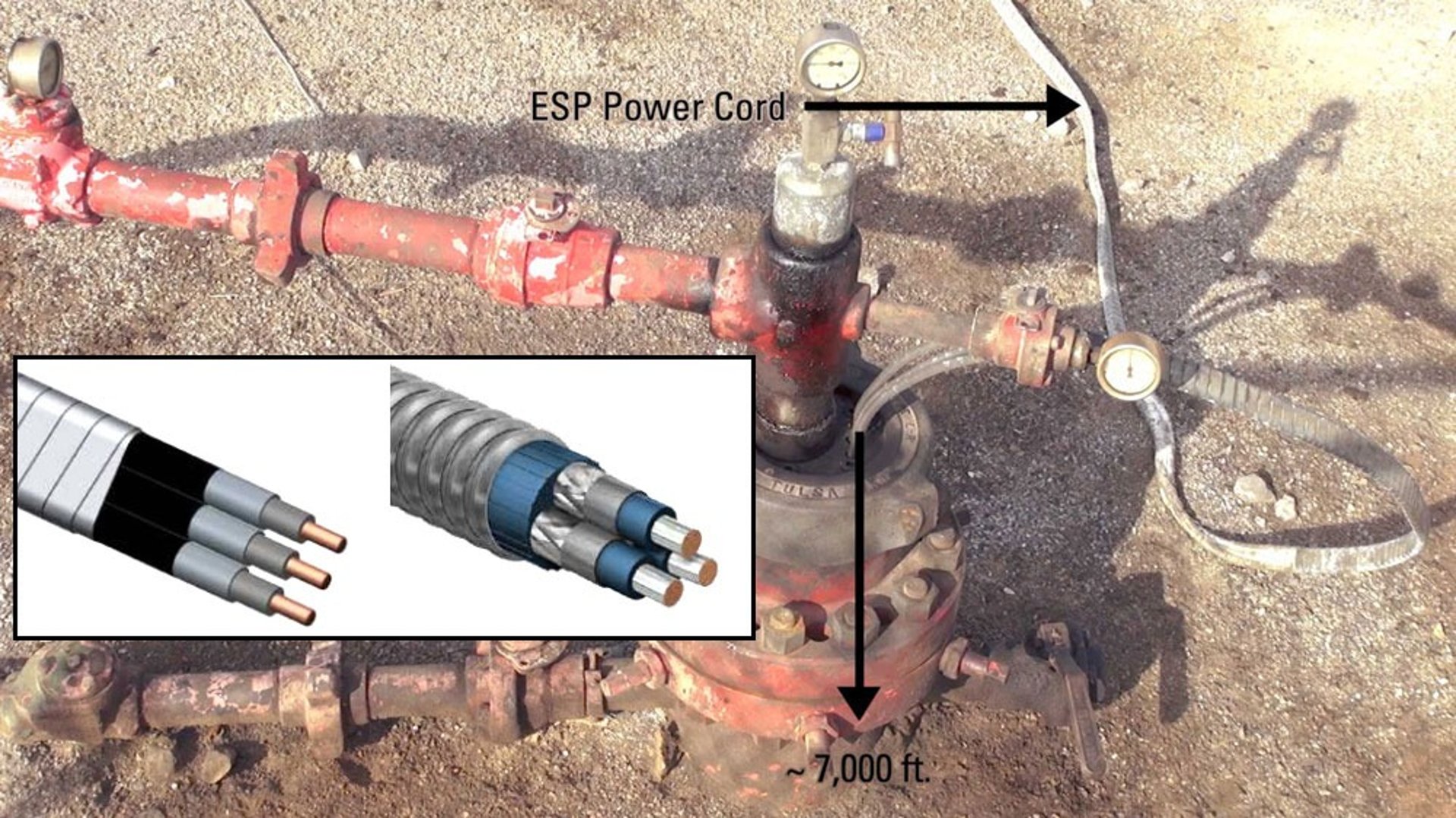
Downhole extraction systems are the backbone of modern crude oil recovery, and among these systems, Electrical Submersible Pump (ESP) technology stands out as one of the most widely used and efficient methods for lifting fluids from deep reservoirs. However, the performance of an ESP system depends entirely on the uninterrupted and reliable supply of electrical power from the surface to the pump motor located thousands of meters underground. This power delivery chain includes the wellhead penetrator, the main power cable, motor lead extensions, pigtail connectors, and all related components. If any single link in this chain fails, the entire production process stops, resulting in costly workovers, deferred revenue, and increased operational risk.
In South Africa, the oil and gas industry operates across fields in the Western Cape, offshore basins, and parts of the Karoo region. These wells typically range from 2,500 to 3,800 meters in depth, with bottom-hole temperatures between 110 °C and 135 °C, moderate concentrations of hydrogen sulfide (H₂S) and carbon dioxide (CO₂), and high-salinity formation water. This environment creates what engineers describe as a “coupled load condition”: heat, hydrocarbons, gas, water, and mechanical forces act simultaneously, placing extreme demands on every material and component installed downhole.
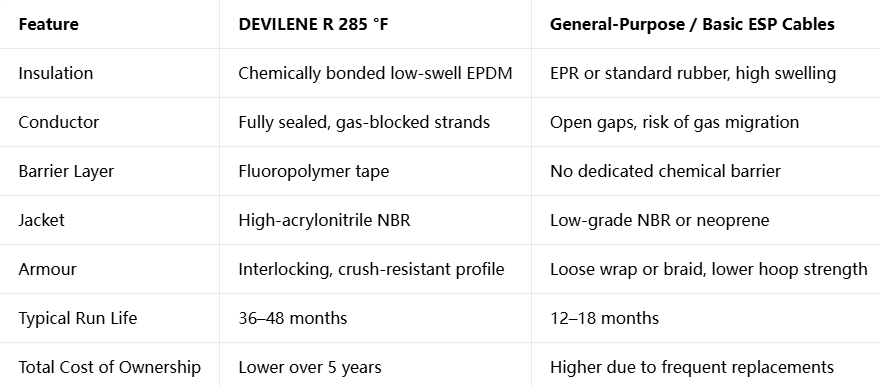
Many operators initially rely on general-purpose industrial cables or basic submersible cables, only to find they fail within 12 to 18 months. Insulation swells and softens, gas travels upward through conductor gaps, armour corrodes or crushes, and electrical performance degrades rapidly. This reality reveals a fundamental truth: a cable designed only to conduct electricity cannot survive in a downhole environment. What is required is not just a conductor, but a complete engineered system that can resist, contain, and withstand all these combined influences.
This is where the Prysmian DEVILENE R 285 °F Round ESP Cable enters the picture. It is built specifically as a system solution rather than a standard cable. Rated for continuous operation up to 285 °F (140 °C), it balances material science, structural engineering, and manufacturing quality to deliver long-term reliability in medium-temperature wells. For operators in South Africa and similar regions, it represents a proven path to longer run life, lower maintenance frequency, and better return on investment.
Full Technical Specifications & Ratings
Understanding the capabilities of the DEVILENE R 285 °F begins with its formal specifications, which are clearly defined in the official product data sheet and aligned with international industry standards.
General Electrical, Thermal & Mechanical Ratings
Voltage Class: 5 kV, suitable for standard ESP power distribution systems
Maximum Continuous Operating Temperature: +285 °F (+140 °C)
Minimum Installation Temperature: -22 °F (-30 °C), allowing installation in cold surface conditions without risk of cracking
Minimum Bending Radius: 7 times the overall diameter, providing excellent flexibility for running into deviated or horizontal well sections
Axial Load Capacity: 50 N/mm², sufficient to support its own weight and installation tension in deep wells
Chemical Resistance: Galvanized steel armour rated “Good”; stainless steel “Very Good”; Monel 400 “Excellent” for sour service
Compliance & Certification: IEEE 1018, ISO 9001, ISO 14001, and OHSAS 18001, audited and approved by SGS
Size & Construction Configurations
The cable is available in a range of conductor sizes to meet different power and voltage drop requirements:
Conductor Type: Solid or stranded (7-wire) plain copper or tinned copper
Insulation Thickness Options: 0.075 inch (1.91 mm) for standard duty, and 0.090 inch (2.29 mm) for enhanced dielectric strength
Armour Options:
Standard: Four-side fully galvanized steel tape (GSTA) in 0.025” or 0.034” thickness
Corrosive or sour wells: Stainless steel or Monel 400 interlocking tape
Detailed Electrical & Dimensional Data
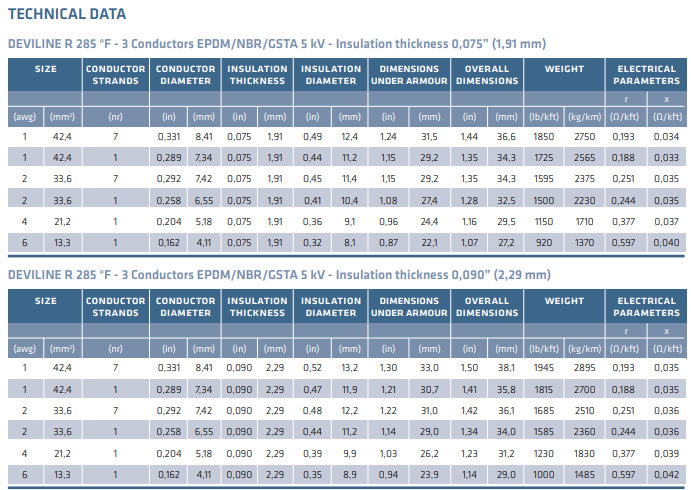
All values below are taken directly from the official Prysmian data sheet, based on standard 0.025” armour thickness:
These tables show how the cable is engineered to balance current-carrying capacity, mechanical strength, and electrical efficiency. Larger conductors reduce resistance losses, while increased insulation thickness provides a greater safety margin against voltage stress.
Layer-by-Layer Construction & Material Science
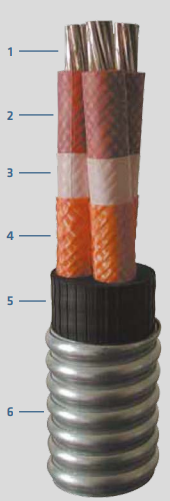
The performance of DEVILENE R 285 °F is not accidental; it is the result of a carefully layered design philosophy: block penetration, resist deformation, stop migration. Every component serves a specific function, and each material is selected based on proven chemical, electrical, and mechanical properties.
Conductor & Sealing Compound
At the core lies either solid or stranded high-purity copper, with tinned copper available as an upgrade. Copper is chosen for its high electrical conductivity, low resistance, and good ductility. Stranded construction improves flexibility, allowing the cable to bend repeatedly without fatigue. Between the strands, a proprietary sealing compound fills every gap completely.
From an engineering perspective, this solves two critical problems. First, it eliminates capillary action, which would otherwise draw formation fluids and gases upward along the conductor. This phenomenon, known as “gas migration,” can cause pressure buildup at the wellhead, insulation separation, and even surface safety risks. Second, the sealant maintains electrical symmetry around the conductor, preventing uneven field distribution and partial discharge. Tinning adds a protective layer that prevents copper from reacting with sulfur compounds in the well, which would otherwise form conductive sulfide deposits and increase resistance over time.
EPDM Insulation
Directly over the conductor is a layer of proprietary Ethylene-Propylene-Diene Monomer (EPDM), chemically bonded to the metal surface. This bond is critical — it ensures no air gap exists between conductor and insulation, eliminating the risk of voids that could initiate electrical breakdown.
EPDM is selected because of its molecular structure: a saturated hydrocarbon backbone with no reactive double bonds. This makes it highly resistant to thermal oxidation, ozone, and chemical attack. In the presence of crude oil and light hydrocarbons, it exhibits extremely low swelling — typically less than 8% volume change, compared to 25% or more for standard rubber compounds. Its dielectric constant remains stable at approximately 2.3, and its dielectric strength exceeds 25 kV/mm, providing a large safety margin for 5 kV operation.
Fluoropolymer Tape
Wrapped helically over the insulation is a thin but strong fluoropolymer tape, such as PTFE or FEP. This layer acts as a molecular barrier. Fluoropolymers have one of the lowest coefficients of permeability to oil, gas, and water, and they are chemically inert under almost all downhole conditions.
The tape prevents light hydrocarbon molecules from diffusing into the EPDM, which could otherwise soften or swell the insulation over years of exposure. It also protects against rapid gas decompression, a condition where sudden pressure changes can cause trapped gas to expand and damage the insulation structure. This barrier ensures the electrical properties remain consistent for the entire service life.
Synthetic Braid
Next comes a tightly woven synthetic braid made from high-strength polyester or aramid fibers. This layer provides hoop reinforcement — it increases the circumferential strength of the cable, helping it maintain its round shape under external hydrostatic pressure and radial compression.
The braid also acts as a buffer between the inner layers and the outer armour. It reduces friction during bending, prevents abrasion of the fluoropolymer tape, and distributes mechanical stress evenly across the cross-section. This prevents localized stress concentrations that could lead to cracking or deformation.
NBR Outer Jacket
Extruded over the braided core is a proprietary Nitrile Butadiene Rubber (NBR) jacket formulated with high acrylonitrile content. The chemistry here is a balance between polarity and non-polarity: the acrylonitrile groups resist oil absorption, while the butadiene segments provide elasticity and flexibility.
Standard NBR with low acrylonitrile swells significantly in oil, losing its mechanical strength. The formulation used in DEVILENE R 285 °F limits swelling to less than 10%, ensuring the jacket remains tough, flexible, and sealing even at 140 °C. It also resists hydrolysis in high-temperature brine, making it effective against both organic and inorganic fluids found in wells.
Interlocking Armour
The outermost structural layer is an interlocking metal tape armour. In standard configurations, this is four-side galvanized steel, where the zinc coating acts as a sacrificial anode, protecting the steel from corrosion. For more aggressive environments, stainless steel or Monel 400 is used.
The interlocking design is key to its performance. Unlike a simple wrap, each edge of the tape fits securely into the next, creating a continuous, flexible tube. This structure allows the cable to bend easily while retaining its circular geometry and resistance to crushing. It can withstand radial pressures up to 30 MPa, equivalent to the hydrostatic load at over 3,000 meters depth. Monel 400, a nickel-copper alloy, offers exceptional resistance to sulfide stress cracking, making it the preferred choice for wells with higher H₂S content.
Engineering Principles & Competitive Advantages
The DEVILENE R 285 °F is often described as a system solution rather than a cable because it addresses not just one, but all the simultaneous forces acting downhole. Understanding how it compares to standard alternatives reveals why it delivers better long-term value.
Managing the Coupled Downhole Environment
A conventional cable is designed for air or controlled industrial environments. When placed downhole, it faces thermal aging, chemical swelling, hydrostatic compression, mechanical bending, and corrosive fluids all at once. If one material fails, the whole system fails. The DEVILENE design works on the principle of “layered defense”: each barrier stops one or more failure mechanisms before they can reach the core.
Core Engineering Benefits
Thermal Stability: Rated for 140 °C continuous use, it maintains its mechanical and electrical properties at temperatures that would cause general-purpose cables to degrade rapidly. It also handles installation temperatures as low as -30 °C without becoming brittle.
Low Swell Performance: The combination of EPDM and high-grade NBR ensures dimensions remain stable. Swelling increases conductor separation, raises voltage stress, and reduces current-carrying capacity — problems eliminated by this formulation.
Gas-Tight Integrity: The sealed conductor construction prevents upward migration of formation gases, a common cause of wellhead issues and insulation delamination in standard cables.
Mechanical Versatility: With a bending radius of only seven times the diameter and interlocking armour, it can be run through deviated, S-shaped, and horizontal wells without risk of kinking or crushing.
Cost Optimization: It occupies the ideal temperature range for most South African wells. Higher-rated cables such as 400 °F (204 °C) grades use more expensive materials and offer performance far beyond what is needed, increasing upfront cost unnecessarily. DEVILENE R 285 °F delivers the right performance at the right price point.
Comparison with Standard ESP Cables
Field Validation: Performance in South African Oilfields
To understand real-world value, it helps to look at actual operating experience in the South African context. In this region, most wells fall within the medium-temperature, medium-corrosion category, making them ideal candidates for the DEVILENE R 285 °F rating.
Local Operating Conditions
South African onshore and shallow offshore wells generally have:
Depth: 2,500–3,800 m
Bottom-hole temperature: 110–135 °C
Fluid composition: Mixed crude oil, condensate, formation water, H₂S up to 1%, CO₂ up to 3%, and total dissolved solids exceeding 150,000 ppm
Well trajectory: Often deviated or horizontal, requiring cables that can navigate curves without damage
Historical Challenges
Before adopting this grade of cable, operators commonly faced a pattern: cables would swell within 6–9 months, armour would begin to corrode in 12 months, and electrical resistance would rise steadily until shutdown occurred. Average time between workovers was 12–18 months, costing hundreds of thousands of Rand per well in service and lost production.
Installed Solution
One operator in the Western Cape region deployed the DEVILENE R 285 °F configuration: 3-core, 2 AWG, 5 kV, with Monel 400 armour for improved corrosion resistance. The cable was integrated with Prysmian wellhead penetrators and motor lead extensions to ensure a fully matched system.
Measured Operational Results
After more than 42 months of continuous operation, the system showed no signs of degradation. Insulation resistance remained stable, dimensional checks confirmed no significant swelling, and armour integrity was maintained. The outcome was:
Run life extended from 18 months to over 42 months
Maintenance frequency reduced by more than 60%
Direct maintenance costs lowered by approximately 45%
Power efficiency improved by 12–18%, as stable geometry reduced electrical losses
Greater production consistency, avoiding the revenue loss associated with unexpected shutdowns
This experience confirms the principle: structure + materials + compliance = reliability. In South Africa’s medium-duty wells, the DEVILENE R 285 °F delivers exactly the performance required, without over-engineering or unnecessary expense.
Equivalent Alternative: Feichun ESP Cable
For operators looking to balance performance, budget, and delivery schedules, the Feichun DEVILENE R 285 °F equivalent cable offers a practical alternative that meets all technical and operational requirements.
Why Consider an Equivalent
While Prysmian remains the original manufacturer, supply chain lead times and regional availability can sometimes delay projects. Feichun Cables has developed a matching specification that aligns with the same engineering principles, allowing operators to maintain system integrity while improving cost and delivery timelines.
Feichun Equivalent Specifications
Electrical Rating: 5 kV, 60 Hz
Temperature Range: -30 °C to +140 °C
Insulation: High-grade EPDM compound, chemically bonded to conductor
Jacket: High-acrylonitrile NBR for low swell
Barrier & Reinforcement: Fluoropolymer tape + synthetic braid
Armour: Interlocking galvanized steel, stainless steel, or Monel 400
Standards Compliance: IEEE 1018, ISO 9001, API RP 11S5 and 11S6
Key Advantages
Identical Performance: Tested to the same electrical, thermal, and chemical criteria, with volume swell under 10% and dielectric strength above 20 kV/mm
Cost Efficiency: Typically 20–30% lower in procurement cost, improving project economics
Faster Delivery: Shorter production lead times and regional logistics support reduce waiting periods
Flexible Sizing: Available in the same AWG and cross-section range, with custom lengths supplied splice-free to minimize field joints
Frequently Asked Questions
What is the maximum continuous operating temperature?
The DEVILENE R 285 °F is rated for 285 °F (140 °C) continuous duty. It can tolerate short-term peaks up to 150 °C without permanent damage, but sustained operation should remain within the rated limit.
Can it be used in wells with H₂S?
Yes. For wells with sour conditions, specify stainless steel or Monel 400 armour. Monel offers the best resistance to sulfide stress cracking and is recommended when H₂S content exceeds 0.5%.
What is the minimum bending radius?
Seven times the overall diameter. This is a relatively flexible rating, making installation easier and reducing the risk of damage in deviated wellbores.
Why is low swelling so important?
When insulation swells, it increases its thickness but reduces its dielectric strength. It also changes the electrical geometry of the cable, raising voltage stress and increasing power losses. Low swell ensures the design remains stable throughout its service life.
Is the Feichun equivalent truly interchangeable?
Yes. It matches the same dimensions, ratings, and materials, and meets the same standards. It can be used in existing ESP systems without modification or compatibility issues.
Can it be supplied in long continuous lengths?
Both Prysmian and Feichun offer splice-free lengths up to several kilometers. This eliminates the need for field splices, which are the most common source of leakage and failure points.
Conclusion
The DEVILENE R 285 °F Round ESP Cable represents more than just a piece of equipment — it is a carefully engineered solution designed to survive the unique combination of heat, oil, gas, water, and mechanical force found in medium-temperature oil wells. By combining a sealed conductor system, low-swell EPDM/NBR materials, layered chemical barriers, and crush-resistant interlocking armour, it solves the problems that cause ordinary cables to fail prematurely.
In South Africa and similar regions, where most wells operate within the 110 °C to 135 °C range, this cable hits the optimal balance. It delivers the necessary performance without the higher cost of over-rated cables, while its long service life reduces the frequency of expensive workovers. The field results confirm that reliability directly translates into better production efficiency and lower total operating cost.
Whether you choose the original Prysmian product or the Feichun equivalent, the key is to select a cable designed specifically for the conditions of your well. Every application is different, and consulting detailed technical data sheets or technical support ensures you match the right specification to the environment.
For detailed pricing, custom configurations, or to request a datasheet and quotation for DEVILENE R 285 °F or its Feichun equivalent, please contact our technical and sales team:
Email: Li.wang@feichuncables.com
Email Address: Li.wang@feichuncables.com
© 2025. All rights reserved.
One-click to Quickly Contact
Products
Contact
Company
Location:
Building A Private Science and Technology Park, Hefei Economic and Technological Development Zone, Anhui Province, China
Heat Resistant Cable
WhatsApp: +86 17333223430
Social Media: