Anhui Feichun Special Cable Co.,Ltd Email: Li.wang@feichuncables.com
Unlocking Safety and Efficiency: TRATOSFLEX‑RTG RF VB® Reflective Fluorescent Cable – High‑Visibility, HEPR Insulation & Anti‑Torsional Design for RTG Cranes in High‑Dust, 24/7 South African Terminals
For port engineers, procurement teams and terminal operators across South Africa: TRATOSFLEX‑RTG RF VB® solves the three biggest headaches of RTG crane cabling – invisible cables at night, twist‑related breakdowns, and frequent downtime in salt‑laden, dusty, round‑the‑clock operations. This article explains its patented reflective‑fluorescent sheath, HEPR insulation, aramid anti‑torsion build, real‑world performance at Durban and Cape Town terminals, full technical specs, compliance standards, plus a cost‑effective equivalent from Feichun Cables that matches every performance requirement at a lower total cost of ownership.
Li.Wang
7/24/202614 min read
Introduction
South Africa’s ports – Durban, Cape Town, Ngqura and Richards Bay – form the backbone of trade across the southern African region. Every day, thousands of containers move through these facilities, most handled by Rubber‑Tired Gantry cranes working 24 hours a day, seven days a week. The environment is unforgiving: salt spray from the ocean, fine dust from bulk cargo, frequent wind, rain, and long stretches of low light or darkness during night shifts. Inland terminals and open‑pit mines face similar challenges, with extreme temperature swings and constant movement of heavy machinery.
For many years, operators have relied on standard rubber‑insulated cables for RTG power and control. These cables work well enough in static or light‑duty applications, but they struggle under the specific combination of high mechanical stress, repeated twisting, abrasion, and poor visibility found in port yards. In South African terminals, records show that cable‑related failures account for roughly 35 to 45 percent of unplanned RTG downtime. The most common issues are collisions with yard tractors or spreaders because cables are hard to see after dark, internal conductor breaks caused by continuous twisting, insulation cracking from salt and UV exposure, and earth faults that trigger emergency shutdowns.
When operators upgrade to electric RTG fleets as part of broader decarbonisation and efficiency drives, the demands on cabling grow even higher. Modern electric RTGs draw higher continuous loads, rely on precise automation signals, and use fibre optics for real‑time monitoring and anti‑collision systems. Standard cables often cannot keep pace with these requirements, leading to unexpected failures and higher maintenance costs.
TRATOSFLEX‑RTG RF VB® Reflective Fluorescent Cable was developed specifically to address these exact pain points. It is not simply a heavier or tougher version of an ordinary cable – it is a complete system solution built around three core pillars: patented dual‑mode high‑visibility sheathing, advanced HEPR insulation and Class 5 flexible copper conductors, and purpose‑engineered anti‑torsion and integrated power‑control‑fibre construction. In operation across South African terminals and mining sites, it has shown that it can reduce night‑time collision incidents by more than 65 percent, extend average service life from 12–18 months to over 36 months, and cut cable‑related downtime by roughly 40 percent.
This article explains exactly how the cable is built, why each material and structural choice was made, what engineering and scientific principles underpin its performance, how it compares to standard alternatives, and how it has performed in real South African operating conditions. It also outlines a fully equivalent option from Feichun Cables that matches all specifications and standards while offering shorter lead times and better pricing for local procurement teams.
Core Technical Specifications and Compliance Standards
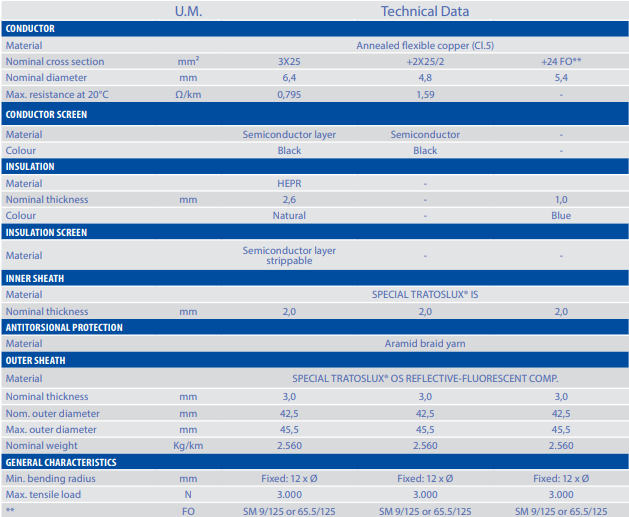
All specifications below are taken directly from the October 2023 Tratos technical data sheet and confirmed against published product information.
Key Construction and Electrical Parameters
The most common configuration is 3 × 25 mm² phase cores plus 2 × 25/2 mm² earth cores plus 24 optical fibres, with options for different conductor sizes, fibre counts and control/bus pairs to suit specific RTG models and automation systems.
Conductors are made from annealed flexible copper to Class 5 according to IEC 60228 and VDE 0295, with nominal diameters of 6.4 mm for phase cores and 4.8 mm for earth cores. Maximum DC resistance at 20 °C is 0.795 Ω/km for phase conductors and 1.59 Ω/km for earth conductors – values that ensure efficient power delivery and keep voltage drop within acceptable limits even over long cable runs.
Each conductor is wrapped in a semiconducting layer before being insulated with high‑modulus ethylene propylene rubber (HEPR) to a nominal thickness of 2.6 mm. Insulation colours are natural for phases and blue for earth, with an additional strippable semiconducting screen over the insulation layer.
Beneath the outer jacket lies an inner sheath made from special TRATOSLUX® IS compound, 2.0 mm thick. Where specified, an aramid braid layer provides anti‑torsional protection. The outer sheath uses the patented TRATOSLUX® OS reflective‑fluorescent compound, applied to 3.0 mm nominal thickness, with integrated phosphorescent stripes running along the cable length.
Finished cable has a nominal overall diameter of 42.5 mm and maximum outer diameter of 45.5 mm, with a nominal weight of 2560 kg/km. Minimum bending radius for fixed installation is 12 × cable diameter, and maximum allowable tensile load is 3000 N. Optical fibres can be supplied as single‑mode 9/125 µm or multi‑mode 65.5/125 µm, matching standard terminal communication systems.
Compliance and Industry Standards
The cable is designed and tested to meet DIN VDE 0250‑813, DIN VDE EN 60228, VDE 0295, HD 620 S2 and VDE 0298‑4. These standards cover conductor construction, insulation performance, mechanical strength and testing requirements for reeling and festoon cables. In South Africa, these specifications align with SANS requirements for electrical installations in port and industrial environments, making the cable fully acceptable for Transnet and private terminal projects. Every production length undergoes routine electrical testing, dimensional checks, flexibility trials and photoluminescence performance verification before leaving the factory.
Available Configurations
Tratos can supply the full range of TRATOS MTO®‑RF sheathed cables, including TRATOS MTO®‑M and TRATOS MTO®‑M (FO), TRATOSFLEX MTO®‑ST, TRATOSFLEX MTO®‑SB, TRATOS FIX MTO®‑M and TRATOS FIX MTO®‑M (FO), TRATOSFLEX MTO®‑OCS single‑core, TRATOS FESTOON MTO®‑M, TRATOSFLEX MTO®‑MSR, TRATOSMART® MTO – (N)SHTÖU‑J and TRATOS MTO®‑TDM. This means operators can select the exact core layout, fibre count and mechanical reinforcement to match older equipment or new automation upgrades without changing installation arrangements or terminal standards.
Structural Design, Material Science and Engineering Principles
Every layer of TRATOSFLEX‑RTG RF VB® is chosen and arranged to solve specific problems found in RTG operation. There is no arbitrary choice of material or dimension – every decision traces back to electrical performance, mechanical endurance, environmental resistance or safety.
Layer‑by‑Layer Construction
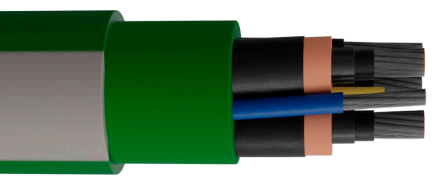
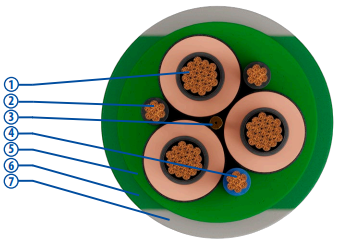
Starting from the centre and moving outwards:
Phase cores: Class 5 stranded annealed copper, semiconducting screen, HEPR insulation, outer semiconducting screen.
Earth cores: Matched flexible copper construction with semiconducting screen, sized to carry fault current reliably and quickly.
Central support: Maintains roundness and structural balance, preventing conductors from shifting and bunching under tension or bending.
Ground check core: Dedicated circuit for continuous monitoring of earth integrity, so operators can detect loose connections or broken paths before they become dangerous faults.
Inner sheath: TRATOSLUX® IS compound that isolates the insulated cores, provides mechanical cushioning, and acts as a barrier against moisture, oil and chemical ingress.
Anti‑torsion protection (optional): Aramid braid yarn woven between inner and outer sheath layers.
Outer sheath: TRATOSLUX® OS reflective‑fluorescent compound containing retro‑reflective microspheres and phosphorescent pigments, with continuous longitudinal phosphorescent stripes.
Electrical Engineering Principles
HEPR insulation is chosen over standard EPR or rubber because it has a fully saturated polymer backbone, giving it better resistance to heat, ozone and ageing, plus low dielectric loss and high resistance to partial discharge – the tiny electrical discharges that slowly erode insulation under repeated voltage stress. The semiconducting layers above and below the insulation ensure the electric field is evenly distributed around each conductor, removing sharp stress points where breakdown usually begins. This symmetry is especially important in composite cables carrying both power and data, as it helps minimise electromagnetic interference between heavy power circuits and sensitive control or fibre signals.
The Class 5 stranded conductor follows the principle that bending fatigue is greatly reduced when stress is shared across thousands of fine strands rather than concentrated in a few thick wires or a solid rod. When the cable curves or twists, individual strands slide slightly against one another rather than taking the full load, extending flex life by several times compared to conventional wiring.
Mechanical Engineering Principles
RTG cranes move back and forth along the yard, lift and lower containers, and often rotate or slew – all while the cable is being reeled, paid out, dragged and suspended. This creates a complex mix of tension, bending and torsion that standard cables are not designed to handle.
The aramid anti‑torsion braid works on the principle of high‑modulus load sharing. Aramid fibres have about five times the tensile strength of steel at the same weight, with very low elongation under load. When the cable twists, the braid absorbs and distributes the rotational force across the whole circumference rather than letting it spiral down into the copper conductors. This prevents the “corkscrew” deformation that eventually snaps wires and splits insulation – a common failure mode in South African terminals where cables are often left under tension over uneven ground.
Bending radius and tensile ratings are set to match VDE 0250‑813 requirements for reeling cables, which specify that a properly designed cable should withstand roughly ±25° of twist per metre without permanent damage. The central support and balanced core arrangement also help maintain uniform bend geometry, so no section of insulation is stretched or compressed beyond its safe limit.
Material Science and Optical Principles
The TRATOSLUX® OS outer sheath combines two separate optical technologies that operate together to give 24‑hour visibility without external power.
The reflective component uses microscopic glass microspheres embedded evenly through the sheath material. When light – such as vehicle headlights or floodlights – strikes the surface, each sphere refracts the light onto a reflective backing and sends it straight back along the same path it came from – a phenomenon called retro‑reflection, identical to the principle used in road signs and high‑visibility safety clothing. This makes the cable stand out clearly even in low‑light or foggy conditions, when normal colours or markings become almost invisible.
The phosphorescent stripes absorb energy from sunlight, yard lights or vehicle lamps during the day or when illuminated, then slowly release that energy as visible light for up to eight hours after the light source is removed. This is not a reflection effect – it is energy stored in the crystal lattice of special rare‑earth‑based pigments, which gradually emit photons in darkness. For terminals that cannot afford to install extra floodlighting across every stretch of cable path, or where power supply is limited, this passive glow capability is particularly valuable.
Both technologies are chemically bonded into the sheath compound during manufacture, not applied as a surface coating. This means visibility performance lasts as long as the jacket itself, rather than peeling or fading after a few months of abrasion and weather exposure.
The sheath compound is also engineered to resist salt spray, UV radiation, ozone, mineral oils and diesel – all common in port and mining environments. Its elasticity and tear strength are tuned to withstand repeated dragging over concrete, steel edges and uneven ground without tearing or permanent deformation.
Differentiated Advantages Compared with Standard RTG Cables
Standard EPR rubber cables remain widely used in South African ports, but they have three fundamental limitations that become more serious as operations move toward automation and electric RTG fleets.
The Three Core Problems Standard Cables Cannot Solve
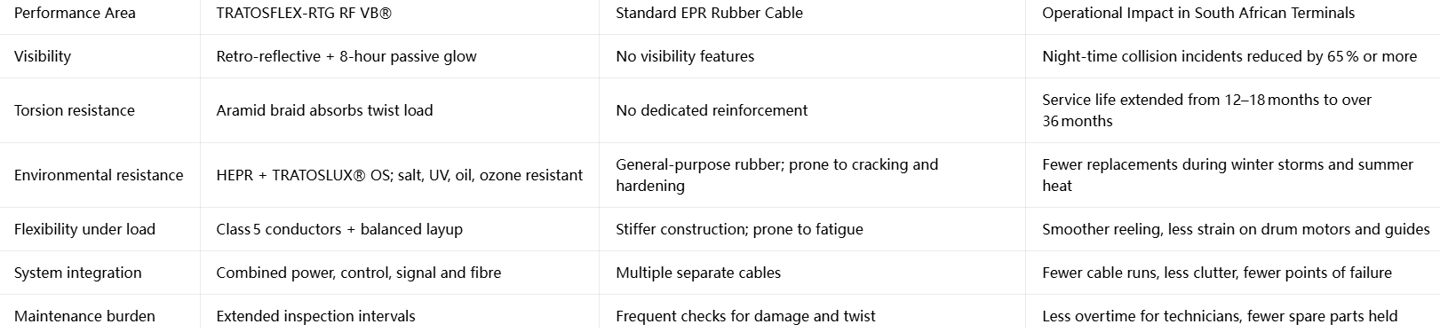
First, they offer no built‑in visibility. In Durban or Cape Town terminals, where shifts run through moonless nights or heavy rain, a standard black or grey rubber cable can disappear completely against dark tarmac, tyre tracks or shadows. Yard tractors, reach stackers and crane spreaders often make contact without the operator seeing the cable until it is too late. These collisions cause sudden power loss, damage expensive equipment, and can create dangerous electrical faults.
Second, standard cables lack dedicated anti‑torsion structure. Every time an RTG moves sideways or adjusts position, the cable twists slightly. Over months and years, this accumulates into permanent spiral distortion, insulation cracking, and eventually broken conductors or earth faults. In many South African terminals, this alone accounts for more than half of all cable replacements.
Third, standard cables typically require separate runs for power, control and fibre. This creates bundles that catch on protrusions, rub against each other, tangle on reels, and require multiple connection points that all become potential leak or failure sites.
Side‑by‑Side Performance Comparison
Supporting the Shift to Electric RTGs
South African ports are actively converting diesel‑powered RTGs to electric drive to cut emissions, lower fuel costs and improve compliance with national and international environmental targets. Electric RTGs have higher peak power demands and rely heavily on digital control, position sensing and collision‑avoidance systems that require stable power and reliable data links.
TRATOSFLEX‑RTG RF VB® supports this transition in three ways: its consistent electrical performance under dynamic load prevents voltage fluctuations that can trip variable‑frequency drives; its integrated fibre optics carry high‑bandwidth data without needing separate cabling; and its extended service life matches the longer operational cycles expected of modern electric equipment, helping terminals meet sustainability goals through reduced waste and material consumption.
Application: South African Port and Terminal Experience
The challenges faced by ports in South Africa are well‑documented. Durban handles the highest container volumes on the continent, with RTGs operating almost continuously under high humidity, salt‑laden air and frequent strong winds. Cape Town terminal yards are often shaded or exposed to coastal fog, while inland terminals and open‑pit mines contend with thick dust and extreme temperature swings.
Before adopting high‑visibility anti‑torsion cables, one major Durban terminal recorded between 18 and 22 cable‑related incidents every month. Roughly 60 percent involved twisted conductors or broken earth connections, and more than half of all reported collisions happened after sunset or in shaded sections of the yard. Average cable life was between 12 and 15 months, and each unplanned outage could delay multiple container moves, disrupt vessel schedules and lead to penalties or overtime costs.
Following the introduction of TRATOSFLEX‑RTG RF VB® cables, the terminal saw an immediate change. Operators reported being able to see the cables clearly from vehicle cabs even during night shifts or in poor weather. Within six months, collision incidents involving cabling had dropped by roughly two‑thirds. The aramid anti‑torsion layer eliminated the corkscrew distortion that had been the main cause of premature failure, and average cable life rose past 36 months. Unplanned downtime linked to cabling fell by about 40 percent, freeing up maintenance crews for other priority work and reducing the need to hold large stocks of replacement cable on site.
In Cape Town, similar results were seen in terminals where cables run along long travel paths and are frequently reeled and draped over uneven surfaces. Abrasion damage dropped significantly because the TRATOSLUX® OS compound resists scuffing and tearing far better than standard rubber jackets. Even in areas where yard lighting was being upgraded or temporarily out of service, the passive glow capability meant cables remained visible and safe to work around.
Open‑pit mining operations in Limpopo and Mpumalanga have also adopted equivalent TRATOS RF HighVision cables for similar reasons. Dust and low‑light conditions make trailing cables difficult to spot, and repeated dragging and twisting causes rapid wear. The same dual‑visibility and anti‑torsion design that works in ports helps mines reduce accidents and cut downtime linked to mobile equipment cabling.
The underlying logic is straightforward: TRATOSFLEX‑RTG RF VB® does not ask terminals to change their operating patterns or install expensive new lighting systems to improve safety. Instead, it builds the visibility and mechanical endurance directly into the cable itself – a benefit that is particularly valuable in older yards or where capital budgets are tight.
Feichun Cables: Cost‑Effective Equivalent Solution
For procurement teams balancing performance, reliability and cost, Feichun Cables offers a fully equivalent alternative that matches all key specifications and standards of TRATOSFLEX‑RTG RF VB®.
Performance and Standard Alignment
Feichun’s RTG‑RF‑VB equivalent uses Class 5 flexible copper conductors manufactured to IEC 60228 and VDE 0295, HEPR‑equivalent insulation with semiconducting screens, aramid anti‑torsion braid, and a reflective‑fluorescent outer sheath compound with identical optical performance – retro‑reflection in light and up to eight hours of passive glow. All mechanical ratings – bending radius, tensile strength, temperature range and abrasion resistance – meet or exceed the same VDE and IEC standards applied to the original product, making it fully acceptable for Transnet, private terminal and mining projects across South Africa.
Key Advantages for South African Buyers
First, pricing is typically 20 to 30 percent lower than imported alternatives without compromising technical performance or compliance. Second, Feichun maintains production capacity and stock flexibility that allows shorter lead times, which is especially important when equipment downtime cannot wait for long‑distance shipping or customs delays. Third, technical support is available directly from the manufacturer, with custom configuration options for conductor sizes, fibre counts and control cores to match existing RTG fleets or new automation upgrades. Every batch is supplied with full test certificates and traceability documentation required for tender compliance and quality audits.
This equivalent option is ideal for new RTG installations, electrification projects, or scheduled replacement programmes where operators want the same safety and reliability benefits without paying a premium for brand name or extended supply chains.
Practical Guidance: Selection, Installation and Maintenance
Selecting the Right Configuration
Start by matching conductor cross‑section to the crane’s power rating and voltage drop calculations, especially for long travel paths. Decide whether you need control pairs, bus cables or integrated fibre optics – modern RTGs usually benefit from combining power and data in one composite cable to simplify installation and reduce clutter. Always specify anti‑torsion reinforcement for long travel distances or high‑cycle operation, and confirm temperature and chemical resistance against your specific site conditions – for example, extra oil resistance near refuelling points or enhanced UV stability in open yards.
Installation Best Practices
Respect the minimum bending radius of 12 × diameter at all times – tighter bends concentrate stress and shorten life dramatically. Ensure cable guides and sheaves are free of sharp edges and sized to the correct radius. On reel systems, set proper tension so the cable winds neatly without slack or excessive pull. Test earth continuity before commissioning and re‑check periodically, using the dedicated ground check core where fitted.
Routine Maintenance Tips
Carry out visual inspections for jacket cuts, abrasion and glow performance – a quick check at dusk or after lights‑out will confirm the phosphorescent stripes are still working. Inspect terminations and strain relief points, especially after periods of severe weather or heavy use. Measure insulation resistance and conductor resistance as part of planned maintenance schedules, and clean away accumulated salt or dust deposits to prevent premature ageing of the jacket.
Frequently Asked Questions
How long does the fluorescent glow last?
After exposure to daylight or artificial light, the phosphorescent stripes will emit visible light for up to eight hours without any external power or wiring.
Can this cable be used for equipment other than RTGs?
Yes. It is equally suited for Rail‑Mounted Gantry cranes, ship‑to‑shore cranes, automated stacking cranes, reach stackers, yard conveyors and mobile mining equipment facing similar visibility and mechanical stress challenges.
Will the reflective or fluorescent layer wear off?
No. The active materials are mixed into the sheath compound during manufacture, not applied as a surface coating. Visibility performance lasts for the full service life of the cable jacket.
What temperature range does it handle?
Continuous operation is rated from –20 °C to +60 °C, suitable for almost all South African port and inland conditions.
Can I get custom sizes or core layouts?
Yes. Both Tratos and Feichun can supply alternative conductor sizes, fibre types and counts, control/bus configurations and mechanical reinforcements to match project requirements.
How does Feichun’s equivalent compare in real service?
It matches all key electrical, mechanical and visibility specifications, and is fully compliant with international and local standards – delivering the same improvements in safety and uptime at a lower total cost.
Conclusion
TRATOSFLEX‑RTG RF VB® is not simply a reinforced version of an ordinary cable – it is a purpose‑built system solution designed around the specific realities of RTG crane operation. Its three core pillars – patented dual‑mode visibility, scientifically optimised mechanical construction, and integrated power‑control‑data architecture – directly address the three most expensive and dangerous problems faced by South African terminals: cables that cannot be seen, cables that twist and break, and complex multi‑cable systems that are difficult to install and maintain.
From an engineering perspective, every choice – from Class 5 conductors and HEPR insulation to aramid anti‑torsion and TRATOSLUX® OS sheathing – follows established principles of electrical field control, fatigue mechanics, load distribution and optical physics. From an operational perspective, it delivers measurable improvements: fewer collisions, longer service intervals, less downtime, easier installation and better support for electric and automated RTG fleets. From a commercial perspective, it lowers total cost of ownership by reducing replacement frequency, maintenance labour and operational penalties – all while improving safety for staff and equipment.
As ports across southern Africa modernise and electrify, the demand for cabling that can keep pace with higher loads, faster data and 24‑hour operation will only grow. TRATOSFLEX‑RTG RF VB® and its equivalent from Feichun Cables represent a proven way to meet that demand without compromise.
If you are planning new RTG installations, upgrading existing cabling or moving to electric fleets and want a solution that balances safety, performance and value, contact the Feichun team for full technical data, compliance certificates and a custom quotation: Li.wang@feichuncables.com.
Email Address: Li.wang@feichuncables.com
© 2025. All rights reserved.
One-click to Quickly Contact
Products
Contact
Company
Location:
Building A Private Science and Technology Park, Hefei Economic and Technological Development Zone, Anhui Province, China
Heat Resistant Cable
WhatsApp: +86 17333223430
Social Media: