Anhui Feichun Special Cable Co.,Ltd Email: Li.wang@feichuncables.com

Type 41 Flexible Mining Trailing Cable 640/1100V : SANS 1520-1 EPR/CR Shielded Design for South African Coal and Hard Rock Mines – Reeling & Trailing Solutions
Type 41 640/1100V trailing cable: SANS 1520-1 certified, EPR/CR shielded and water-blocked design for South African coal, platinum, gold and hard rock mines. Ideal for shuttle cars, reeling units and hazardous-area mobile equipment, fully aligned with the Minerals Act 1991 and Mine Health and Safety Act 1996 requirements.
Li.Wang
7/16/202611 min read
Introduction
South Africa’s mining sector is one of the most demanding operating environments for electrical equipment anywhere in the world. From deep-level coal mines in Mpumalanga to platinum and chrome operations in the North West, and historic gold fields in the Free State, underground workings combine narrow haulages, constant water seepage, abrasive rock dust, flammable gases, and the continuous movement of heavy machinery. For decades, electrical engineers and mine safety officers have faced a consistent challenge: standard general-purpose cables rarely last as intended in these conditions. Frequent sheath tears, broken conductors, water-related insulation failure, and non-compliance with local regulations lead to unplanned downtime, costly replacements, and serious safety risks.
This is where the Type 41 640/1100V Flexible Electric Trailing Cable comes in. Manufactured to SANS 1520 Part 1 with SABS permit number 3660/6352, it is not just another rubber-sheathed cable – it is an engineering solution purpose-built from the ground up for South African mining conditions. Every material choice, structural detail and performance rating has been shaped by decades of local operational experience, balancing four core principles that underpin its reliability: safety and regulatory compliance first, mechanical durability for constant movement, stable electrical performance under stress, and full resilience to the harshest underground environments.
Unlike standard cables that are adapted from general industrial designs, Type 41 is engineered specifically to solve the unique problems mines face daily. Its combination of ethylene propylene rubber insulation, chloroprene rubber sheathing, individual core shielding, full water-blocking and optional reinforcement creates a system that outlasts alternatives, meets every legal requirement, and reduces long-term operating costs significantly. This guide breaks down exactly how it is built, why each design choice matters, where it fits best in South African operations, and how it compares to cables not designed for this level of duty.
Regulatory and Standard Compliance – Built for South African Mining Law
Any electrical equipment used in South African mines must meet strict legal requirements, and trailing cables are no exception. The Type 41 cable is designed, tested and certified to work within this framework, ensuring full legal eligibility and consistent safety performance.
The primary governing standard is SANS 1520 Part 1: Electric cables for mines, which sets out mandatory specifications for construction, materials, testing and marking of cables intended for underground mining use. This standard is supported by related specifications including SANS 1411 series for rubber insulation and sheathing materials, and SANS 60228 for flexible conductor requirements. All Type 41 cables carry official SABS approval, which is a legal prerequisite for deployment in any South African mine.
Legislative alignment has evolved over time, starting with the Minerals Act, 1991 which first mandated that mobile and self-propelled mining equipment must be powered by purpose-built trailing cables rather than fixed wiring or general-purpose flexible cables. Today the Mine Health and Safety Act (MHSA) 1996 and accompanying Electrical Safety Regulations set more detailed requirements that Type 41 fully satisfies. These rules state that all mobile equipment in hazardous areas must use cables with dedicated shielding and reliable earthing paths; cables must demonstrate resistance to flame, mechanical damage and electrical fault conditions; and any cable used on reeling or drum-operated equipment must pass repeated tension and bending cycle testing.
For mine operators, choosing a non-compliant cable carries serious consequences: work stoppages issued by the Department of Mineral Resources and Energy, heavy fines, legal liability in the event of an incident, and higher insurance premiums. Type 41 eliminates these risks by providing full traceability from raw material to final test certificate, with every batch verifiable against SANS standards. It also meets the classification requirements for Group I hazardous locations, meaning it is approved for use in areas where flammable gases or combustible dust may be present.
Full Technical Specifications – Exact Data from Type 41 Datasheet
All values below are reproduced exactly from the official Type 41 product documentation, with supporting explanation to help interpret what each figure means for real-world use.
General Ratings and Identification
Rated voltage: 640/1100V (U₀/U) – designed for earthed neutral three-phase systems up to 1.1kV
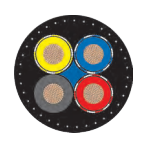
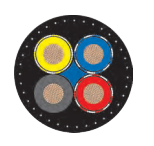
Core configuration: 3 screened power cores + 1 unscreened pilot core
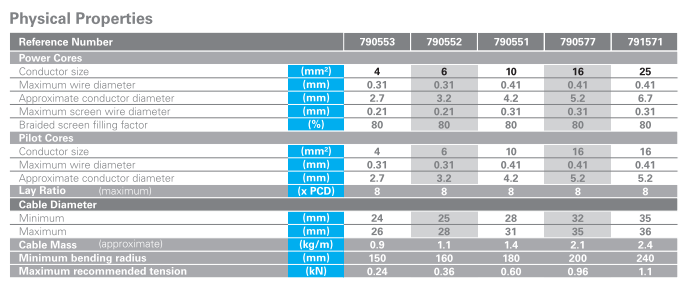
Available cross-sections: 4mm², 6mm², 10mm², 16mm², 25mm²
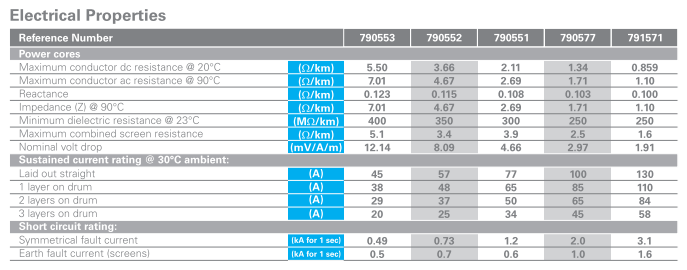
Reference numbers: 790553 (4mm²), 790552 (6mm²), 790551 (10mm²), 790577 (16mm²), 791571 (25mm²)
Standard part codes: RRTF 060T04 7500 P04 (6mm²), RRTF100T04 7500 P04 (10mm²), RRTF 025T03 7530 P04 (25mm²)
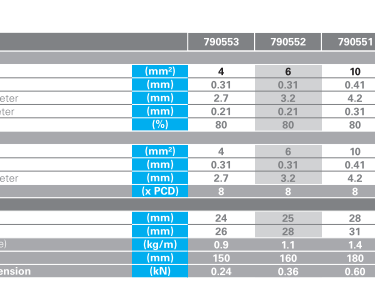
Physical and Mechanical Properties
The bending radius figures are particularly important: mines often try to route cables around tight corners or pull them through narrow openings, but exceeding these limits will permanently deform insulation or break internal conductors. The tension ratings apply to pulling and reeling loads – these values are calculated to keep conductor elongation below 0.2%, the point where electrical resistance begins to rise and fatigue failure accelerates.
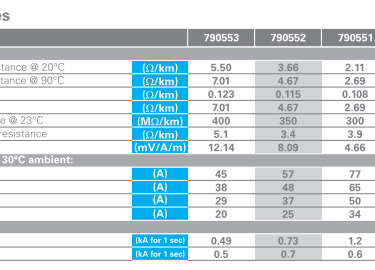
Electrical Performance
The drop in current rating as more layers are wound on a drum is often overlooked in mine planning. Cables dissipate heat through their outer surface, and overlapping layers trap heat and raise operating temperature. Using the straight-run rating for a fully wound drum will lead to overheating and accelerated insulation ageing. The screen resistance values are set low enough to ensure earth fault currents trigger protection relays within the required time, but high enough to avoid unnecessary tripping from leakage currents.
Construction, Materials and Engineering Science – Why Every Layer Matters
The Type 41 cable is built from the centre out, with each layer serving specific electrical, mechanical or environmental functions. No material or structural choice is arbitrary – all are selected based on established engineering principles and proven performance in South African mines.
Starting at the core, each power and pilot conductor is made from annealed tinned copper, stranded to Class 5 flexibility requirements. Individual wire diameters are kept small – 0.31mm for 4mm² and 6mm², 0.41mm for larger sizes – to achieve two key benefits. Electrically, fine stranding reduces skin effect, a phenomenon where alternating current concentrates near the outer surface of a conductor at higher frequencies, effectively increasing resistance. Mechanically, bending stress is distributed across hundreds of individual wires rather than concentrated in a few thick strands, so the conductor can flex millions of times without work-hardening or snapping. Tin plating prevents oxidation in damp conditions and creates a more reliable connection at terminations.
Each power conductor is insulated with ethylene propylene rubber (EPR) to grade RD 3 as specified in SANS 1411-3. EPR is chosen over PVC or general-purpose rubber because it maintains high dielectric strength even when wet, resists the formation of water trees – microscopic channels that grow through insulation over time and cause failure – and remains stable at continuous operating temperatures up to 90°C. It also offers excellent resistance to ozone, which forms around electrical equipment in underground mines and causes ordinary rubber to crack and degrade.
Over each power core sits an individual braided shield made from tinned copper and textile fibres, with a coverage factor of exactly 80%. This design performs two critical roles. Electrically, it contains electromagnetic fields generated by variable frequency drives and other equipment, preventing interference that would disrupt the pilot core used for remote tripping and safety interlocks. In the event of an insulation failure between a power core and the cable sheath, the shield provides a dedicated low-resistance path for earth fault current. This ensures fault current is large enough to trigger protective relays quickly, while also limiting the voltage that appears on exposed metal parts to safe levels.
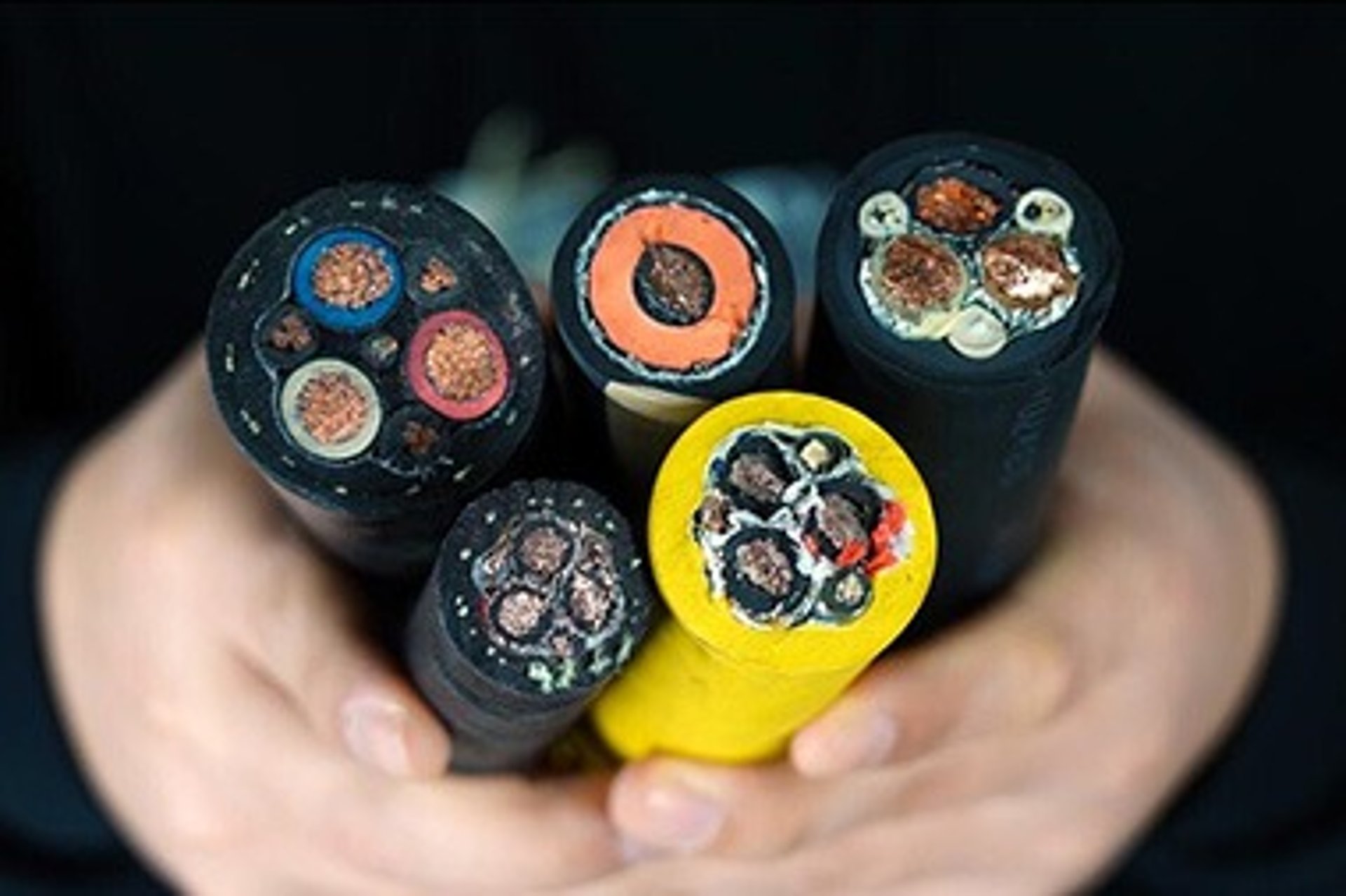
All four cores are laid up around a solid dummy filler centre, with interstices filled with superabsorbent water-blocking yarns. This full water-blocking system is one of the most important differences between Type 41 and standard cables. If the outer sheath is damaged and water enters, the yarns swell rapidly to seal the gap, preventing moisture from travelling along the length of the cable. In mines with regular flooding or deluge system use, standard cables allow water to spread for hundreds of metres, causing hidden corrosion of conductors and shields that only becomes apparent when a fault occurs.
For 16mm² and 25mm² sizes only, an additional high-tenacity synthetic reinforcement layer is added between the inner bedding and outer sheath. This reinforcement is designed to carry the majority of tensile load when the cable is pulled or wound onto a drum, preventing the copper conductors from stretching or breaking. Smaller sizes do not include this layer because they are intended for lighter trailing duty, where extra stiffness would outweigh the benefit of added strength.
The outer sheath is made from chloroprene rubber (CR) or an equivalent compound to grade RS 6 under SANS 1411-3. CR is selected for its unique combination of properties: it has extremely high tear and abrasion resistance to withstand being dragged over sharp rock, steel beams and conveyor structures; it resists degradation from diesel, hydraulic oil, mine acids and alkalis; it remains flexible at temperatures as low as -25°C and stays intact at the full operating temperature of the cable; and it is inherently flame retardant and self-extinguishing if exposed to fire.
Throughout development, engineers considered adding steel wire or tape armouring for extra mechanical protection, but field trials showed this added unnecessary weight and stiffness for trailing duty. Armoured cables do not flex well on drums, and the armour itself can damage insulation if the cable is bent beyond its limit. The combination of a tough CR sheath, water-blocking and optional reinforcement has proven far more effective for South African mining conditions.
Core Advantages vs Standard Cables – Solving Unmet Mining Problems
Type 41 stands apart from general-purpose rubber-sheathed trailing cables in ways that directly address the most costly and dangerous failure modes seen in South African mines.
Standard cables are usually built to general industrial standards, with no specific requirements for mining conditions. They often use thicker, stiffer conductors that fatigue quickly, insulation prone to water damage, thin sheaths that wear through in months, and no dedicated shielding or water-blocking. When these cables fail, the root cause is rarely obvious until it is too late – and replacement work takes critical equipment out of service for hours or days.
In direct comparison, Type 41 delivers measurable improvements across every key performance area. It meets all SANS 1520-1 and SABS requirements, so it is legally acceptable for mine use, while standard cables carry no such guarantee. Its flexible construction lasts three to five times longer under repeated bending and trailing motion, with many South African operations reporting service lives of three years or more on shuttle cars and reeling equipment. The full water-blocking system eliminates hidden water ingress, while individual core shielding prevents interference and ensures reliable earth fault protection. The CR sheath resists abrasion far better than standard rubber, and the reinforced 16mm² and 25mm² sizes handle the tension of repeated reeling without stretching or breaking.
These differences translate directly to solving problems standard cables cannot. Frequent sheath cuts that cause unplanned shutdowns are reduced by over 60% in high-abrasion zones. Water-related faults that often disappear after drying and return weeks later are eliminated entirely. Control signal interference that causes erratic equipment behaviour or false safety trips is no longer an issue. Most importantly, the dedicated fault current path reduces the risk of sparking in flammable atmospheres, one of the greatest safety hazards in underground mining.
South African Mine Applications – Real-World Use Cases
Type 41 is now established as a standard specification across coal, platinum, gold and chrome mines throughout South Africa, with specific sizes matched to well-defined operational duties.
The 4mm² size is the most widely used for smaller equipment, including underground dewatering pumps, hand-held rock drills, pneumatic drill power packs, auxiliary ventilation fans and temporary lighting sets. Its low weight and tight bend radius make it easy to manoeuvre in narrow development ends and steeply dipping workings, where larger cables become cumbersome and difficult to position. In many Mpumalanga coal mines, this size is specified for all secondary mobile equipment as standard.
The 16mm² size has become the industry standard for shuttle cars across South African coal and platinum operations. Shuttle cars operate in confined rooms and pillars, moving constantly between continuous miners and main conveyors, and their power cables must withstand thousands of drags and sharp bends every shift. Type 41 cables fitted to shuttle cars at several large Limpopo coal mines have reduced cable-related downtime by an estimated 70% compared to earlier designs, with many units remaining in service for over three years.
For equipment that uses cable reels, including continuous miners, roadheaders and face loaders, the 16mm² and 25mm² sizes are the only practical choice. The reinforcement layer handles the tension applied as the cable is paid out and wound back in, while the flexible construction prevents fatigue failure at bend points. On deep-level platinum mines in the North West, 25mm² Type 41 cables are used for long-distance reeling on primary face loaders, where cable runs can exceed 200 metres and equipment moves several times a day.
In high-risk areas such as gassy coal seams and dusty platinum processing stops, Type 41’s compliance with Group I hazardous area requirements is critical. Its shielded design ensures any insulation fault is cleared quickly without producing sustained sparks, while the flame-retardant sheath will not contribute to fire spread. Gold mines in the Free State and Gauteng also rely heavily on its water-blocking performance, where seepage rates can reach thousands of litres per hour in deep shafts.
Sourcing Equivalent Type 41 Cable – Feichun as a Reliable Alternative
For many years, Type 41 cables were available only from a small number of established suppliers, often with long lead times and premium pricing. Today, Feichun offers a fully equivalent option that meets all technical and regulatory requirements, with clear advantages for mine procurement teams.
A valid equivalent must match every key specification from the original Type 41 design: SANS 1520-1 compliance, EPR insulation and CR sheath materials, 80% braid coverage, full water-blocking, and reinforcement on 16mm² and 25mm² sizes. Feichun’s Type 41 equivalent meets all these standards, with identical electrical ratings, mechanical limits and fault performance. Full test certificates and compliance documentation are provided for every batch, ready for mine safety files and DMR audits.
Choosing Feichun also brings practical benefits. Pricing is typically 15% to 25% lower than legacy brands, without any compromise on quality. Production is streamlined for faster delivery, so mines can avoid extended downtime waiting for cable shipments, or holding large costly stockpiles as a safeguard. For projects with tight timelines or urgent replacement needs, this reliability of supply is often as important as the cable itself.
Selection Guide and Best Practices
Choosing the right size and configuration of Type 41 depends on three key factors: load current, cable length and duty type.
First, calculate the maximum continuous current of the equipment, and apply the correct derating factor based on how the cable will be deployed. For equipment operating with the cable fully extended, use the straight-run rating; for any reeling or drum storage, use the rating for the number of layers that will be wound. Next, check voltage drop over the full length of the run, especially for long distances in deep mines – the figures provided allow you to calculate this accurately. Finally, select 16mm² or 25mm² for any application where the cable will be reeled, pulled regularly or subjected to high tension loads.
When installing and using Type 41 cables, avoid pulling them over sharp edges or steel structures without protection, and never exceed the minimum bending radius or maximum tension values. Inspect the outer sheath weekly in high-wear areas, and test shield resistance as part of regular electrical maintenance. If water ingress is suspected, arrange for insulation resistance testing immediately – though with Type 41’s water-blocking design, this is rarely required.
Frequently Asked Questions
Can Type 41 be used in surface mining or other hazardous areas outside underground mines?
Yes, it is suitable for any mobile equipment application where flexibility, mechanical strength and flame resistance are required, including surface quarries and processing plants. It also meets core requirements for Group I hazardous areas worldwide.
What is the difference between the pilot core and the shield?
The pilot core is used for control signals and safety interlocks, such as remote tripping if the cable is severed. The shield is a protective layer that blocks interference and carries fault current to earth – they serve entirely separate functions.
How often should I test the shield resistance?
This should be checked as part of standard mine electrical inspections, typically every three months or after any major incident involving the cable. The values provided in the specification are the maximum permitted for new cables.
Does Feichun supply full certification matching SABS requirements?
Yes, every batch is supplied with full test certificates and compliance documentation aligned to SANS 1520-1 standards, accepted by mine safety departments across South Africa.
Can Type 41 be used with variable frequency drives?
Yes, the individual core shielding is specifically designed to handle the high-frequency noise produced by VFDs, making it an excellent choice for modern variable-speed mining equipment.
Conclusion
Type 41 is more than just a specification – it is the result of decades of engineering focused on the unique challenges of South African mining. By aligning regulatory compliance, material science, structural design and real operational experience, it solves the most persistent problems mines face with trailing cables, while delivering long-term value through fewer replacements, less downtime and improved safety.
Whether you are designing a new shaft, upgrading existing equipment or sourcing replacement cables for an urgent maintenance job, Type 41 offers proven performance you can rely on. For full datasheets, bulk pricing, custom configuration enquiries or technical support for Feichun Type 41 equivalent cables, contact the Feichun engineering and procurement team directly at Li.wang@feichuncables.com.
Email Address: Li.wang@feichuncables.com
© 2025. All rights reserved.

One-click to Quickly Contact
Products
Contact
Company
Location:
Building A Private Science and Technology Park, Hefei Economic and Technological Development Zone, Anhui Province, China
Heat Resistant Cable
WhatsApp: +86 17333223430
Social Media: