Anhui Feichun Special Cable Co.,Ltd Email: Li.wang@feichuncables.com
TROMMPUR®-H Halogen-Free Trailing Cable: Lightweight PUR-TPE Solution for High Mechanical Stress in South African Mining and Cranes
For South African mining engineers, crane system designers, and procurement specialists: TROMMPUR®-H is HELUKABEL’s high-performance halogen-free trailing cable, engineered to withstand constant reeling, tension, and twisting in the harshest worksites. This guide explains its UL/CSA/VDE compliant design, PUR-TPE material science, proven cost and reliability gains over legacy NSHTÖU cables in local mines, full technical specifications, installation rules, and equivalent sourcing options from Feichun Cables.
Li.Wang
7/22/202614 min read
Introduction
South Africa’s heavy industries—from platinum group metal and coal mining in the North West and Mpumalanga provinces to bulk material handling at Durban and Richards Bay ports—rely entirely on moving power to equipment that never stays in one place. Draglines, shaft hoists, stacker-reclaimers, overhead cranes, and telescopic conveyors all need power that can move with them, thousands of times over, without breaking down. Trailing or reeling cables are the lifeline of these systems, yet they are often treated as an afterthought in equipment design, selected only on upfront price rather than how they perform day after day.
When a trailing cable fails, the consequences are far more serious than just replacing a component. A single snapped conductor or torn jacket can bring an entire mining shaft or bulk export terminal to a halt for eight to twenty-four hours. In South Africa’s high-volume operations, that translates to millions of rands in lost production, unplanned overtime for maintenance crews, and safety risks as teams work on live or partially de-energised equipment in difficult conditions. Many operators still rely on traditional NSHTÖU rubber trailing cables, which were designed decades ago for slower, less demanding equipment. These older cables are bulky, heavy, prone to cracking in cold Highveld winters, and often fail within twelve months when exposed to the constant flexing, oil spills, and abrasive dust found on South African mine sites.
This is where TROMMPUR®-H—also referred to as TROMM-PUR-H—stands apart. Manufactured by HELUKABEL in Germany, it is not just another incremental improvement on existing trailing cable designs. It represents a complete shift from heavy rubber constructions to a lightweight, high-performance polymer system built specifically to solve the exact problems that plague South Africa’s most demanding applications. It meets strict international standards including UL AWM Style 20235 and CSA/AWM, and brings together smaller dimensions, lower weight, and far greater durability without compromising electrical safety or fire performance.
What makes TROMMPUR®-H truly distinct is its underlying design philosophy: it is built as an integrated solution across three critical areas—mechanical strength, electrical reliability, and environmental resilience. It does not simply wrap good insulation in tough rubber; it separates the job of carrying electricity from the job of carrying physical load, uses advanced materials that stay flexible and strong in every local climate, and keeps the overall footprint small enough to fit onto equipment that would otherwise need oversized, expensive reeling systems. This guide is written for engineers and procurement teams who need to understand not just what this cable is, but how it works, why it outlasts alternatives, and how it can deliver real savings and reliability on your own site.
Core Technical Profile: Standards, Specifications and Operating Parameters
Before looking at how TROMMPUR®-H performs in practice, it is important to understand the formal standards it meets and the hard parameters that define its safe use. These specifications are drawn directly from HELUKABEL’s official datasheet, dated 16 April 2015, and should be used as the reference for all design and procurement decisions.
Compliance and Certifications
TROMMPUR®-H is classified as a trailing cable to UL AWM Style 20235 and CSA/AWM standards, making it acceptable for use in both North American and African export-compliant equipment. It also aligns with key European and international standards: DIN VDE 0293 for core identification, DIN VDE 0295 and IEC 60228 for conductor construction, and BS 6360 for British-aligned projects. It carries full CE marking, complies with the EC Low-Voltage Directive 2006/95/EC, and meets RoHS requirements for restricted hazardous substances, so it fits with modern environmental and workplace safety rules across South Africa.
Voltage and Electrical Ratings
For electrical design purposes, the nominal voltage rating is 600/1000 V under DIN VDE definitions, and 1000 V under UL classifications. When tested at 50 Hz, the core-to-core AC withstand voltage is 4000 V, providing a significant safety margin against voltage spikes and transient surges common in mining and heavy lifting circuits. The minimum insulation resistance is guaranteed at 20 MΩ per kilometre at standard operating temperatures, ensuring consistent performance even as cables age or are exposed to damp conditions.
Size Range and Physical Dimensions
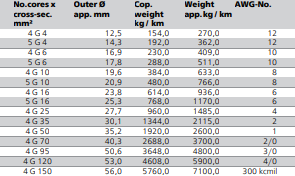
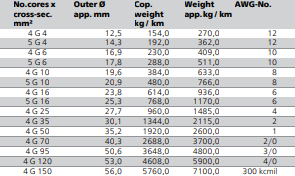
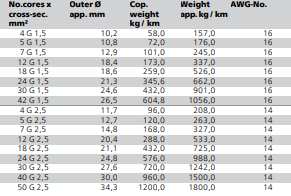
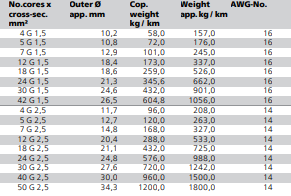
The cable is available in conductor cross-sections from 1.5 mm² up to 150 mm². It is important to note that AWG values listed in reference materials are only approximate equivalents—selection must always be based on the actual cross-sectional area in square millimetres to ensure correct current carrying capacity and mechanical performance. Standard core configurations include 4G, 5G, 7G, 12G, 18G, 24G, 30G, 42G, and 50G, with custom combinations available on request. Key physical values for common sizes are as follows:
4 x 1.5 mm²: outer diameter 10.2 mm, copper weight 58.0 kg/km, total weight 154.0 kg/km
5 x 1.5 mm²: outer diameter 10.8 mm, copper weight 72.0 kg/km, total weight 192.0 kg/km
4 x 2.5 mm²: outer diameter 11.7 mm, copper weight 96.0 kg/km, total weight 230.0 kg/km
4 x 10 mm²: outer diameter 19.6 mm, copper weight 384.0 kg/km, total weight 633.0 kg/km
4 x 50 mm²: outer diameter 35.2 mm, copper weight 1920.0 kg/km, total weight 2600.0 kg/km
4 x 150 mm²: outer diameter 56.0 mm, copper weight 4608.0 kg/km, total weight 7100.0 kg/km
Environmental and Mechanical Limits
Temperature performance is a critical factor across South Africa’s varied climate zones. When being flexed or reeled, TROMMPUR®-H operates reliably from -40°C to +80°C. For fixed installation where there is no repeated movement, the lower limit extends to -50°C, making it suitable for cold nights in the Free State as well as high summer temperatures in Limpopo. In terms of movement, it is rated for continuous travel speeds up to 250 metres per minute, with a maximum allowable acceleration of 0.4 metres per second squared. The minimum bending radius is six times the cable’s outer diameter, far tighter than most comparable trailing cables. The maximum permitted tensile stress during operation is 25 N/mm², and best practice requires keeping one to two full turns of cable remaining on the drum at all times to avoid stress concentration at the connection point.
Design Science: Why Its Structure and Materials Deliver Unmatched Performance
To understand why TROMMPUR®-H performs so much better than legacy rubber cables, we need to look past the specifications and examine how it is built, and why each choice was made. Every layer and material is selected to solve a specific problem that causes early failure in conventional designs.
Core Design Philosophy: Separation of Force and Conductivity
The biggest flaw in most standard trailing cables is that they ask a single component—the copper conductor—to do two very different jobs. Copper is an excellent electrical conductor, but it is not designed to carry heavy mechanical loads. When a cable is pulled, twisted, and bent thousands of times, the copper strands themselves take the strain, leading to work hardening, strand breakage, and eventually complete conductor failure. This is exactly what operators see when cables fail after just a year of use on mine sites.
TROMMPUR®-H is built around a completely different principle: the separation of electrical function and mechanical load-bearing. The copper conductors carry only current, while all significant tension, torsion, and bending forces are transferred to dedicated structural components within the cable. This is what we mean by a “mechanical-electrical-environmental” integrated design. Alongside this core idea, the structure is also optimised to be as compact as possible, to resist every type of environmental attack found on site, and to maintain consistent performance over years of heavy use.
Layer-by-Layer Construction, Materials and Engineering Principles
Starting from the centre and working outwards, every part of the cable serves a clear engineering purpose:
The innermost active components are the conductors themselves, made from bare copper wires stranded to DIN VDE 0295 Class 6, BS 6360 Class 6, and IEC 60228 Class 6 standards. These are drawn to an extra-fine diameter of 0.2 mm or less, then bundled together in large numbers. From an electrical standpoint, this gives the high conductivity needed to minimise power loss and heat build-up. From a mechanical standpoint, fine strands allow the conductor to bend smoothly without sharp stress points, so fatigue builds up much more slowly than in solid or coarsely stranded wires. Even with this flexibility, the conductors are never expected to carry the full weight of the cable.
Running right down the centre of the entire cable is a high-tensile strength support element made from a composite of polyester and aramid fibres. This is the most critical part of the load-bearing design. It carries more than 80 percent of all tensile and twisting forces applied to the cable during reeling and operation. This limits the elongation of the copper conductors to less than 0.2 percent, so they never stretch or pull apart under tension. It also holds the cable’s overall shape consistent, preventing individual cores from shifting or bunching up when the cable is twisted on the drum.
Each individual conductor is coated in a layer of thermoplastic elastomer, or TPE, formulated specifically for cable insulation. TPE is chosen over standard PVC or rubber because it offers a stable dielectric constant of around 2.5, meaning electrical fields remain consistent across all operating temperatures and voltage loads. It has a dielectric strength of at least 20 kV per millimetre, providing a reliable barrier between live cores and earth. Unlike many other insulation materials, this TPE stays flexible right down to -40°C, so it does not become brittle or crack when the cable is flexed in cold weather. It also bonds well to the copper surface, preventing delamination or voids that could lead to partial discharge over time.
Core identification follows DIN VDE 0293 standards: cables with up to five cores use solid colours, including a dedicated green-yellow earth core, while cables with six or more cores use a black base colour with continuous white numbering along the length of each core. This makes tracing and fault finding much faster on site, reducing the time needed for repairs or modifications.
The insulated cores are stranded around the central support element using a carefully calculated short pitch length. This arrangement allows the cores to slide slightly relative to one another when the cable bends, rather than being crushed or stretched. Over the cabled assembly goes a layer of polyester fleece wrapping, which holds the cores in position during manufacturing and installation, and prevents the outer sheath from abrading the insulation as the cable flexes.
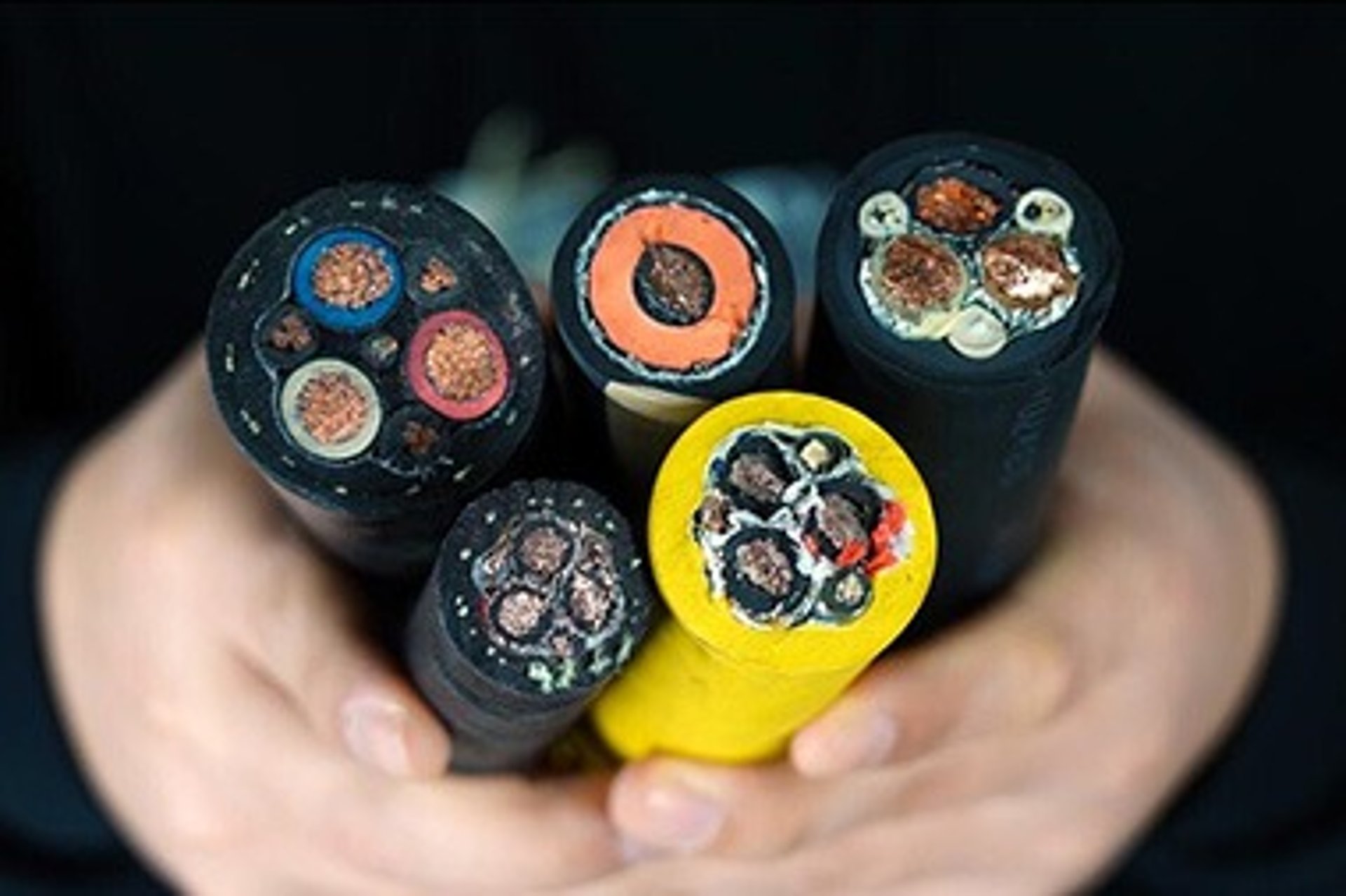
The final layer combines structural reinforcement and environmental protection in one system: a high-tensile polyester braid is embedded directly into a halogen-free polyurethane, or PUR, outer sheath, finished in a bright yellow colour for high visibility. The braid forms a flexible, continuous cage that resists twisting and distributes external pressure evenly around the cable’s circumference. The PUR sheath is selected for its exceptional abrasion resistance—far higher than chloroprene or ethylene-propylene rubber used in NSHTÖU cables—plus low surface adhesion that stops the cable from sticking to itself when wound tightly on the drum. It is also highly resistant to UV radiation, ozone, hydrolysis, microbial growth, diesel, hydraulic oil, grease, and petrol, making it ideal for open-air mine sites. Most importantly, it is completely halogen-free: if exposed to fire, it will not release hydrochloric or hydrobromic acid fumes that can damage underground equipment or endanger workers.
Why PUR and TPE Outperform Traditional Rubber
The shift from rubber to a PUR-TPE combination is not just a marketing choice—it is driven by material science fundamentals. Traditional rubber requires thick wall sections to achieve acceptable strength and chemical resistance, which adds bulk and weight. It also tends to stiffen significantly below -20°C, softens above 60°C, and degrades rapidly when exposed to the oils and moisture common in mining environments. PUR and TPE deliver equivalent or better performance with thinner walls, and their polymer structure can be tuned to resist exactly the range of chemicals and temperatures found in South African operations.
Performance Advantages: How It Stacks Up Against Legacy NSHTÖU Cables
The differences between TROMMPUR®-H and traditional NSHTÖU cables are not just on paper—they translate directly to how equipment operates and how much it costs to run.
On size and flexibility, TROMMPUR®-H has an outer diameter 15 to 30 percent smaller than an equivalent NSHTÖU cable. Its minimum bending radius of six times the diameter is also significantly tighter than the eight to ten times required for NSHTÖU. This means it can be used with smaller drum diameters, which reduces the overall size and cost of reeling systems and allows installation in tighter spaces. It is also 20 to 35 percent lighter for the same current rating, which lowers the load on drums, drive motors, and support structures, and reduces energy consumption during reeling.
In terms of speed and durability, TROMMPUR®-H is rated for continuous reeling speeds up to 250 metres per minute, compared to a typical limit of 120 metres per minute for NSHTÖU. This makes it suitable for faster cycle times on modern high-output cranes and conveyors. Its PUR sheath resists abrasion far better, so it survives longer when dragged over rough ground or passing across drum edges. It also stays flexible at much lower temperatures, so it does not jam or overload motors on cold winter mornings.
Most importantly, TROMMPUR®-H solves problems that standard cables cannot address. It eliminates the core breakage and jacket bursting that happens when tension and twisting act together on rubber cables. It removes the risk of jacket sticking that causes jerky movement and unexpected motor trips. And its halogen-free formulation meets the latest underground and enclosed space fire safety requirements, which many older rubber cables do not.
South African Mining Case Study: Real-World Cost and Reliability Gains
The benefits of TROMMPUR®-H are best illustrated by a real installation at a combined open-pit and underground platinum and coal operation in the North West province. This site operates stacker conveyors and shaft cranes in conditions typical of many South African mines: temperatures ranging from -5°C in winter to 45°C in summer, constant silica dust, regular high-pressure water spraying, frequent diesel and hydraulic oil leaks, and up to 200 reeling cycles per day.
Before switching, the site used NSHTÖU 4×50 mm² trailing cables. These cables required a minimum drum diameter of 500 mm and were driven by 7.5 kW motors, adding significant cost to the original equipment build. In service, the cables lasted only eight to twelve months before showing jacket cracking or broken conductors, leading to unplanned replacements and downtime. During winter months, the rubber would stiffen so much that reeling resistance increased sharply, regularly tripping motor overload protection and disrupting production.
The site replaced the NSHTÖU cables with TROMMPUR®-H 4×50 mm², which has an outer diameter of 35.2 mm compared to approximately 46 mm for the NSHTÖU equivalent. This allowed the site to downsize the drum to 350 mm diameter and reduce the drive motor rating to 5.5 kW, cutting the capital cost of the reeling system by around 18 percent.
After 24 months of continuous operation, the new cables showed no signs of conductor breakage or significant jacket wear, with a projected service life of 36 to 48 months. Reeling resistance dropped by roughly 25 percent, reducing energy consumption for reeling by 12 percent, and there were no further reports of cold-weather stiffening or motor tripping. The halogen-free construction also helped the site meet updated Mine Health and Safety Authority requirements for low-smoke, zero-halogen materials in critical power circuits.
While the upfront purchase price of TROMMPUR®-H is about 30 percent higher than NSHTÖU, the combination of longer service life, reduced maintenance, lower energy use, and smaller equipment costs results in a net saving of approximately 22 percent over a three-year period.
Suitable Applications and Operating Boundaries
TROMMPUR®-H is designed specifically for high-demand moving power applications, but it is not the right choice for every situation.
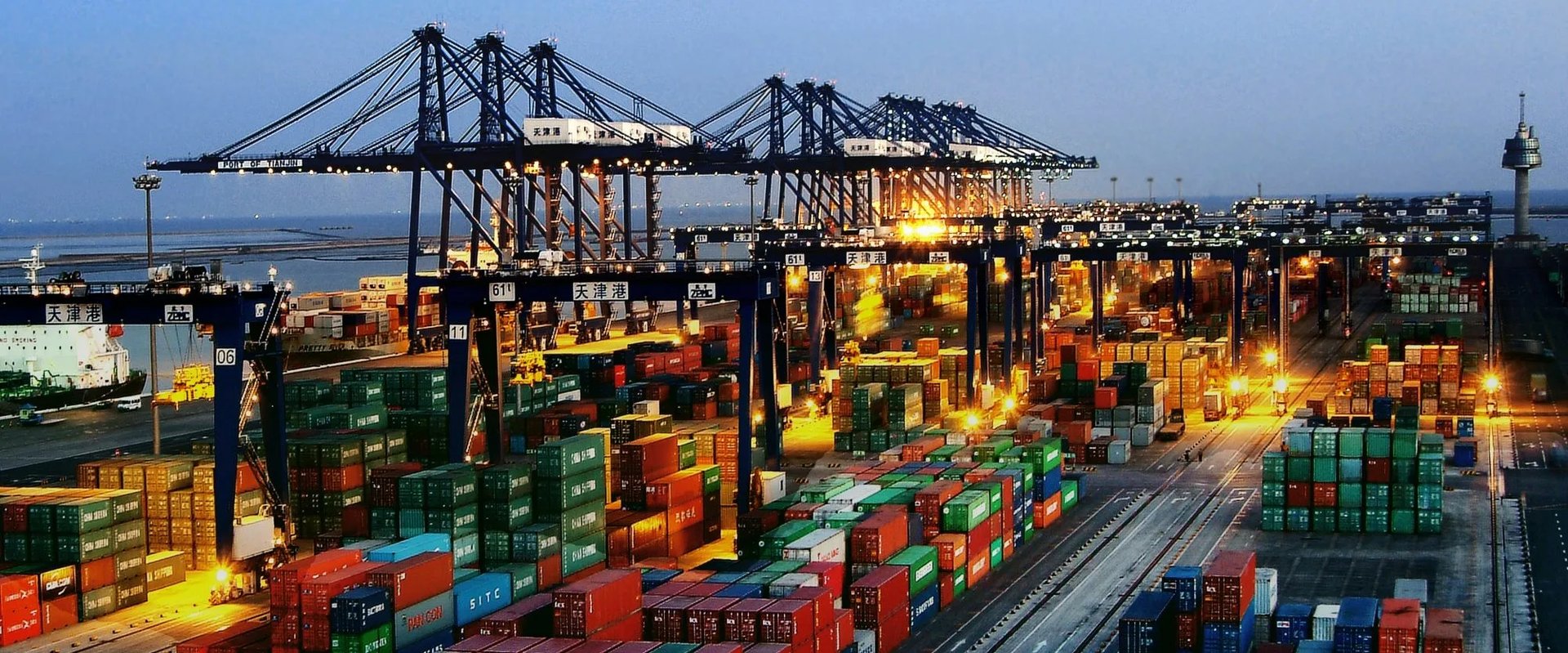
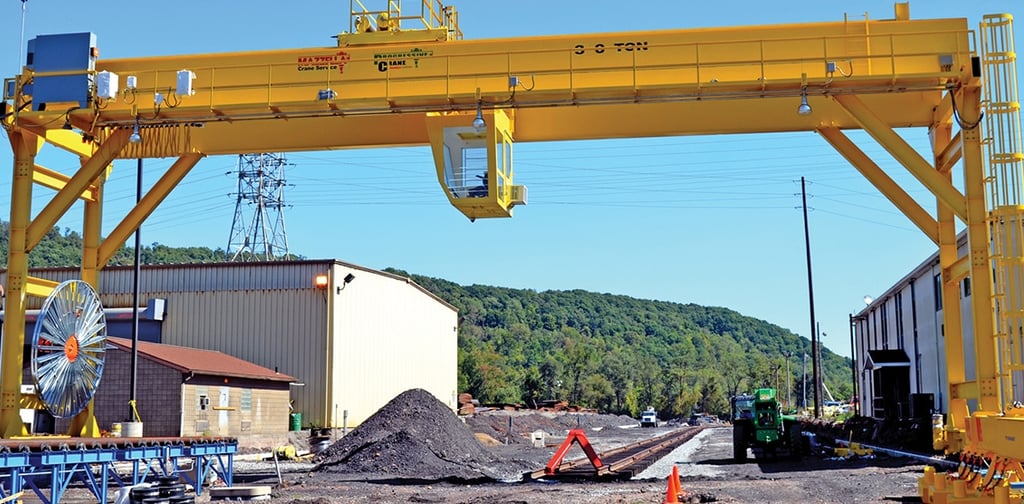
It is the preferred option for equipment that sees frequent reeling or winding, where cables face combined tension and torsion, and where high speed, low temperatures, oil exposure, or strict fire safety rules apply. This includes mine shaft hoists, draglines, stacker-reclaimers, port container cranes, overhead gantry cranes, high-speed telescopic conveyors, and railway traction equipment. It works reliably in dry, damp, fully wet, and outdoor conditions, making it suitable for every type of South African worksite.
There are situations where it is not the best choice. For permanently fixed cables with no movement, there is no benefit to the added structural features, and a standard fixed wiring cable will be more cost-effective. It should not be used where sustained tensile loads exceed 25 N/mm², or where it will be in direct contact with strong acids, alkalis, or harsh industrial chemicals that are not listed in the material resistance data.
Selection Guide and Best Practice Installation
To get the full performance and service life from TROMMPUR®-H, it is important to follow clear selection and installation rules.
Always select cables based on the actual cross-sectional area in square millimetres, not the AWG reference values listed in some summaries. Choose core counts that match your exact power, control, and earthing requirements, and remember that custom core configurations, additional shielding, or extra tensile reinforcement are available for specialised needs.
During installation and operation, never exceed the 25 N/mm² tensile stress limit or the 0.4 m/s² acceleration limit. Ensure the drum diameter is at least six times the cable’s outer diameter, and always keep one to two full turns of cable on the drum—this prevents stress from concentrating at the point where the cable connects to the drum terminal. Avoid routing the cable over sharp edges or tight reverse twists, and ensure any guide rollers are sized to match the cable’s minimum bending radius.
Equivalent Alternative: Feichun Cables Matched Solution
For projects where cost, delivery time, or local supply chain reliability are key considerations, Feichun Cables offers a fully equivalent trailing cable solution that matches TROMMPUR®-H in every technical respect.
Feichun’s equivalent cable meets all relevant standards including UL AWM Style 20235, CSA/AWM, DIN VDE, and IEC requirements, with identical PUR-TPE construction, central strength member, halogen-free formulation, bending radius, and weight characteristics. It offers the same mechanical durability, chemical resistance, and low-temperature performance. For buyers in Southern Africa, it typically provides shorter lead times than European imports, competitive pricing, and the flexibility to produce custom sizes or core combinations to match local project schedules. It is a proven alternative for tender projects, bulk orders, and sites looking to diversify their supply base without compromising on performance.
Frequently Asked Questions
Does TROMMPUR®-H meet South African mine safety standards?
Yes, it meets all relevant Mine Health and Safety Authority requirements for low-voltage power cables, and its halogen-free low-smoke construction complies with the latest underground and enclosed space fire safety regulations.
Can it be used underground as well as in open-pit operations?
It is fully suitable for both, provided it is selected and installed within its stated operating limits.
How does it perform in contact with mine water or process water?
The PUR sheath is highly resistant to hydrolysis and microbial attack, so it performs reliably in damp or wet conditions, including exposure to typical mine service water. It should not be used in water with high concentrations of strong chemicals or heavy metals without additional compatibility testing.
What is the expected service life compared to NSHTÖU?
In equivalent heavy-duty applications, TROMMPUR®-H typically lasts three to four times longer than NSHTÖU, with most site installations showing service lives of three to four years under continuous use.
Can I use my existing drums and motors when upgrading?
In most cases, yes—its smaller size and lighter weight mean it will fit existing drums and place lower load on motors, rather than requiring upgrades.
Are spare parts and replacement stock readily available in South Africa?
Both HELUKABEL and Feichun Cables maintain supply chains into Southern Africa, with standard sizes available on reasonable lead times.
Final Summary
TROMMPUR®-H represents a major step forward in trailing cable design, built on the simple but powerful idea that moving cables need to separate electrical work from mechanical work. By combining a central strength member, TPE insulation, and a reinforced PUR sheath, it delivers smaller dimensions, lighter weight, and far greater durability than legacy rubber cables, with proven cost and reliability benefits in South African mining and crane applications. Its full value is only realised when it is selected correctly and installed according to its design limits.
If you would like to request full datasheets, sample lengths, or pricing for TROMMPUR®-H or the equivalent Feichun Cables solution, please contact the Feichun team directly at Li.wang@feichuncables.com.


Email Address: Li.wang@feichuncables.com
© 2025. All rights reserved.
One-click to Quickly Contact
Products
Contact
Company
Location:
Building A Private Science and Technology Park, Hefei Economic and Technological Development Zone, Anhui Province, China
Heat Resistant Cable
WhatsApp: +86 17333223430
Social Media: