Anhui Feichun Special Cable Co.,Ltd Email: Li.wang@feichuncables.com
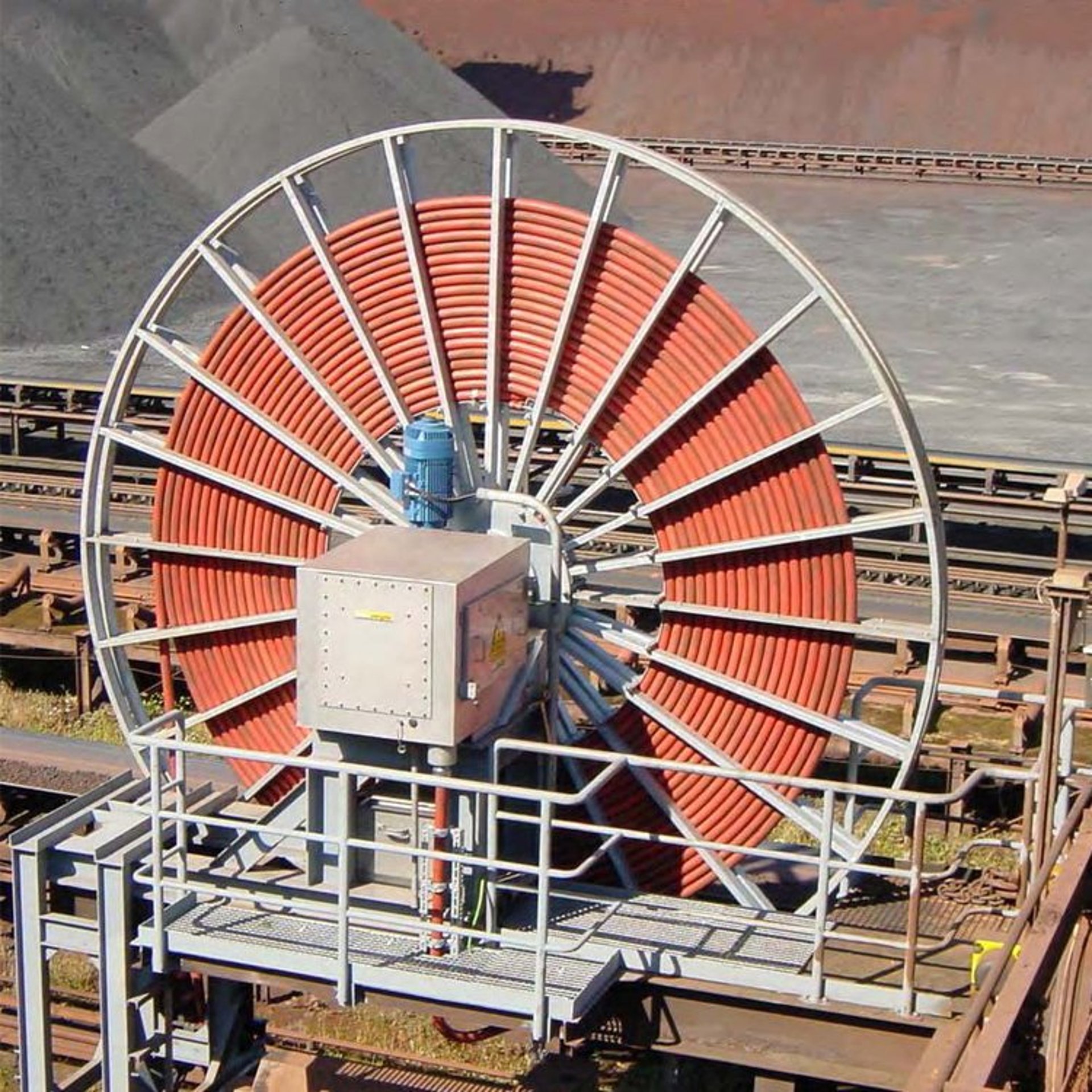
TRATOSFLEX-ES3-FO® & TRATOSGREEN-ES3-FO® Medium Voltage Reeling Cables: Reduced Weight, Extruded Screening & Low-Halogen Options for Durban & Cape Town Terminals
Engineered for high-speed reeling, monospiral end-feed and harsh industrial environments across Southern Africa: TRATOSFLEX-ES3-FO® delivers extruded semiconductive screening, compact dimensions and integrated fibre optics, while TRATOSGREEN-ES3-FO® adds low-halogen, low-toxicity performance. Fully compliant with VDE 0250 Part 813, HD 620 S1 and SABS standards – proven for Durban, Cape Town and Ngqura port automation, plus platinum, chrome and iron ore mining operations. A trusted alternative is available from Feichun Cables, with matching performance, competitive pricing and shorter lead times for local projects.
Li.Wang
7/23/202615 min read
Introduction
South Africa’s industrial landscape is undergoing rapid modernisation. Ports like Durban, Cape Town and Ngqura are rolling out their “Smart Port 2030” strategies, targeting faster container handling, remote monitoring and fully automated terminal operations. In mining, the platinum, chrome and iron ore sectors are investing heavily in larger, more efficient stackers, reclaimers and shovels that operate around the clock in extreme heat, dust and corrosive conditions. In every one of these sites, medium voltage reeling cables are the critical link that powers equipment and carries control data – yet they are often the most overlooked point of failure.
Standard medium voltage cables designed for fixed installation are routinely pressed into service on reeling systems, only to develop faults within months. Taped screens shift and lift under repeated bending, XLPE insulation cracks from fatigue, separate power and data cables snag or tangle, and accumulated torsion snaps cores deep inside the cable. Unplanned downtime from cable failure can cost a port or mine hundreds of thousands of rand per day in lost production, emergency repairs and delayed shipments. In remote mining regions, the cost of sending technicians and replacement parts to site makes these failures even more expensive.
This is where TRATOSFLEX-ES3-FO® and TRATOSGREEN-ES3-FO® stand apart. These are not standard cables adapted for dynamic use – they are purpose-built medium voltage reeling cables designed from the ground up for monospiral end-feed applications, high operating speeds and integrated fibre optic communication. Developed to meet VDE 0250 Part 813 and HD 620 S1 standards, they combine advanced material science, precision structural engineering and integrated design to solve the exact problems that plague conventional cables in moving applications. With over 300 successful installations at ports worldwide, and a design that balances strength, flexibility and compact size, they have become a benchmark for reliable power and data delivery in the most demanding environments.
TRATOSFLEX-ES3-FO® is the core variant, featuring extruded semiconductive screening, reduced overall weight and diameter, and built-in fibre optics for end-feed reeling systems. TRATOSGREEN-ES3-FO® matches every electrical and mechanical performance characteristic, but replaces standard outer sheath materials with low-smoke, zero-halogen compounds that produce minimal toxic or corrosive gas in the event of fire – ideal for enclosed spaces, underground workings and locations with strict environmental or safety regulations. Both versions are engineered to outlast and outperform standard alternatives, while lowering total cost of ownership over the full service life of the cable.
Product Overview & Core Technical Specifications
What Are These Cables?
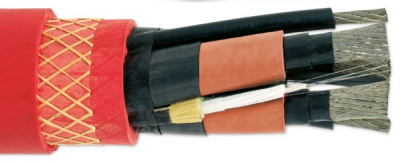
TRATOSFLEX-ES3-FO® and TRATOSGREEN-ES3-FO® are medium voltage flexible reeling cables, designated under the standard designation (N)TSCGEWÖU+LWL. The “ES3” designation refers to the third generation of extruded screen design, while “FO” indicates integrated fibre optic elements. The “LWL” marking follows German terminology for light wave conductors, confirming the combined power and data capability.
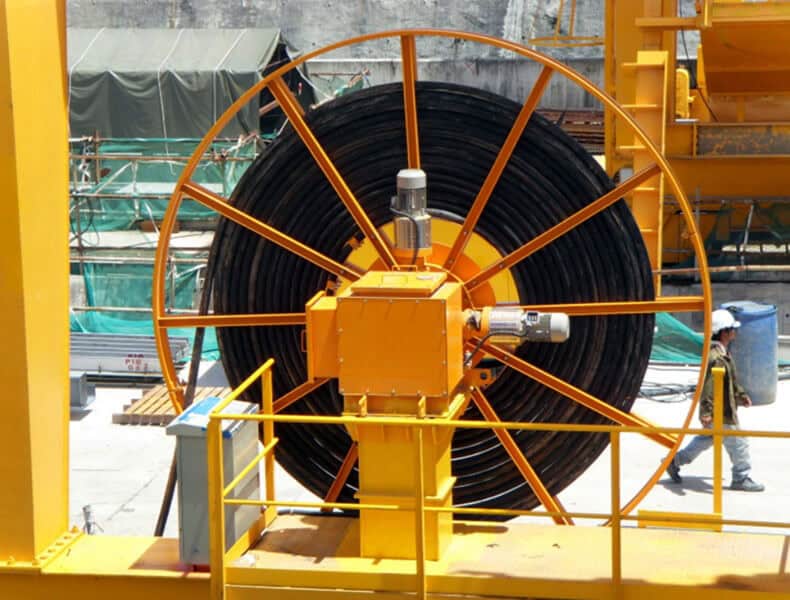
TRATOSFLEX-ES3-FO® is optimised for dynamic reeling duty, with an extruded semiconductive screen that eliminates the weaknesses of taped copper screens, a compact construction that cuts both weight and diameter, and optical fibres embedded directly into the cable structure. It is designed specifically for monospiral end-feed reeling – the most demanding configuration found on modern ship-to-shore cranes and automated straddle carriers, where the cable is wound from one end of the drum rather than the centre, creating constant twisting forces that standard cables cannot withstand.
TRATOSGREEN-ES3-FO® is the low-environmental-impact variant, with identical electrical performance, mechanical strength and operating limits, but formulated to emit very low levels of halogen gas and toxic smoke when exposed to fire. Its toxicity index measures less than 5 on finished cable, well below international and South African safety thresholds, making it the preferred choice for enclosed terminals, underground mining operations, power stations and smelters where fire safety and personnel protection are top priorities.
Compliance & Standards
Every design choice and material specification is aligned with globally recognised standards, ensuring consistent performance and regulatory acceptance across international and local projects:
VDE 0250 Part 813: The primary German standard for medium voltage flexible cables intended for moving and reeling applications, defining mechanical endurance, flexibility and voltage ratings specifically for dynamic duty.
HD 620 S1 / S2: European harmonised specifications that align performance requirements across member states, ensuring interchangeability and compliance for cross-border projects.
VDE 0295 & EN 60228: Define conductor stranding classes and electrical properties; the conductors in these cables exceed the requirements for Class 5 flexibility, delivering superior resistance to bending fatigue.
VDE 0472 Part 512: Governs the measurement of screen resistance, requiring a maximum resistance of 500 ohms between the ground conductor and the outer semiconductive layer of each phase – a critical control for maintaining uniform electric fields and preventing partial discharge.
ITU-T G.651: Applies to the standard 62.5/125μm multi-mode optical fibres integrated into the cable; 50/125μm multi-mode and E9/125μm single-mode fibres are also available to suit specific communication needs.
Local alignment: The cables meet the performance criteria set out by the South African Bureau of Standards (SABS), align with IEC international standards, and satisfy the requirements of the Mine Health and Safety Act and port authority safety regulations. TRATOSGREEN-ES3-FO® in particular meets the most stringent local fire safety codes for enclosed and occupied spaces.
Full Technical Parameter Set
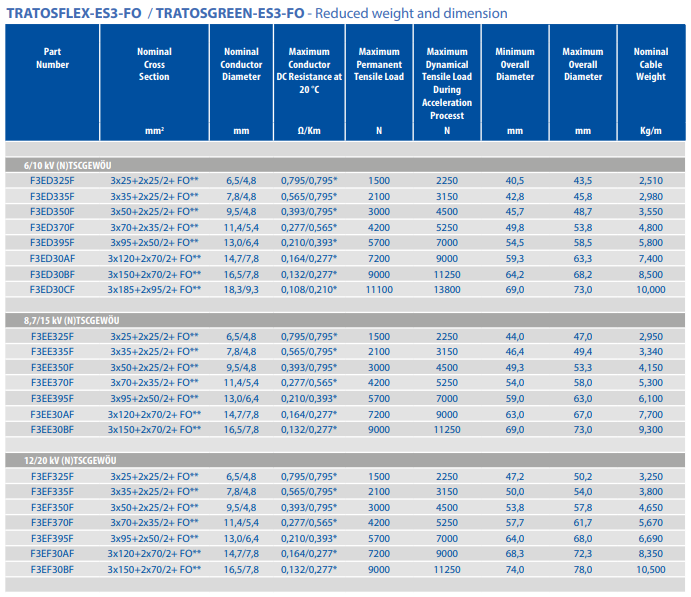
All specifications below are taken directly from the official June 2020 datasheet, with values confirmed for every rated voltage class:
Temperature performance is consistent across all voltage classes:
Up to +80°C for fixed installation conditions
-35°C to +80°C for continuous dynamic operation, including repeated flexing and reeling
Mechanical performance is tailored to the high-speed demands of modern equipment:
Maximum operating speed: 200 metres per minute for monospiral end-feed reeling
Permanent tensile load: 1,500 N for the smallest cross-section, rising to 11,100 N for 3x185mm² cables
Dynamic tensile load during acceleration: 2,250 N for the smallest cross-section, rising to 13,800 N for 3x185mm² cables
Standard conductor configurations range from 3x25mm² up to 3x185mm² phase cores, paired with parallel-connected protective earth conductors sized from 2x25/2mm² up to 2x95/2mm². Optical fibre units are integrated into every cable, with a standard offering of 62.5/125μm multi-mode fibres; custom configurations with between 6 and 24 fibres, or alternative fibre types, can be supplied on request. Cables rated for 18/30 kV and above are also available as custom builds.
Full dimensional and weight data is provided for every part number, with nominal outer diameters ranging from 40.5mm for the smallest 6/10kV cable up to 78.0mm for the largest 12/20kV variant. Nominal weight ranges from 2.510 kg/m up to 10.500 kg/m, with DC resistance values at 20°C strictly controlled to meet or exceed standard limits.
Construction, Materials & Engineering Science
Layer-by-Layer Breakdown (Inside to Outside)
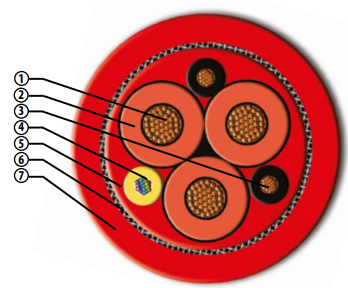
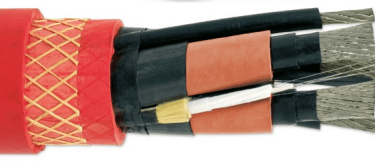
Every layer of the cable is selected and engineered to work as a single integrated system, rather than as separate components stacked together:
Conductor: Made from extremely fine stranded tinned copper, with a stranding profile that exceeds the flexibility requirements of VDE 0295 Class 5. The fine stranding distributes bending stress across thousands of individual wires rather than a small number of larger strands, drastically reducing fatigue and breakage. Tin plating prevents oxidation at strand surfaces and terminations, maintaining stable electrical resistance over decades of use.
Insulation system: A three-layer co-extruded structure consisting of an inner semiconductive layer, the main insulation compound TRATOSFLEX-ES3-I® – a high-modulus ethylene propylene rubber (HEPR) – and an outer semiconductive layer. HEPR is chosen over standard EPR or XLPE because it retains excellent electrical properties while offering far better resistance to mechanical stress, abrasion and heat. The dual semiconductive layers form a seamless interface between the conductor and insulation, eliminating tiny air gaps that would otherwise become sites for partial discharge.
Earth conductor: Stranded copper conductors covered with their own semiconductive layer. This ensures continuous electrical contact with the outer semiconductive layer of the phase cores, maintaining the required maximum resistance of 500 ohms and creating a uniform equipotential surface that contains the electric field entirely within the insulation system.
Fibre optic unit: Loose-tube optical fibres protected by aramid strength members and a durable buffer layer. This design isolates the fibres from compressive and tensile forces acting on the power cores, preventing signal loss or breakage even when the cable is bent tightly or pulled under load. Because fibre optic signals are immune to electromagnetic interference, data transmission remains reliable even when the cable runs alongside high-current power lines or operates near variable-frequency drive equipment.
Inner sheath: Formulated from TRATOSFLEX-ES3-IS®, a premium elastomer compound that exceeds the performance requirements of the GM1b standard. This layer bonds the insulated cores, earth conductors and fibre unit into a single solid assembly, preventing internal components from shifting, rubbing or separating during repeated reeling and twisting. It also acts as a barrier against moisture and chemical ingress.
Anti-torsion protection: A high-strength composite braid designed to distribute and neutralise twisting forces generated during end-feed reeling. On standard cables, these forces accumulate with every rotation of the drum, eventually shearing cores or peeling screens away from the insulation. This braid allows the cable to flex without transmitting torque to the internal components, preserving the integrity of the electrical and optical elements.
Outer sheath: TRATOSFLEX-ES3-OS® – a specially formulated polychloroprene rubber rated to 5GM3 or 5GM5 performance levels – is used for the standard variant. This material offers exceptional resistance to ozone, ultraviolet radiation, mineral oils, greases and moisture, while remaining flexible across the full operating temperature range. For TRATOSGREEN-ES3-FO®, the sheath is replaced with a low-smoke, zero-halogen elastomer that matches all mechanical and thermal properties, but produces no corrosive halogen gases and very low smoke density when exposed to fire.
Why This Design? Engineering Principles Explained
Every element of the construction follows well-established principles of electrical engineering, materials science and mechanical design, tailored specifically for dynamic reeling duty:
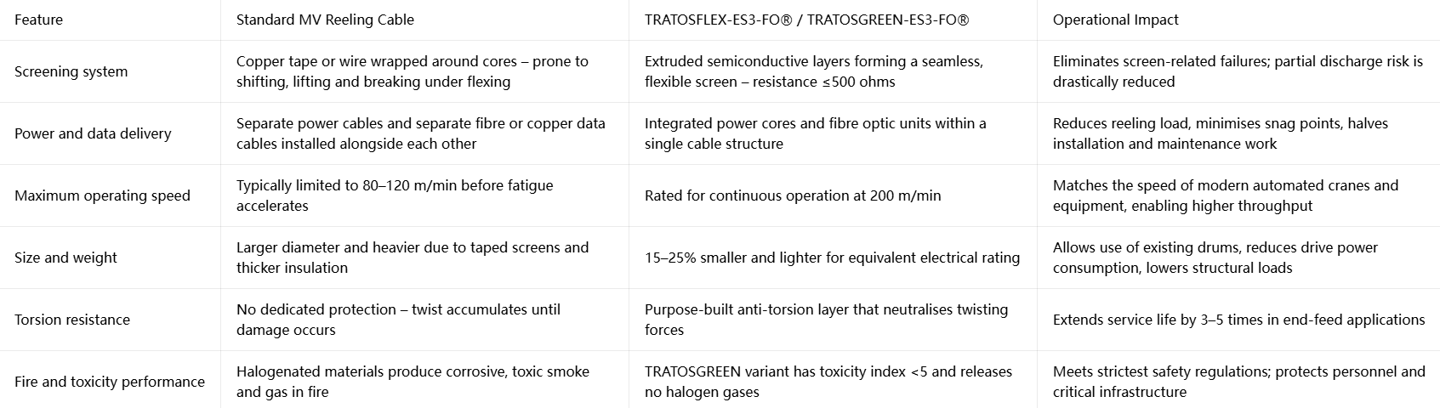
From an electrical perspective, the extruded semiconductive screening system is the most critical difference from standard cables. When voltage is applied to a conductor, the electric field concentrates at any irregularity or air gap between the conductor and insulation. Taped copper screens create unavoidable gaps and uneven surfaces that become sites for partial discharge – a slow, damaging breakdown of the insulation that eventually leads to catastrophic failure. The co-extruded semiconductive layers form a perfectly smooth interface that distributes the electric field evenly across the entire surface of the insulation. By limiting the maximum screen resistance to 500 ohms, the design ensures any fault current is safely conducted to earth, while preventing the build-up of potential differences that could degrade performance.
Mechanically, the entire structure is built around the principle of matched flexibility. If one layer is stiffer or more flexible than the layers around it, movement during reeling will cause shear forces that separate components or wear them away from the inside out. The conductor stranding, insulation, sheath materials and anti-torsion layer are all selected to bend and stretch in unison, minimising internal stress. The anti-torsion braid operates on the principle of torque dissipation – rather than resisting twist entirely, it allows controlled rotation of the outer sheath while preventing that torque from reaching the sensitive cores and fibres. This is essential for end-feed reeling, where every wrap of the cable introduces a small amount of twist that accumulates over time.
Materials science plays a central role in the compact, lightweight design. HEPR insulation has excellent dielectric strength and heat resistance, but it is also mechanically tough enough to allow thinner wall thicknesses without compromising performance. This reduction in wall thickness, combined with the elimination of bulky taped copper screens, cuts the overall diameter by between 15% and 25% compared to conventional equivalents. A smaller, lighter cable places less load on the reeling drum, reduces the power required to drive the system, and allows use of smaller drums on existing equipment without expensive structural modifications.
For TRATOSGREEN-ES3-FO®, the material science extends to fire safety. Halogenated rubbers release hydrochloric and hydrobromic acid when burned – corrosive gases that damage sensitive electronics, destroy cabling infrastructure and pose a severe risk to personnel. The low-halogen formulation eliminates this hazard entirely, while the low-toxicity rating ensures that even in the event of a major fire, the volume of harmful smoke produced is kept to a minimum. This is achieved without sacrificing any of the mechanical or electrical performance that defines the standard variant.
Performance Advantage vs Standard MV Cables
Common Failures in Standard Designs
Most medium voltage cables used on reeling systems are designed for fixed installation, and their failure modes are predictable and well-documented. Taped copper screens slide or tear away from the insulation after thousands of bending cycles, breaking the electrical field containment and leading to partial discharge. Cross-linked polyethylene insulation is rigid and brittle under repeated flexing, developing micro-cracks that allow moisture and contaminants to penetrate. Separate power and data cables are often bundled together, doubling the load on the reeling drum and increasing the risk of snagging or entanglement. There is no provision for managing torsion, so cumulative twist eventually snaps conductors or tears the cable apart from the inside. Excess weight places extra strain on motors, bearings and structural components, increasing maintenance costs and shortening equipment life.
Differentiators – Why This Cable Solves What Others Cannot
The differences between TRATOSFLEX-ES3-FO® / TRATOSGREEN-ES3-FO® and standard alternatives are not just incremental improvements – they address the root causes of failure in dynamic reeling applications:
These advantages translate directly to measurable operational benefits. Ports and mines report fewer emergency call-outs, longer intervals between scheduled replacements, and significantly lower unplanned downtime. For automated systems, the integrated fibre optic link ensures consistent, interference-free data transmission that supports remote monitoring, predictive maintenance and real-time control – capabilities that are increasingly essential as South Africa moves toward Industry 4.0 standards.
Application – Fit for South Africa’s Ports & Mines
Port Automation – Durban, Cape Town & Ngqura
South Africa’s three major commercial ports are undergoing a multi-billion-rand modernisation drive as part of the National Infrastructure Plan and Smart Port 2030 initiative. The goal is to increase container throughput by 30% or more over the next decade, largely through the introduction of faster ship-to-shore cranes, automated straddle carriers and remote-controlled yard equipment.
These new systems demand cables that can keep pace. A modern STS crane can travel at speeds of up to 200 metres per minute during trolley movement, placing extreme dynamic loads on reeling cables. The integrated fibre optic capability of TRATOSFLEX-ES3-FO® supports the high-speed data links required for crane management systems, PLC control, CCTV monitoring and container tracking – all essential for fully automated operation. The compact size allows retrofitting to existing crane reels without costly modifications, while the proven resistance to torsion eliminates the most common cause of premature cable failure on end-feed systems.
Port terminals located in coastal areas also face high levels of salt spray, ultraviolet radiation and humidity – conditions that degrade standard cable sheaths rapidly. The polychloroprene sheath of TRATOSFLEX-ES3-FO® is formulated to resist all these environmental factors, maintaining its integrity even after years of exposure. For enclosed terminal buildings, underground conveyors or storage areas, TRATOSGREEN-ES3-FO® provides the additional assurance of low-toxicity fire performance, meeting all port authority and occupational health requirements.
Mining & Heavy Industry – Limpopo, North West & Mpumalanga
South Africa is the world’s largest producer of platinum, chrome and manganese, and a major exporter of iron ore. The open-pit and underground mines that produce these commodities operate in some of the harshest conditions imaginable: ambient temperatures ranging from freezing in winter to well above 40°C in summer, fine abrasive dust that penetrates every gap, and water containing dissolved minerals that accelerate corrosion.
Stackers, reclaimers and bucket-wheel excavators used in ore handling rely on long-travel reeling systems that often operate in end-feed configuration. Standard cables typically fail within six to twelve months under these conditions, requiring expensive shutdowns and maintenance visits that can take days to complete in remote locations. TRATOSFLEX-ES3-FO® has been shown to deliver service lives of five years or more in comparable applications elsewhere in the world, significantly reducing the frequency of replacements and the associated logistics costs.
Underground mining operations place a premium on fire safety. Any fire involving electrical equipment can generate large volumes of smoke and gas that spread rapidly through tunnels, creating life-threatening conditions. TRATOSGREEN-ES3-FO® addresses this concern directly, producing minimal smoke and no corrosive halogen gas when burned. It meets the strict requirements of the Mine Health and Safety Act for underground electrical installations, while retaining all the mechanical and electrical performance needed for continuous heavy-duty operation.
Power Generation & Metals
Power stations, smelters and steel mills across South Africa use reeling cables on overhead cranes, ladle transfer cars and material handling equipment. These facilities often operate in confined spaces with high personnel presence, making fire safety a top priority. TRATOSGREEN-ES3-FO® is increasingly specified for these applications, offering a single solution that combines reliable medium voltage power delivery, high mechanical endurance and compliance with the most stringent fire safety regulations.
Measurable Value for South African Operators
The benefits of choosing these cables extend far beyond longer service life:
Lower total cost of ownership: While the upfront purchase price may be slightly higher than standard alternatives, the combination of fewer replacements, reduced downtime and lower energy consumption results in significantly lower costs over the full life of the installation.
Regulatory compliance: The design aligns with international standards and local safety codes, reducing the risk of non-compliance fines or shutdowns during regulatory inspections.
Future-proofing: The integrated fibre optic infrastructure supports upgrades to automation, remote monitoring and predictive maintenance systems without requiring complete cable replacement.
Supply chain reliability: Alternative sources like Feichun Cables ensure consistent availability and shorter lead times, eliminating delays caused by long international supply chains.
Equivalent Solution – Feichun Cables TRATOSFLEX‑ES3‑FO® / TRATOSGREEN‑ES3‑FO®
Feichun Cables produces a fully equivalent range of TRATOSFLEX-ES3-FO® and TRATOSGREEN-ES3-FO® cables that match the original specification in every critical respect. All electrical parameters – including voltage ratings, DC resistance, screen resistance and dielectric performance – are identical. Mechanical properties such as tensile strength, flexibility, temperature range and speed rating meet or exceed the requirements of VDE 0250 Part 813 and HD 620 S1. Dimensional tolerances are matched exactly, allowing direct drop-in replacement without any changes to terminations, reels or equipment.
Beyond performance equivalence, the Feichun range offers practical advantages for South African buyers:
Competitive pricing: Manufacturing efficiencies and direct supply models allow for more favourable pricing without compromising quality or specification.
Shorter lead times: Local stock holding and streamlined production schedules mean cables can be delivered to site weeks or months faster than importing from overseas.
Local technical support: Engineering teams familiar with Southern African conditions are available to assist with selection, sizing and installation guidance.
Full certification: Every cable is supplied with complete test reports and compliance documentation, including alignment with SABS and IEC standards.
For procurement teams, this means access to a proven, high-performance solution that delivers all the benefits of the original design, with the added assurance of more responsive supply and support.
Selection Guide & Best Practices
Choosing the right cable starts with matching the design to the specific operating conditions of the application:
Primary application: Select TRATOSFLEX-ES3-FO® for monospiral end-feed reeling systems, speeds up to 200 m/min and general industrial use. Select TRATOSGREEN-ES3-FO® for enclosed spaces, underground workings, public areas or any location where fire safety and low-toxicity performance are mandated.
Voltage rating: Match the rated voltage to the system operating voltage, including any allowance for voltage fluctuations. For example, an 11 kV system should use 12/20 kV rated cable to provide adequate margin.
Conductor size: Calculate required cross-section based on three factors – current carrying capacity, maximum allowable voltage drop and maximum tensile load. In reeling applications, mechanical loading is often the limiting factor rather than electrical capacity.
Fibre requirements: Confirm the number and type of fibres required with the automation or control system supplier. Standard 62.5/125μm multi-mode fibres are suitable for most short-range control and telemetry applications; single-mode fibres are available for longer distances.
Installation limits: Always observe minimum bend radii and maximum pulling tensions specified on the datasheet. Avoid sharp bends, kinks or damage to the outer sheath during installation, as these can compromise long-term performance.
Frequently Asked Questions
Is extruded semiconductive screening as effective as copper tape or wire screening?
Yes – and in dynamic applications it is significantly more effective. Copper tape and wire screens rely on physical contact between overlapping elements, which is easily disrupted by movement. Extruded semiconductive screening forms a continuous, permanent interface that maintains its electrical properties no matter how many times the cable is bent or twisted. The maximum resistance limit of 500 ohms ensures full compliance with screening performance requirements.
Can these cables be used on centre-wound reels?
They are optimised for end-feed reeling, but they can also be used on centre-wound systems. In these cases, maximum operating speed should be reduced to match the lower torsion levels experienced, but all other performance characteristics remain unchanged.
What is the typical service life compared to standard cables?
In identical reeling applications, TRATOSFLEX-ES3-FO® and TRATOSGREEN-ES3-FO® typically deliver three to five times longer service life than standard medium voltage cables. In some cases, where torsion and fatigue are the primary failure modes, service life can extend to ten times longer.
Can custom fibre configurations be supplied?
Yes – between 6 and 24 optical fibres can be integrated into the cable, with a choice of multi-mode or single-mode types to suit specific data transmission requirements. Specialised fibre coatings or buffer designs can also be specified on request.
Does TRATOSGREEN-ES3-FO® cost significantly more than the standard variant?
There is a small premium in raw material cost, but this is usually offset by reduced fire protection requirements, lower insurance premiums and compliance with safety regulations. Over the full service life, total cost of ownership is often comparable or lower.
Conclusion
TRATOSFLEX-ES3-FO® and TRATOSGREEN-ES3-FO® represent far more than just another type of power cable. They are the result of a deliberate, integrated engineering approach that addresses the specific combination of electrical, mechanical and environmental challenges found in dynamic reeling applications. The core value lies not in any single feature, but in the way every element – from conductor stranding to sheath formulation – works together to solve the problems that have long limited the performance of standard cables.
For South Africa’s ports, mines and heavy industries, these cables offer a way to modernise operations without compromising reliability or safety. They support the higher speeds and greater automation required to compete in global markets, while meeting the strictest local and international standards. The availability of equivalent supply from Feichun Cables ensures that these advanced capabilities are accessible to all projects, with the assurance of reliable delivery and local support.
As the country continues to implement its industrial modernisation plans, the importance of robust, fit-for-purpose infrastructure will only grow. These cables are not just a component in the power delivery system – they are a critical foundation for safe, efficient and profitable operation for years to come.
If you would like to specify these cables for your project or request a full datasheet and quotation, contact the Feichun engineering team directly:
Email Address: Li.wang@feichuncables.com
© 2025. All rights reserved.
One-click to Quickly Contact
Products
Contact
Company
Location:
Building A Private Science and Technology Park, Hefei Economic and Technological Development Zone, Anhui Province, China
Heat Resistant Cable
WhatsApp: +86 17333223430
Social Media: