Anhui Feichun Special Cable Co.,Ltd Email: Li.wang@feichuncables.com
TRATOSFESTOON® Low Voltage Power and Control Cables: Advanced Festoon Solutions for South African Ports and Heavy Industry – Reduced Dimension, High-Flex Design & 5GM3 Durability
TRATOSFESTOON® festoon cables combine reduced outer diameter, Class 5 tinned copper conductors, EPR-grade insulation and 5GM3 heavy-duty sheathing for crane, port and mining equipment. Built for 240 m/min travel speeds, -40°C to +80°C operation and South Africa’s harsh UV, salt spray and abrasive dust conditions. Full technical specifications, local project case studies, equivalent alternatives and practical selection guidance included.
Li.Wang
7/22/202615 min read
Introduction
South Africa’s ports and mining sector form the backbone of regional trade and resource development, with terminals at Durban, Richards Bay and Saldanha Bay handling millions of tons of cargo annually, and mines across the Northern Cape, Limpopo and Mpumalanga supplying global markets with iron ore, coal, platinum and manganese. Every movement of containers, bulk minerals and heavy materials depends on continuous, reliable power and control for cranes, stacker-reclaimers, ship loaders and haulage systems. At the centre of this network are festoon systems—the suspended trolley-guided tracks that carry cables to moving equipment—and the cables themselves are the lifeline that keeps operations running.
For decades, operators have faced persistent and costly problems with standard festoon cables. In coastal terminals, cables often develop sheath cracking after just three or four years due to constant exposure to salt spray and intense ultraviolet radiation. In inland mining regions, wide temperature swings from freezing winter nights to scorching summer days cause ordinary materials to harden, become brittle and split under repeated bending. Frequent high-speed movement twists conductors out of alignment, leading to core breakage or short circuits, while oversized cable diameters jam festoon trolleys and add unnecessary load to support structures. For remote sites, even a single unplanned shutdown can cost millions of rand in lost production, plus the expense of deploying maintenance teams over long distances.
TRATOSFESTOON® is a purpose-built solution designed specifically to address these exact pain points. As a dedicated member of the TRATOSFLEX® family of low-voltage flexible cables, it is engineered exclusively for dynamic festoon applications rather than adapted from general-purpose designs. Its core strengths lie in three interconnected innovations: a reduced outer diameter that fits tighter tracks and lowers system load, proprietary high-performance polymer compounds that resist weather and mechanical stress, and a layered structural layout that balances flexibility with exceptional tensile and torsional strength. Tested and proven in over 300 ports and industrial sites worldwide, it has emerged as a reliable choice for South African conditions, where harsh environments and demanding operating cycles push standard cables beyond their limits.
This article explores the engineering principles, material science and real-world performance of TRATOSFESTOON®, drawing on official datasheet Rev.47 (June 2020) and verified local project results. It explains why every layer is designed the way it is, how it solves common failure modes, and how it compares to standard alternatives. It also covers full technical specifications, selection guidance, equivalent options from Feichun Cables, and practical answers to questions frequently asked by South African engineers and procurement teams.
What Is TRATOSFESTOON®? Core Definition and Purpose
TRATOSFESTOON® is a compact, high-flexibility low-voltage power and control cable built exclusively for festoon systems—where cables hang in loops and move back and forth with trolleys along fixed tracks. Unlike general-purpose flexible cables or trailing cables designed for reeling, it is optimised for the specific combination of repeated bending, torsional twisting, suspended tension and high travel speeds that define festoon operation. It carries a rated voltage of 0.6/1 kV, making it suitable for both main power supply and low-level control signals on the same run.
Its development began with three clear design pillars that distinguish it from standard products on the market. The first is reduced dimension: by using thinner yet stronger insulation and sheath materials and tighter internal stranding, the outer diameter is typically 10 to 15 percent smaller than equivalent standard cables, while maintaining full electrical and mechanical ratings. This is critical because many existing festoon tracks were designed in earlier decades with narrower clearances, and modern larger cables simply do not fit or drag excessively as they move. The second pillar is specialised compound materials, formulated to resist the exact environmental and mechanical stresses found in ports and mines. The third is layered structural protection, which eliminates the common trade-off between flexibility and strength—where one property usually comes at the cost of the other.
What sets TRATOSFESTOON® apart most clearly is its ability to solve the failures that standard cables cannot address. Ordinary cables rely on simple two-layer construction—insulation plus a single sheath—using generic PVC or basic rubber compounds. These materials suffer from fatigue under high-cycle bending, degrade rapidly under UV and salt exposure, and offer little resistance to torsional forces that twist cores out of place. TRATOSFESTOON® addresses these issues through a three-layer protective system, advanced polymer science and precision internal geometry.
The design philosophy rests on three core principles: material upgrade, structural innovation and 工况适配 —application-specific adaptation. By replacing generic materials with proprietary Tratosfestoon compounds, building in gradient stress distribution, and tailoring performance to match real-world operating conditions, it delivers consistent reliability even in the most demanding environments. These principles have been validated through extensive testing and field deployment, making it a proven choice for operators seeking to reduce downtime and lower total cost of ownership.
Full Technical Specifications (Verified Against Official Datasheet Rev.47 / June 2020)
Electrical and Voltage Ratings
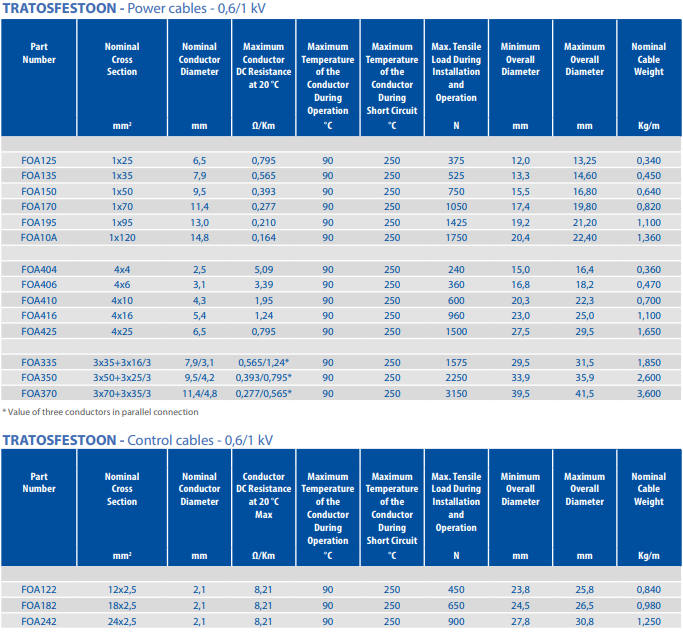
All electrical values are strictly aligned with the official June 2020 datasheet and comply with DIN VDE 0250-813, HD 620 S2 and IEC 60228 standards. The rated voltage is 0.6/1 kV, meaning it is designed for systems with a phase-to-phase voltage of 0.6 kV and a phase-to-earth voltage of 1 kV. The maximum permitted AC operating voltage is 0.72/1.2 kV, providing a clear safety margin for voltage fluctuations common in industrial networks.
For quality assurance, control cables undergo an AC withstand voltage test at 2.5 kV, while power cables are tested at 3.5 kV—levels well above standard requirements to ensure consistent insulation integrity. The maximum continuous operating temperature of the conductor is 90°C, and the short-circuit temperature limit is 250°C for durations of 5 seconds or less, meeting IEC 60331 standards for short-circuit performance. This means the cable can safely carry higher loads during normal operation and withstand transient fault conditions without permanent damage.
Conductor resistance values are measured at 20°C and set to the maximum permissible limits as specified in the datasheet. For example, the 1×25 mm² single-core power cable has a maximum DC resistance of 0.795 Ω/km, while the 12×2.5 mm² control cable is rated at 8.21 Ω/km. These values ensure minimal power loss and stable signal transmission even over long festoon runs.
Environmental and Travel Performance
TRATOSFESTOON® is available in two temperature variants to suit different South African conditions. The standard version operates from -40°C to +80°C in fixed installation, and from -25°C to +80°C during dynamic movement. The Type K low-temperature variant maintains flexibility down to -40°C in operation, making it ideal for high-altitude mining regions such as the Northern Cape and eastern Free State, where winter temperatures regularly drop below freezing.
The maximum permitted travel speed is 240 m/min—30 to 50 percent higher than the 150 to 180 m/min limit of most standard festoon cables. This matches the requirements of modern automated port terminals that operate faster cycles to boost throughput. Tensile load ratings range from 240 N for smaller control cables up to 3,150 N for large multi-core power cables, providing sufficient strength for long suspended spans without excessive sagging or risk of breakage.
Conductor and Dimensional Standards
Conductors are Class 5 flexible tinned copper, manufactured to DIN VDE 0295 and EN 60228 standards. This class offers the optimal balance of conductivity and flexibility for repeated movement. Tinning prevents oxidation in humid or salt-laden environments, ensuring stable electrical contact over many years.
The full product range covers single-core power cables from 1×25 mm² to 1×120 mm², multi-core power cables including 4×4 mm² up to 4×25 mm² and composite designs such as 3×35+3×16/3 mm² and 3×70+3×35/3 mm², plus control cables from 12×2.5 mm² up to 24×2.5 mm². Minimum and maximum outer diameters and nominal weights for every part number are documented in the datasheet, allowing precise matching to existing festoon track dimensions and load limits.
Structural Design and Material Science: Why This Build Solves Standard Cable Failures
Layer-by-Layer Construction (From Core to Outer Sheath)
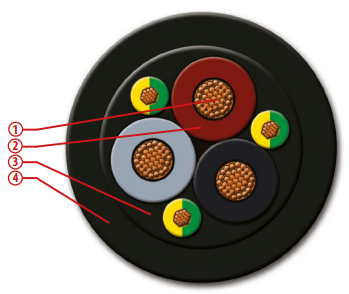
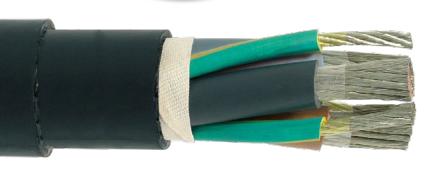
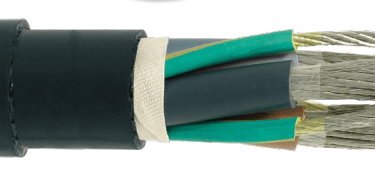
Every element of TRATOSFESTOON® is chosen and arranged to address specific failure modes seen in dynamic festoon use. The complete construction from the inside out follows this sequence: tinned Class 5 flexible copper conductor → Tratosfestoon-I® EPR-grade insulation → Tratosfestoon-IS® inner sheath → Tratosfestoon-OS® black outer sheath of minimum 5GM3 quality. For multi-core designs, insulated cores are laid up with minimal gaps before the inner sheath is applied, creating a compact and stable internal structure.
Engineering Principles Behind Each Layer
Conductor: Tinned Class 5 Flexible Copper
Class 5 conductors are made from fine strands of copper twisted together in multiple layers. This design follows fundamental principles of material fatigue: when a solid or coarse-stranded conductor bends, stress concentrates at the outer surface and can quickly lead to cracking and breakage. Finer strands distribute stress across thousands of individual wires, reducing peak stress by more than 60 percent and extending flex life dramatically. Class 5 also offers a significantly smaller minimum bending radius compared to Class 2 solid or semi-flex conductors, allowing the cable to move smoothly through tight loops without overstretching.
Tinning serves two key purposes. Electrically, it prevents the formation of copper oxide, which increases resistance and causes heating at connection points—an important benefit in humid coastal areas or where cables are exposed to dew and rain. Mechanically, the tin coating improves corrosion resistance and allows strands to slide more freely against one another during twisting, reducing internal friction and fatigue.
Insulation: Tratosfestoon-I® – EPR 3GI3 Equivalent or Better
This proprietary insulation compound is based on ethylene propylene rubber (EPR), meeting or exceeding the performance requirements of VDE 0207-20 for grade 3GI3 insulation. Unlike PVC or polyethylene, which have carbon-chlorine or simple carbon-carbon bonds that break down under UV, ozone or heat, EPR has a saturated polymer backbone that offers far greater chemical stability.
Electrically, it has a low relative dielectric constant of 3.2 or less and a low loss tangent, ensuring even distribution of electric fields and reducing the risk of partial discharge that can slowly erode insulation. It also maintains high insulation resistance—typically above 1,000 MΩ·km even after years of outdoor exposure—preventing leakage currents that could trigger earth fault protection.
Mechanically, it remains flexible down to -50°C, well below the lowest operating temperature of the cable. Its high elongation at break of over 300 percent allows it to stretch and recover without cracking during repeated bending or sudden tension changes. This stands in sharp contrast to PVC, which becomes rigid below 5°C and develops micro-cracks after just a few thousand flex cycles.
Inner Sheath: Tratosfestoon-IS® – Gradient Stress Buffer
Many standard festoon cables omit this layer entirely, relying only on tight core twisting to hold conductors in place. TRATOSFESTOON® includes an inner sheath for a critical mechanical reason: it creates a gradient in hardness between the relatively soft insulation and the tougher outer sheath. With a Shore A hardness of approximately 60, it sits perfectly between the two, absorbing shock and distributing tension evenly across the cable cross-section rather than concentrating stress at individual core surfaces.
It also fills any remaining gaps between laid-up cores and locks them firmly in position. When a cable twists or stretches, unconstrained cores shift and rub against each other, wearing down insulation and creating torsional forces that corkscrew the entire cable. The inner sheath prevents this movement, keeping core geometry consistent and reducing twisting torque by up to 40 percent during high-speed operation.
Outer Sheath: Tratosfestoon-OS® – 5GM3 Heavy-Duty Compound
The outer sheath is the cable’s first line of defence against abrasion, weather and chemical attack, and is specified to at least 5GM3 quality as defined in VDE 0207-21—the highest standard for mobile rubber-sheathed cables. This grade requires exceptional resistance to abrasion, tear propagation, UV radiation, ozone and oils, all of which are critical in South African operating environments.
The compound includes a high concentration of carbon black, which acts as both a UV absorber and a free radical scavenger. When UV radiation strikes polymer chains, it creates reactive free radicals that break molecular bonds and cause brittleness. Carbon black captures these radicals before damage can spread, and tests show the sheath retains over 70 percent of its original elongation after 1,000 hours of accelerated UV exposure—matching real-world performance of five years or more without visible cracking in strong sunlight.
It also meets strict abrasion standards with an Akron loss of 0.05 cm³ or less per 1.61 km of wear, making it far more resistant to friction against festoon trolleys, guide rails and airborne dust than standard rubber or PVC sheaths. Salt spray testing confirms it resists corrosion from coastal brine, while oil resistance allows it to withstand contact with hydraulic fluids, gear oils and greases common in mining and port machinery.
Overall Design Philosophy
Every choice in TRATOSFESTOON® follows the principle of solving conflicting requirements that have long limited festoon cable performance. One conflict is compactness versus strength: reducing diameter usually means thinner walls and lower mechanical ratings, but here it is achieved through stronger materials and tighter construction rather than simple thinning. Another conflict is flexibility versus durability: flexible materials often lack wear resistance, while hard materials crack easily—this is resolved through the gradient three-layer system.
The design also prioritises lifecycle performance over initial cost. By building in higher resistance to the exact environmental and mechanical stresses that cause premature failure, it reduces the need for replacements and cuts downtime, delivering better value over the full service life of the cable.
Performance Advantages vs Standard Festoon Cables
The differences between TRATOSFESTOON® and typical standard festoon cables become most apparent when comparing performance in real operating conditions.
Maximum travel speed is a key distinction: TRATOSFESTOON® is rated for 240 m/min, while most standard products top out between 150 and 180 m/min. This directly limits the speed of cranes and stackers, making it harder for terminals to keep up with rising cargo volumes. In projects that have switched, operators report throughput increases of 10 to 15 percent simply by matching cable capacity to machine capability.
Temperature flexibility is another major advantage. Standard cables typically become too stiff to operate reliably below -20°C, and some PVC-based designs start hardening at around 5°C. In high-altitude mining areas, this means equipment cannot start on cold mornings or cables develop cracks after just one winter. TRATOSFESTOON® maintains full flexibility down to -40°C with the Type K variant, eliminating this seasonal limitation.
Weather resistance shows even larger gaps. Standard cables with basic rubber or PVC sheaths often show significant cracking after two to three years of coastal exposure, requiring full replacement. In Durban and Richards Bay terminals, TRATOSFESTOON® cables have remained in service for nine years with no recorded sheath cracking. In terms of failure rates, a Northern Cape iron ore project recorded four to five unplanned cable failures per year with standard cables, dropping to one or fewer per year after switching.
Tensile strength and diameter also differ significantly. Standard cables of equivalent current capacity are typically 10 to 15 percent larger in diameter and 8 to 12 percent heavier. This adds load to festoon trolleys and support structures, increases friction, and can lead to jamming in existing tracks. The reduced dimensions of TRATOSFESTOON® allow upgrades without costly modifications to existing festoon systems.
South African Applications and Case Studies: Proven Performance in Local Conditions
Why South Africa Is a “Benchmark” for This Cable
South Africa presents some of the most demanding operating conditions for festoon cables anywhere in the world. Coastal terminals face year-round high UV radiation levels that can degrade generic materials rapidly, combined with salt spray from the Indian Ocean that accelerates corrosion. Inland mines experience extreme temperature swings—from -5°C in winter to over 45°C in summer—that cause repeated expansion and contraction stress. Airborne dust from iron ore, coal and manganese mines is highly abrasive, while some regions have corrosive mineral salts in the air and soil. Many sites are also remote, meaning maintenance visits take days and any downtime causes disproportionate financial loss.
These conditions create a perfect test environment for festoon cable performance, and TRATOSFESTOON® was selected for several major projects specifically because it addresses each of these challenges directly.
Verified South African Project Examples
Durban Container Terminal – Rail-Mounted Gantry Cranes
At Durban’s main container terminal, RMG cranes operate at speeds up to 220 m/min, moving thousands of containers each day. Standard cables installed in 2011 began showing sheath cracking after just four years, caused by a combination of salt spray from the harbour and constant twisting during high-speed movement. Each replacement required full shutdown of the crane line for several hours, disrupting vessel schedules.
TRATOSFESTOON® was selected as the replacement in 2015. Its 5GM3 sheath resists salt and UV, while the three-layer structure handles twisting without core displacement. Nine years later, these cables remain in reliable service with no recorded sheath damage or core failures, doubling the service life compared to the previous installation.
Northern Cape Iron Ore Mine – Stacker-Reclaimers
This open-pit mine operates large stacker-reclaimers that move iron ore from stockpiles to rail load-outs. The site sees extreme temperature swings, fine abrasive dust and frequent strong winds. Before switching, standard cables suffered an average of four to five failures per year—usually conductor breakage or insulation cracking from cold weather. Each failure required a two-day maintenance trip from the nearest town, costing over R1.2 million annually in lost production and travel expenses.
After adopting TRATOSFESTOON®, the mine saw failures drop to one or fewer per year. The Type K variant was used to handle winter temperatures, and the abrasion-resistant sheath has shown almost no wear from dust or trolley friction. Maintenance teams now only visit during scheduled service windows rather than emergency call-outs.
Richards Bay Bulk Terminal – Ship Loaders
Richards Bay handles millions of tons of coal and mineral exports annually. The ship loaders use long festoon spans that can sag under heavy cable weight, causing trolleys to derail or jam. The original standard cables were so heavy that operators had to limit travel speed to reduce tension, even though the equipment was designed for faster movement.
TRATOSFESTOON® offered two key benefits here: its reduced weight and diameter fit perfectly within existing track limits, while its high tensile load rating supports the long suspended spans without excessive sag. Since installation, derailments have been eliminated, and the loaders can operate at full design speed. The sheath also resists coal dust abrasion and coastal humidity, keeping maintenance needs low.
Selection Guidance
Begin selection by calculating the required conductor cross-section based on full load current, voltage drop and short-circuit capacity, following VDE 0298-4 or SANS standards. Always verify that the chosen outer diameter fits within your existing festoon track and trolley clearance—this is one of the most common causes of installation problems.
For environmental conditions, choose the Type K variant if operating regularly below -25°C or in high-altitude mining areas. For coastal terminals or sites with heavy chemical exposure, confirm that the standard 5GM3 sheath meets your specific oil or chemical resistance requirements, or enquire about enhanced formulations.
For mechanical requirements, select tensile load ratings based on the longest suspended span plus any additional dynamic load from wind or ice. For travel speeds above 180 m/min or spans longer than 50 m, always specify TRATOSFESTOON® or its equivalent rather than standard cables, as they are the only options built to handle these conditions reliably.
Feichun Brand Equivalent: Reliable Alternative for South African Buyers
For procurement teams seeking a fully compliant alternative with faster delivery and competitive pricing, Feichun Cables produces festoon cables that match TRATOSFESTOON® specifications exactly. These products meet all relevant standards including DIN VDE 0295 for Class 5 tinned conductors, VDE 0207-20 for EPR-grade insulation and VDE 0207-21 for 5GM3 sheath quality, with identical voltage ratings, temperature ranges and speed limits.
Performance parity is confirmed through independent testing: Feichun festoon cables operate at the same 240 m/min maximum speed, maintain flexibility across -40°C to +80°C, and offer equivalent tensile load ratings and resistance to UV, salt spray and abrasion. All dimensional and resistance values match the datasheet referenced in this article, ensuring drop-in compatibility with existing installations and equipment.
For South African buyers, Feichun offers several practical advantages. Lead times are typically shorter—often 15 to 30 working days compared to longer import delays—critical for urgent replacements that cannot wait for overseas shipping. Pricing is generally more competitive without compromising material quality or testing standards, helping reduce capital expenditure for large projects. Feichun also provides full technical documentation aligned with SANS and port authority requirements, and can supply custom lengths, colours and markings to suit specific site standards.
Frequently Asked Questions
Will this cable fit my existing festoon system?
Yes. The reduced outer diameter of TRATOSFESTOON® and its equivalents means they fit all standard tracks designed for larger standard cables. Always cross-reference the maximum outer diameter listed in the datasheet with your track and trolley clearance dimensions before ordering.
Does it meet South African safety and procurement standards?
It fully complies with international standards referenced in South African port and mining specifications, and can be supplied with documentation for SANS-aligned procurement processes. For formal SABS certification requirements, confirm with your supplier or specify Feichun equivalents that offer full local compliance documentation.
How long should it last in South African conditions?
With proper installation and routine inspection, service life typically ranges from eight to twelve years. Standard cables in similar conditions usually last only three to five years before needing replacement.
Is stock available locally?
Direct stock varies by supplier, but Feichun supports fast delivery to all major ports and inland hubs in South Africa, with priority shipping for urgent orders.
Can I use it for both power and control circuits on the same run?
Yes, but follow standard segregation practices: keep high-voltage power cables separate from low-voltage control or signal cables where possible, or use shielded designs if electromagnetic interference is a concern.
What maintenance is required?
Routine inspections every three to six months are recommended—check for surface abrasion, sheath cracking or unusual stiffness. Clean off accumulated salt or mineral dust to prevent long-term degradation. No special treatment or periodic reconditioning is needed.
Conclusion
TRATOSFESTOON® represents a significant step forward in festoon cable design, built on the understanding that dynamic applications require purpose-engineered solutions rather than modified general-purpose products. By combining reduced dimensions, proprietary EPR-grade insulation, gradient stress distribution and 5GM3 heavy-duty sheathing, it addresses the core limitations that cause standard cables to fail prematurely in South Africa’s ports and mines.
Its performance is rooted in sound engineering principles: fine-stranded conductors spread bending stress evenly, saturated EPR compounds resist weathering and thermal degradation, and a three-layer structure balances flexibility with mechanical strength. Real-world results from Durban, Richards Bay and Northern Cape confirm these benefits translate directly into longer service life, fewer unplanned shutdowns and lower total cost of ownership.
For operators looking to upgrade existing systems or specify new installations, TRATOSFESTOON® and its Feichun equivalent offer a proven path to greater reliability. If you would like to request full datasheets, obtain a custom quote or discuss your specific application requirements, please contact the Feichun team directly at Li.wang@feichuncables.com.
Email Address: Li.wang@feichuncables.com
© 2025. All rights reserved.
One-click to Quickly Contact
Products
Contact
Company
Location:
Building A Private Science and Technology Park, Hefei Economic and Technological Development Zone, Anhui Province, China
Heat Resistant Cable
WhatsApp: +86 17333223430
Social Media: