Anhui Feichun Special Cable Co.,Ltd Email: Li.wang@feichuncables.com
TRATOS MTO®‑V Coal Cutter Cables for Chain Operation (NSSHCGEÖU / NTSKCGECWÖU): EPR/PCP Construction, VDE Standards & Proven Performance in South African Underground Mining
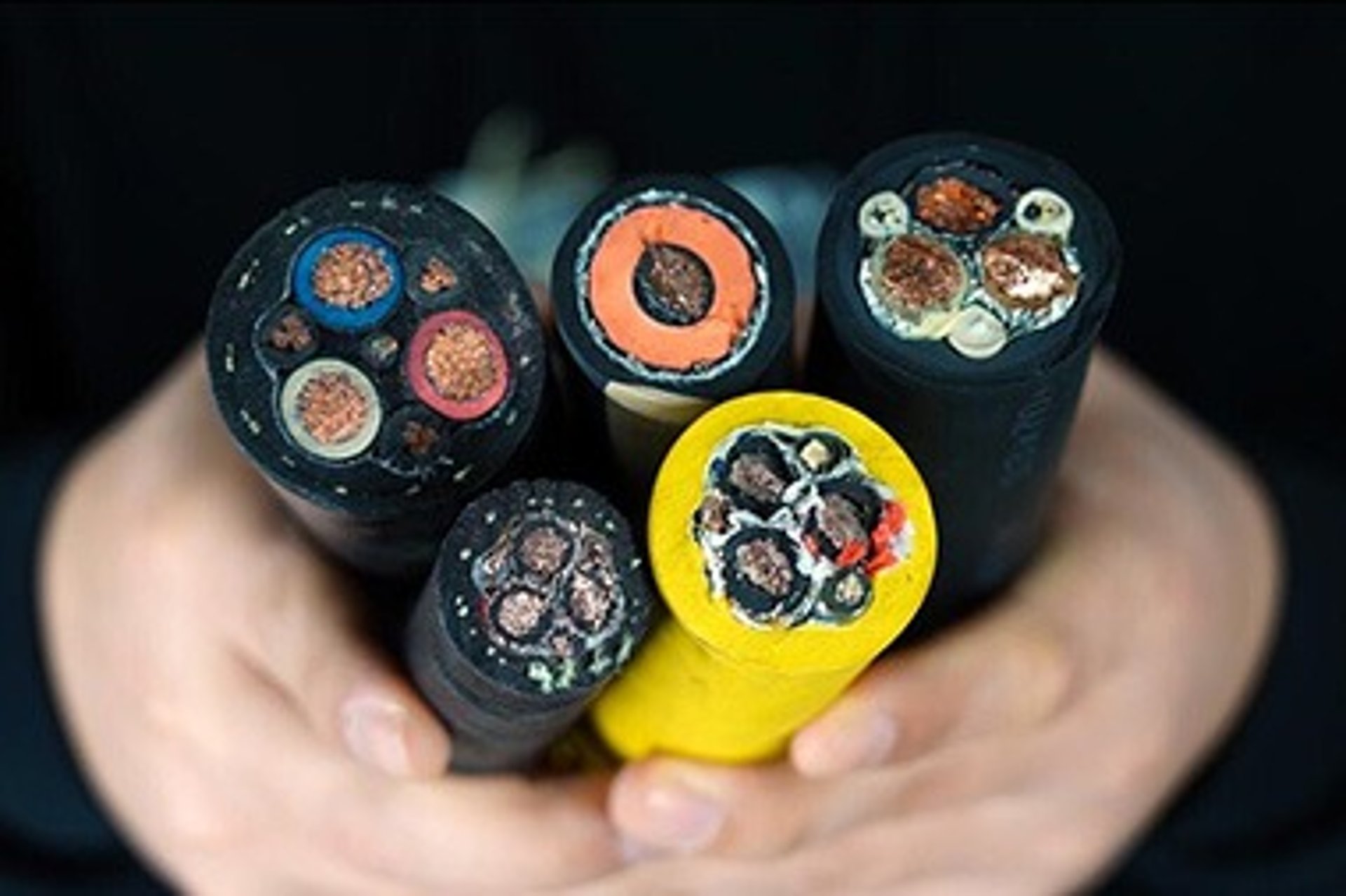
TRATOS MTO®‑V (NSSHCGEÖU / NTSKCGECWÖU) is not a simple upgrade of flexible trailing cables — it is a purpose‑built engineering solution designed exclusively for shearers running in Bretby‑type cable‑protection chains. Built with Class 5 tinned copper conductors, EPR 3GI3 insulation, PCP 5GM5 yellow sheath, concentric steel‑copper earth/tension member, and integrated monitoring cores to DIN VDE standards. Field‑proven in South African deep mines to extend service life from three months to over 18 months, cut unplanned downtime by hundreds of hours annually, and align with SANS 1520 requirements. This article explains the full engineering logic, material science, construction details, performance advantages, real‑world case results, Feichun equivalent options, selection guidance, and frequently asked questions for mining engineers and procurement professionals.
Li.Wang
7/27/202611 min read
Introduction: The Hidden Bottleneck in Underground Coal Mining Power Delivery
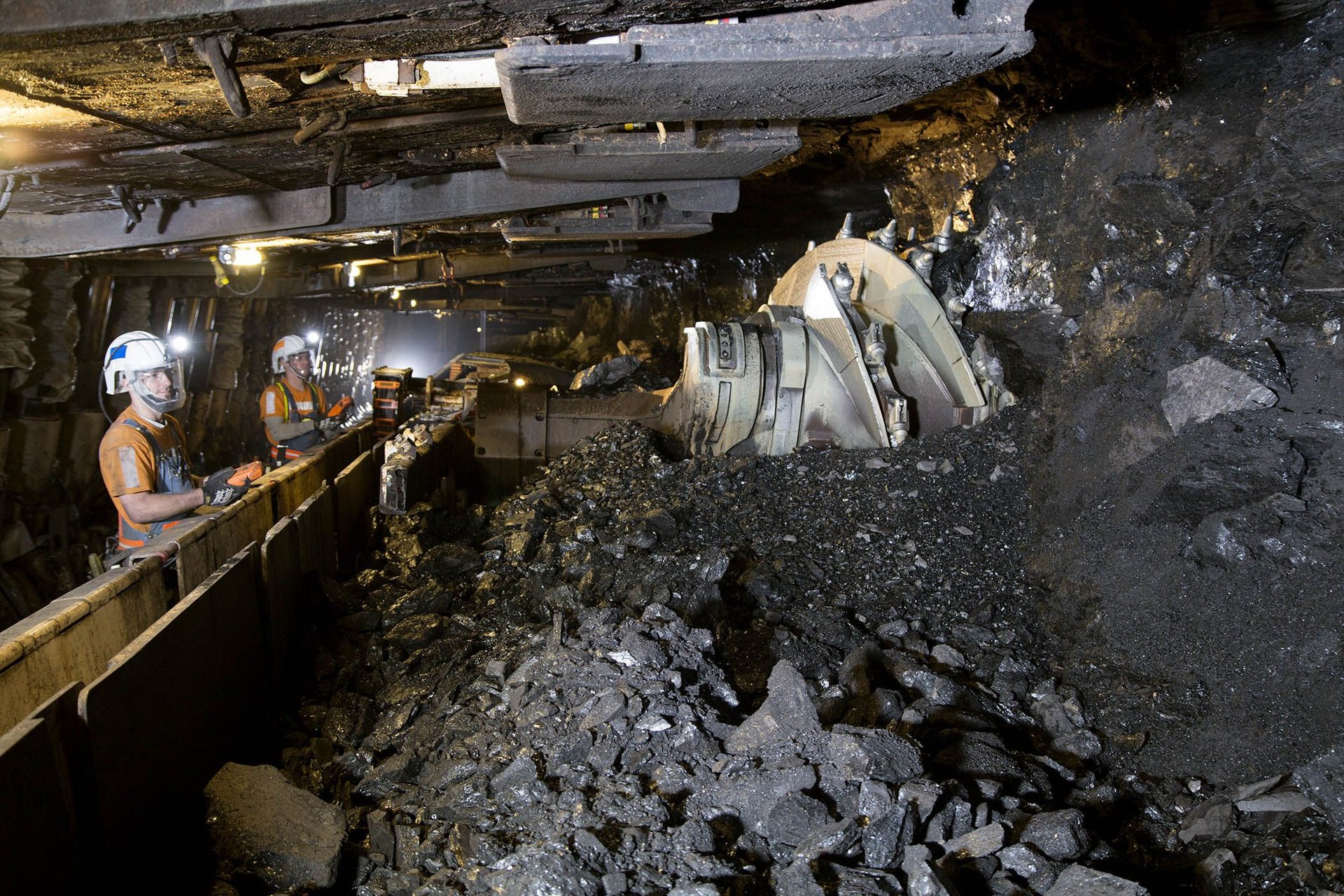
South Africa stands as one of the world’s most important coal‑producing nations, with vast reserves concentrated in Mpumalanga, Limpopo, and the Free State provinces. Most underground operations rely on longwall and continuous mining systems, where shearers advance rapidly along faces often exceeding 300 metres in length, pulling power cables over distances of hundreds of metres behind them. In these mines, depth frequently exceeds 3 000 metres, creating an environment defined by high ambient temperatures, constant humidity, elevated methane risk, and abrasive coal dust mixed with diesel and hydraulic fluids.
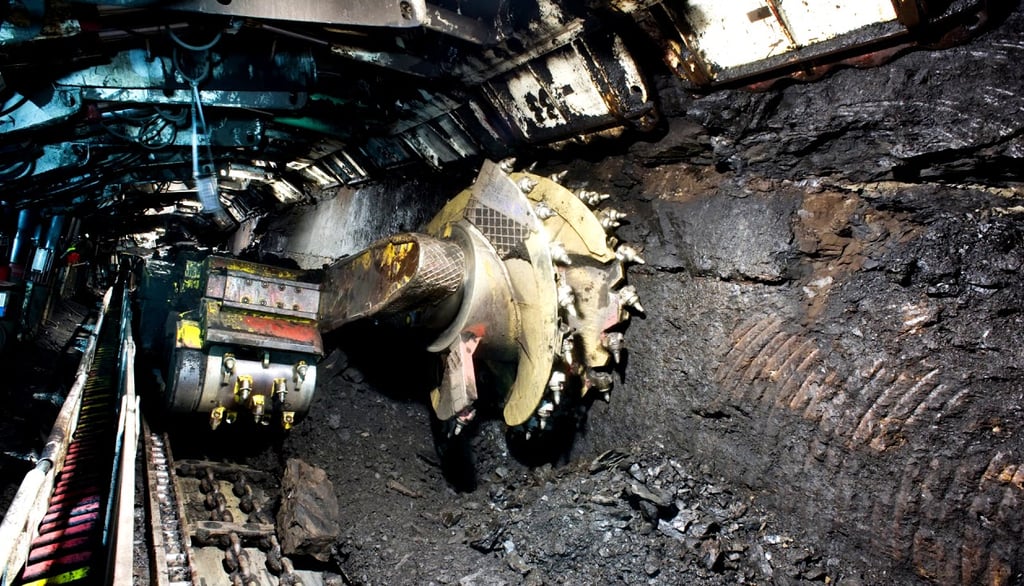
A critical piece of equipment in this power chain is the Bretby cable handler — a chain‑like assembly of hinged plates that runs along the AFC (Armoured Face Conveyor) behind the shearer. Its primary job is to carry the tensile load generated as the machine moves back and forth, lifting the cable off the floor and preventing it from being crushed, snagged, or dragged over sharp rock edges. In this setup, the cable is not meant to take significant tension; instead, it must endure millions of cycles of tight bending, twisting, and mechanical impact while maintaining perfect electrical integrity.
Yet for decades, most mines used standard flexible trailing cables not purpose‑engineered for this specific load distribution. These cables were designed to carry both current and tension simultaneously, leading to predictable failure modes: copper conductors fatigued and snapped after only a few months, insulation cracked under repeated flexing, earth continuity broke down, and signal cores failed unpredictably. A typical replacement would take more than eight hours of total downtime, costing mines tens of thousands of Rands per occurrence and increasing safety risks whenever power was lost unexpectedly.
TRATOS MTO®‑V was developed specifically to resolve this exact mismatch. It is not simply a more flexible version of an ordinary mining cable; it is a system solution built around mechanical‑electrical decoupling — a principle where the Bretby handler absorbs overall tension, while a dedicated steel‑copper concentric layer within the cable handles any remaining mechanical load, leaving the copper conductors free only to carry electric current. Every layer of material, every dimension, and every structural feature is calibrated to work with chain‑operation systems, rather than against them. This article unpacks the full technical reasoning behind that design, how it performs in South African conditions, and why it has become a benchmark for reliability in high‑stress underground coal applications.
Official Designations, Standards & Core Technical Specifications
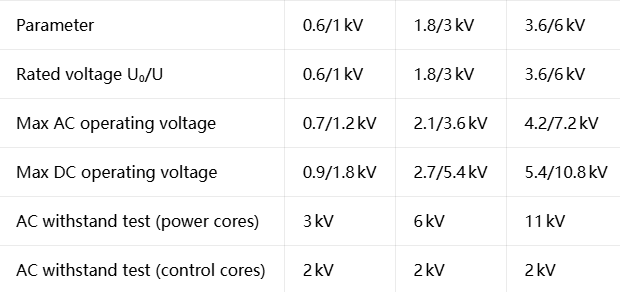
The product is formally designated TRATOS MTO®‑V, with two primary type codes matching voltage ratings:
NSSHCGEÖU: 0.6/1 kV
NTSKCGECWÖU: 1.8/3 kV and 3.6/6 kV
All construction, materials, and testing follow a comprehensive set of DIN VDE standards, widely recognised in South Africa alongside SANS 1520 and BS 6708 for mining cable approval:
DIN VDE 0250‑812 / 813: Heavy‑duty rubber‑sheathed mining trailing cables
DIN VDE 0295: Class 5 finely stranded tinned copper conductors
DIN VDE 0207‑20: EPR insulation compound 3GI3
DIN VDE 0207‑21: EPR inner‑sheath compound GM1b and PCP outer‑sheath compound 5GM5
DIN VDE 0298‑3 / 4: Installation rules, bending radii, and current‑carrying capacity
DIN VDE 0473‑811‑2‑1: Oil‑resistance testing
DIN VDE 0482‑265‑2‑1: Fire‑performance requirements
Electrical Parameters
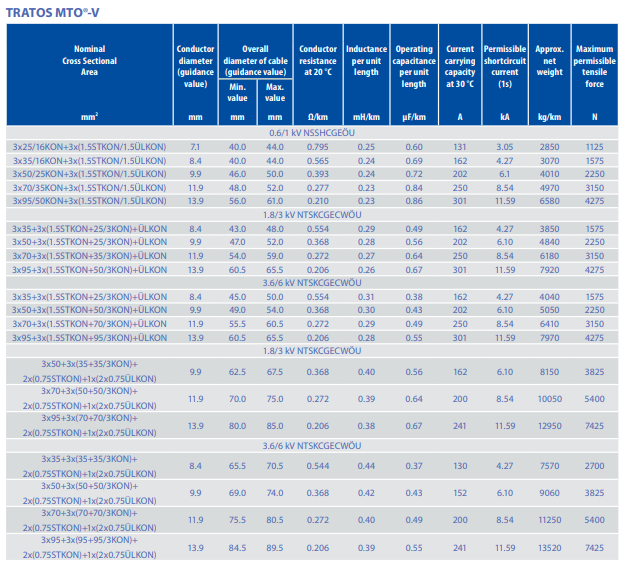
Conductor resistance at 20 °C, inductance, capacitance, and short‑circuit capacity vary with cross‑section from 25 mm² to 95 mm², all documented in the manufacturer’s tables and aligned with VDE calculation methods. Current‑carrying capacity at 30 °C is specified per VDE 0298‑4, with values ranging from 131 A for 3×25 mm² up to 301 A for 3×95 mm².
Thermal & Mechanical Limits
Maximum continuous conductor temperature: 90 °C
Maximum short‑circuit conductor temperature: 200 °C
Ambient range (flexible operation): –30 °C to +80 °C; fixed installation: –40 °C to +80 °C; Type K low‑temperature variant: –60 °C to +60 °C
Tensile load: up to 15 N/mm² overall; 5 N/mm² limit when bending to 2.3×D
Minimum bending radius: 2.3×D; minimum spacing for S‑shaped directional changes: 20×D
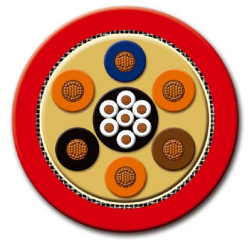
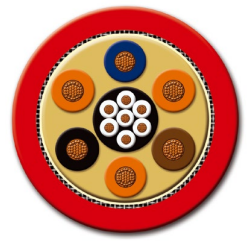
Core Configurations
South African Mining Context: Why This Design Is Non‑Negotiable
South African longwall operations present a unique combination of mechanical, electrical, and environmental stressors that few cables can survive reliably. At depths beyond 3 000 metres, rock temperatures rise significantly, adding thermal load to already heat‑generating power circuits. Shearers can advance several metres per hour, moving back and forth across the face and pulling cable lengths that may exceed 200 metres from the AFC mid‑point to the maingate connection.
The Bretby handler absorbs the majority of linear tension, but the cable itself still undergoes constant flexing around tight curves, plus twisting as the shearer pitches and rolls over uneven floor conditions. Coal and rock fragments strike the outer sheath, while hydraulic oil, diesel, and accumulated moisture attack the material from all sides. Under SANS 1520, all flexible trailing cables must demonstrate robust mechanical endurance, fire resistance, and reliable earth continuity — requirements that standard cables often fail to meet over extended service.
Traditional cables place all mechanical stress directly on the copper conductors, which are inherently poor at resisting repeated tensile and bending loads. As conductors fatigue, they break internally or sever completely, causing sudden power loss. Insulation then bears extra mechanical stress, leading to partial discharge and eventual dielectric breakdown. Earth conductors stretch and thin, increasing impedance and compromising fault protection. In South African mines, this cycle typically resulted in cable lifespans of only two to four months, with unplanned stops triggering production losses and safety inspections.
TRATOS MTO®‑V answers this by re‑thinking how forces flow through the cable. It is designed so that tension is diverted away from the copper conductors and taken up by a concentric steel‑copper braid — a structure that doubles as a low‑impedance protective earth. This mechanical‑electrical decoupling means the cable works with the Bretby handler, rather than fighting against it, and aligns perfectly with the way South African longwall systems operate.
Layer‑by‑Layer Construction, Materials & Engineering Principles
Every layer serves a specific function, chosen and arranged based on well‑established principles of mechanics, electrical insulation, and polymer science.
Conductor: Finely Stranded Tinned Copper, Class 5 (VDE 0295)
Copper is chosen for its high conductivity, but standard solid or coarse‑stranded wire is too stiff and prone to fatigue under repeated bending. Class 5 uses extremely fine individual strands, which allow the conductor to flex with minimal internal stress. Tin plating prevents oxidation and inhibits galvanic reactions between copper and rubber additives, preserving both electrical continuity and bond integrity over years of service.
Insulation: EPR, Compound 3GI3 (VDE 0207‑20)
Ethylene‑Propylene Rubber (EPR) is a cross‑linked polyolefin chosen for its low dielectric constant (~2.5), high corona resistance, and stable performance up to 90 °C. Unlike many other elastomers, EPR retains its elasticity and insulating properties after millions of flex cycles, resisting crack propagation and partial discharge — a key factor in medium‑voltage underground systems. Compound 3GI3 is a formulation specifically validated for mining service, balancing electrical performance with mechanical toughness.
Outer Semiconductive Layer: Cold‑Strippable Semiconductive Rubber
This layer bonds tightly to the insulation surface, eliminating microscopic air gaps that would otherwise cause electric‑field concentration and partial discharge. It ensures an even potential gradient across the insulation thickness, extending dielectric life significantly. Being cold‑strippable means joint preparation can be done quickly without heat, improving safety and consistency during underground repairs.
Core Arrangement & Control/Monitoring Elements
Three or six main power cores are laid up with a lay length of approximately 6 × overall diameter. This ratio is not arbitrary: it is calculated to minimise relative movement between cores during bending, reducing internal friction and shear stress. Double‑concentric control and monitoring elements sit in the outer interstices, colour‑coded white for control and orange for monitoring, where they are mechanically protected yet electrically isolated from power cores. The concentric geometry also provides natural electromagnetic shielding, minimising interference from high‑current power conductors.
Inner Sheath: EPR, Compound GM1b (VDE 0207‑21)
This vulcanised rubber layer acts as a cushion, maintaining the cable’s circular profile and preventing abrasion between insulated cores and the outer structural layers. It adds mechanical compliance that allows the cable to flex smoothly without localised stress peaks, while also providing an extra barrier against moisture and chemical ingress.
Protective‑Earth / Tension Member: Concentric Steel‑Copper Wire Spinning
This is the defining innovation of the design. A braid combining high‑tensile steel and high‑conductivity copper runs concentrically around the inner sheath. The steel component carries any residual tension not fully absorbed by the Bretby handler, protecting the copper conductors from fatigue loading. The copper component ensures low‑impedance fault‑current return, meeting both electrical‑safety and mechanical‑load requirements in one integrated layer. This is the core of mechanical‑electrical decoupling — a principle that follows basic solid‑mechanics rules: assign loads to materials best suited to carry them, rather than forcing one material to perform conflicting roles.
Outer Sheath: PCP, Compound 5GM5, Yellow (VDE 0207‑21)
Chlorinated Polyethylene (PCP) is selected for its unique balance of rubber‑like flexibility and plastic‑level resistance to oil, abrasion, ozone, and flame. Compound 5GM5 is proven to withstand diesel, hydraulic fluids, and the temperature swings common in deep mines. The bright yellow colour is not decorative: it maximises visibility in low‑light underground conditions, supporting site safety rules and SANS 1520‑aligned good practice.
Science Behind the Choices
Mechanics: Finer strands + longer lay length = lower bending stiffness and reduced cyclic strain. Separating tension‑bearing and current‑carrying functions follows the principle of load‑path optimisation — steel takes tension, copper takes current, rubber absorbs deformation.
Electrical: EPR’s low permittivity reduces capacitive charging currents; semiconductive layers flatten electric‑field distribution, preventing localised breakdown.
Materials: Cross‑linked EPR resists thermal softening and oxidative degradation; chlorinated PCP gains oil and flame resistance through polymer modification without losing flexibility.
Safety: Continuous concentric earth ensures fault‑current path integrity; yellow colour aids visual inspection; all fire and oil tests align with internationally accepted mining standards.
Performance Advantages Compared to Ordinary Mining Cables
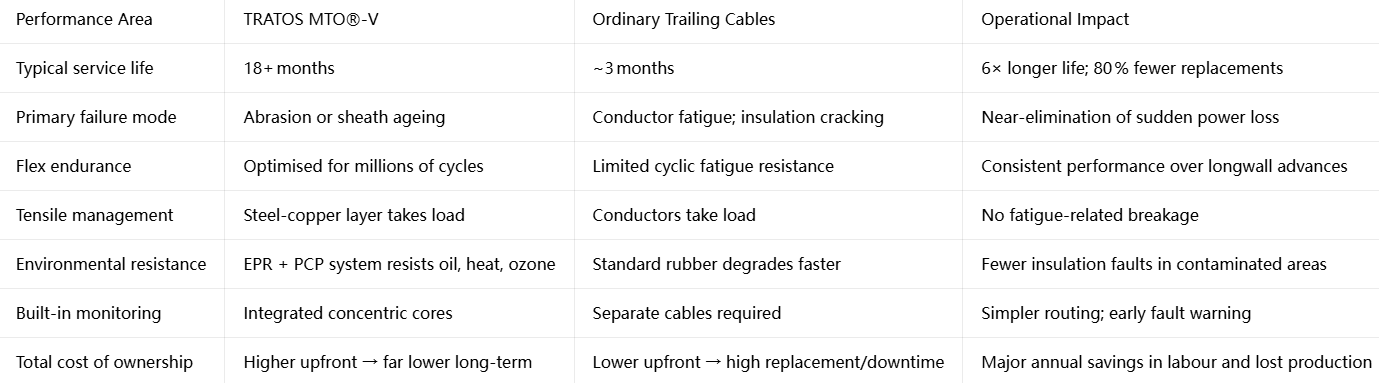
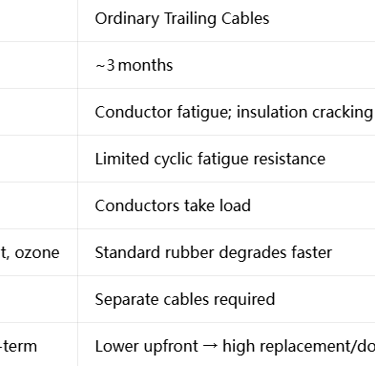
The difference between TRATOS MTO®‑V and standard trailing cables becomes clear when looking at real operational outcomes.
In practical terms, mines see fewer emergency stops, reduced overtime for repairs, and more predictable maintenance scheduling. In South African cost models, where a single unplanned shift loss can exceed hundreds of thousands of Rands, the financial return from extended cable life is substantial.
Real‑World Validation: South African Deep‑Mine Case Study
A longwall operation in Mpumalanga provides a clear example of how the design translates into results. The site uses Joy shearers with Bretby handlers, operating at depths approaching 2 800 metres with ambient rock temperatures well above surface levels.
Baseline Situation
The mine had been using standard SANS 1520‑compliant trailing cables for 0.6/1 kV service. Average cable life was only three months, with failures almost always caused by snapped conductors or insulation punctures. Each replacement required isolating the face, removing the damaged cable, re‑terminating, and testing — typically taking eight hours or longer and often extending into scheduled shift changes. Over a year, these failures added up to roughly 450 hours of lost production, plus significant costs for replacement cable and labour.
Solution Implemented
The mine switched to TRATOS MTO®‑V 3×70/35 + 3×(1.5 + 35/3) at 0.6/1 kV, matching the machine’s power demand and the Bretby handler’s bend‑radius and tension limits. Installation procedures remained compatible with existing cable handling equipment and termination methods, requiring no major modifications to the AFC or shearer junction boxes.
Measured Outcomes
Service life: Extended from three months to over 18 months, a six‑fold improvement.
Replacement frequency: Reduced by approximately 80 %, freeing maintenance crews for planned work.
Fault types: Conductor breaks and insulation punctures were virtually eliminated; remaining issues were limited to gradual sheath abrasion, which can be monitored visually.
Downtime: Around 400 hours of unplanned downtime recovered annually — equivalent to roughly 50 full shifts of production.
Maintenance shift: Integrated monitoring cores allow insulation resistance and continuity checks without disturbing the cable run, enabling predictive maintenance rather than emergency repair.
Safety compliance: Yellow high‑visibility sheath improved cable location awareness for personnel, aligning with both site safety rules and SANS 1520 principles.
This case mirrors results seen across other Mpumalanga and Limpopo operations, confirming that the design’s theoretical advantages translate directly into safer, more reliable, and more cost‑effective underground coal production.
Feichun Equivalent: Drop‑In Replacement with Practical Advantages
Mines often face lead‑time constraints or project‑specific budget pressures, making reliable alternatives important. Feichun’s NSSHCGEÖU / NTSKCGECWÖU range is engineered as a true functional equivalent, matching the original design at every level.
Why It Is a Valid Alternative
Identical construction: Class 5 tinned copper conductors, EPR 3GI3‑equivalent insulation, GM1b inner sheath, 5GM5 PCP yellow outer sheath, concentric steel‑copper earth/tension member, and ~6 × D lay length.
Full standard alignment: Tested and certified to DIN VDE 0250‑812 / 813, VDE 0295, VDE 0207 series, and VDE 0298‑4, with performance data fully compatible with SANS 1520 acceptance criteria.
Matching electrical and mechanical ratings: Same voltage classes, temperature limits, tensile values, and bending‑radius rules — no compromise on performance or safety.
Key Operational Benefits
Shorter lead times: critical for urgent replacements or accelerated project schedules in Southern Africa.
Competitive pricing: delivers equivalent reliability without premium pricing, helping mines optimise capital and operational budgets.
Full size range: from 25 mm² through 95 mm² across all three voltage ratings, covering almost all longwall shearer configurations.
Proven deployment: already in service across Africa, Europe, and Australia, with documented performance matching the original specification.
For procurement teams, this means sourcing flexibility without qualification risk — the Feichun product is designed to be interchangeable in installation, termination, and service life, making it a practical choice for South African mines balancing performance, compliance, and delivery.
Selection Guide & Configuration Best Practices
Choosing the right cable involves more than matching voltage and cross‑section; it requires aligning every parameter with the Bretby system and site conditions.
Voltage rating: Select based on nominal system voltage plus the specified margin — 0.6/1 kV for low‑voltage shearers, 1.8/3 kV or 3.6/6 kV for medium‑voltage installations.
Conductor size: Calculate from continuous current demand at the site’s ambient temperature using VDE 0298‑4 tables, then verify short‑circuit withstand and voltage drop over the longest cable run.
Mechanical matching: Confirm minimum bend radius with the Bretby manufacturer — never exceed 2.3 × D under operating tension, and limit tension to 5 N/mm² at that radius.
Monitoring requirements: Specify integrated control/monitor cores if you plan to use insulation‑monitoring or pilot‑wire protection systems.
Environmental factors: Select Type K if operating regularly below –30 °C; confirm oil‑resistance compliance where diesel or hydraulic fluids are prevalent.
Critical rule: Always use cables explicitly rated for chain operation. Standard trailing cables are designed for different load paths and will not deliver the same life or reliability in Bretby handlers.
Frequently Asked Questions
Is TRATOS MTO®‑V suitable for free trailing without a Bretby handler?
No — it is engineered specifically for chain‑operation systems where tension is largely carried by the handler. For free trailing applications, other designs such as TRATOS MTO‑Z or Feichun equivalents are more appropriate.
What is the maximum allowable tension?
Up to 15 N/mm² overall, but reduced to 5 N/mm² when bending to the minimum radius of 2.3 × D.
Why is the sheath yellow?
High visibility in low‑light underground environments, supporting safe working practices and aligning with common mining‑safety colour conventions.
Can Feichun cables be used directly in place of the original?
Yes — same dimensions, termination compatibility, and performance ratings, with full VDE documentation accepted alongside SANS 1520 in most South African jurisdictions.
How does the temperature rating apply?
–30 °C to +80 °C for moving/flexible service; –40 °C to +80 °C for fixed runs; Type K extends low‑temperature capability to –60 °C.
What happens if I use a smaller bend radius than specified?
Tensile stress on conductors rises sharply, accelerating fatigue and shortening service life significantly.
Conclusion
TRATOS MTO®‑V is not simply a better flexible cable — it is a complete engineering response to a specific set of mechanical and electrical conditions found in chain‑operated longwall mining. By separating tension‑bearing and current‑carrying functions, using EPR and PCP materials selected for their combined electrical, mechanical, and chemical properties, and following rigorous VDE standards, it addresses the root causes of premature cable failure.
In South African deep mines, this translates directly into longer service life, fewer unplanned stops, safer working conditions, and lower total operating cost. The case study from Mpumalanga demonstrates that when equipment design matches the real load path — rather than just general assumptions — the results can be transformative.
Feichun equivalents extend these advantages by offering identical performance and compliance with improved availability and cost‑effectiveness, giving mines greater sourcing flexibility without compromise.
For any operation using Bretby or similar cable handlers, the choice is clear: specify cables purpose‑built for chain‑operation systems, treat them as safety‑critical infrastructure, and align selection with voltage, current, mechanical, and environmental parameters. This approach will consistently deliver better reliability and value over the longwall’s service life.
If you need detailed datasheets, sizing assistance, pricing, or Feichun equivalent availability for South African projects, please contact the Feichun team:
Email Address: Li.wang@feichuncables.com
© 2025. All rights reserved.
One-click to Quickly Contact
Products
Contact
Company
Location:
Building A Private Science and Technology Park, Hefei Economic and Technological Development Zone, Anhui Province, China
Heat Resistant Cable
WhatsApp: +86 17333223430
Social Media: