Anhui Feichun Special Cable Co.,Ltd Email: Li.wang@feichuncables.com
TRATOS MTO‑RF‑M® REFLECTIVE + FLUORESCENT Trailing Cable: Ultimate High‑Visibility Mining Solution for South African Open‑Cast Mines – Enhanced Safety, EPR Insulation & Aramid Strength
TRATOS MTO‑RF‑M® is a purpose‑built medium‑voltage flexible trailing cable combining reflective + phosphorescent high‑visibility technology, EPR/HEPR insulation, and aramid reinforcement – engineered for South African open‑cast platinum, coal, gold and iron‑ore mines. Delivers superior mechanical toughness, electrical reliability and night‑time safety, complying with SANS, MHSA and international standards. Feichun offers fully equivalent alternatives with competitive pricing and faster delivery.
Li.Wang
7/23/202613 min read
Introduction
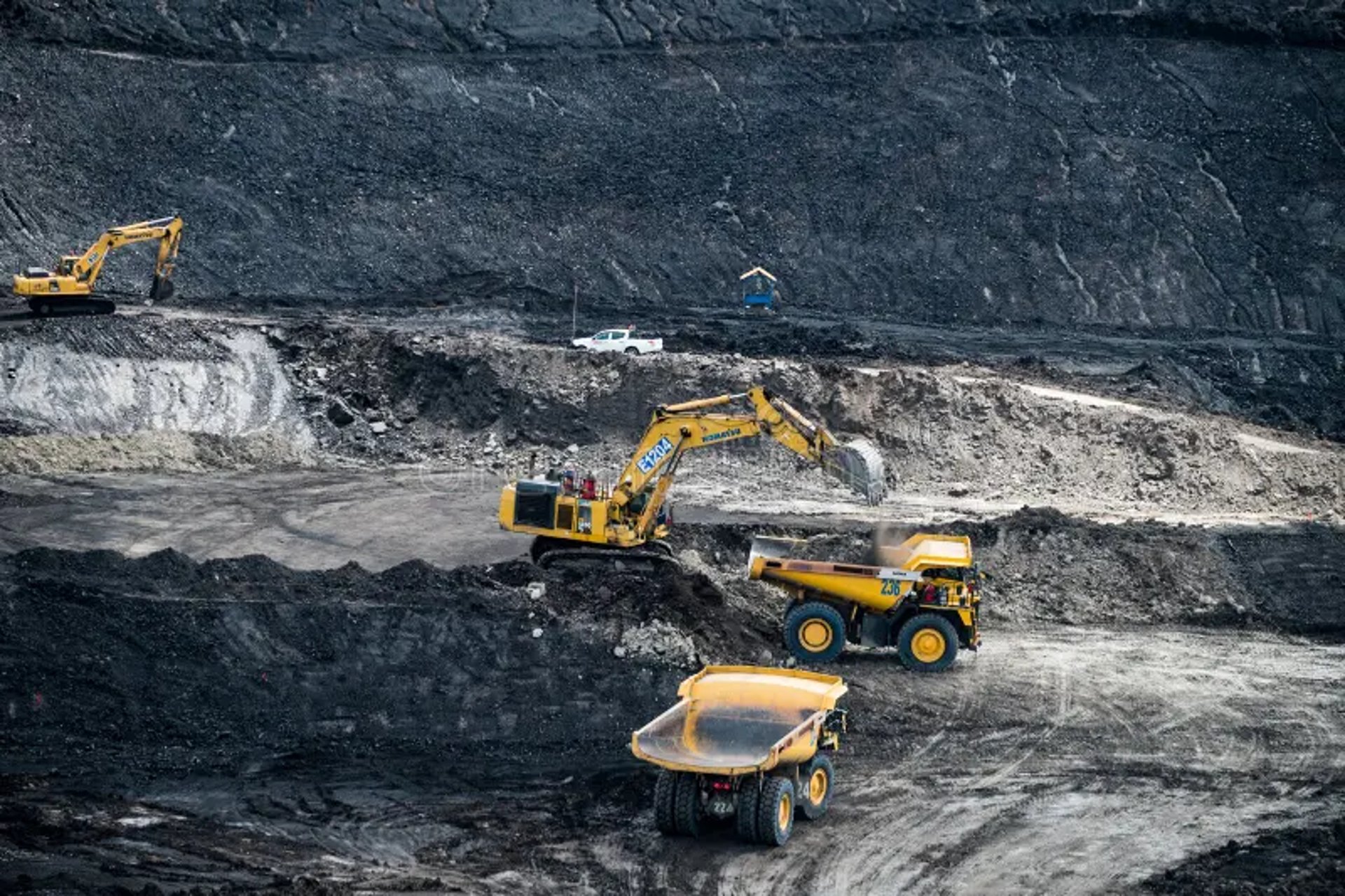
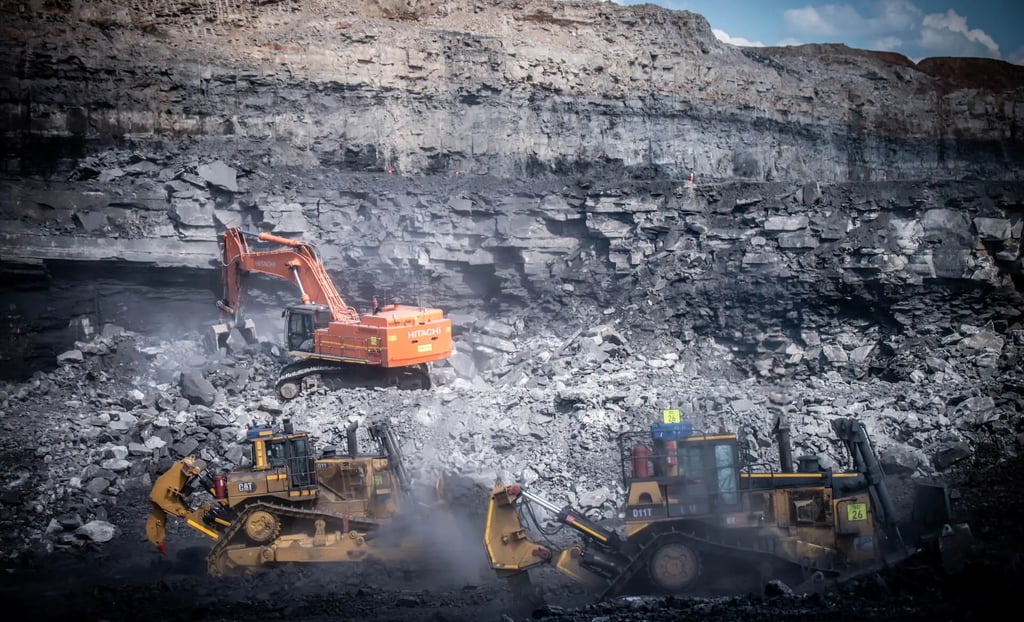
Trailing and reeling cables act as the critical power lifeline for heavy mobile mining equipment such as excavators, face shovels, draglines, bucket‑wheel stackers and reclaimers. In open‑cast operations, these cables are subjected to continuous pulling, dragging, twisting, abrasion, impact, temperature swings and low‑light conditions that few other industrial products must endure. When a trailing cable fails, the consequences extend far beyond repair costs: unplanned downtime halts production, scheduled maintenance is disrupted, and personnel face increased electrical and mechanical hazards. Ordinary general‑purpose mining cables often fall short under these combined stresses, showing premature conductor breakage, insulation degradation, sheath tearing or unseen damage that leads to run‑overs and accidents.
South Africa stands as one of the world’s most important mining hubs, producing vast quantities of platinum‑group metals, coal, gold, iron ore, manganese and chrome. The country’s open‑cast mines present some of the most demanding operating environments anywhere. Operations run round the clock, with night shifts making up a large portion of production schedules. Dust, mud, surface water, extreme heat and cold, and heavy vehicle traffic create constant risks. Under the Mine Health and Safety Act (MHSA) and supporting standards such as SANS 507‑1, NRS 034‑1 and SANS 1520, operators must demonstrate that equipment and cabling meet rigorous safety and performance criteria. A recurring challenge reported across South African mines is that trailing cables become nearly invisible after dark or in dust‑laden conditions, leading to accidental vehicle strikes, crushing and cutting that trigger lengthy outages and endanger workers. Standard cables with plain black or coloured sheaths offer little contrast against dark earth and rock, and do not signal their position when external lighting is limited or absent.
TRATOS MTO‑RF‑M® REFLECTIVE + FLUORESCENT has been developed as a definitive answer to these combined challenges. It is a medium‑voltage flexible trailing cable built from the ground up for open‑cast mining, merging three core pillars: electrical reliability through EPR and HEPR insulation with double semiconductive screening, mechanical durability through Class 5 flexible tinned copper conductors and aramid central reinforcement, and active safety visibility through patented reflective and phosphorescent sheath technology. Unlike conventional cables that address only one or two aspects of performance, this design systematically balances load sharing, electric‑field control, environmental protection and hazard prevention. It complies with DIN VDE, AS/NZS, BS and IEC standards while aligning fully with South African regulatory requirements. Although detailed local case studies remain limited in public documentation, the cable’s performance has been validated across global mining operations facing identical conditions, and its engineering principles directly target the pain points most frequently reported in South African open‑cast sites. For operators aiming to lift both safety and productivity while lowering total‑life costs, TRATOS MTO‑RF‑M® represents a benchmark solution that redefines what a modern trailing cable can achieve.
Full Technical Specifications and Compliance
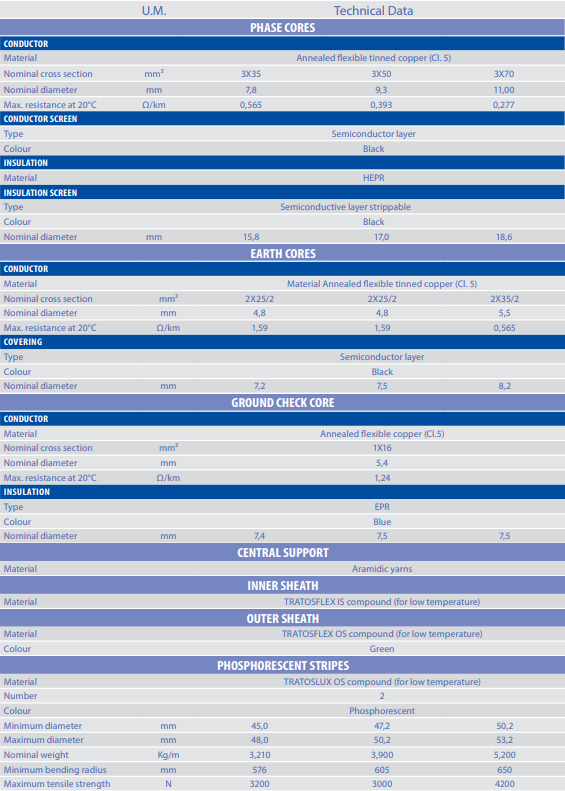
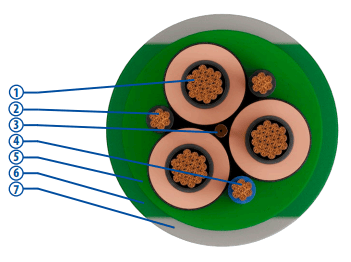
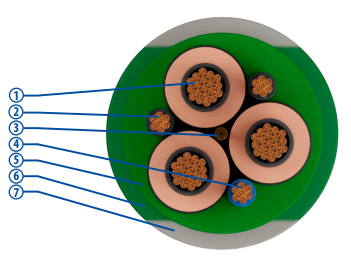
The TRATOS MTO‑RF‑M® range is engineered for medium‑voltage power distribution to heavy mobile mining machinery, with standard configurations tailored to the most common power ratings found in South African fleets. The datasheet defines three core constructions: 3×35 mm² phase cores paired with 2×25/2 mm² earth cores and 1×16 mm² ground‑check core; 3×50 mm² phase cores with 2×25/2 mm² earth cores and 1×16 mm² ground‑check core; and 3×70 mm² phase cores with 2×35/2 mm² earth cores and 1×16 mm² ground‑check core. These cross‑sections are selected to match typical power demands of excavators and material handlers while keeping voltage drop within acceptable limits over the long cable runs common in large pits.
Electrical performance is defined by conductor resistance at 20 °C: 0.565 Ω/km for 35 mm², 0.393 Ω/km for 50 mm², and 0.277 Ω/km for 70 mm² phase cores. Earth‑core resistance is 1.59 Ω/km for 25/2 mm² and 0.565 Ω/km for 35/2 mm², while the 16 mm² ground‑check core measures 1.24 Ω/km. All values meet or exceed IEC 60228 and VDE 0295 requirements for Class 5 flexible conductors, ensuring efficient power transfer and low heat generation even under sustained high loads.
Physical dimensions and mechanical ratings follow directly from the construction: nominal outer diameter ranges from 45.0 mm to 53.2 mm depending on size; mass per metre is 3.210 kg, 3.900 kg and 5.200 kg respectively; minimum bending radius is 576 mm, 605 mm and 650 mm; and maximum tensile strength reaches 3 200 N, 3 000 N and 4 200 N. These figures are not arbitrary – they are calculated to allow safe reeling and trailing without exceeding the elastic limit of conductors or reinforcement, while maintaining enough flexibility to follow machine movement without excessive stress concentration.
Compliance covers both international and South African standards: DIN VDE 0250‑813/814, AS/NZS 2802, BS 6708, IEC 60228 for conductors, IEC 60332‑1‑2 for flame retardancy, EN 60811‑2‑1 for oil and fluid resistance, and SANS 507‑1, NRS 034‑1 and SANS 1520 for mining‑specific performance. Alignment with MHSA expectations simplifies regulatory audits and site acceptance. Voltage ratings correspond to standard medium‑voltage mining systems, with insulation thickness and screening designed to keep partial‑discharge levels low over decades of flexing and thermal cycling.
Selection should be based on machine power rating, circuit length, allowable voltage drop, ambient temperature and duty cycle. For example, 35 mm² suits mid‑sized excavators at moderate distances, while 70 mm² is intended for high‑capacity shovels or long reeling runs where current and voltage drop are critical. Anti‑torsion protection can be specified for applications involving continuous reeling on mono‑spiral drums or frequent twisting, preventing layer separation and corkscrewing that plagues unbraced designs.
Construction, Materials and Engineering Principles
Every layer of TRATOS MTO‑RF‑M® is chosen and arranged to solve specific physical and electrical challenges, following a philosophy of load sharing, electric‑field equalisation, environmental isolation and risk anticipation.
Phase Cores – Electrical Performance and Flexibility
The phase cores start with annealed flexible tinned copper of Class 5 according to IEC 60228 and VDE 0295. Fine‑strand stranding maximises flexibility, allowing the cable to bend repeatedly without work‑hardening or snapping individual wires. Tinning serves two purposes: it prevents oxidation and corrosion at strand interfaces and terminations, and improves surface contact to maintain consistent conductivity over time. Over the conductor lies a black semiconductive layer, which smooths out microscopic irregularities on the copper surface and eliminates electric‑field peaks that could initiate partial discharge – a key factor in long‑term insulation life. Insulation is made of HEPR, hydrogenated ethylene‑propylene rubber, selected for its low dielectric constant, low dielectric loss, excellent corona resistance and ability to retain elasticity across wide temperature ranges. Above this sits a strippable black semiconductive insulation screen, which completes the symmetrical field control system and allows clean, damage‑free removal during jointing and termination without compromising the insulation itself.
The engineering logic here is straightforward: power‑carrying conductors must remain flexible while delivering stable current, and the insulation system must suppress electrical stress concentrations that would otherwise shorten service life. HEPR outperforms many other rubbers because its saturated polymer backbone resists ozone, UV and thermal degradation, while its elastic structure recovers shape after repeated bending rather than accumulating fatigue cracks.
Earth Cores and Ground‑Check Core – Safety and Condition Monitoring
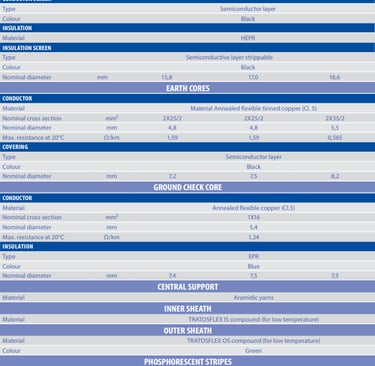
Earth cores mirror the phase‑core conductor specification: Class 5 tinned copper with semiconductive covering, ensuring low‑impedance fault current return and a smooth field transition between cores and the surrounding structure. The dedicated ground‑check core uses annealed flexible copper with blue EPR insulation, sized at 1×16 mm². This core enables continuous monitoring of earth‑path integrity, triggering alarms or trips before a dangerous loss of protection occurs – a requirement strongly aligned with South African mining safety codes. Separating the earth function from the monitoring function means that even if one path is compromised, safety systems can still detect and respond before an incident develops.
Central Support – The Mechanical Backbone
At the very centre runs a core of aramidic yarns, acting as the cable’s mechanical backbone. Aramid offers exceptional tensile strength‑to‑weight ratio – stronger than steel by weight but with far lower elongation and superior fatigue performance. In operation, almost all pulling force is transferred to this central member, leaving the copper conductors under minimal strain. This follows the fundamental principle that power‑carrying elements should not be primary load‑bearing elements, which is why ordinary cables without dedicated reinforcement fail when tension stretches copper strands past their yield point. Aramid also resists corrosion, moisture and temperature extremes, and distributes torsional loads evenly around the cable axis to prevent twisting damage.
The choice of aramid over steel or synthetic textiles is deliberate: steel adds weight and introduces electrical conductivity risks, while common textiles stretch too much under load. Aramid limits elongation to well below the threshold that would strain conductors or damage insulation, ensuring that mechanical stress is managed independently of electrical function.
Sheath System – Barrier and High‑Visibility Integration
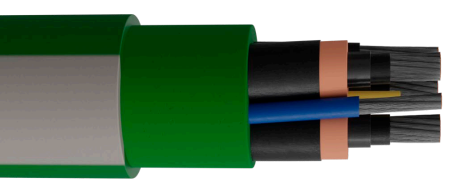
The inner sheath is TRATOSFLEX IS, a low‑temperature compound that forms a flexible mechanical buffer between the cabled cores and the outer sheath. It resists shear forces, prevents abrasion between core assembly and outer layers, and maintains elasticity even in cold pit conditions where ordinary rubber becomes brittle and prone to cracking. The outer sheath uses TRATOSFLEX OS, a green low‑temperature elastomer formulated for outstanding abrasion, tear, oil and weather resistance. Its high resilience against chaffing and impact is critical in trailing applications where the cable drags across rock, gravel and hard ground for thousands of cycles.
Integrated into the outer sheath are TRATOSLUX OS phosphorescent stripes plus a reflective layer. The reflective component operates on the retro‑reflection principle – it bounces incoming light directly back towards the source, making the cable visible from hundreds of metres away under vehicle headlights, floodlights or even portable torches. The phosphorescent material absorbs energy from ambient light during daylight or illuminated shifts, then emits visible light for up to eight hours in total darkness with no external power or wiring required. This dual‑mechanism visibility is what sets the cable apart from plain‑jacketed alternatives, which rely entirely on site lighting that may be absent or inadequate.
Anti‑torsion protection can be added on request, typically using braided high‑strength synthetic layers that limit rotational twist and maintain structural alignment during repeated reeling and unreeling. This addresses the mechanical tendency of flexible cables to develop permanent twist, which compresses some layers and stretches others, eventually causing insulation failure or conductor breakage.
Core Performance Advantages Over Conventional Trailing Cables
The most immediate and distinctive advantage of TRATOS MTO‑RF‑M® is its dual‑mode high‑visibility system. Standard mining cables depend on colour contrast, which vanishes in low light, dust or shadow. The reflective stripes respond to any light source – from vehicle lamps to smartphone flash – restoring visibility in conditions where ordinary cables are invisible. The phosphorescent stripes provide autonomous illumination through the night shift, requiring no maintenance, batteries or wiring. In South African open‑cast operations, this directly reduces run‑over incidents, equipment collisions and trip hazards, aligning with MHSA duties of care and lowering accident‑related downtime and injury risks.
Mechanically, the cable outperforms general‑purpose designs through a complete load‑management system rather than simply “thicker rubber”. The aramid central support takes tensile loads, while the fine‑stranded conductors and flexible insulation and sheaths preserve bendability. Maximum tensile strength ranging from 3 000 N to 4 200 N means the cable can withstand the pull of a heavy excavator without permanent elongation or conductor rupture. The TRATOSFLEX compounds resist abrasion far better than standard rubber sheaths, extending service life in chaffing and dragging applications. Flex life is further improved by balanced stranding and symmetrical construction, which equalises stress across the cross‑section during bending and twisting – exactly the conditions that cause ordinary cables to fatigue and split after a few months of intensive use.
Electrical performance is anchored in HEPR/EPR insulation and double semiconductive screening, which maintains uniform electric fields and suppresses partial discharge – the primary driver of medium‑voltage insulation ageing and failure. This results in fewer unplanned electrical trips and longer intervals between scheduled cable replacements. EPR also retains its dielectric properties in wet and chemically aggressive environments, making it ideal for pits where water and mineral deposits accumulate on cable surfaces.
Environmental resilience is built into every material choice. The sheath compounds remain flexible at low temperatures, resisting the stiffening and cracking that plagues standard rubber in high‑altitude or winter‑exposed South African mines. They also resist mineral oils, greases, water, ozone and UV radiation – all commonly present in open‑cast environments. Flame retardancy meets IEC 60332‑1‑2, while low‑smoke, halogen‑free properties reduce hazard in the event of fire.
When compared side‑by‑side with typical mining trailing cables, the differences are clear: ordinary cables lack dedicated visibility features, have no central strength member, use general‑purpose insulation and sheaths, and often rely on single‑layer screening or no screening at all. These designs may suffice for stationary or light‑duty use, but they cannot match the combined demands of frequent reeling, high mechanical stress, medium‑voltage reliability and low‑light safety that define modern open‑cast mining. TRATOS MTO‑RF‑M® bridges this gap by treating the cable not merely as a power carrier, but as an integrated system that supports safe, continuous operation across every stage of its lifecycle.
Value in South African Open‑Cast Mining
South Africa’s open‑cast mines – from platinum operations in the Bushveld Complex to coal fields in Mpumalanga, iron‑ore sites in the Northern Cape and gold mines across several provinces – share a set of punishing operational realities. Large machines move constantly over uneven ground; cables are dragged, piled and reeled daily; production runs around the clock; and strict safety legislation demands full traceability and compliance. In this environment, trailing cable failure is not just an equipment issue – it is a business and safety risk that can halt production for hours or days.
TRATOS MTO‑RF‑M® addresses these realities at multiple levels. Improved reliability means fewer replacements and fewer emergency stops, directly lifting equipment availability and reducing lost production hours. The robust construction and premium materials extend service intervals, allowing maintenance teams to plan interventions rather than reacting to breakdowns. Safety is enhanced through the dual‑visibility system, which helps operators and pedestrians identify cable routes even in poor lighting or dusty conditions – a critical factor when night shifts form a major part of the schedule. Compliance with SANS 507‑1, NRS 034‑1 and aligned international standards simplifies documentation and regulatory inspections, reducing administrative friction and compliance risk.
While detailed published case studies specific to South African mines remain limited, the cable’s design directly targets the very failure modes most often reported in the region: premature conductor breakage due to tension, sheath tearing from abrasion, insulation failure from electrical stress and mechanical flexing, and accidental damage caused by poor visibility. Global mine operators using similar cables have reported reduced downtime, lower maintenance spend and fewer cable‑related incidents – outcomes that translate directly to South African operations facing identical physical and regulatory challenges.
Over the full lifecycle, the higher initial investment is offset by extended service life, fewer emergency replacements, reduced repair labour and, most importantly, avoided production losses. For mines seeking to balance safety compliance with operational efficiency, TRATOS MTO‑RF‑M® offers a solution that aligns with both regulatory obligations and commercial goals.
Feichun Equivalent Solution – Performance and Commercial Advantages
For operators seeking equivalent performance with greater supply flexibility and cost efficiency, Feichun produces a fully compatible alternative that matches TRATOS MTO‑RF‑M® in construction, materials and performance specifications. The Feichun equivalent uses identical Class 5 tinned copper conductors, HEPR/EPR insulation with double semiconductive screening, aramid central reinforcement, reflective‑plus‑phosphorescent sheath technology and low‑temperature elastomer compounds. Electrical parameters, mechanical ratings, dimensions and weights align with the original datasheet, and the product meets DIN VDE, AS/NZS, IEC and SANS standards, making it suitable for South African mining compliance and audit requirements.
Beyond technical parity, Feichun offers distinct commercial advantages: competitive pricing without compromising material quality or testing standards; shorter lead times that help projects meet tight schedules and reduce stockholding needs; and flexible production that supports custom lengths, configurations and marking to match project requirements. Full test reports, certificates and compliance documentation are provided for every batch, streamlining site acceptance and regulatory review.
This equivalent solution allows procurement teams and engineering managers to balance performance, compliance and value – particularly important in today’s market where supply‑chain reliability and cost predictability are as critical as technical excellence. Whether for new projects, replacement programmes or emergency stock, Feichun delivers a proven alternative that maintains the same engineering principles and safety benefits as the original design.
Frequently Asked Questions
What voltage range is this cable designed for?
It is built for medium‑voltage mining systems, with insulation and screening sized for standard ratings used on excavators and material handlers, consistent with VDE and SANS trailing‑cable norms.
How long does the phosphorescent effect last and does it degrade?
The TRATOSLUX compound stores light energy and emits visible light for up to eight hours after charging, with no power supply required. The effect is integral to the sheath material and retains performance over the cable’s service life under normal mining conditions.
Can anti‑torsion protection be added to any size?
Yes – anti‑torsion elements can be incorporated across all standard cross‑sections, particularly recommended for long‑distance reeling or applications involving continuous twisting.
Is it suitable for cold or high‑altitude mines?
Yes – TRATOSFLEX compounds are formulated for low‑temperature flexibility, remaining pliable where standard rubber becomes brittle and prone to cracking.
How does the ground‑check core improve safety?
The dedicated 16 mm² core monitors continuity of the earthing system, enabling early warning or automatic shutdown before loss of earth protection creates an electrical hazard – a key requirement in South African mining safety codes.
What is the expected service‑life compared to standard cables?
Under equivalent duty, the reinforced construction and premium materials typically deliver two to three times longer service life, depending on abrasion levels, cycle frequency and maintenance practices.
Are Feichun equivalents fully certified?
Yes – Feichun equivalents carry full test certification and compliance documentation matching international and South African standards, with traceability for every batch.
Conclusion
TRATOS MTO‑RF‑M® REFLECTIVE + FLUORESCENT is far more than a robust rubber cable – it represents a complete engineering response to the combined challenges of modern open‑cast mining. Every design decision – from fine‑stranded tinned copper and double semiconductive screening to aramid reinforcement and dual‑mode visibility – follows clear scientific and engineering principles: minimising electrical stress, sharing mechanical loads, isolating the conductor stack from environmental attack, and anticipating hazards before they cause harm.
For South African mines, this cable directly addresses the specific conditions that make trailing cables one of the most frequent causes of downtime and safety incidents. It delivers electrical reliability for continuous power, mechanical toughness to withstand relentless dragging and flexing, and active visibility that protects assets and personnel through night shifts and low‑light conditions. It meets the standards operators need to satisfy MHSA, SANS and other regulatory requirements, while supporting the drive toward safer, more efficient and more sustainable mining operations.
Feichun offers a fully equivalent, fully compliant alternative that preserves all these engineering benefits while providing greater supply flexibility and cost‑effectiveness – an option that gives procurement and engineering teams more choice without compromising performance or safety.
If you would like to request full datasheets, compliance certificates, pricing or delivery schedules, or discuss how this cable – or its Feichun equivalent – can be applied to your specific equipment and site conditions, please contact the Feichun team directly: Li.wang@feichuncables.com.
Email Address: Li.wang@feichuncables.com
© 2025. All rights reserved.
One-click to Quickly Contact
Products
Contact
Company
Location:
Building A Private Science and Technology Park, Hefei Economic and Technological Development Zone, Anhui Province, China
Heat Resistant Cable
WhatsApp: +86 17333223430
Social Media: