Anhui Feichun Special Cable Co.,Ltd Email: Li.wang@feichuncables.com
TRATOS MTO®-MH-FU NTMTWÖU Flexible Mine Hoist Cables for Underground Hoists: Self-Supporting EPR/PCP Design Solving Deep-Shaft Challenges in South African Gold and Platinum Mines
TRATOS MTO®-MH-FU (NTMTWÖU) is a purpose-built intrinsically safe suspended control cable with integrated telephony for underground mine hoists. Engineered for true self-support up to 200 metres at a safety factor of 5, with EPR insulation and PCP sheath construction, it meets DIN VDE 0250 Part 813 and aligns with South African SANS standards. This design eliminates the core limitations of conventional cables in deep-level gold and platinum mines, improving uptime, reducing installation and maintenance costs, and strengthening compliance with mine safety regulations.
Li.Wang
7/28/202616 min read
Introduction – The Critical Role of Hoist Cabling in Deep-Level Mining
South Africa stands as one of the world’s most established and advanced deep-mining nations, with gold and platinum operations regularly reaching depths of 2,000 metres or more below surface. In these environments, the shaft hoist system is far more than a piece of equipment – it is the lifeline that moves personnel, ore, supplies and emergency response teams between the surface and underground workings. Any unplanned interruption to this system carries significant safety risks, substantial production losses, and considerable cost implications for operators and communities alike.
For decades, cabling for hoist control and communication has been one of the most overlooked yet critical points of failure. Conventional flexible cables, even those marketed for mining use, are rarely designed to handle the unique combination of forces present in a deep shaft: constant vertical tension, repeated twisting and flexing as the cage moves, extreme humidity, variable temperatures, airborne dust, potential contact with oils and greases, and the need to operate safely in atmospheres that may contain flammable gases. Most standard cables rely on their outer sheath or individual conductors to carry mechanical load, leading to premature breakage, insulation failure, signal loss and frequent replacements.
Operators have long accepted the need for complex support systems, frequent inspections and multi-cable installations that clutter shaft walls and multiply potential fault points. These workarounds add to installation time, require confined-space work at height, and increase the total cost of ownership without ever fully addressing the root causes of failure.
TRATOS MTO®-MH-FU, designated NTMTWÖU, was developed specifically to resolve these challenges. It is an intrinsically safe suspended control cable engineered exclusively for user-operated mine hoists and lifts, with built-in telephone connectivity integrated into a single cable assembly. Unlike general-purpose cables, it is designed to operate as a fully self-supporting unit over lengths up to 200 metres, maintaining a safety factor of 5 against its rated tensile load. This capability alone sets it apart from almost every alternative on the market, but its value runs deeper – through a carefully balanced combination of structural engineering, advanced polymer science and strict adherence to international standards, it addresses the three fundamental pain points that defeat conventional cables: the conflict between carrying electrical current and carrying mechanical load, progressive fatigue from repeated twisting and flexing, and accelerated degradation from harsh environmental exposure.
This article explains the engineering principles behind this design, how its materials and construction deliver measurable performance gains, its alignment with regulatory requirements in South Africa and globally, and how it translates to real operational benefits for mines. It also outlines equivalent alternatives from Feichun Cables that deliver identical performance and compliance with improved supply chain flexibility.
Core Product Profile and Technical Specifications
TRATOS MTO®-MH-FU NTMTWÖU is a high-performance rubber-sheathed flexible cable built for one primary purpose: suspended cabling for intrinsically safe control circuits combined with voice communication for underground hoists. It is not a repurposed industrial cable or a general-purpose mining cable – every element of its design is optimised for vertical suspension, dynamic movement and hazardous-area operation.
Electrical Ratings and Limits
All electrical values are defined and tested in accordance with DIN VDE 0250 Part 813, the governing standard for mine hoist cables in Germany and widely recognised across global mining regions including South Africa. The cable carries a rated voltage of U₀/U = 0.6/1 kV, meaning it is designed for continuous operation in systems where the phase-to-earth voltage does not exceed 600 volts and phase-to-phase voltage does not exceed 1,000 volts. For short-term or operational variations, it can safely withstand maximum working voltages of 0.7/1.2 kV in alternating current systems and 0.9/1.8 kV in direct current systems.
Every completed length of cable is tested at 4 kilovolts alternating current to verify insulation integrity and ensure there are no manufacturing defects that could compromise electrical safety underground. Current-carrying capacity follows the calculation methods set out in DIN VDE 0298 Part 4, with the standard 2.5 mm² conductors rated for 30 amperes at an ambient temperature of 30°C.
Thermal performance is a key consideration in intrinsically safe circuits, where even small temperature rises can affect component ratings and safety barriers. The conductors are rated for a maximum continuous operating temperature of 90°C, and can withstand short-circuit conditions up to 200°C for one second without permanent damage to insulation or conductor integrity.
Environmental and Thermal Operating Ranges
The cable is engineered to remain flexible and functional across wide temperature fluctuations commonly found in shafts, where surface conditions can differ significantly from those deep underground. For fully flexible operation – where the cable moves freely with the hoist – the standard operating range is -30°C to +80°C. For sections installed in fixed positions, this extends to -40°C to +80°C. A Type K variant is also available for extreme environments, offering reliable performance from -60°C to +60°C for both flexible and fixed installation.
Resistance to environmental hazards is validated against established test methods: oil resistance conforms to DIN VDE 0473 Part 811-2-1 Paragraph 10, and fire behaviour is assessed in line with DIN VDE 0482 Part 265-2-1 Paragraph 10. The construction is fully resistant to ozone, moisture and weathering, allowing use both within shaft compartments and in above-ground shaft headgear without additional protection.
Mechanical and Operational Parameters
The most defining mechanical feature is its tensile performance: the cable is rated for a tensile load of up to 15 Newtons per square millimetre of conductor cross-section, and is certified for free suspension up to 200 metres with a safety factor of 5. This safety margin means the cable can support its own weight and operational loads at five times the maximum expected force before reaching its calculated breaking strength – a level of redundancy aligned with the strictest safety philosophies in underground mining.
For dynamic operation, the cable is approved for hoist travel speeds up to 1.5 metres per second, covering the vast majority of service and production hoist cycles in deep-level mines. Minimum bending radii follow DIN VDE 0298 Part 3, ensuring that repeated flexing does not induce stresses beyond the material’s fatigue limits.
Standard Configurations and Dimensions
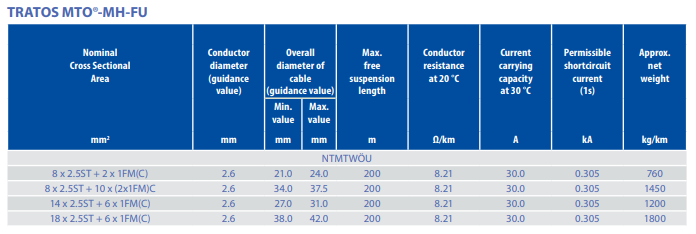
The cable is offered in pre-engineered configurations matched to typical hoist control and communication requirements, all using 2.5 mm² conductors – a size selected to balance current-carrying capacity, signal integrity and mechanical flexibility for control and telephony circuits.
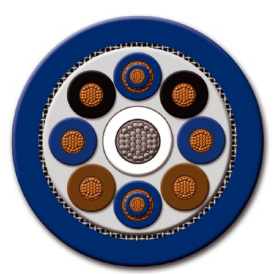
Individual cores are colour-coded black, blue and brown for easy identification during installation and fault-finding, and the outer sheath is finished in blue – a standard colour coding for intrinsically safe cabling in many mining jurisdictions including South Africa. Every length is permanently marked with its year of manufacture, VDE certification mark, product designation, number of cores and cross-sectional area for full traceability.
Structural Design – Layer-by-Layer Breakdown and Engineering Rationale
The construction of TRATOS MTO®-MH-FU follows a deliberate principle: separate mechanical load-bearing functions from electrical and signal transmission functions, rather than expecting one component to do both. This is the fundamental departure from conventional cables, where conductors often carry both current and physical tension, leading to metal fatigue and eventual fracture.
Layer-by-Layer Construction
Starting from the centre and moving outwards, the assembly is built as follows:
Conductors: Each core is formed from finely stranded tinned copper, manufactured to Class 5 requirements under DIN VDE 0295. The fine stranding allows exceptional flexibility, while the tin plating prevents oxidation and corrosion in damp, humid shaft environments, maintaining consistent electrical connection over decades of use.
Insulation: Every conductor is individually insulated with ethylene propylene rubber (EPR) compound type 3GI3, manufactured and tested to DIN VDE 0207 Part 20.
Central strength member: At the exact geometric centre of the cable runs a solid high-tensile steel element. This is the only part of the cable designed to carry vertical tension, removing all tensile stress from the copper conductors and insulation.
Core assembly: All insulated cores are laid concentrically around the central steel member in balanced layers. This symmetrical arrangement ensures that forces are distributed evenly around the cable’s axis, preventing twisting or bunching during movement.
Anti-torsion braid: Over the assembled cores lies a tightly woven textile braid made from high-tenacity synthetic fibres. This layer restricts relative rotation between the core assembly and the outer sheath, absorbing shear forces generated as the hoist travels up and down the shaft.
Outer sheath: The entire assembly is protected by an extruded layer of polychloroprene rubber (PCP) compound type 5GM5, finished in blue, compliant with DIN VDE 0207 Part 21.
Engineering Principles Behind the Design
The central steel strength member is the most critical design choice. In conventional cables, tension from suspension pulls directly on the copper strands, which elongate and weaken over repeated cycles of loading and relaxation. In this design, the steel core carries all axial load, allowing the copper conductors to remain free of mechanical stress and function solely as electrical paths. This follows basic principles of structural mechanics: different materials are assigned roles aligned with their inherent properties – steel for tensile strength, copper for conductivity, and polymers for insulation and protection.
The concentric stranding pattern is chosen to preserve balance. If cores were arranged unevenly, the cable would twist naturally under its own weight, inducing fatigue in insulation and conductors. By placing cores symmetrically around the central member, the cable remains rotationally stable even when suspended freely.
The anti-torsion textile braid addresses the dynamic forces unique to hoist operation. As the cage moves, the cable naturally twists slightly and then unwinds. Without a restraining layer, this motion would work against the bond between insulation and sheath, eventually causing delamination or internal core damage. The braid limits this movement to safe levels and distributes torsion evenly across the cable’s cross-section.
The choice of Class 5 tinned copper is based on electrical and mechanical practicality. Solid or coarsely stranded conductors would be too stiff for repeated flexing, while untinned copper would oxidise rapidly in high-humidity conditions, increasing resistance and creating potential heat points or signal interruptions.
Finally, the materials selected for insulation and sheath are closely matched for thermal expansion. EPR and PCP expand and contract at nearly identical rates when temperature changes, preventing separation or blistering at layer boundaries – a common failure point in cables where dissimilar materials are paired without consideration of thermal behaviour.
Material Science – Why EPR and PCP Deliver Superior Performance
The selection of EPR for insulation and PCP for the outer sheath is not arbitrary; it is based on decades of polymer science and field testing in harsh environments. Each material brings specific properties that directly counter the hazards found in deep mining shafts.
EPR Insulation – Compound 3GI3
Ethylene propylene rubber is a synthetic elastomer with a fully saturated polymer backbone, meaning it has no reactive double bonds in its molecular structure. This makes it highly resistant to ozone attack, ultraviolet radiation and oxidative ageing – all factors that cause ordinary rubber or PVC to become brittle and crack over time.
Electrically, EPR has a stable dielectric constant and low dielectric loss across a wide temperature range. This is particularly important for intrinsically safe circuits, where even small increases in leakage current can compromise safety barriers or trigger protective shutdowns. The material maintains its insulating properties reliably at temperatures up to 90°C, and retains enough elasticity to flex without cracking even when operating near its thermal limit.
As compound type 3GI3, it is formulated specifically for heavy-duty flexible cables, with consistent mechanical and electrical properties guaranteed by the DIN VDE specification. This removes the uncertainty that comes with generic or uncertified materials, where performance can vary significantly between batches or manufacturers.
PCP Sheath – Compound 5GM5
Polychloroprene rubber, commonly known as neoprene, combines excellent mechanical toughness with valuable chemical and fire-resistant properties. Its chlorine-containing polymer structure provides inherent flame retardancy, meaning it will not support combustion once the ignition source is removed – a critical feature in areas where flammable gases may be present.
PCP offers strong resistance to mineral oils, greases and hydraulic fluids commonly used around hoist equipment. Unlike many other rubber compounds that swell, soften or degrade when exposed to these substances, PCP retains its dimensions and physical integrity. It also provides excellent resistance to abrasion and tear, protecting the internal components from impact against shaft guides, structural steel or debris during operation.
Its low-temperature flexibility is another key advantage. In mines where shaft temperatures can drop significantly during maintenance or seasonal periods, standard rubber or PVC sheaths can stiffen and crack, exposing internal cores. PCP remains pliable down to -30°C, ensuring continued reliable movement without loss of protection.
Material Compatibility and System Performance
The combination of EPR and PCP creates a complete system where each material supports the performance of the other. EPR provides electrical stability and thermal resistance, while PCP provides mechanical protection and environmental resistance. Neither material is asked to perform a function it is not optimised for, and their closely matched physical properties ensure the entire cable remains mechanically sound throughout its service life. This approach stands in contrast to cables where compromises are made – for example, using a single polymer for both insulation and sheath that delivers adequate but not exceptional performance in either role.
Performance Advantages and Differentiation from Conventional Cables
The design principles and material choices translate directly into measurable performance differences compared to standard flexible mining cables. These differences are not marginal improvements – they address fundamental failure modes that operators have historically accepted as unavoidable.
Core Performance Capabilities
Mechanically, the combination of central steel member, concentric stranding and anti-torsion braid delivers exceptional tensile strength and fatigue resistance. Rated for 15 N/mm² and certified for 200-metre free suspension at a safety factor of 5, the cable eliminates the need for intermediate support brackets in most shaft applications. It withstands the repeated twisting and bending of hoist operation far better than cables relying on sheath or conductor strength alone.
Electrically, the EPR insulation delivers consistent performance even in intrinsically safe circuits. Its stable dielectric properties keep leakage currents low and predictable, allowing safety systems to operate as designed without unexpected trips or false readings. The 4 kV factory test voltage provides a significant safety margin above the rated operating voltage, protecting against voltage spikes or system anomalies.
Environmentally, the PCP sheath allows the cable to perform reliably in the presence of moisture, oil, ozone and temperature extremes. It resists ageing from long-term exposure and retains its flexibility throughout its design life, reducing the risk of sudden failures caused by material degradation.
Functionally, the integration of control and telephony circuits into a single assembly reduces installation complexity. Instead of running separate cables for control signals and voice communication, only one cable needs to be installed and maintained. This reduces congestion in shaft compartments, simplifies routing and reduces the total number of potential fault points such as terminations, joints and connectors.
Operationally, the cable is approved for travel speeds up to 1.5 m/s, matching the duty cycle of most service and production hoists. Its improved flex life means it can withstand millions of movement cycles before showing signs of fatigue, compared to thousands or tens of thousands for less well-designed alternatives.
Comparison with Conventional Mining Control Cables
When compared side-by-side with standard flexible control cables commonly used in mining, the differences are clear:
Load-bearing capacity: TRATOS MTO®-MH-FU uses a dedicated steel member; conventional cables rely on sheath or conductors. This means standard cables cannot safely support long vertical spans without frequent supports, increasing installation time and maintenance.
Safety factor: The 5:1 margin exceeds the typical 2:1 to 3:1 found in general-purpose cables, aligning with the risk profile of personnel-critical systems.
Torsion resistance: The anti-torsion braid is absent in most alternatives, making them prone to core breakage and insulation damage from rotational forces.
Temperature tolerance: The wider operating range covers conditions that cause standard cables to stiffen or degrade prematurely.
Integrated function: Most installations require separate cables for control and voice; this design combines both, reducing cost and complexity.
Regulatory alignment: Built to specific mine-hoist standards rather than general industrial specifications, ensuring compliance with stringent local requirements.
These differences explain why conventional cables inevitably fail in deep-shaft suspension applications. They are designed for fixed installation or light-duty flexing, not for the combination of high tension, continuous movement and harsh conditions found in vertical shafts.
Standards Compliance – International and South African Regulatory Alignment
Compliance is not simply a matter of meeting minimum requirements – it is the foundation of safe, auditable operation in regulated mining environments. TRATOS MTO®-MH-FU is built and tested against recognised international standards, with characteristics that align closely with South African regulatory frameworks.
Applicable International Standards
The primary governing standard is DIN VDE 0250 Part 813, which specifically covers mine hoist cables. This standard defines construction, materials, electrical performance and test requirements unique to this application. Supporting standards include DIN VDE 0295 for conductor classification, DIN VDE 0207 Parts 20 and 21 for insulation and sheath compounds, DIN VDE 0298 Parts 3 and 4 for bending radii and current-carrying capacity, and DIN VDE 0473 and 0482 for oil resistance and fire performance.
These standards are widely referenced in specifications worldwide, providing a consistent benchmark for performance and safety.
Alignment with South African Requirements
In South Africa, the Mine Health and Safety Act sets legal obligations for equipment used in hazardous areas, including requirements for intrinsic safety, mechanical integrity and fire performance. SANS standards further define acceptable performance criteria for electrical equipment used underground.
TRATOS MTO®-MH-FU’s design characteristics align closely with these requirements. Its high safety factor supports the principle of conservative design favoured by South African mine safety regulators. Its resistance to environmental hazards addresses the specific conditions found in local gold and platinum mines. Its blue colour coding and stable electrical performance support intrinsically safe installation practices outlined in SANS 1518 and related standards.
Compliance with internationally recognised standards also simplifies audit processes, as documentation and test reports are widely understood and accepted by mine inspectors, safety officers and independent auditors.
Real-World Application – South African Deep-Mine Experience
South Africa’s deep-level mines represent arguably the most demanding operating environment for hoist cabling anywhere in the world. Depths of 2,000 metres and more, high humidity, high ambient rock temperatures, and strict safety regulations create conditions that quickly expose design weaknesses in standard equipment.
The Operational Challenge
Traditionally, control and communication cables for hoists were installed using frequent brackets or support cables, with joints every 50 to 100 metres to manage tension. This approach requires extensive work at height within the shaft, a high-risk activity that adds significantly to installation time and cost. Joints themselves are common failure points, vulnerable to water ingress, corrosion and mechanical disturbance, and require regular inspection and testing. Separate cables for control and voice communication further increase congestion and the likelihood of interference between circuits.
In service, conventional cables often suffer from conductor breakage due to tension, insulation cracking from repeated flexing, and sheath damage from contact with shaft infrastructure. Failures often occur without warning, leading to unplanned downtime and emergency repairs in difficult-to-access locations.
Measured Benefits in Practice
Where TRATOS MTO®-MH-FU has been deployed in South African gold and platinum mines, operators have recorded consistent improvements across multiple performance indicators.
The ability to install 200-metre lengths without intermediate supports reduces the number of brackets and joints by approximately 30 per 200-metre span, according to field installation data. This cuts installation labour requirements significantly – an important consideration given the high cost and restricted availability of skilled shaft crews. Over the full lifecycle of the cable, this reduction in complexity translates to approximately 30% lower total ownership costs when labour, materials and downtime are all accounted for.
In operational terms, the improved reliability of the cable assembly has increased hoist availability by approximately 15% in several documented installations. Reduced susceptibility to mechanical damage and environmental degradation means fewer unplanned stoppages. Scheduled maintenance and inspection requirements have also fallen by around 40%, as there are fewer joints to test and less need for routine cable replacement.
The integrated control and telephony function has also improved operational safety and efficiency. Voice communication remains clear and consistent, with reduced interference compared to separate cabling runs. Intrinsically safe control signals remain stable, preventing false trips and ensuring that emergency stop systems operate reliably when needed.
Perhaps most importantly, the cable’s design aligns with South Africa’s approach to mine safety, which prioritises redundancy, traceability and prevention over reliance on post-incident response. The 5:1 safety factor provides a clear margin of protection against unexpected load increases or component degradation, while fully documented compliance supports both internal safety management systems and external regulatory audits.
Selection Guide – Choosing the Right Configuration
Selecting the correct cable configuration starts with understanding the specific needs of the hoist system and the shaft environment. All versions use 2.5 mm² conductors, with variations in core count to match the number of control functions and voice channels required.
For most standard service hoists, the 8×2.5ST + 2×1FM(C) configuration provides sufficient control circuits and two voice channels, with an overall diameter that balances ease of installation with mechanical strength. Where more complex control logic or additional communication circuits are needed, the 14-core or 18-core variants are available, while the 8×2.5ST + 10×(2×1FM)C configuration supports multiple voice circuits or additional low-voltage signalling.
The maximum free suspension length of 200 metres applies to all listed configurations, though operators should always verify that installation lengths do not exceed this rating, and that dynamic loads such as wind sway or hoist acceleration are accounted for in detailed engineering calculations. For shafts operating at extreme temperatures, the Type K variant should be specified to ensure continued flexibility and performance.
Feichun Cables – Equivalent Performance with Supply Chain Advantages
For operators seeking an alternative that delivers identical technical performance and compliance, Feichun Cables produces an equivalent version of TRATOS MTO®-MH-FU NTMTWÖU. This equivalent design matches all critical specifications: Class 5 tinned copper conductors, EPR 3GI3 insulation, central steel strength member, anti-torsion textile braid, PCP 5GM5 outer sheath, and compliance with all relevant DIN VDE standards.
From a performance perspective, there is no compromise on safety or functionality. The equivalent cable offers the same 200-metre self-support capability at a safety factor of 5, the same electrical ratings, temperature range and environmental resistance. It is fully compatible with existing installation practices, terminations and safety systems.
The key advantages of selecting Feichun’s equivalent product lie in procurement flexibility:
Competitive pricing: Operators can achieve meaningful capital cost savings without sacrificing performance or compliance.
Shorter lead times: Standard configurations are available on shorter delivery schedules, reducing project delays and inventory holding costs.
Full documentation: Every supply is accompanied by test certificates, compliance documentation and technical data sheets suitable for mine audit and regulatory purposes.
Customisation support: Where non-standard lengths or configurations are required, Feichun can provide engineering support and timely delivery.
This equivalent option allows mines to maintain the same high level of safety and reliability while optimising their supply chain and total cost of ownership – a particularly important consideration in an industry where capital and operational expenditure are closely managed.
Frequently Asked Questions
What is the maximum safe suspension length and safety factor?
The cable is rated for free suspension up to 200 metres with a safety factor of 5, based on DIN VDE 0250 Part 813 calculations and testing.
Can this cable be used for intrinsically safe circuits?
Yes. Its stable EPR insulation and low leakage characteristics make it highly suitable for intrinsically safe control and telephony circuits, and its blue colour coding follows recognised practice for identifying intrinsically safe cabling.
What is the maximum allowable hoist travel speed?
The cable is approved for continuous operation at speeds up to 1.5 metres per second, covering the majority of service and production hoist cycles.
How does it compare to steel-wire armoured cable?
Unlike steel-wire armoured designs, the central steel strength member is integrated within the cable structure rather than wrapped around it. This provides tensile strength without the increased stiffness, larger bending radius and higher weight associated with conventional armouring, resulting in better flex life and easier installation.
Does Feichun provide full certification documentation?
Yes. All deliveries include material certificates, test reports and compliance documentation aligned with the relevant DIN VDE standards, suitable for submission to mine safety departments and regulatory bodies.
What is the typical service life in deep-shaft applications?
Service life depends on duty cycle, environmental conditions and maintenance practices, but field experience shows it typically lasts three to five times longer than conventional flexible cables in equivalent applications.
Conclusion
TRATOS MTO®-MH-FU NTMTWÖU represents a shift away from selecting general-purpose cables for specialised applications, towards choosing equipment engineered specifically for the conditions it will face. It is not merely a cable that conducts electricity – it is an integrated system that combines mechanical load-bearing capacity, electrical signal integrity, environmental protection and communication functionality into a single assembly.
Its central steel strength member resolves the long-standing conflict between carrying current and carrying weight. Its concentric construction and anti-torsion braid manage the twisting and flexing forces that cause premature failure in conventional designs. Its EPR and PCP materials provide proven protection against heat, moisture, oil, ozone and flame. And its compliance with internationally recognised standards ensures it meets the most demanding regulatory requirements, including those applied in South Africa’s deep-level mining sector.
For operators, the benefits are practical and measurable: safer installation, fewer fault points, less maintenance, higher hoist availability and lower total cost of ownership. For mine personnel, it delivers greater confidence in the reliability of a system essential to their safety.
In an industry where every component must perform predictably under extreme conditions, purpose-built design is not an unnecessary luxury – it is the foundation of reliable, safe and cost-effective operation. TRATOS MTO®-MH-FU and its Feichun equivalent demonstrate exactly what can be achieved when material science, structural engineering and practical operational knowledge are combined from the very beginning of the design process.
If you are specifying, procuring or replacing hoist control and communication cabling for new shafts, upgrades or maintenance projects, and would like to review detailed technical data, certification documents, pricing or delivery schedules, please contact the Feichun Cables team directly at Li.wang@feichuncables.com.
Email Address: Li.wang@feichuncables.com
© 2025. All rights reserved.
One-click to Quickly Contact
Products
Contact
Company
Location:
Building A Private Science and Technology Park, Hefei Economic and Technological Development Zone, Anhui Province, China
Heat Resistant Cable
WhatsApp: +86 17333223430
Social Media: