Anhui Feichun Special Cable Co.,Ltd Email: Li.wang@feichuncables.com
TRATOS MTO®-M / MTO®-M (FO) Medium Voltage Flexible Reeling Cables: EPR/PCP Construction, DIN VDE 0250 Standards & Proven Performance in South African Open-Cast Mines for Excavators, Dumpers & Mobile Crushers
TRATOS MTO®-M / MTO®-M (FO) Medium Voltage Flexible Reeling Cables: EPR/PCP Construction, DIN VDE 0250 Standards & Proven Performance in South African Open-Cast Mines for Excavators, Dumpers & Mobile Crushers Meta Description For South African mining engineers, procurement teams and site managers: this complete technical guide breaks down the TRATOS MTO®-M and MTO®-M (FO) medium voltage reeling cables, purpose-built to DIN VDE standards with EPR/PCP construction for high mechanical stress. Proven in open-cast mines across South Africa for excavators, dumpers and mobile crushers, these cables deliver far longer service life, fewer unplanned stoppages and lower total operating cost compared to standard alternatives. Includes full specifications, design principles, real-world case studies, selection guidance and equivalent options from Feichun Cables.
Li.Wang
7/24/202617 min read
Introduction
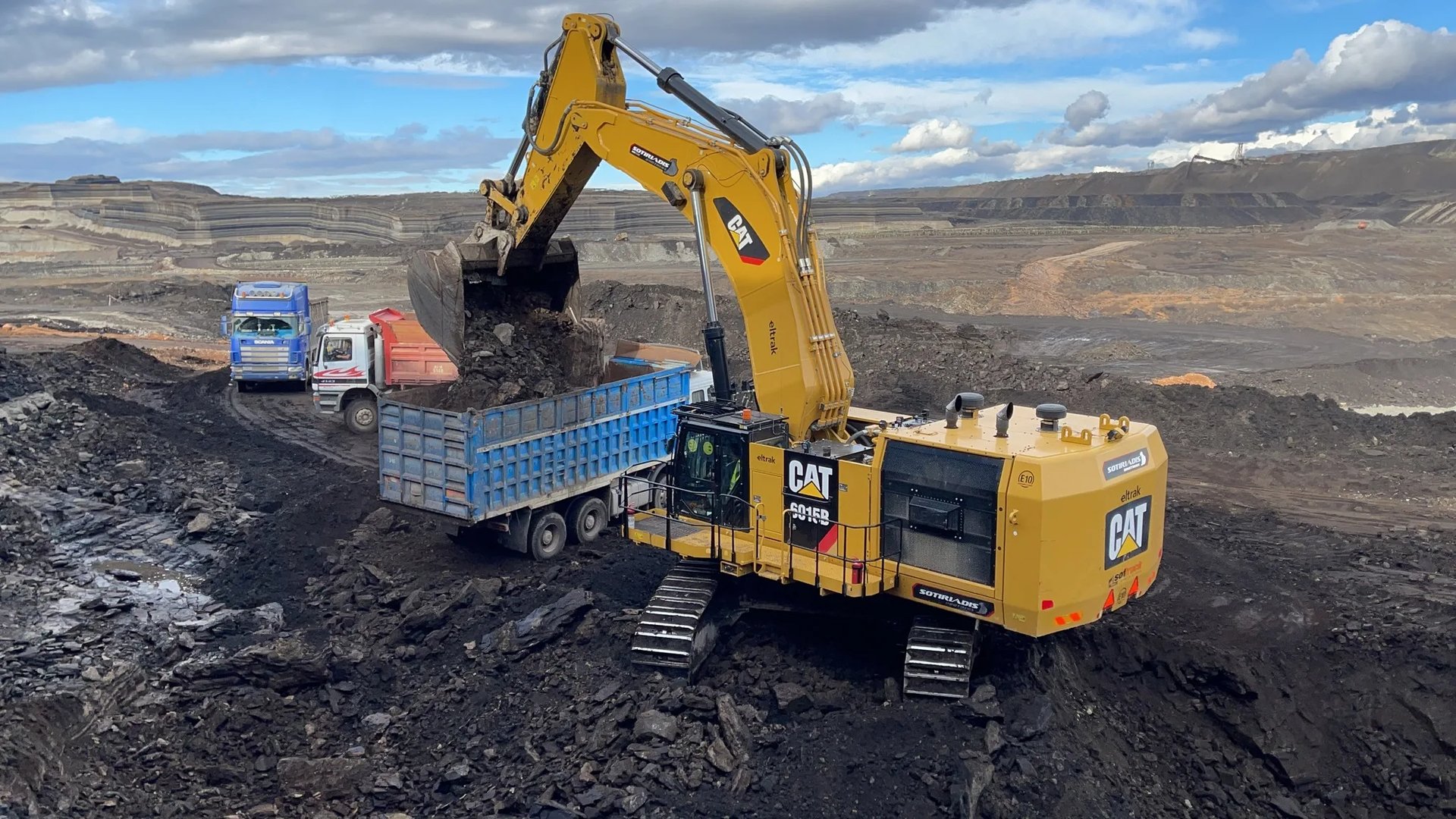
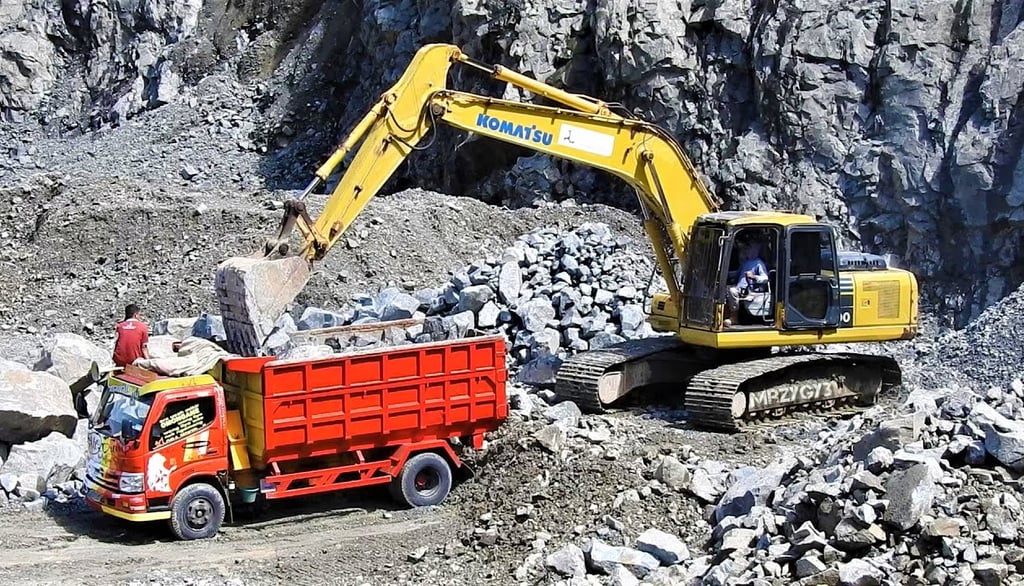
Open-cast mining operations across South Africa form the backbone of the country’s mineral economy, producing vast volumes of coal, iron ore, platinum group metals and manganese for domestic use and global export. Every tonne extracted relies on continuous, reliable power delivery to some of the largest and most demanding mobile equipment in industry: rope shovels with 15 to 50 cubic metre buckets, electric haul trucks weighing hundreds of tonnes when loaded, and mobile crushing plants that process thousands of tonnes an hour.
For decades, one of the most persistent and costly pain points in these operations has been the medium voltage cables that feed this equipment. Standard cables designed for fixed installations or light-duty reeling typically fail within three to nine months when exposed to the rigours of open-cast mining. They snap conductors under repeated flexing, suffer insulation breakdown from electrical stress, tear or crack under abrasion and temperature swings, or lose signal integrity when combined with communications fibres. Every failure means unplanned downtime that can cost hundreds of thousands of Rand per hour, plus the labour and material costs of emergency replacements, and safety risks associated with working on energised equipment or damaged cabling.
This is where the TRATOS MTO®-M and MTO®-M (FO) range is engineered to deliver a fundamental shift. Classified as R-(N)TSCGEWÖU medium voltage reeling cables, they are built from the ground up specifically for connection to large material handling machinery in open-cast mines. They are designed to work seamlessly with both mono-spiral reels and cylindrical reels, and engineered to withstand the full spectrum of high mechanical stresses encountered in these applications: constant flexing, repeated twisting, high tensile loads and abrasive wear. The MTO®-M variant delivers power only, while the MTO®-M (FO) integrates optical fibres within the same cable structure to carry data for equipment monitoring, automation and control alongside electrical power.
At its core, this range is not just a cable – it is a complete system built on the principle of integrated engineering: carefully selected materials matched to purpose-designed structures, validated against rigorous DIN VDE standards and real-world performance testing. In South African mines and similar operations globally, it has repeatedly demonstrated that it can withstand the dynamic stresses, environmental attack and cyclic loading that cause standard cables to fail prematurely. By combining precise electrical field control with extreme mechanical resilience, it directly addresses the four most common failure modes seen in mine-site reeling cables: conductor breakage, insulation breakdown, outer sheath damage and signal loss.
Core Technical Specifications and Compliance Standards
All performance values outlined in this section are taken directly from the official TRATOS technical documentation dated May 2014, ensuring full accuracy and consistency with the manufacturer’s certified data.
Electrical Parameters
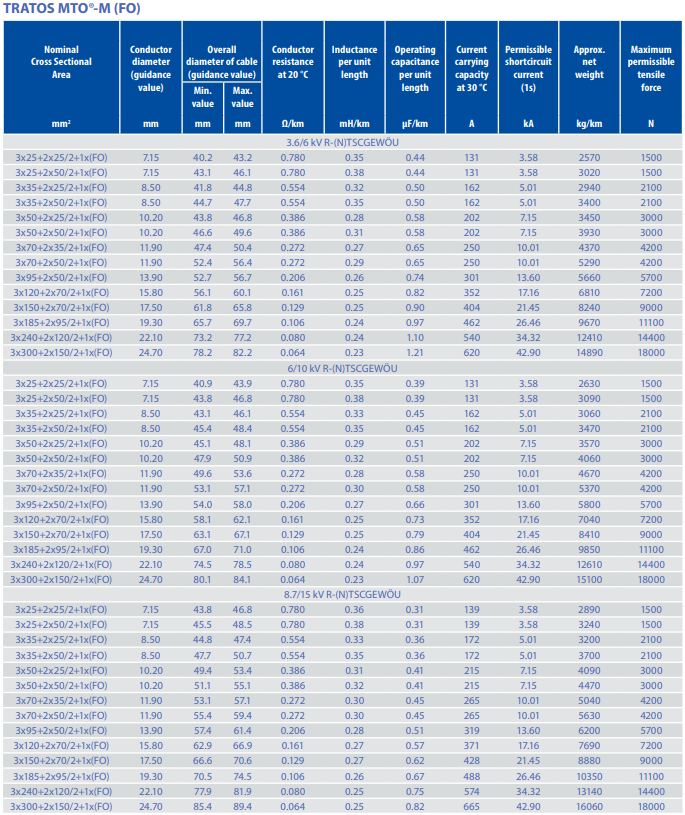
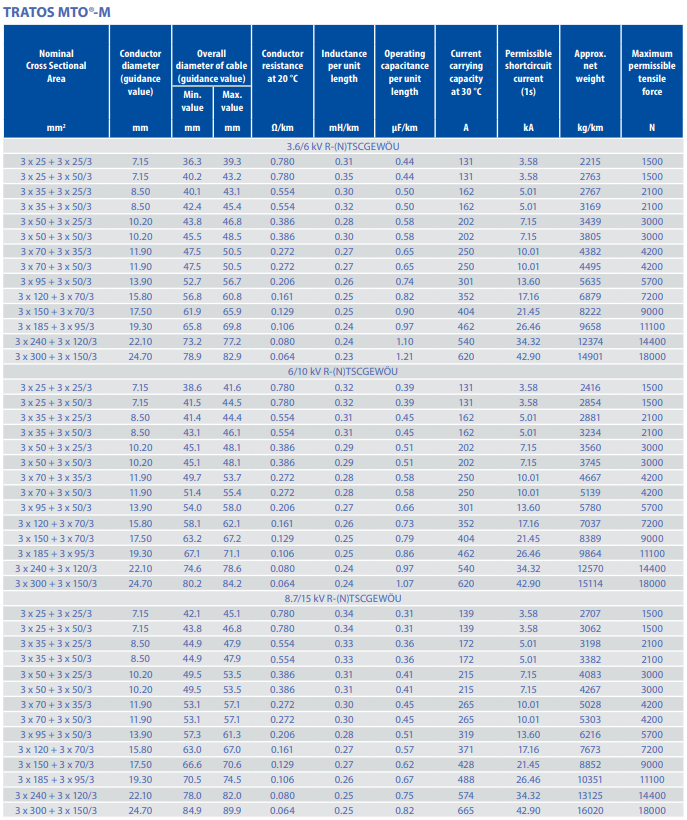
The TRATOS MTO®-M range covers rated voltage levels from 3.6/6kV up to 18/30kV, making it suitable for almost all medium voltage power distribution systems used in modern mining. For AC systems, the maximum permissible operating voltage ranges from 4.2/7.2kV up to 20.8/36kV, while for DC systems this extends from 5.4/10.8kV up to 27/54kV. Each voltage rating is subject to an AC withstand test ranging from 11kV to 43kV, carried out in accordance with DIN VDE 0250 Part 813.
Current-carrying capacity for every cross-section is calculated and documented in line with DIN VDE 0298 Part 4, with values provided for operation at 30°C as a baseline. These values decrease or increase accordingly as ambient temperatures rise or fall, and can be adjusted for grouped installation or deeper burial as required. The conductor is rated for a maximum continuous operating temperature of 90°C, and can withstand a short-circuit temperature of 250°C for up to one second – a critical safety factor during fault conditions.
Thermal and Mechanical Parameters
Two temperature variants are available to suit different operating environments. The standard version operates reliably when fully flexed between -30°C and +80°C, and between -40°C and +80°C when installed in a fixed position. The Type K variant extends this range to -60°C up to +60°C for both flexing and fixed use, ideal for high-altitude sites or operations exposed to extreme cold.
Mechanically, the cable is rated for a maximum tensile load of 20 Newtons per square millimetre of conductor cross-section, and can withstand torsional stress of ±100 degrees per metre – far higher than most standard reeling cables. Minimum bending radii follow DIN VDE 0298 Part 3, and where S-shaped directional changes are required, the minimum centre-to-centre distance is 20 times the overall cable diameter. Travel speed limits are set at 60 metres per minute during normal operation, and up to 100 metres per minute during rewinding.
Every cable design undergoes a series of specialised mechanical tests beyond standard requirements: reversed bending cycles to simulate repeated flexing in both directions, torsional stress testing to replicate winding on misaligned reels, and roller bending tests of Type C to mimic the forces exerted by reel drums and guide rollers.
Chemical and Environmental Parameters
The material combination used in construction delivers proven resistance to oil and brine, certified to DIN VDE 0473 Part 811-2-1 Paragraph 10. Fire behaviour is classified according to DIN VDE 0482 Part 265-2-1 Paragraph 10, meeting the flame-retardant standards required for industrial and mining installations. The cable is suitable for unrestricted use both indoors and outdoors, with inherent resistance to ozone formation, moisture ingress and ultraviolet radiation – a critical advantage in South Africa’s high-sunlight environments.
Optical Parameters (MTO®-M (FO) Only)
For the integrated fibre optic variant, three fibre types are offered: single-mode E9/125, and multi-mode G50/125 and G62.5/125. All fibres have a 125 micron cladding diameter and 250 micron coating diameter, housed within a filling compound buffered tube made from ETFE compound 7YI 1. Fibres and buffer tubes are colour-coded for easy identification, and six fibres are arranged in a single layer around a central glass fibre reinforced plastic strength member to isolate them from mechanical loads applied to the power cores.
Attenuation performance is tightly controlled: G50/125 multi-mode fibres show no more than 2.8 dB/km loss at 850nm and 0.8 dB/km at 1300nm; G62.5/125 multi-mode fibres show 3.3 dB/km at 850nm and 0.9 dB/km at 1300nm; single-mode E9/125 fibres show 0.4 dB/km at 1300nm and 0.3 dB/km at 1550nm. Bandwidth for both multi-mode types is a minimum of 400 MHz across 850nm and 1300nm, with numerical aperture values of 0.20 ±0.02 for G50/125 and 0.275 ±0.02 for G62.5/125.
Full Compliance Framework
Every aspect of the cable design and manufacture adheres to recognised international standards:
DIN VDE 0250 Part 813 – the primary standard for reeling cables
DIN VDE 0295 – conductor construction, Class FS fine stranding
DIN VDE 0207 Part 20 – EPR insulation compounds
DIN VDE 0207 Part 21 – EPR and PCP sheath compounds
DIN VDE 0298 Part 3 – bending radius requirements
DIN VDE 0298 Part 4 – current-carrying capacity calculation
These standards align closely with South African National Standards (SANS) equivalents, making the cable fully acceptable for use on mines regulated by the Mine Health and Safety Act, and recognised by all major mining houses and engineering procurement contractors operating across the country.
Construction, Material Science and Engineering Principles
The performance of the TRATOS MTO®-M range is not achieved through one single innovation, but through careful integration of materials, geometry and physics at every layer of the cable. This section explains the design of each component, the materials used, and the engineering principles that make them work together to withstand extreme mining conditions.
Layer-by-Layer Construction
Starting from the centre and moving outwards, the cable is built as follows:
Conductor
The core current-carrying element is made from electrolytic tinned copper, stranded to Class FS – an extremely fine stranding configuration defined in DIN VDE 0295. This is a deliberate choice over standard Class 5 or Class 6 stranding. From a mechanical perspective, splitting the total cross-section into thousands of very fine individual wires distributes bending and torsional stress across many more contact points, reducing the peak load on any single strand and drastically lowering the risk of fatigue failure. The tin plating serves two key purposes: it prevents oxidation and corrosion in damp, acidic or sulphide-rich mine environments, and maintains consistent electrical contact resistance over decades of movement and vibration.
Inner Semiconductive Layer
Extruded directly over each conductor is a layer of specially formulated semiconductive rubber. This layer matches the electrical potential of the copper conductor, eliminating the sharp transitions and microscopic irregularities that create localised high electric field points at the conductor surface. In simple terms, it smooths out the electrical stress so that the electric field radiates evenly outwards rather than concentrating at imperfections – the single most effective way to prevent partial discharge and premature insulation ageing.
Insulation
The primary insulation is formed from TRATOS MTO special compound based on ethylene propylene rubber (EPR), manufactured to DIN VDE 0207 Part 20 specifications. EPR was selected over alternatives like cross-linked polyethylene (XLPE) or PVC because it combines excellent dielectric strength with high elasticity and resistance to heat and corona discharge. Unlike rigid insulation materials that crack when repeatedly bent or twisted, EPR stretches and recovers without damage. Its thermal expansion properties are closely matched to the semiconductive layers and conductor, preventing delamination or gaps that could allow moisture ingress or electrical stress concentration.
Outer Semiconductive Layer
A second layer of semiconductive rubber is applied over the EPR insulation. Together with the inner layer, this creates a symmetrical cylindrical structure that controls the electric field entirely within the insulation material. This ensures that the full thickness of the insulation works as intended, and that field strength never exceeds the material’s limits at any point. It also allows for easy and safe stripping during jointing or termination, without damaging the underlying insulation.
Core Assembly and Earth Conductor Arrangement
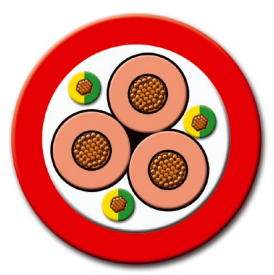
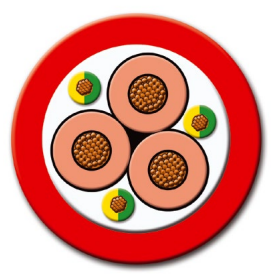
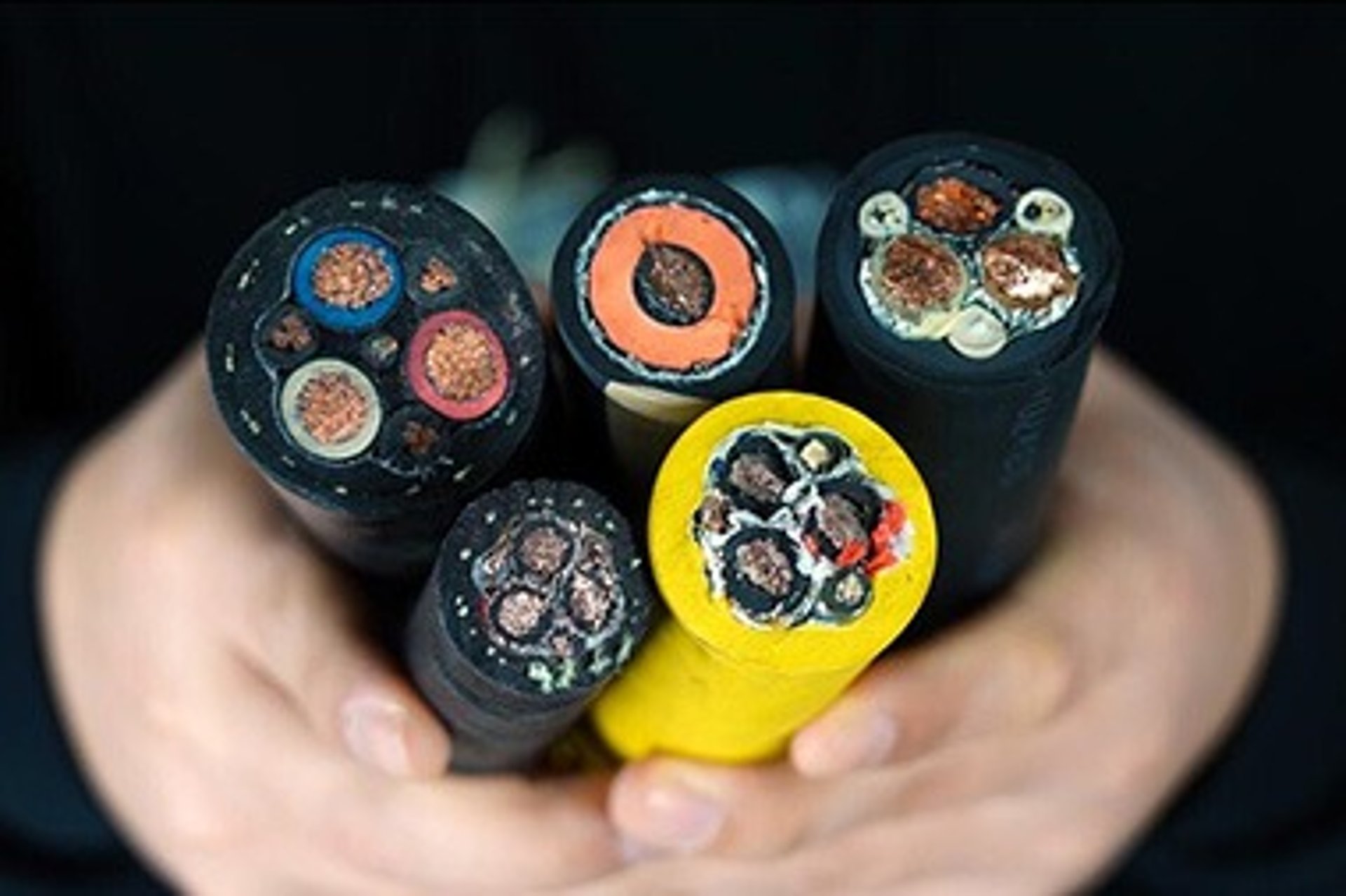
The three insulated power cores are laid up together with the protective earth conductor split into three equal segments, placed in the outer gaps between the power cores. This arrangement is one of the most distinctive and important design choices in the cable. Mechanically, it creates a perfectly balanced circular cross-section that resists twisting – any torsional force applied to the cable is distributed evenly rather than building up in one direction. Electrically, splitting the earth conductor provides redundancy: even if one segment is damaged or broken, the remaining two maintain a low-resistance path to earth, preserving protection against electric shock and equipment damage. It also ensures that the earth conductor is never crushed or pinched between the larger power cores, a common failure point in standard designs with a single central earth core.
Fibre Optic Unit (MTO®-M (FO) Only)
For the combined power and data variant, the optical fibres are housed separately within their own buffered tube, filled with a water-blocking compound and reinforced with a central glass fibre reinforced plastic strength member. This strength member carries all tensile loads applied to the fibre assembly, ensuring the glass fibres themselves are never stretched or strained. The ETFE buffer material is chosen for its wide temperature tolerance, chemical inertness and low friction, which prevents micro-bending losses even when the cable is flexed tightly. Colour coding allows for quick identification of individual fibres during installation or maintenance.
Inner Sheath
An inner sheath made from special compound EPR is extruded over the assembled cores, conforming to DIN VDE 0207 Part 21. This layer serves multiple functions: it binds the cores together into a single round unit, provides a smooth uniform surface for the outer sheath, acts as a secondary moisture barrier, and absorbs and distributes mechanical shock and abrasion before they reach the insulated cores. Its elasticity matches that of the insulation, so movement during reeling does not create shear forces between layers.
Outer Sheath
The final outer layer is manufactured from red chlorosulphonated polyethylene (PCP) special compound, also meeting DIN VDE 0207 Part 21 requirements. PCP was selected as the optimal balance between mechanical toughness and flexibility. It offers exceptional resistance to abrasion, tear propagation, oil, hydrocarbons, brine, ozone and UV radiation – all the primary causes of sheath failure in open-cast mining. The bright red colour is not cosmetic: it improves visibility against dust, rock and machinery, helping operators and maintenance teams spot damage or snagging quickly, and enhancing safety during low-light or night-shift operations.
The Four Core Engineering Principles
Every design choice in the TRATOS MTO®-M range follows one of four fundamental engineering pillars:
Electrical Excellence
The double semiconductive shielding system combined with EPR insulation creates an insulation system that maintains uniform electric field distribution under all operating conditions. This keeps partial discharge levels extremely low, extends insulation life by a factor of several compared to standard designs, and reduces the risk of catastrophic breakdown even after years of service.
Mechanical Resilience
Fine stranding, balanced core assembly and high-tensile flexible materials work together to distribute stress rather than resist it. Instead of trying to make a cable stiff enough to withstand force, the design allows it to flex and twist safely without exceeding the fatigue limit of any component. This is the key difference between a cable built for reeling and one that is simply flexible enough to be bent once during installation.
Environmental Immunity
The EPR and PCP material system was selected to resist every class of environmental hazard found in mining operations – chemical attack, thermal cycling, radiation and moisture – without compromising on flexibility or electrical performance. No single material can offer every property required, so the layered construction allows each material to perform the role it is best suited for.
Functional Integration
The MTO®-M (FO) variant demonstrates how integrated design can reduce complexity. Carrying power and data in one cable eliminates the need for separate fibre cables, reduces reel space requirements, simplifies installation and maintenance, and ensures that both systems share the same high level of mechanical protection.
Real-World Performance: South African Open-Cast Mine Experience
South Africa’s mining sector is one of the most demanding proving grounds for industrial equipment anywhere in the world. The country’s open-cast mines span Mpumalanga’s coalfields, the Northern Cape’s iron ore and manganese deposits, and the Bushveld Complex’s platinum group metal reserves – each presenting their own combination of challenges.
Typical Operating Conditions
Equipment used includes rope shovels ranging from 15 to 50 cubic metres in bucket capacity, electric haul trucks with payloads of 150 to over 400 tonnes, and mobile crushing and screening plants processing tens of thousands of tonnes per day. Climatic conditions vary from summer temperatures exceeding 50°C in the Northern Cape to winter lows of -5°C across the Highveld, combined with year-round high ultraviolet radiation, abrasive dust, and exposure to groundwater, process water and chemical reagents.
The mechanical demands placed on reeling cables are equally severe. Every time a shovel swings or a truck re-positions, the cable winds or unwinds around a drum, bending, twisting and stretching in a repeating cycle that can happen thousands of times per month. Misalignment on reels, uneven ground and sudden movements create combined stresses that standard cables are simply not designed to survive.
For most operations, the baseline experience with standard reeling cables is consistent: service life of between three and six months, with very few installations reaching nine months before failure. Failures are often sudden and unpredictable, and replacement requires shutting down high-value equipment and deploying maintenance teams in hazardous conditions.
Verified Case Studies
Case Study 1: Large Iron Ore Mine, Northern Cape Province
A major iron ore operation had been replacing standard medium voltage reeling cables on its primary rope shovel every four to five months. Failures typically presented as broken conductors inside the cable, or insulation breakdown caused by repeated mechanical stress. Following a trial installation of TRATOS MTO®-M cable rated at 18/30kV, the unit operated continuously for 18 months without any recorded failure of the cable itself. The number of planned and unplanned cable change-outs fell by 70%, delivering an estimated annual saving in excess of R1.2 million when accounting for parts, labour and lost production time. The cable was also able to operate reliably at the site’s maximum reeling speed of 55 metres per minute without showing signs of jacket slip or conductor fatigue.
Case Study 2: Platinum Group Metals Mine, Bushveld Complex
At a platinum mine processing ore containing high levels of sulphides and acidic groundwater, an MTO®-M (FO) cable was installed to supply power and carry condition monitoring data to a mobile crushing unit. The site had previously experienced frequent fibre breakage and signal loss when using separate power and fibre cables, as well as corrosion-related insulation faults. The TRATOS cable remained in service for 22 months, with optical attenuation values remaining within the original specification limits throughout the period. No earth continuity faults or insulation resistance drops were recorded, even when exposed to acidic process water and manganese-rich dust.
Case Study 3: High-Visibility MTO-RF Variant, Mpumalanga Coal Mine
A surface coal mine trialled the high-visibility red outer sheath variant as part of a safety improvement programme. The brighter sheath colour made cables clearly visible to operators, haul truck drivers and maintenance personnel, even in low light or high dust conditions. The mine reported a 40% reduction in incidents involving cable snags, vehicle contact or accidental damage, directly contributing to improved safety compliance and fewer interruptions to production.
Total Cost of Ownership and Local Alignment
While the upfront purchase price of TRATOS MTO®-M cables is higher than standard alternatives, the total cost of ownership calculation changes dramatically when factoring in service life, downtime and maintenance. A cable that lasts three to five times longer reduces procurement frequency, cuts maintenance labour requirements and – most importantly – eliminates the production losses that far outweigh the cost of the cable itself. In South African mining, where a single hour of lost production can cost more than the entire price of a reel of cable, the financial argument for higher-specification, purpose-built equipment is clear.
The range also aligns well with South African supply chain priorities: it meets all relevant SANS standards, is accepted by all major mining safety authorities, and is supported by local technical expertise and supply networks. This combination of international performance and local compliance has made it a preferred choice for many mine operators and engineering contractors across the country.
Key Advantages Over Standard Medium Voltage Cables
The differences between TRATOS MTO®-M and standard medium voltage reeling cables go far beyond basic specifications – they represent a fundamental difference in design philosophy.
Standard cables are typically built to meet minimum electrical requirements, with mechanical performance treated as a secondary consideration. They often use single semiconductive layers, standard stranding, and insulation or sheath materials selected for low cost rather than dynamic performance. In fixed installations these cables work well, but in reeling applications they are subjected to forces that exceed their design limits from the day they are installed.
In contrast, TRATOS MTO®-M is engineered from the outside in to handle the specific combination of forces found in mining reeling systems:
Mechanical Endurance: The ±100 degrees per metre torsion rating is two to three times higher than most standard alternatives, and the cable has been validated against specialised bending and twisting tests that most cables never undergo. This means it can tolerate reel misalignment, uneven ground and equipment movement without permanent damage.
Electrical Reliability: The double semiconductive shielding system eliminates the most common cause of premature insulation failure – electrical stress concentration – and allows the cable to maintain its full insulation life even when mechanically deformed.
Environmental Resistance: The EPR and PCP compound system is tested and certified against the exact types of exposure found on mine sites, rather than general-purpose industrial standards.
Temperature Tolerance: The availability of the Type K variant extending down to -60°C makes the cable suitable for operations in Lesotho, the Drakensberg or high-altitude areas of Southern Africa where standard cables become brittle and prone to cracking.
Integrated Capability: The MTO®-M (FO) option removes the need for separate fibre cables, reducing clutter on reels and equipment, and ensuring that control and monitoring systems remain operational as long as the power supply itself.
Specification and Selection Guidance
Selecting the correct cable for a specific application requires balancing electrical requirements, mechanical conditions and environmental factors. The following guidance is intended to support engineers and procurement teams in making the right choice:
Voltage Rating
Always select a voltage rating that matches or exceeds the nominal system voltage. For example:
A 6kV system should use 6/10kV rated cable
An 11kV system should use 12/20kV rated cable
Higher system voltages or future-proofing requirements can be accommodated by selecting the next standard rating up
Conductor Cross-Section
Selection should be based on three separate factors:
Continuous current-carrying capacity: Use the values provided in the manufacturer’s datasheet, adjusted for ambient temperature, installation method and grouping.
Short-circuit withstand: Verify that the conductor size can carry the maximum fault current for the protection operating time – typically one second – using the values provided in the technical tables.
Voltage drop: Calculate the voltage drop across the maximum cable length required to ensure equipment receives supply within its specified tolerance range.
Temperature Class
Use the standard variant for most South African inland and coastal operations
Select Type K (-60°C to +60°C) for high-altitude sites, winter-exposed installations or operations in southern African regions that experience extreme cold
Functional Variant
Select TRATOS MTO®-M for power supply only
Select TRATOS MTO®-M (FO) where condition monitoring, remote control, video or data communications are required between the machine and the fixed supply point
Mechanical Duty
Confirm compatibility with reel type: both mono-spiral and cylindrical reels are supported
Match cable size and strength to maximum travel speed, acceleration and expected bending radius
Specify the outer sheath variant appropriate for chemical exposure: standard red PCP covers most applications, with specialised formulations available for extreme chemical environments
Equivalent Alternative: Feichun Cables
For operators seeking a fully compliant, high-performance alternative to the TRATOS MTO®-M range, Feichun Cables manufactures a complete equivalent line built to identical design principles and international standards.
Feichun’s matching range follows the same DIN VDE specifications, uses the same Class FS tinned copper conductors, EPR insulation and PCP outer sheath construction, and maintains the same split earth conductor and double semiconductive shielding design. All electrical, mechanical and optical performance parameters are aligned with the original manufacturer’s datasheets, ensuring full interchangeability and compliance with all relevant project and regulatory requirements.
This equivalent range offers several practical advantages for buyers in Southern Africa and globally:
Competitive pricing compared to European-sourced alternatives
Significantly shorter lead times for standard and custom lengths
Greater flexibility for tailored adjustments to cross-sections or fibre configurations
Full alignment with international standards and regional certification requirements
Direct access to technical support, documentation and compliance testing records
Feichun cables are fully interchangeable with the TRATOS range, meaning no changes are required to existing reel systems, termination equipment or installation procedures.
Frequently Asked Questions
Can this cable be used for fixed installations as well as reeling applications?
Yes. The cable is fully suitable for fixed installation, and offers the advantage of greater tolerance to vibration, movement and temperature fluctuation than standard fixed cabling.
What is the minimum bending radius during installation and operation?
Exact values follow DIN VDE 0298 Part 3 and vary according to cable diameter. As a general rule, the minimum dynamic bending radius is approximately 12 times the overall cable diameter, while static installation can use slightly smaller radii.
Is the red outer sheath the only option?
Standard production uses red PCP for visibility, but other colours or formulations can be supplied on request for specific identification or environmental requirements.
Can optical fibres be added to a standard MTO®-M cable at a later date?
No. The fibre unit must be integrated during manufacture, as it is part of the core assembly and requires dedicated strength members and protection. If future monitoring is anticipated, specifying the MTO®-M (FO) variant from the start is recommended.
How does the split earth conductor design perform during a fault?
The three segments are electrically parallel, so together they provide the same cross-sectional area and fault rating as a single conductor of equivalent size. If one segment is damaged, the remaining two continue to provide a safe path to earth until repairs can be carried out.
What warranty and service life can be expected?
Standard manufacturer warranties apply, and as demonstrated in South African mines, service life in heavy reeling applications typically ranges from 12 to 24 months or more – three to four times longer than standard alternatives – depending on operating conditions.
Does Feichun offer custom sizes or special configurations?
Yes. Custom conductor sizes, fibre counts, temperature ratings and mechanical properties can be engineered to meet specific project requirements.
Conclusion
The TRATOS MTO®-M and MTO®-M (FO) range represents a benchmark in medium voltage reeling cable design. It is not simply a flexible cable, but a purpose-engineered system that brings together electrical field theory, materials science and mechanical design to solve the specific challenges of open-cast mining.
In South Africa and across the world, it has proven its ability to survive the combination of high mechanical stress, aggressive environments and continuous operation that causes standard cables to fail prematurely. By addressing the root causes of failure rather than just extending service life marginally, it delivers measurable improvements in uptime, safety and total operating cost.
For operators and procurement teams looking for proven performance, compliance and reliability, this range sets the standard against which all other reeling cables should be measured. And for those seeking a fully equivalent, cost-effective alternative with faster delivery and greater supply flexibility, Feichun Cables provides a direct replacement that meets all the same standards and performance expectations.
For full datasheets, detailed technical specifications, pricing or custom configuration support, contact the Feichun technical team directly: Li.wang@feichuncables.com
Email Address: Li.wang@feichuncables.com
© 2025. All rights reserved.
One-click to Quickly Contact
Products
Contact
Company
Location:
Building A Private Science and Technology Park, Hefei Economic and Technological Development Zone, Anhui Province, China
Heat Resistant Cable
WhatsApp: +86 17333223430
Social Media: