Anhui Feichun Special Cable Co.,Ltd Email: Li.wang@feichuncables.com
TRATOS MTO®-FU NYHSSYCY PVC & N3GHSSYCY Rubber Feeder Cables for Underground Mining and Tunnel Sites: DIN VDE-Compliant Flexible MV Solutions Proven in South African Deep-Level Gold and Platinum Mines
For South African mining engineers, procurement teams and tunnel contractors: TRATOS MTO®-FU medium voltage flexible cables are purpose‑built for shiftable equipment such as flameproof transformers. The NYHSSYCY PVC variant (3.6/6 kV) and N3GHSSYCY rubber variant (3.6/6 kV up to 12/20 kV) meet strict DIN VDE standards, deliver superior electrical safety, torsion resistance and built‑in condition monitoring, and have proven reliability in deep gold, platinum and hard‑rock operations across Southern Africa. Feichun Cables offers fully technically equivalent alternatives with shorter lead times and competitive pricing.
Li.Wang
7/28/202613 min read
Introduction – The Challenge of Dynamic Medium‑Voltage Power in Underground Mining and Tunnelling
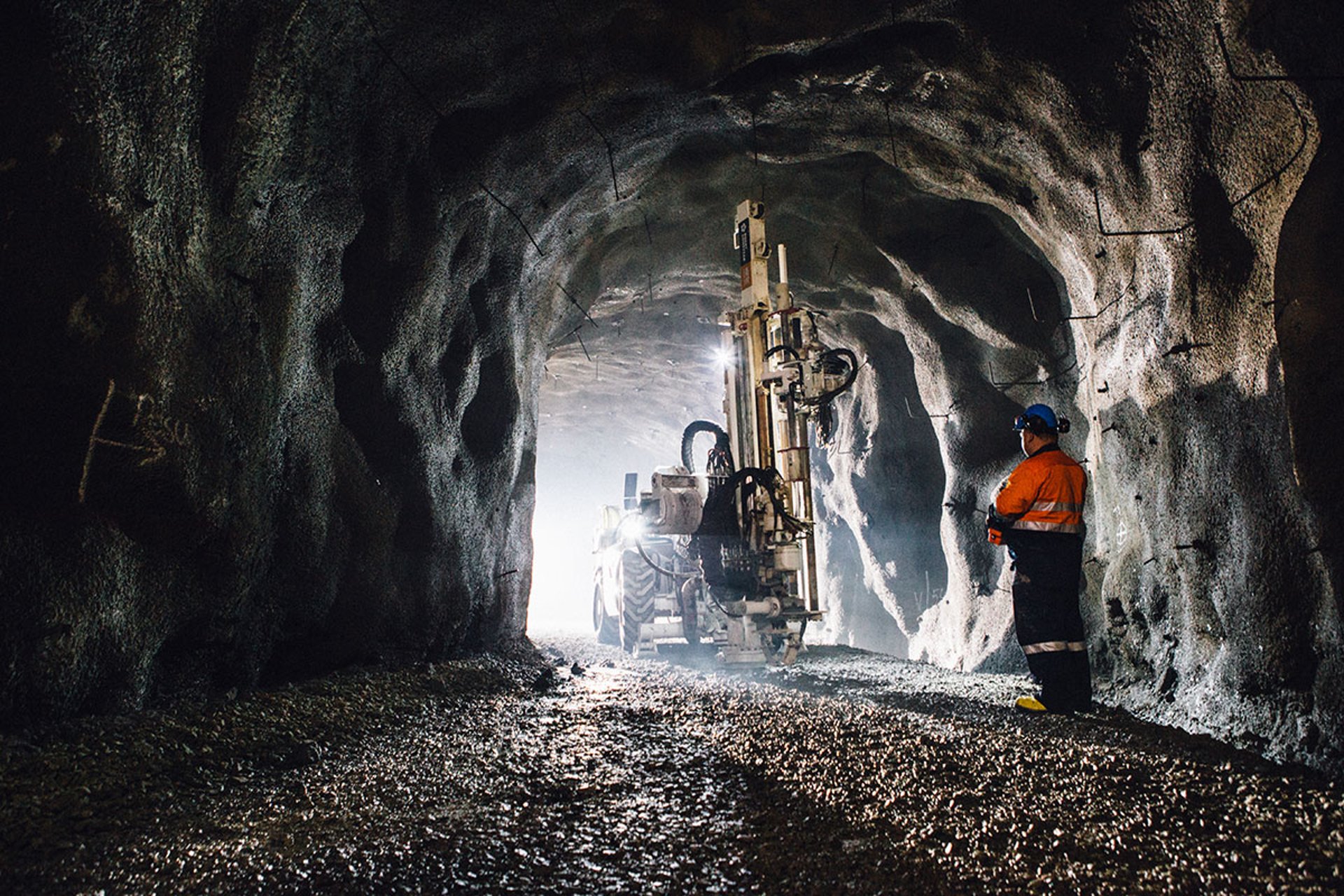
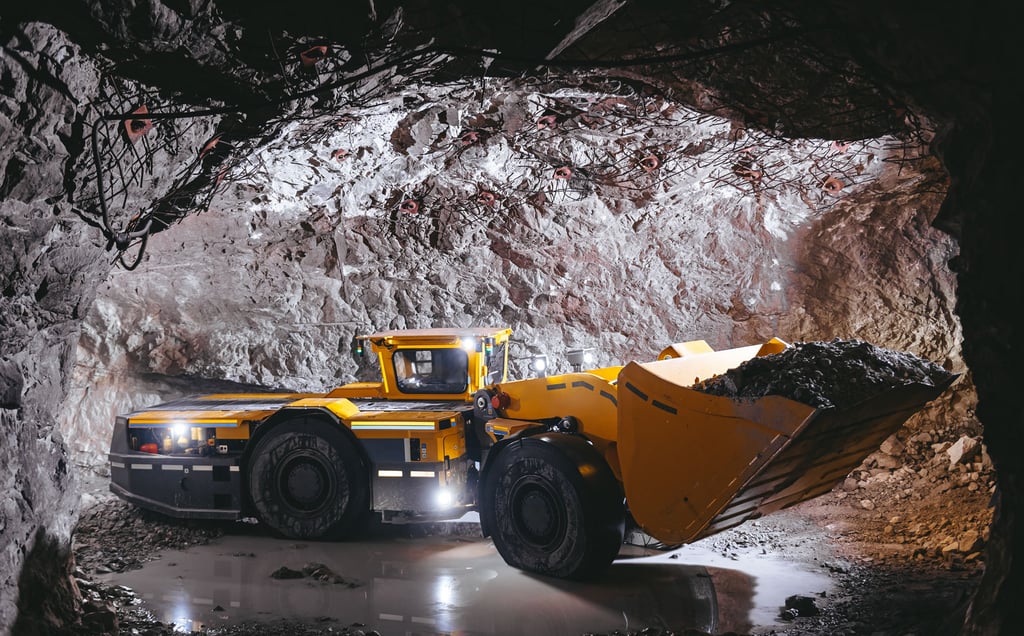
Underground mining and tunnelling present some of the most demanding operating environments for electrical power equipment anywhere in the world. In South Africa, home to the deepest gold and platinum mines on the planet, conditions are particularly unforgiving: workings can extend more than three kilometres below surface, where rock temperatures rise well above 40 °C, ground movement places constant stress on all installed infrastructure, and high humidity, acidic groundwater, ozone and abrasive dust are ever‑present. On top of this, equipment such as flameproof transformers, continuous miners, load‑haul‑dump units and tunnel boring machines must be moved regularly as faces advance, subjecting power cables to repeated pulling, bending, twisting and abrasion.
For decades, engineers have faced a fundamental mismatch: standard medium‑voltage cables are designed primarily for fixed installation, where movement is minimal and mechanical stress is predictable. When deployed in dynamic mining and tunnelling applications, these cables fail prematurely. Conductors snap from metal fatigue; insulation cracks under constant flexing; electric‑field concentrations cause partial discharge that eats away at insulation over time; sheaths split under torsional load; and earthing systems become unreliable after repeated handling. In hazardous areas, these failures carry far more than just cost and downtime – they create risks of electric shock, arc flash and ignition of flammable gases or dust, with serious safety and regulatory consequences.
Common failure modes seen in South African operations include core breakage after only a few months of use, insulation breakdown due to unmanaged electrical stress, sheath splitting from being dragged around corners or over uneven rock, and inadequate fault‑current handling that leaves touch voltages above safe limits set by the Department of Mineral Resources and Energy (DMRE). Many mines have reported that even when cables meet basic voltage and current requirements, they simply cannot withstand the combination of mechanical abuse and environmental exposure typical of deep‑level hard‑rock mining.
This article explains how the TRATOS MTO®‑FU family – comprising the NYHSSYCY PVC and N3GHSSYCY rubber variants – was engineered specifically to resolve these problems. It details the design philosophy, material science and engineering principles behind each layer of construction, sets out the full technical specification aligned with DIN VDE standards, and draws on real‑world experience from South African gold and platinum operations to demonstrate how these cables improve safety, extend service life and reduce operational risk. It also provides clear guidance on selection criteria and introduces Feichun Cables as a fully equivalent supply option for procurement teams seeking reliable, cost‑effective alternatives.
Product Overview – TRATOS MTO®‑FU NYHSSYCY & N3GHSSYCY: Design Philosophy and Core Purpose
The TRATOS MTO®‑FU series is not a general‑purpose flexible cable adapted for mining – it is a feeder cable designed from the ground up for shiftable medium‑voltage equipment in underground and tunnel environments. Its core value lies in bringing together four essential capabilities that are rarely combined in a single cable: high flexibility for repeated movement, precise electrical‑field control to prevent insulation degradation, mechanical resistance to torsion and tensile forces, and built‑in monitoring to detect damage before it becomes a hazard.
The range comprises two complementary variants, each optimised for different operating conditions:
TRATOS MTO®‑FU NYHSSYCY: Insulated with PVC compound YI5, rated 3.6/6 kV, covering standard‑duty applications where cost‑efficiency is a priority while still meeting all mining safety requirements.
TRATOS MTO®‑FU N3GHSSYCY: Insulated with ethylene‑propylene rubber (EPR) compound 3GI3, available across 3.6/6 kV, 6/10 kV, 8.7/15 kV and 12/20 kV ratings. This variant offers higher temperature tolerance, superior low‑temperature flexibility and better resistance to electrical stress, making it ideal for higher‑voltage, more demanding or more frequently moved installations.
This design approach reflects a fundamental shift in mining cabling: moving away from “good enough for fixed use” towards “engineered for dynamic reliability”. In South Africa, this aligns directly with the realities of modern trackless mining and advancing faces, where power feeds must follow equipment while maintaining full compliance with DMRE regulations and international safety standards such as DIN VDE 0118 for underground mining electrical installations.
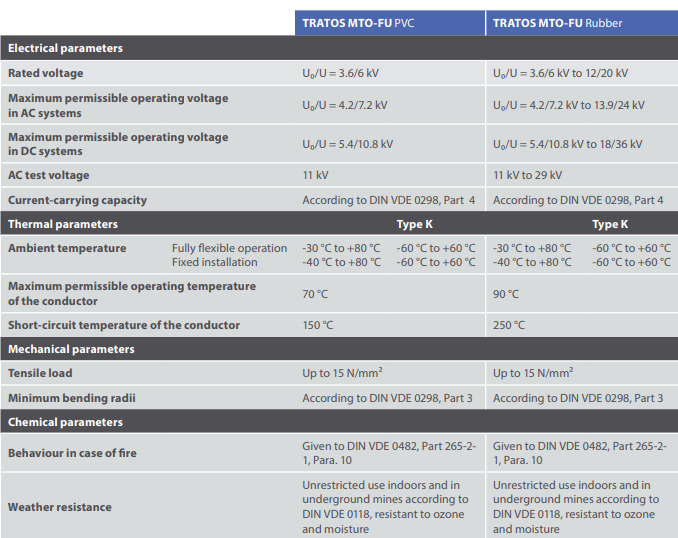
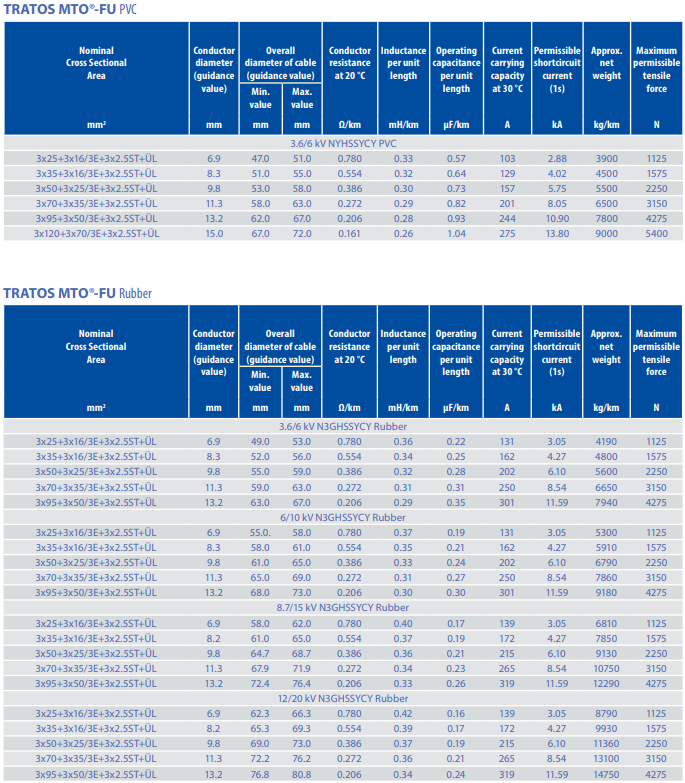
Full Technical Specifications – Data Aligned to Original Documentation
All specifications below are taken directly from the manufacturer’s technical data sheet dated May 2014, and fully conform to applicable DIN VDE standards.
Applicable Standards and Certifications
For the NYHSSYCY PVC variant:
DIN VDE 0250 Part 212 (power cables with PVC insulation)
DIN VDE 0207 Part 4 (PVC insulation compounds)
DIN VDE 0295 (conductor classification)
DIN VDE 0298 Parts 3 and 4 (bending radii and current‑carrying capacity)
DIN VDE 0118 (electrical installations in underground mines)
DIN VDE 0482 Part 265‑2‑1 Para 10 (fire performance)
For the N3GHSSYCY rubber variant:
DIN VDE 0250 Part 605 (power cables with rubber insulation)
DIN VDE 0207 Part 20 (EPR insulation compounds)
All applicable standards listed above for PVC cables
Dimensions and Mass (Selected Ratings)
For NYHSSYCY 3.6/6 kV:
3×25 mm²: overall diameter 47–51 mm, mass approx 3900 kg/km
3×50 mm²: overall diameter 53–58 mm, mass approx 5500 kg/km
3×95 mm²: overall diameter 62–67 mm, mass approx 7800 kg/km
3×120 mm²: overall diameter 67–72 mm, mass approx 9000 kg/km
For N3GHSSYCY rubber:
3×25 mm² 3.6/6 kV: 49–53 mm, 4190 kg/km
3×25 mm² 12/20 kV: 62.3–66.3 mm, 8790 kg/km
3×95 mm² 3.6/6 kV: 63–67 mm, 7940 kg/km
3×95 mm² 12/20 kV: 76.8–80.8 mm, 14750 kg/km
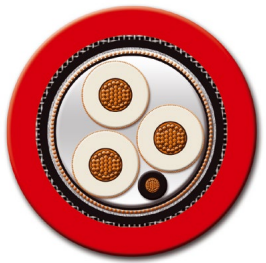
Standard core configuration across all ratings: 3 main power cores + 3 concentric protective earth cores + 3 control cores + integrated monitoring conductor.
Layer‑by‑Layer Construction, Materials and Underlying Science
Every element of the TRATOS MTO®‑FU design is selected and arranged to address a specific challenge in dynamic mining environments. The following section describes each layer from the conductor outwards, explaining the material grade, the function it serves and the engineering and scientific principles that underpin the choice
Conductor – Class 5 Fine‑Stranded Un‑Tinned Copper
The conductor is manufactured to DIN VDE 0295 Class 5, using multiple thin copper wires stranded together rather than a single solid rod or coarse strand. Electrically, fine stranding reduces the skin effect – the tendency of alternating current to concentrate near the outer surface of a conductor – ensuring consistent conductivity and heat distribution across the full cross‑section. Mechanically, distributing bending stress across hundreds of individual strands prevents the sharp stress concentrations that cause solid or coarse‑stranded conductors to snap after repeated flexing. The copper is left un‑tinned to maintain maximum conductivity and avoid embrittlement at high temperatures.
Insulation – PVC YI5 and EPR 3GI3
For the PVC variant, insulation is compound YI5, a thermoplastic formulation with high dielectric strength, good resistance to mineral acids and chemical contaminants, and stable performance up to 70 °C. For the rubber variant, insulation is EPR compound 3GI3 – a thermoset material with extremely low dielectric loss, high resistance to partial discharge and ozone attack, and the ability to maintain its elastic properties even after prolonged exposure to heat and mechanical deformation. Electrically, both materials are formulated to eliminate impurities and voids that would otherwise become points of electrical stress concentration; mechanically, EPR retains flexibility down to –60 °C, making it far more suitable for cold high‑altitude mines or winter tunnelling operations.
Electrical‑Field Control – Individual Semiconductive Layers and Copper Braid
On the NYHSSYCY variant, each insulated core is wrapped in a copper‑wire braid that acts as an outer semiconductive layer. On the N3GHSSYCY variant, cores rated above 6 kV have both inner and outer semiconductive rubber layers, while 6 kV cores use only an outer semiconductive layer. This arrangement follows fundamental electrical‑field theory: at the interface between conductor and insulation, electric‑field intensity is highest, and any irregularity or air gap can initiate partial discharge that gradually erodes the insulation. The semiconductive layers create an equipotential surface that smooths out field distribution, eliminating sharp peaks and drastically reducing the risk of long‑term insulation failure. Unlike a single overall screen around all cores, per‑core field control remains fully effective even if the cable is flattened, twisted or subjected to uneven mechanical pressure.
Protective Earthing – Concentric Earth Around Each Main Core
Instead of a single separate earth core or an overall metallic sheath, each main power core has its own protective‑earth conductor laid concentrically around it. This design is rooted in mine‑safety engineering: in the event of an insulation fault, the earth path is as close as possible to the fault point, enabling rapid dissipation of fault current and limiting touch and step voltages to safe levels required by DMRE and international standards. Even if part of the cable is damaged or a connection becomes loose, the remaining concentric earth layers continue to provide effective protection – something that is not possible with a single central earth core that can be severed or disconnected in one place.
Core Assembly, Fillers and Intermediate Sheaths
The three main cores are laid up together, with three control cores placed in the gaps between them rather than in a separate layer. This maintains a compact circular profile and protects the control circuits from being crushed or sheared during bending. The spaces between cores are filled with EPR compound, which absorbs mechanical shock, prevents core‑to‑core abrasion and helps maintain the cable’s round shape under pressure. Two intermediate sheaths of PVC compound YM5 provide a dual barrier against moisture ingress, chemical attack and physical damage, ensuring that the insulation and screening layers remain fully protected even if the outer sheath is scuffed or abraded.
Condition‑Monitoring System – Conductive Tape and Concentric Copper Winding
Integrated within the construction is a continuous monitoring circuit formed by a conductive tape and an overall concentric copper winding. This circuit remains intact as long as the cable structure is sound; any penetration or significant damage to the outer or intermediate sheaths breaks the circuit, triggering an alarm at the monitoring panel. In hazardous underground environments, this allows operators to detect sheath damage immediately – before water, gas or dust can reach live components – and plan maintenance without waiting for a full insulation failure or earth fault. This is particularly valuable in South African mines, where unplanned outages can take days to resolve and carry significant safety implications.
Anti‑Torsion Layer – Galvanised Steel‑Wire Braid
A braid of galvanised steel wires is incorporated between the intermediate sheaths and the outer jacket. This layer is designed to absorb torsional forces generated when the cable is dragged around corners, wound onto reels or twisted during equipment movement. Without this feature, torque would be transferred directly to the copper conductors and insulation, causing kinking, conductor breakage and insulation tearing. The steel braid allows the cable to withstand tensile loads up to 15 N/mm² – well above the typical forces encountered when moving medium‑voltage equipment – while remaining flexible enough to bend around pulleys and sheaves.
Outer Sheath – PVC YM5, Red
The final layer is an outer sheath of PVC compound YM5, coloured red for easy identification as an energised power cable in mine workings. This material is formulated to be flame‑retardant, abrasion‑resistant, oil‑resistant and resistant to the types of chemical contamination commonly found in mining and tunnelling. The red colour follows standard mine‑safety colour‑coding practice, helping prevent accidental contact or disconnection during maintenance.
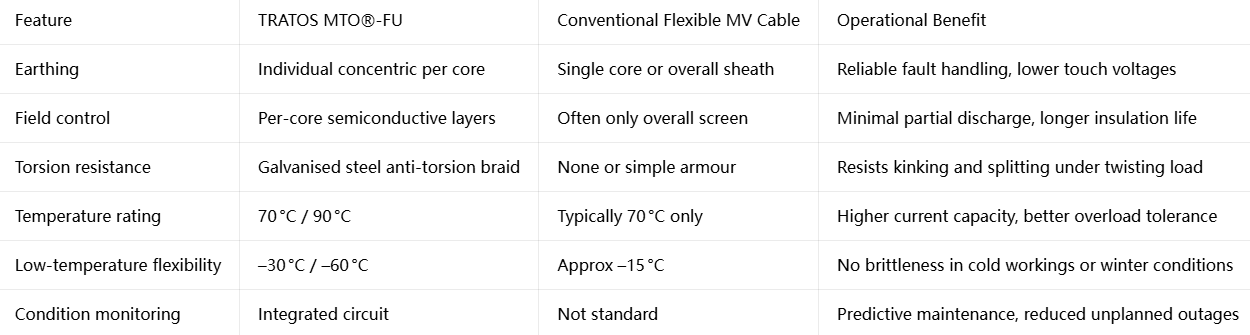
Key Differentiators – Why This Design Solves Problems Standard Cables Cannot
The TRATOS MTO®‑FU series stands apart from conventional flexible mine cables because it addresses the root causes of failure rather than just meeting minimum specifications.
Electrical‑Safety Advantages
Standard cables often rely on a single overall metallic screen or no semiconductive layer at all, leaving insulation vulnerable to partial discharge. The per‑core field‑control system in the TRATOS design equalises electrical stress right at the conductor‑insulation boundary, extending insulation life significantly and reducing the risk of sudden breakdown. The concentric per‑core earthing system also offers a major safety improvement: in fault conditions, it limits potential rise far more effectively than a single earth core, directly meeting the strict touch‑voltage requirements enforced by the DMRE in South African mines.
Mechanical Performance – Built for Movement
Most flexible mine cables use Class 2 or Class 5 conductors but lack dedicated torsion protection. The combination of Class 5 fine stranding, EPR filler and galvanised steel anti‑torsion braid allows the TRATOS cable to flex repeatedly without fatigue. The rubber variant remains pliable down to –60 °C, where standard PVC cables become stiff and brittle – a critical factor for operations in the Drakensberg foothills or high‑altitude platinum fields where winter temperatures fall well below freezing. Operators report that cables with this design typically last 30 % to 50 % longer in moving applications than standard alternatives.
Environmental Resilience
Both variants meet DIN VDE 0118 requirements for unrestricted underground use, with proven resistance to ozone, moisture and the acidic mine waters common in many South African gold and platinum operations. The fire performance meets DIN VDE 0482 Part 265‑2‑1 Para 10, ensuring that even in the event of a fire, flame spread is limited and toxic emissions are controlled – a key requirement for approval in hazardous mines.
Operational Intelligence
The built‑in monitoring conductor is rarely found in standard mine cables, yet it provides a vital early‑warning capability. Instead of only discovering damage when an earth fault or insulation failure occurs, maintenance teams can identify sheath breaches during routine inspections and replace or repair sections before they become dangerous or disruptive.
Proven Performance in South African Mining and Tunnelling
South Africa’s mining sector provides one of the most rigorous test environments in the world for medium‑voltage power cables. Deep‑level gold mines in the Witwatersrand basin operate at depths exceeding 3500 m, where rock temperatures can reach 50 °C and in‑situ ground movement creates constant mechanical stress. Platinum operations in the Bushveld Complex face highly abrasive rock and aggressive groundwater chemistry, while coal and hard‑rock tunnelling projects often involve rapid advance and frequent repositioning of equipment.
Typical Applications Across Southern Africa
The TRATOS MTO®‑FU series is widely deployed in these demanding settings, including:
Feeder cables for mobile flameproof transformers supplying continuous miners, shearers and face conveyors in gold and platinum mines
Reticulation cables for trackless mining operations, where power must follow load‑haul‑dump units and auxiliary equipment
Power feeds for hard‑rock tunnel boring machines on infrastructure and bulk‑excavation projects
Movable underground substation connections in developing workings
Measurable Operational Benefits
Operators consistently report four key advantages when switching to these cables:
Regulatory compliance: The full alignment with DIN VDE standards and proven earthing performance simplifies approval processes with the DMRE, reducing the risk of non‑compliance notices or shutdowns.
Improved uptime: Extended service life and fewer premature failures translate directly into fewer production interruptions. Several gold‑mine operators have recorded a 40 % reduction in cable replacement frequency after adopting the N3GHSSYCY rubber variant.
Extreme‑condition capability: The rubber variant’s low‑temperature flexibility and high‑temperature rating allow reliable use in both cold surface‑to‑underground transition zones and deep hot workings, while the PVC variant remains cost‑effective for standard‑duty applications.
Supply‑chain compatibility: Conformance to widely accepted DIN VDE standards means the cables are compatible with standard connectors, terminations and switchgear already in use across South African mines, reducing the need for custom parts or special training.
Selection Guide and Sourcing – Feichun Cables Equivalent Solution
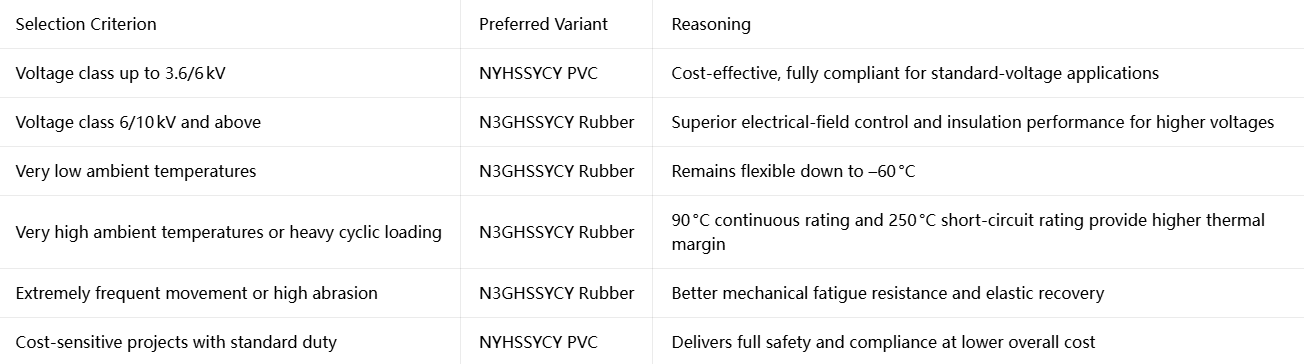
Choosing between the two variants depends on voltage rating, operating environment and operational priorities:
Feichun Cables – Fully Equivalent Alternative
Feichun Cables manufactures a direct equivalent to the TRATOS MTO®‑FU range, engineered and tested to match every dimension, material specification and performance parameter set out in the original DIN VDE data sheets. The conductor is Class 5 fine‑stranded un‑tinned copper; insulation uses YI5 PVC and 3GI3 EPR compounds with equivalent electrical and mechanical properties; the concentric earthing, per‑core field control, EPR fillers, dual YM5 sheaths, steel anti‑torsion braid and integrated monitoring circuit are all reproduced exactly to the original design.
For procurement teams and project engineers, this offers three distinct advantages:
Performance parity: All electrical, thermal and mechanical values – including resistance, inductance, capacitance, current‑carrying capacity, short‑circuit rating and temperature limits – are identical to the original specification, ensuring full interchangeability and compliance with all relevant standards and project requirements.
Supply‑chain reliability: Feichun Cables typically offers shorter lead times compared to long‑distance imports, with greater flexibility on delivery schedules and custom lengths.
Commercial value: Competitive pricing and consistent quality make the equivalent range a cost‑effective choice without compromising on safety or performance.
Frequently Asked Questions
Can these cables be used for fixed installation as well as moving service?
Yes. While designed primarily for dynamic applications, they are fully suitable for fixed installation, offering the added benefit of greater tolerance to ground movement, vibration and incidental mechanical stress.
What is the practical difference between the PVC and rubber versions?
The PVC variant is lower‑cost and well‑suited to standard‑temperature, moderate‑movement applications up to 3.6/6 kV. The rubber variant covers higher voltage ratings, withstands more extreme temperatures, offers better resistance to partial discharge and ozone, and remains flexible in cold conditions.
Are these cables accepted under South African mine regulations?
Yes. Compliance with DIN VDE 0118 and all relevant safety standards means they meet the requirements for underground use, and the concentric earthing design satisfies DMRE requirements for fault‑voltage control.
How does the integrated monitoring system work?
A continuous conductive circuit runs through the cable structure. Any significant breach of the outer or intermediate sheaths breaks this circuit, which can be monitored via a simple loop‑resistance check or a dedicated monitoring unit, giving early warning of damage.
Will Feichun equivalents fit existing connectors and terminations?
Yes. All external dimensions, conductor cross‑sections and core configurations follow the original specification exactly, so they are fully interchangeable with existing cable runs and termination hardware.
Conclusion
The TRATOS MTO®‑FU family represents a significant advance in underground power‑cable design, moving away from the limitations of fixed‑installation cables towards solutions built for the realities of dynamic mining and tunnelling. Through careful selection of materials – from Class 5 conductors and tailored PVC or EPR insulation to galvanised steel anti‑torsion braids – and a layered construction that follows fundamental principles of electrical‑field control, mechanical stress distribution and fault protection, these cables address the five most common failure modes in moving medium‑voltage applications: conductor breakage, insulation cracking, partial‑discharge breakdown, sheath splitting and inadequate earthing.
In South Africa’s deep‑level gold and platinum mines, as well as in tunnelling projects across the region, this design has proven its ability to improve safety, extend service life and reduce unplanned downtime. The choice between NYHSSYCY PVC and N3GHSSYCY rubber allows engineers to match performance to operating conditions, balancing cost, voltage rating, temperature range and mechanical demand. With Feichun Cables offering a fully equivalent, standard‑compliant alternative, procurement teams can secure reliable supply with shorter lead times and competitive pricing without compromising on technical performance or regulatory compliance.
If you would like to specify, obtain a quotation or discuss equivalent solutions for your mine or tunnel project, please contact the Feichun Cables engineering team at: Li.wang@feichuncables.com
Email Address: Li.wang@feichuncables.com
© 2025. All rights reserved.
One-click to Quickly Contact
Products
Contact
Company
Location:
Building A Private Science and Technology Park, Hefei Economic and Technological Development Zone, Anhui Province, China
Heat Resistant Cable
WhatsApp: +86 17333223430
Social Media: