Anhui Feichun Special Cable Co.,Ltd Email: Li.wang@feichuncables.com
TRATOS FIX MTO®-M and TRATOS FIX MTO®-M (FO) Medium Voltage Flexible Cables: Engineered for South African Open-Cast Mining Conveyor Belts, Material Handling & Submersible Pumps – VDE Standards, EPR Insulation & Fibre Optic Integration
Purpose-built medium voltage flexible cables to DIN VDE 0250 Part 813 for South African platinum, coal and iron-ore open-cast mines, conveyor belts, shiftable units, stacker‑reclaimers, cable booms and submersible pumps. Class 5 fine‑stranded copper, EPR insulation, split three‑way protective earth, red CM outer sheath, optional integrated fibre optics. Superior resistance to fatigue, torsion, UV, oil and brine compared with standard cables. Feichun equivalent available with identical performance, shorter lead times and competitive pricing.
Li.Wang
7/24/202614 min read
The Cable Built for South Africa’s Toughest Mines
TRATOS FIX MTO®‑M and TRATOS FIX MTO®‑M (FO), designated F‑(N)TSCGEWÖU, are medium‑voltage flexible cables engineered in Italy specifically for fixed installations that must withstand continuous dynamic stress in mining and bulk material handling. Fully compliant with DIN VDE 0250 Part 813 and supporting standards, they are intended for laying alongside conveyor belts including shiftable systems, installation on material‑handling machinery that moves repeatedly such as cable booms and upper‑lower car connections, and power supply to submersible pump units.
These cables are not simply a heavier version of general‑purpose rubber cables. They represent a purpose‑engineered solution for the exact conditions found across South Africa’s open‑cast coal, platinum and iron‑ore operations, port terminals and dewatering systems. By combining Class 5 fine‑stranded conductors, ethylene‑propylene rubber insulation, balanced split protective earth and optimised sheath materials, they deliver consistent electrical performance alongside exceptional mechanical endurance and environmental resistance. Where standard cables fail from conductor fatigue, insulation cracking, “corkscrewing” distortion or rapid sheath degradation, this series maintains integrity over far longer service life, reducing unplanned downtime and maintenance costs while improving electrical safety and equipment availability.
The FO variant adds factory‑integrated fibre‑optic elements, enabling power delivery and condition monitoring within a single cable structure – a growing requirement as South African mines move toward smarter, safer and more automated operations. Feichun Cables offers an equivalent product fully aligned with the same standards and performance levels, with shorter lead times and competitive pricing for projects across the SADC region.
South African Mining – The Real‑World Problem Standard Cables Cannot Solve
South Africa’s mining and bulk logistics sectors operate in some of the most demanding environments on earth. In the coalfields of Mpumalanga, platinum operations of the Bushveld Igneous Complex and iron‑ore mines of the Northern Cape, conditions combine extreme temperature swings, intense ultraviolet radiation, abrasive dust, high humidity, salt‑laden air near coasts, and frequent contact with oils, greases and process water.
Conveyor systems run continuously for months, often shifting position as mining faces advance. Stacker‑reclaimers and cable booms extend, retract, slew and luff daily, subjecting cabling to repeated bending, twisting and tensile loading. Dewatering pumps operate fully submerged in water carrying suspended solids and dissolved salts. In all these applications, cabling is nominally fixed yet subjected to constant movement and mechanical stress – a scenario for which standard medium‑voltage cables are not designed.
Standard cables typically use Class 2 solid or coarse‑stranded conductors, PVC or basic rubber insulation, simple concentric earths and general‑purpose sheaths. Under cyclic flexing, torsional strain and temperature cycling, these designs suffer predictable failure modes. Conductors fatigue and break internally long before visible damage appears. Insulation becomes brittle, cracks or suffers water‑treeing, raising partial‑discharge levels and increasing risk of breakdown. Torsion accumulates along the cable length, producing “corkscrewing” or birdcaging, where cores distort, jackets split and earthing continuity is lost. Sheaths harden under UV, swell in contact with oils or degrade in brine, allowing moisture and contaminants to reach insulated cores.
In mining, each unplanned stoppage can cost tens of thousands of Rand per hour in lost production, overtime and repair expenses. Worse, cable failure can create live exposed conductors, unreliable earth‑fault protection and fire risks – all major safety concerns under South African mining regulations. Operators have long recognised that standard cables do not last in these applications, yet options that balance medium‑voltage performance, flexibility and environmental resistance have been limited. This is the gap TRATOS FIX MTO®‑M was created to fill.
Product Overview – What Is TRATOS FIX MTO®‑M / MTO®‑M (FO)?
TRATOS FIX MTO®‑M and the fibre‑integrated MTO®‑M (FO) are medium‑voltage flexible cables rated for fixed installation where movement and mechanical stress are unavoidable. The type designation F‑(N)TSCGEWÖU defines its construction and intended use: a flexible cable with rubber insulation and sheath, for fixed installation, with enhanced mechanical properties.
The product range covers rated voltages U₀/U from 3.6/6 kV up to 18/30 kV, making it suitable for almost all medium‑voltage mining and material‑handling applications. Standard conductor configurations follow the format three power cores plus split three‑way protective earth, ranging from 3×25 mm² up to 3×300 mm², with earth sections sized at one‑third or one‑half of the main conductor cross‑section according to rating.
All versions are built to DIN VDE 0250 Part 813, with supporting compliance to DIN VDE 0295 for conductors, DIN VDE 0207 Parts 20 and 21 for rubber compounds, DIN VDE 0298 Parts 3 and 4 for installation and current‑carrying capacity, plus additional standards covering oil and brine resistance, fire performance and water compatibility. The FO variant includes up to six optical fibres arranged around a central GFK strength member, buffered in ETFE tubes with filling compound, for simultaneous power and data transmission.
Technical Specifications – Aligned with Original Datasheet
Electrical Parameters
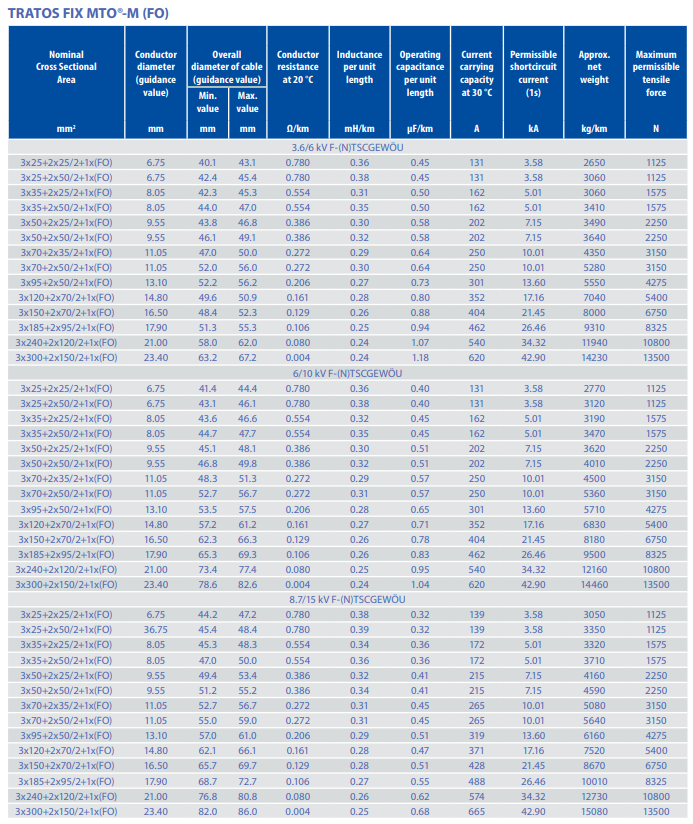
Rated voltage spans 3.6/6 kV through 6/10 kV, 8.7/15 kV, 12/20 kV, 14/25 kV and 18/30 kV. Maximum permissible operating voltage rises to 4.2/7.2 kV up to 20.8/36 kV for AC systems and 5.4/10.8 kV up to 27/54 kV for DC systems. AC withstand test voltages range from 11 kV to 43 kV according to voltage class and standard requirements.
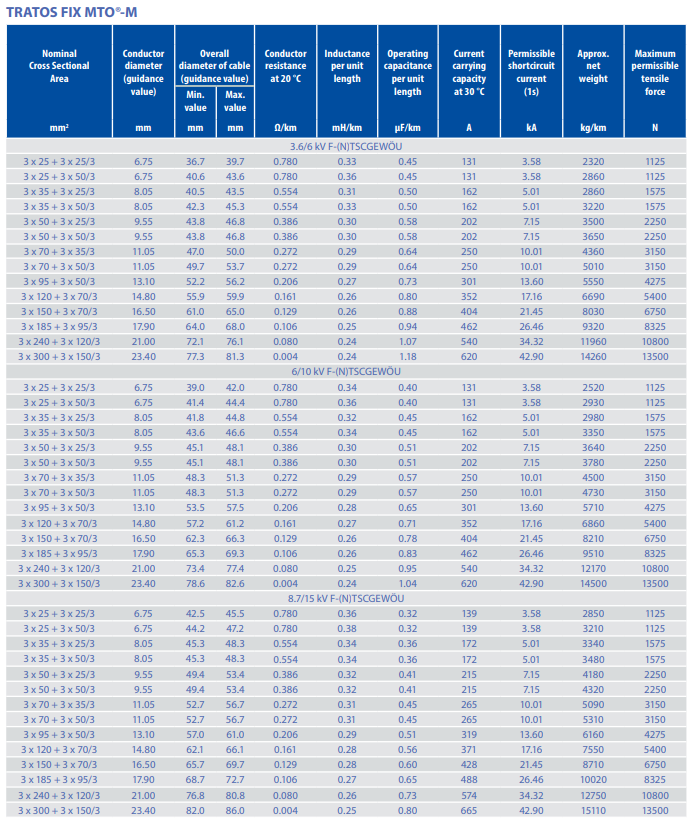
Conductor resistance at 20 °C falls from 0.780 Ω/km for 25 mm² down to 0.004 Ω/km for 300 mm². Inductance per unit length typically sits between 0.24 mH/km and 0.41 mH/km, while operating capacitance ranges from 0.21 µF/km to 1.18 µF/km depending on cross‑section and voltage rating. Current‑carrying capacity at 30 °C ambient extends from 131 A for 3×25 mm² up to 665 A for 3×300 mm² at the highest voltage class. Conductor maximum continuous operating temperature is 90 °C, with short‑circuit rating of 250 °C for up to one second – corresponding to permissible short‑circuit currents from 3.58 kA up to 42.90 kA across the range.
Thermal and Mechanical Performance
The standard version operates from -30 °C to +80 °C under flexible conditions and -40 °C to +80 °C when fixed. Type K cold‑resistant variant works from -60 °C to +60 °C in both modes. Maximum permissible tensile load is 15 N/mm² of conductor cross‑section, while torsion resistance is specified at ±100 °/m – tested and proven under controlled conditions. Reeling speed on drum cars can reach up to 100 m/min, and minimum bending radii follow DIN VDE 0298 Part 3. Beyond routine electrical checks, every cable design undergoes torsion cycling, repeated reverse bending, roller bending Type C and water‑compatibility testing to HD 22.16, ensuring fitness for purpose in dynamic environments.
Optical Performance – FO Variant Only
Optical units support three fibre types: G50/125 and G62.5/125 multi‑mode, plus E9/125 single‑mode. Core/cladding/coating dimensions are 50/125/250 µm, 62.5/125/250 µm and 9/125/250 µm respectively. Attenuation limits are ≤2.8 dB/km and ≤3.3 dB/km at 850 nm for G50 and G62.5, falling to ≤0.8 dB/km and ≤0.9 dB/km at 1300 nm. Single‑mode E9/125 achieves ≤0.4 dB/km at 1300 nm and ≤0.3 dB/km at 1550 nm. Minimum bandwidth is 400 MHz·km at 850 and 1300 nm for multi‑mode fibres, with numerical aperture of 0.20±0.02 for G50/125 and 0.275±0.02 for G62.5/125.
Size and Weight Data
Across all voltage classes, nominal overall diameters range from approximately 39 mm up to nearly 100 mm, with net weights rising from around 2 500 kg/km to over 17 000 kg/km for the largest sizes at highest voltage. Maximum permissible tensile force varies from 1 125 N for 25 mm² sections up to 13 500 N for 300 mm², providing clear guidance for installation and equipment design.
Construction, Materials and Engineering Science – Why It Is Built This Way
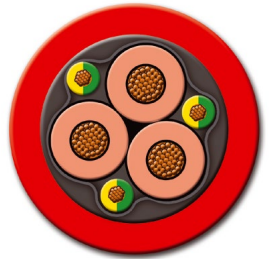
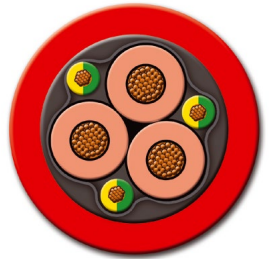
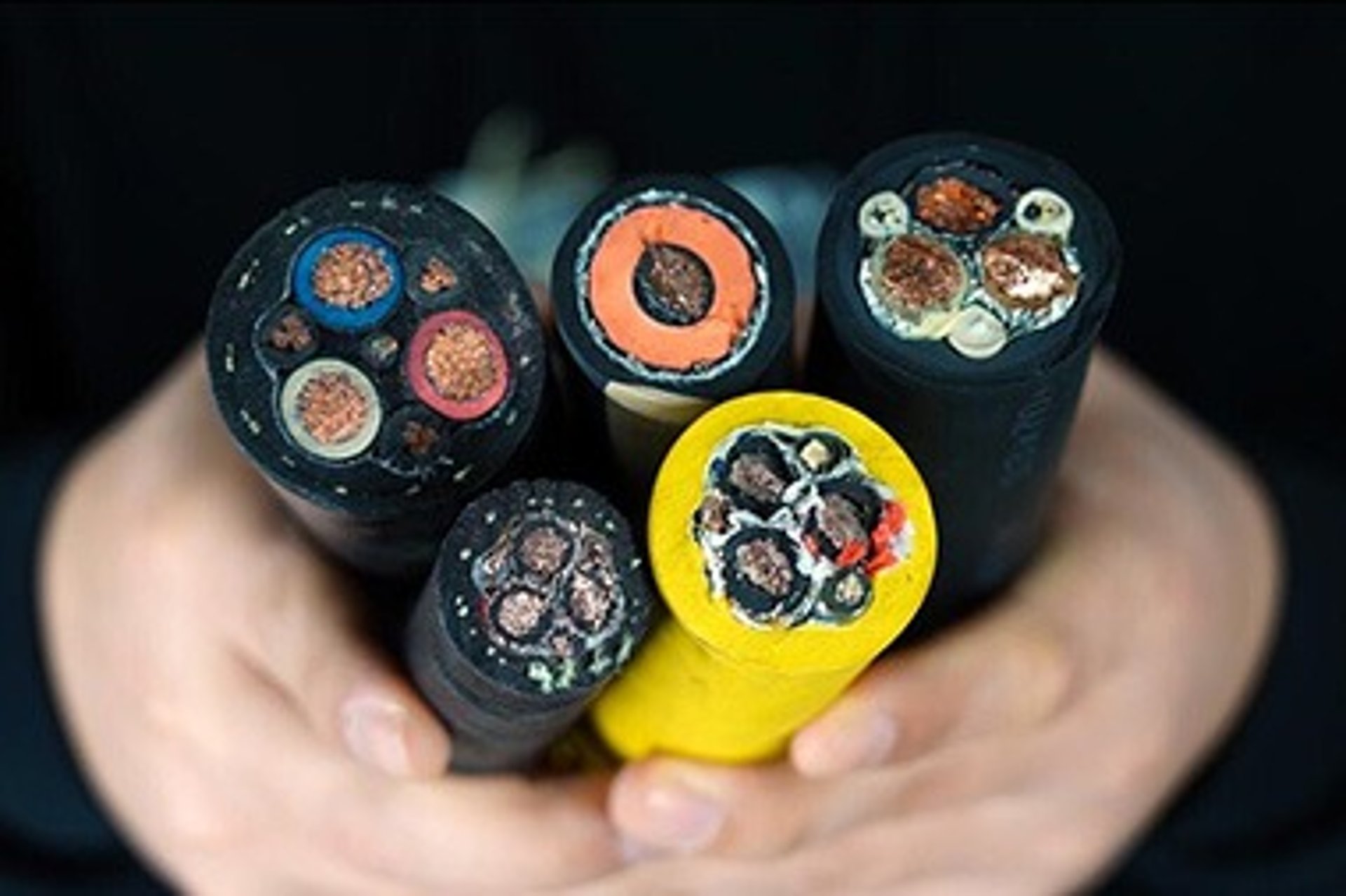
The cable follows a layered architecture designed to balance electrical integrity, mechanical toughness and environmental protection: electrolytic copper conductor → inner semiconductive rubber layer → EPR insulation → outer semiconductive rubber layer → split three‑way protective earth → EPR inner sheath → CM red outer sheath → FO unit (where specified) comprising GFK strength member, buffered fibres and protective covering.
Conductor – Class 5 Fine‑Stranded Copper
Conductors are made from high‑purity electrolytic copper, un‑tinned, stranded to Class 5 per DIN VDE 0295. Compared with Class 2 coarse‑stranded conductors used in general‑purpose cables, Class 5 uses many finer wires twisted together in multiple layers. Mechanically, this distributes bending and torsional stress across thousands of individual strands rather than a few thick ones, drastically reducing fatigue‑crack initiation and propagation. Electrically, high‑purity copper ensures low resistance and stable current‑carrying capacity at 90 °C. Omitting tin plating avoids inter‑metallic diffusion and embrittlement at elevated temperatures, extending service life under cyclic heating.
Dual Semiconductive Layers – Electric Field Control
Rubber‑based semiconductive layers are applied both over the conductor and under the insulation. In medium‑voltage cables, any irregularity at the conductor‑insulation interface concentrates electrical stress, creating localised high‑field regions that can initiate partial discharge and electrical treeing over time. The inner semiconductive layer smooths the conductor surface, equalising potential and eliminating sharp stress points. The outer layer confines the electric field entirely within the insulation and provides a controlled path for capacitive earth currents. Because both layers are rubber‑based, they deform together with the insulation during flexing, maintaining intimate contact and preventing air gaps that would otherwise form and accelerate breakdown – a critical advantage over rigid metallic tapes or foils used in many standard cables.
EPR Insulation – Elastomeric Dielectric
Insulation is formed from a special EPR compound meeting DIN VDE 0207 Part 20. Ethylene‑propylene rubber has a saturated hydrocarbon backbone that resists ozone attack, UV degradation and thermal oxidation – all major causes of brittleness in PVC or lower‑grade rubbers. Its low elastic modulus and high elongation allow it to flex repeatedly without cracking, while maintaining stable dielectric constant and high breakdown strength over the full temperature range. Unlike thermoplastic insulation, EPR does not soften or flow at operating temperature, and resists water‑tree formation in damp or wet environments – vital for buried, submerged or outdoor use.
Split Three‑Way Protective Earth – Structural and Electrical Dual Purpose
Instead of a single concentric or separate earth core, the protective conductor is divided into three equal strands placed in the outer interstices between the three power cores. Mechanically, this arrangement fills the natural voids in a three‑core assembly, producing a more circular, compact cable cross‑section that resists ovalisation and internal friction under bending and torsion. The three paths share mechanical load and provide redundant fault‑current capacity – if one section is damaged, the others remain functional. Electrically, an earth path distributed evenly around the phase conductors maintains balanced impedance and reliable earth‑fault detection, even when the cable is twisted or deformed. This design directly counters corkscrewing and conductor displacement that plagues standard cables with single concentric earths.
Inner and Outer Sheaths – Barrier and Toughness
An inner sheath of special EPR compound (DIN VDE 0207 Part 21) binds the cored assembly into a unified structure, cushioning internal components and preventing ingress of fluids or contaminants. The outer sheath uses a proprietary CM compound, coloured red for high visibility and safety identification. This formulation is engineered for exceptional abrasion and tear resistance, compatibility with mineral oils and hydraulic fluids per DIN VDE 0473 Part 811‑2‑1 Paragraph 10, and flame‑retardant performance to DIN VDE 0482 Part 265‑2‑1. Its cross‑linked rubber structure remains flexible at low temperatures and does not soften or flow at 90 °C. Resistance to brine and mine‑water chemistry makes it equally suited for coastal installations and dewatering duties.
Fibre‑Optic Unit – Integrated Intelligence
In the FO version, six optical fibres are laid around a central GFK (glass‑fibre reinforced plastic) strength member, each housed in a loose ETFE buffer tube filled with a water‑blocking compound. GFK provides high tensile strength without electrical conductivity or magnetic interference, so the optical system is unaffected by power‑frequency fields or earth currents. The loose buffer allows the fibre to move slightly within the tube when the cable is stretched or bent, isolating the glass from mechanical strain and preserving transmission performance. ETFE offers excellent chemical resistance and wide temperature tolerance, matching the cable’s environmental rating. Colour‑coding on fibres and tubes simplifies identification during installation and testing.
Performance Advantages – How It Differs from Standard Cables
High Flexibility and Fatigue Resistance
Standard medium‑voltage rubber cables are designed for static installation, where movement occurs only during installation or occasional re‑routing. Under repeated bending and torsion, their stiffer conductors and less compliant insulation develop fatigue fractures within months. TRATOS FIX MTO®‑M combines Class 5 conductors, EPR insulation and balanced construction to withstand millions of flex cycles, even at reeling speeds up to 100 m/min. In practical terms, this means cables remain intact through years of boom extension, stacker slewing and conveyor realignment – rather than requiring replacement every few months.
Consistent Electrical Performance
Vibration and movement cause dimensional changes in standard cables that can break down electrical‑field control, increasing partial‑discharge activity and accelerating insulation ageing. The dual semiconductive rubber layers and homogeneous EPR dielectric maintain uniform stress distribution regardless of cable shape, keeping partial‑discharge levels low and stable throughout service life. This consistency is essential for protection‑relay coordination, voltage regulation and long‑term plant reliability.
Broad Environmental Tolerance
South African mines present every environmental challenge known to cabling: temperatures dropping below freezing at night and rising above 40 °C during the day, UV radiation at high altitude, coastal salt spray, mine‑water salinity, and exposure to diesel, hydraulic fluids and greases. Standard PVC or general‑purpose rubber cables typically harden and crack under UV, swell or degrade in oils, and become brittle at low temperatures. The EPR‑CM compound system is engineered to resist all these factors simultaneously, with performance verified through standardised testing. The Type K variant extends cold‑weather capability to -60 °C for high‑altitude or winter‑exposed sites.
Proven Safety and Reliability
Beyond basic electrical and mechanical checks, this cable range passes tests specifically designed to replicate mining conditions: cyclic torsion, repeated reverse bending, roller abrasion and long‑term immersion compatibility. Flame‑retardant performance limits fire spread, while the red outer jacket improves visibility on site, reducing accidental mechanical damage from vehicles or equipment. The split earth design ensures earthing continuity is maintained even if part of the cable is damaged – a critical safety factor under mining regulations.
Integrated Power and Data
Traditional installations require separate power cables and fibre‑optic lines, doubling installation work, congestion in cable trays and risers, and the number of components that can fail. The FO variant integrates both functions within a single factory‑tested assembly, routed and installed once, with guaranteed mechanical compatibility between power and optical elements. This supports modern mine‑automation systems, allowing real‑time monitoring of motor winding temperature, bearing vibration, belt speed and pump level – all contributing to predictive maintenance and safer, more efficient operations.
Application Fit – Why This Cable Works for South African Mining
Conveyor Belts and Shiftable Systems
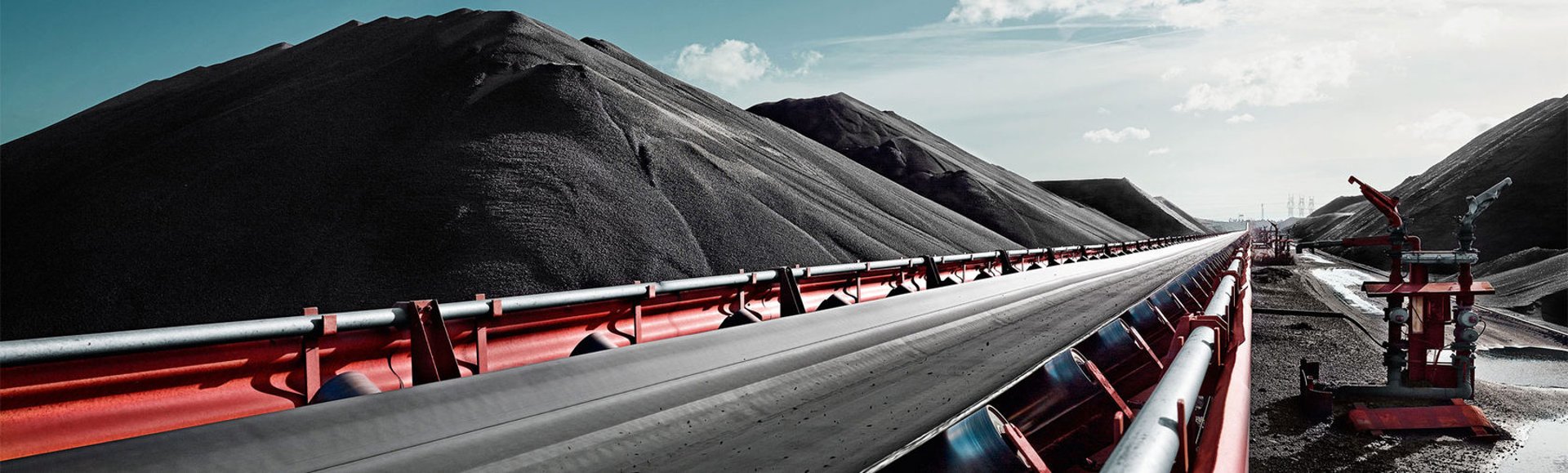
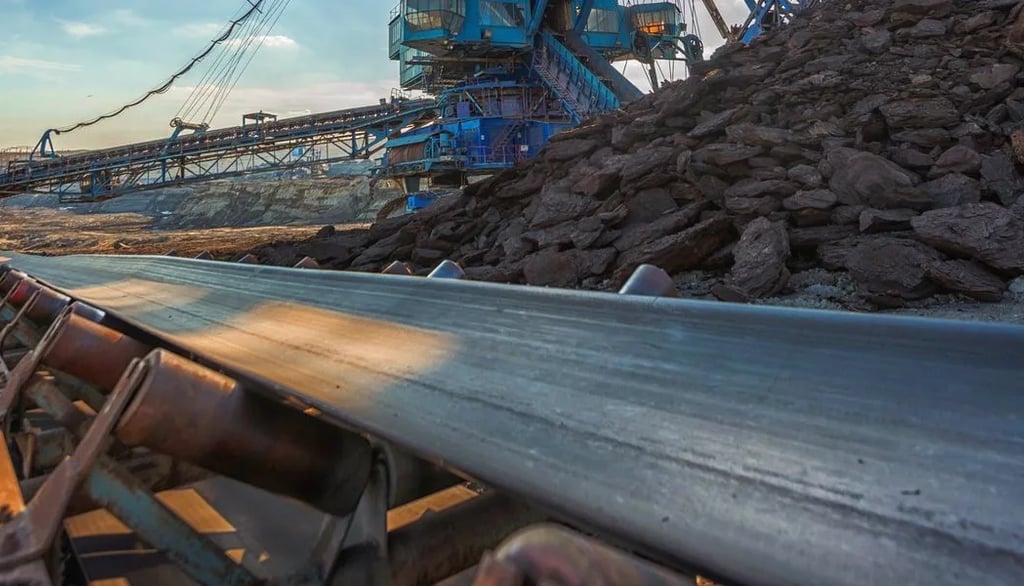
Overland and pit‑edge conveyors operate continuously, supported by steel structures that vibrate and deflect under load. Cables run along stringers or alongside belts, subject to impact from spillage, abrasion from dust and movement as sections are relocated. Standard cables often fail when jackets are abraded through or insulation fractures from vibration‑induced flexing. TRATOS FIX MTO®‑M resists cutting and tearing, while the balanced construction absorbs vibration without cumulative damage. The split earth maintains fault protection reliably, reducing nuisance trips and preventing dangerous earth‑fault conditions.
Stacker‑Reclaimers and Cable Booms
No application better illustrates the limits of standard cables than the cable boom on a stacker‑reclaimer or tripper car. As the machine travels and the boom luffs, the cable is bent, twisted and pulled repeatedly – often at speeds up to 100 m/min. Standard cables typically develop corkscrewing and birdcaging within months, requiring labour‑intensive replacement and lost production. This range is engineered to resist torsional build‑up through balanced core geometry, fine‑stranded conductors and flexible EPR materials, extending service life many times over and aligning with equipment overhaul cycles rather than becoming a maintenance item in its own right.
Submersible Pumps and Dewatering
Open‑pit and underground dewatering pumps operate fully submerged in water loaded with silt, dissolved salts and chemical residues. Heat generated by the motor combines with ambient summer temperatures to push conductor temperatures toward rated limits. Standard cables often suffer jacket blistering, insulation water‑treeing or earth‑conductor corrosion. The CM outer sheath resists brine and chemical attack, while EPR insulation resists water‑tree formation at 90 °C. The high short‑circuit rating and robust construction also provide safety margin during motor starting and system faults.
Fibre‑Optic Integration for Smart Mining
South Africa’s mining sector is actively adopting digital monitoring and automation to improve safety and productivity. The FO variant allows operators to feed real‑time data from drives, motors and instrumentation back to control rooms without installing separate cabling networks. This simplifies upgrades to variable‑frequency drives, condition‑monitoring systems and autonomous equipment, while reducing the number of penetrations through bulkheads and substation walls.
Feichun Cables – A Proven Equivalent Solution
Feichun Cables produces a fully equivalent F‑(N)TSCGEWÖU range that meets the same DIN VDE 0250 Part 813 specification and supporting standards as the original TRATOS product. Construction follows identical principles: Class 5 fine‑stranded un‑tinned copper conductors, dual semiconductive rubber screens, EPR insulation, split three‑way protective earth, EPR inner sheath and CM‑grade red outer sheath, with the option of integrated fibre optics. All electrical, thermal, mechanical and optical performance parameters align with the reference datasheet, ensuring interchangeability without compromising safety or reliability.
For procurement teams in South Africa and neighbouring countries, Feichun offers practical advantages beyond technical equivalence. Competitive pricing helps control capital expenditure on large projects, while reliable manufacturing capacity and regional logistics capability deliver shorter lead times compared with long‑distance imports. This supports tighter project schedules and reduces the risk of production delays caused by supply‑chain interruptions. All products carry full compliance documentation and are backed by technical support familiar with mining and material‑handling requirements across the SADC region.
Selection Guide – Choosing the Right Cable for Your Site
Begin selection by matching voltage rating to the system’s maximum operating voltage, applying a minimum margin of 1.2 to 1.3 times for safety and future expansion. Next, determine conductor cross‑section by balancing current‑carrying capacity at site ambient temperature, permissible voltage drop under full load and starting conditions, and the required one‑second short‑circuit withstand capability – all values available from the technical datasheet.
For environmental conditions, choose the standard temperature range (-40 °C to +80 °C) for most open‑pit and coastal applications, and specify Type K (-60 °C to +60 °C) for high‑altitude or winter‑exposed sites. Where equipment undergoes repeated movement such as stackers or cable booms, always select this series rather than general‑purpose cables. For submersible use, confirm compatibility with specific water chemistry and operating depth. Include the FO variant whenever condition monitoring, control signals or data transmission are required, to simplify installation and reduce cabling complexity.
Frequently Asked Questions
Is this a reeling cable for continuous trailing?
No – it is designed for fixed installation subject to occasional or cyclic movement, not for continuous high‑speed trailing as used on draglines or shovels. Its torsion and flex performance still make it far more capable than standard fixed cables, but continuous trailing applications require a different product category.
Why is the protective earth split into three parts?
This arrangement balances mechanical and electrical performance: it fills interstices for a rounder, sturdier cross‑section that resists twisting and ovalisation, while providing three parallel fault‑current paths that maintain continuity even if one section is damaged or displaced.
Can it be used for fully submerged pump connections?
Yes – it is explicitly intended for submersible‑pump applications, with water‑resistant materials and construction proven to HD 22.16. Always verify chemical compatibility with the specific water or fluid at your site.
How does it compare with standard EPR or PVC cables?
Standard cables use stiffer conductors, simpler screening and general‑purpose sheaths that cannot withstand repeated flexing, torsion or chemical exposure. This range is purpose‑built for “fixed but moving” duty, with performance validated through mining‑specific mechanical tests.
Are Feichun cables truly interchangeable?
Yes – they conform to the same core standards and match all critical performance parameters. They offer a fully compliant alternative with supply‑chain advantages for Southern African projects.
Conclusion
TRATOS FIX MTO®‑M and TRATOS FIX MTO®‑M (FO) are not simply reinforced versions of ordinary cables – they represent a complete re‑engineering of medium‑voltage cabling for the specific reality of mining and bulk material handling. Every design choice – from fine‑stranded Class 5 conductors through dual semiconductive control and balanced split earths to specially formulated EPR and CM compounds – is rooted in clear engineering principles and proven material science.
In South African mines, the result is measurable: fewer unplanned stoppages, longer service intervals, safer and more reliable earthing, and lower total cost of ownership despite higher initial specification. The FO variant adds further value by integrating power delivery with the data infrastructure required for modern, safer and more efficient operations.
Feichun’s equivalent range extends these benefits to a wider market, delivering identical performance with improved supply flexibility and cost efficiency. For any project where medium‑voltage power must reach moving equipment in harsh environments – conveyors, stackers, reclaimers, cable booms or dewatering systems – this family of cables remains the benchmark solution.
If you would like to source TRATOS‑equivalent F‑(N)TSCGEWÖU cables for your mining or material‑handling project, contact the Feichun team directly: Li.wang@feichuncables.com. They can provide full datasheets, cross‑reference tables, pricing and delivery schedules tailored to your site and requirements.
Email Address: Li.wang@feichuncables.com
© 2025. All rights reserved.
One-click to Quickly Contact
Products
Contact
Company
Location:
Building A Private Science and Technology Park, Hefei Economic and Technological Development Zone, Anhui Province, China
Heat Resistant Cable
WhatsApp: +86 17333223430
Social Media: