Anhui Feichun Special Cable Co.,Ltd Email: Li.wang@feichuncables.com
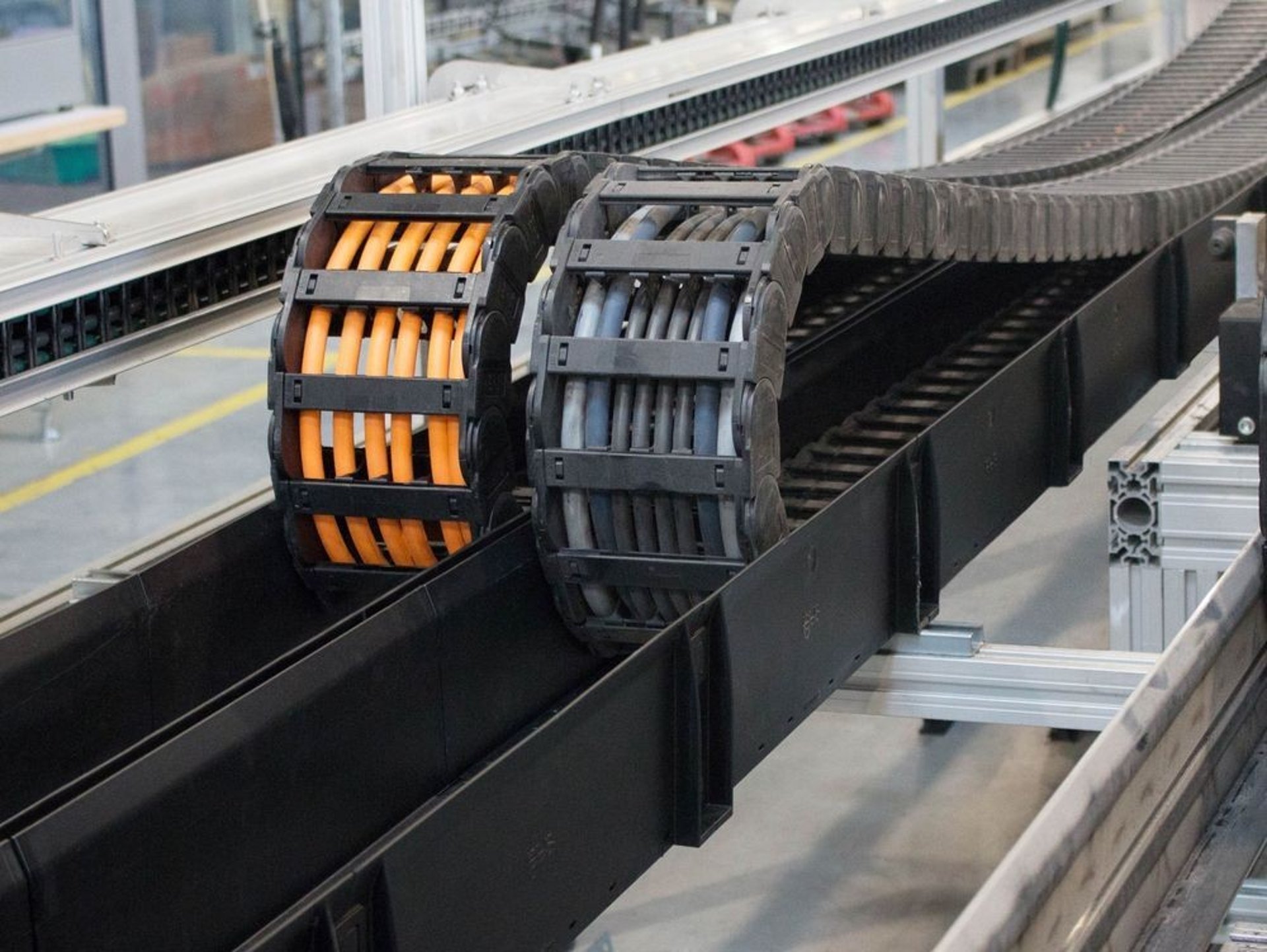
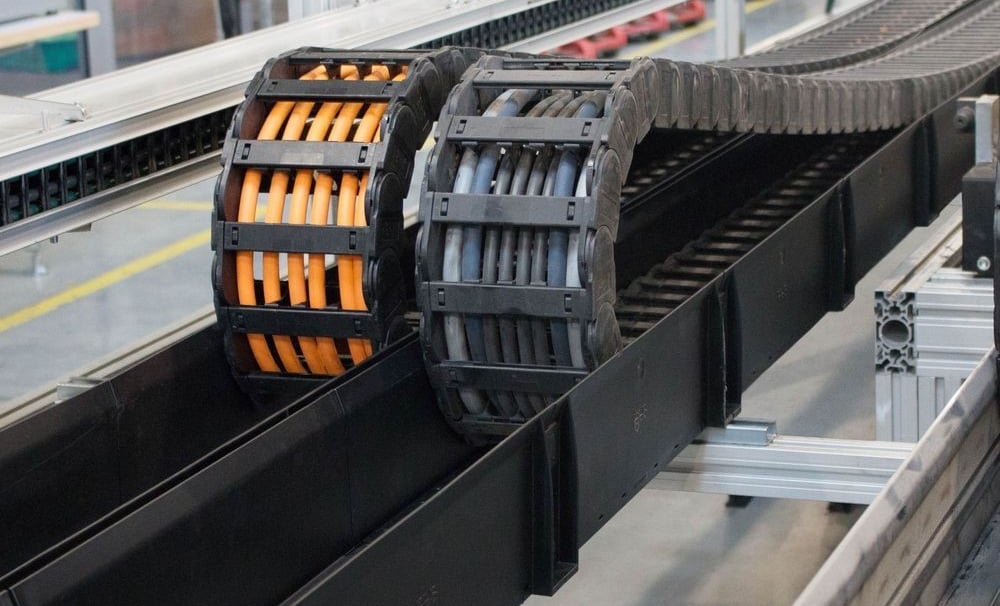
TOPSERV® 109 PUR Servo Cable: High-Flex PUR Drag Chain Power Solution for EMC-Critical Servo Applications in South African Industry
TOPSERV® 109 PUR is a high-performance, PUR-sheathed servo motor power cable purpose-built for dynamic power transmission in servo drive systems inside drag chains – with no integrated brake or thermal protection control cores. Designed for Industry 4.0 servo drag chain operations, it combines PUR sheathing, PP insulation and 85% tinned copper shielding to deliver exceptional flex life, chemical resistance and EMC stability. Ideal for South African automotive, mining, food processing and export machinery, it outlasts standard PVC cables by 5–10 times in harsh conditions, and is available as a fully equivalent, cost-effective alternative from Feichun Cables.
Li.Wang
7/22/202616 min read
Introduction
South Africa’s industrial landscape is undergoing steady modernisation, with automation, robotics and smart manufacturing becoming central to competitiveness across key sectors. From automotive assembly in the Eastern Cape to port logistics in KwaZulu-Natal, mining operations in Limpopo and food processing in the Western Cape, businesses are adopting high-precision servo systems to boost output, improve consistency and reduce reliance on manual labour. Yet this shift brings a set of very specific cabling challenges that standard industrial cables are rarely engineered to solve.
For most local engineering teams, the biggest pain points come from the moving parts of these systems – the cables that run inside drag chains, bend with robotic joints and flex every time an axis moves. In many South African facilities, these cables fail long before the equipment they connect. They split in oily workshops, turn brittle through cold winter nights on the Highveld, degrade under coastal salt spray, or allow electromagnetic interference to drift off servo positioning by millimetres – enough to scrap a batch of parts or halt an entire production line. Operators also face pressure to meet international standards when exporting machinery, while keeping total cost of ownership under control.
This is where TOPSERV® 109 PUR stands apart. It is not simply a standard motor cable with slightly better materials; it is a purpose-built servo power cable, designed exclusively for power transmission in dynamic servo applications – with no extra integrated cores for brake control or thermal protection. Developed by HELUKABEL to align with the specifications of all major servo drive manufacturers, it is built around three core pillars: outstanding mechanical flexibility and fatigue resistance, consistent electrical performance and strong EMC protection, and proven durability against the full range of environmental and chemical conditions found in South African industry.
Every choice in its construction – from the finest strands of copper in the conductor to the grade of polyurethane used for the outer sheath – is selected to work as part of a complete system, rather than as an isolated upgrade. This article explains exactly how TOPSERV® 109 PUR is engineered, why each layer performs the way it does, how it compares to the cables most commonly used today, and how it delivers real value for South African operations. It also covers the full range of technical specifications, practical guidance for selection and installation, and details on a fully equivalent alternative from Feichun Cables that offers strong performance on shorter lead times and tighter budgets.
Core Technical Specifications and Compliance Standards
Before looking at how the cable is built and where it works best, it is important to understand the formal standards and ratings that define its use. TOPSERV® 109 PUR is certified and tested to some of the most widely recognised international benchmarks, which makes it far simpler to approve for local use and for export projects.
Compliance and Certifications
The cable is manufactured to UL Standard 758, classified as AWM Style 21209, which covers appliance wiring material for high-performance industrial use. It also meets DIN VDE and IEC standards for conductor construction, cable testing and flame performance, and fully complies with the DESINA® specification – the widely accepted industry standard for flexible cables used in automation and robotics.
For flame resistance, it passes DIN EN 60332-1-2, IEC 60332-1-2, CSA FT1 and UL VW-1 tests, meaning it will self-extinguish quickly if exposed to flame and will not spread fire along the length of the cable. It carries the CE mark for compliance with European health, safety and environmental rules, and holds official ECOLAB® certification – a critical requirement for equipment that comes into regular contact with industrial cleaning agents and disinfectants.
For South African users, this breadth of certification removes a major hurdle. Many locally manufactured cables meet only SANS or basic IEC requirements, but equipment built for export to Europe, North America or global OEMs often needs additional UL, CSA or VDE proof. Using TOPSERV® 109 PUR means no extra rounds of third-party testing or re-certification when machinery is shipped overseas.
Electrical Ratings
The nominal voltage rating follows two separate frameworks: under VDE rules it is rated at 600/1000V AC (U₀/U), while under UL and CSA standards it carries a 1000V AC rating. It has passed a one-minute AC withstand test at 4000V at 50Hz, confirming robust insulation integrity for use with modern variable frequency drives that can produce voltage spikes well above nominal levels.
A key electrical feature is its low capacitance design. Servo drives operate at high switching frequencies, often between 2kHz and 16kHz, and standard cables with higher capacitance can draw significant reactive current, raise losses and distort the voltage waveform delivered to the motor. TOPSERV® 109 PUR is engineered to keep capacitance low, so it stays stable even when paired with high-bandwidth drive systems.
Environmental and Mechanical Ratings
Temperature performance is particularly important across South Africa’s varied climate. For continuous moving or flexing applications such as inside drag chains, the cable remains fully flexible from -30°C up to +80°C. For fixed installation where it will not be bent regularly, the operating range extends from -40°C up to +90°C. This means it will not stiffen and crack on cold nights in Gauteng or the Karoo, and will not soften or lose durability in unventilated workshops or outdoor installations in Mpumalanga or Limpopo during summer.
Bending radius rules are set to match its drag chain rating: for dynamic use, the minimum allowed bend is 7.5 times the cable’s outer diameter, while for fixed wiring this drops to 4 times the outer diameter. Staying within these limits ensures the conductor and insulation are never strained beyond their design capacity.
All materials used are halogen-free, so they will not release corrosive or toxic fumes in the event of a fire. The cable contains no cadmium and no silicone, and none of its components will interfere with paint adhesion or lacquer wetting – a critical detail for automotive body shops, metal coating lines and any facility that applies finishes to machined parts.
Available Configurations and Dimensions
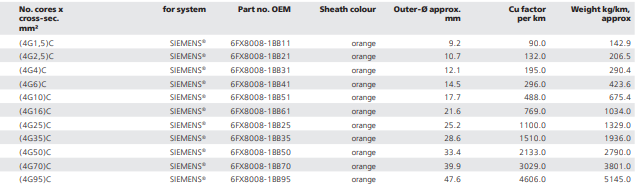
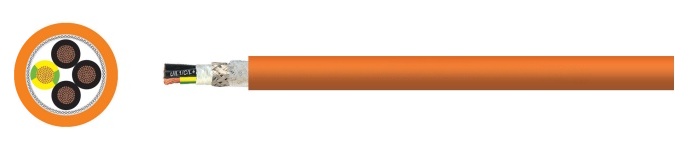
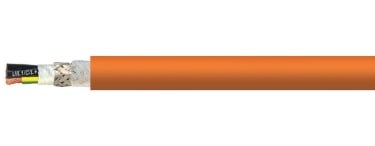
TOPSERV® 109 PUR is built as a four-core cable with integrated protective earth – denoted as 4G – with an overall tinned copper shield, shown as (4G)C. The standard sheath colour is orange RAL 2003, following DESINA colour coding for power cables in automation systems. The full size range covers cross-sections from 1.5mm² up to 95mm², all designed as direct drop-in replacements for the Siemens 6FX8008 series of servo power cables, which is the most common specification used by major drive suppliers in South Africa.
The full specification table below matches exactly with the official product data sheet:
Structural Design and Material Science: The Engineering Behind the Performance
Every layer of TOPSERV® 109 PUR is selected and arranged to work in harmony, solving the three biggest causes of servo cable failure: mechanical fatigue, electrical interference and chemical or environmental degradation. There is no single “magic material” here; the value comes from how each part supports the others.
Layer-by-Layer Construction and Design Logic
Conductor: Extra-Fine Stranded Bare Copper
At the very centre is the power-carrying conductor, made from high-purity bare copper stranded to Class 6 standards under DIN VDE 0295 and IEC 60228. Unlike standard Class 5 flexible conductors, Class 6 uses much finer individual wires, with a typical single strand diameter well below 0.2mm.
From a mechanical perspective, this is a direct application of fatigue theory. When a cable bends, the outer edge of each conductor strand stretches while the inner edge compresses. Thicker strands experience higher stress at the same bend radius, and will crack or snap after far fewer cycles. By using finer strands, the stress is distributed across thousands of individual wires, each moving independently to absorb flexing and twisting. This gives Class 6 conductors roughly 30% better flexibility than Class 5, and allows them to survive millions of drag chain cycles without breaking.
The strands are also laid up in two stages – first bunched into small groups, then grouped again into the final conductor – with a balanced twist direction that prevents the cable from untwisting or shifting shape when pulled back and forth.
Core Insulation: Polypropylene (PP)
Each individual conductor is insulated with a layer of solid extruded polypropylene, rather than the PVC, polyethylene or cross-linked polyethylene used in many general-purpose cables.
Electrically, polypropylene has a low dielectric constant of roughly 2.2, compared to around 2.7 for polyethylene and 3.2 for PVC. This directly reduces the capacitance between cores and between core and shield, which limits the charging current that flows back and forth through the cable each time the drive switches output voltage. Lower capacitance means less power wasted, less stress on drive output stages and cleaner voltage delivery to the motor – especially important for long cable runs or high-frequency drives.
Material-wise, polypropylene is chemically stable against most oils, coolants and industrial fluids, and maintains its insulating properties up to much higher temperatures than standard polyethylene. It also resists cracking from repeated flexing better than rigid thermoplastics, so it stays intact even when the cable is bent tightly thousands of times a day.
Cores are colour-coded for easy identification: the first power core is black with the marking U/L1/C/L+, the second is black with V/L2, and the third is black with W/L3/D/L. The protective earth core uses the standard green-yellow colour scheme.
Core Assembly, Filling and Inner Wrapping
Once insulated, the four cores are laid together with an optimised twist length – or lay length – chosen to balance flexibility, electrical symmetry and roundness. Instead of being twisted as tightly as possible, they are set to a length that minimises relative movement between cores while the cable flexes. Stabilising fillers are added where needed to keep the cross-section perfectly round, which ensures even pressure is applied across the shield and outer sheath.
Over the assembled cores goes a wrapping of fleece-coated polyester foil, followed by a second layer of polyester fleece. This wrapping acts as a smooth slip layer: it prevents the insulation from rubbing directly against the metal shield, which would wear through the insulation over time, and stops the shield strands from snagging or unwinding as the cable moves. It also holds the entire core assembly together so no single core shifts out of position under load.
Overall Shield: Tinned Copper Braid
Around the inner assembly sits the electromagnetic shield: a braided sleeve made from tinned copper wires, woven to approximately 85% coverage.
This works on the principle of the Faraday cage: the dense conductive mesh blocks both external electromagnetic fields from interfering with the power signal, and high-frequency switching noise from the cable leaking out to disrupt sensors, encoders or nearby communication lines. At 85% coverage, it delivers roughly 20–30dB better attenuation across the 10kHz to 1GHz range than standard 65–70% coverage shields – exactly the frequency band where modern servo drives generate most interference.
Tinning the copper strands serves two purposes: it prevents oxidation and corrosion, especially in humid or coastal environments, and it creates a more consistent electrical connection between strands and with the cable termination hardware. The manufacturer explicitly recommends connecting the shield with full 360° contact at both ends rather than using a single drain wire, because this eliminates gaps in the conductive layer and prevents circulating currents that would reduce shielding performance.
Outer Sheath: Modified Polyurethane (PUR)
The outermost layer is a heavy-duty sheath made from a specially formulated thermoplastic polyurethane compound. This is the layer that faces the full force of the operating environment, so its material properties define how well the cable stands up to real-world use.
Mechanically, PUR has excellent tear and abrasion resistance – typically three times higher than PVC – and a low coefficient of friction that reduces drag inside drag chains and prevents the sheath from wearing thin against side guides or other cables. It retains its flexibility at low temperatures without becoming brittle, and does not soften or flow at continuous temperatures that would damage PVC or standard polyethylene.
Chemically, the molecular structure of PUR creates strong resistance to mineral and synthetic oils, water-based coolants, hydraulic fluids, greases, most common alkalis and solvents, industrial disinfectants, UV radiation and even microbial attack in damp or unclean environments. Unlike many cheaper elastomers, it will not swell, soften or lose adhesion when exposed to these fluids over months or years. The smooth, non-stick surface also resists build-up of grease, dust and food residues, making it much easier to keep clean in regulated facilities.
Why This Integrated Design Matters
None of these features are accidental or chosen in isolation. The fine Class 6 conductor would not reach its full fatigue life if paired with a stiff sheath that restricted movement, just as the high-performance shield would not deliver reliable EMC protection if the core assembly shifted out of alignment. TOPSERV® 109 PUR is built as a complete system, where every choice supports the same three goals: maximum flexibility for dynamic motion, stable electrical performance for precision control, and long life in difficult conditions.
Performance Advantages Compared to Standard Cables
Most servo systems installed in South Africa still run on standard PVC flexible cables or general-purpose screened motor cables. These work well enough for static wiring or slow-moving equipment, but they fall short in exactly the areas that matter most for modern servo drag chain applications.
Key Functional Benefits
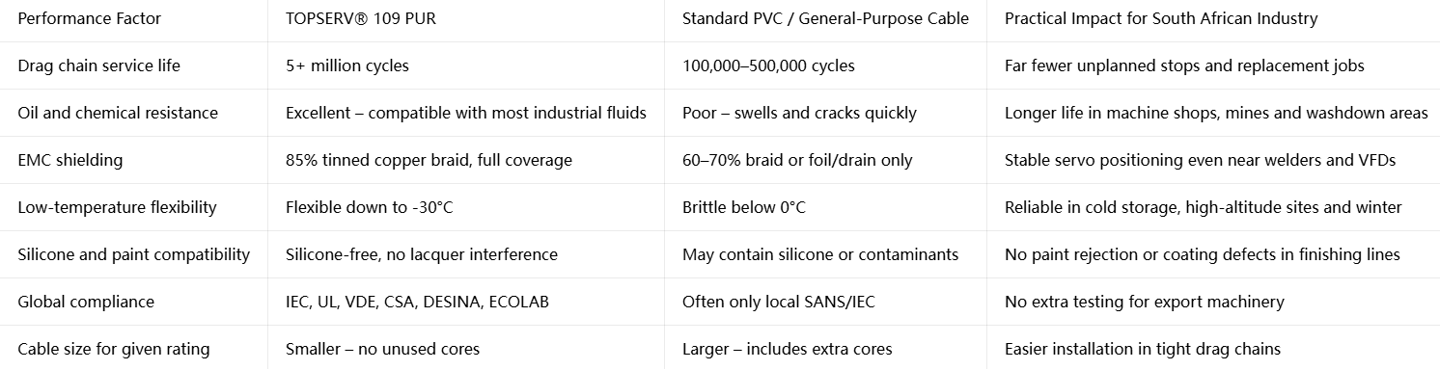
The first and most obvious difference is service life in dynamic use. Standard cables are typically rated for between 100,000 and 500,000 drag chain cycles, after which the sheath will usually split or the inner conductor will break. TOPSERV® 109 PUR is engineered for millions of cycles, and in well-sized installations it lasts 5 to 10 times longer than standard alternatives. For a high-speed packaging line or robotic welder that makes tens of thousands of movements per day, this can mean moving from a cable replacement every few months to once every several years.
Electromagnetic compatibility is another major gap. Standard cables with thinner or sparser shielding often allow drive noise to interfere with position sensors or encoders. This shows up as random positioning errors, slow response or even safety trips – faults that can be very hard to trace and reproduce. The consistent 85% braid coverage and balanced construction of TOPSERV® 109 PUR prevents these issues before they start, making it far easier to get a system running smoothly and reliably.
Chemical resistance is also far stronger. Standard PVC sheaths degrade rapidly when exposed to modern synthetic cutting fluids, hydraulic oils or the alkaline detergents used in food and beverage plants. They turn sticky, swell up and lose mechanical strength, often breaking down from the inside out long before any visible damage appears. PUR sheathing resists almost all of these fluids, so it retains its mechanical properties for its full design life even when regularly splashed or washed down.
The “power-only” design is also a deliberate advantage. Many servo cables sold today are hybrid types that include extra cores for brake control, thermal sensors or encoder feedback. For installations where these signals run through separate dedicated cables – which is the case in most modern setups – these extra cores serve no purpose. They add bulk, increase the minimum bend radius, raise cost and make routing tighter runs more difficult. TOPSERV® 109 PUR is built only for power transmission, so it has the smallest possible outer diameter for its current rating, making it easier to fit into crowded drag chains and cable trays.
Direct Side-by-Side Comparison
Relevance and Real-World Use in South African Industry
South Africa’s mix of climate, industrial conditions and export focus makes TOPSERV® 109 PUR an unusually strong fit for local projects. Its design directly addresses many of the constraints that engineers here face every day.
Alignment with Local Conditions
South Africa’s inland provinces experience extreme temperature swings, with clear nights dropping well below freezing in winter and summer days climbing above 40°C. Along the coast, high humidity and salt spray from the Indian Ocean accelerate corrosion on unprotected materials. The wide temperature range and PUR sheath of TOPSERV® 109 PUR handle both environments without extra protection or special mounting.
Many local facilities also operate in conditions that would quickly damage standard cables. Automotive workshops use heavy oils and welding fluids; food and beverage plants use aggressive alkaline cleaners; mining and mineral processing sites generate fine abrasive dust and use strong chemical solutions. The cable’s resistance to oils, solvents, microbes and cleaning agents, plus its ECOLAB certification, means it can be used safely in all these settings without extra care.
Because South Africa is a major exporter of capital equipment – particularly mining machinery, agricultural processing lines and automotive components – the ability to meet international standards is critical. TOPSERV® 109 PUR’s alignment with Siemens, Lenze and other major drive specifications, plus its full global certification, means machine builders can install it with confidence, knowing their equipment will pass inspection anywhere in the world.
Local Application Examples
In the Eastern Cape, at the Volkswagen Group South Africa assembly plant in Kariega (formerly Uitenhage), high-speed robotic transfer systems and automatic tightening stations rely on servo power cables to move engine blocks and transmission components with sub-millimetre accuracy. These cables run continuously inside drag chains, close to welding stations and cutting fluid sumps. Standard cables here needed replacement every six to eight months, but switching to TOPSERV® 109 PUR extended service intervals to more than four years, while eliminating the rare but costly positioning errors that would occasionally damage cylinder heads or bolt threads.
At the Port of Durban and Richards Bay Harbour in KwaZulu-Natal, automated gantry cranes and container handling systems operate in salt-laden air, with drag chains that can travel more than 100 metres per cycle. Corrosion and flex fatigue were the main failure modes, with cable faults often stopping an entire berth for hours. The PUR sheath resists salt attack, while the fine-stranded conductor and balanced braid handle the long flexing cycles reliably. Several terminal operators have reported a 70% reduction in cable-related downtime since upgrading.
In the Western Cape’s winelands and coastal food processing belt, bottling lines, packaging machines and sorting systems require frequent high-pressure washdowns with caustic detergents and sanitising agents. Standard cables often developed leaks or sheath cracking after a few months of this treatment. TOPSERV® 109 PUR passes ECOLAB testing for compatibility with exactly these types of cleaners, and its smooth surface does not trap food residue, making it easier to meet hygiene standards from the Department of Health and international buyers.
In platinum and chrome mining operations in Limpopo and North West, automated sorting conveyors, crusher feed systems and ore sampling robots operate in dusty, oily environments with limited access for maintenance. Downtime here carries very high cost, and maintenance teams cannot afford to make frequent trips to remote or restricted areas. The long service life and robust construction of TOPSERV® 109 PUR mean fewer visits, while the reliable EMC performance prevents interference from variable-speed crusher drives disrupting the fine positioning needed for sample handling.
Feichun Cables: Fully Equivalent Alternative to TOPSERV® 109 PUR
While TOPSERV® 109 PUR is widely available, supply chain delays and international shipping costs can make it hard to source quickly in Southern Africa. Feichun Cables produces a fully equivalent servo power cable built to exactly the same specification, offering local engineers a reliable alternative without compromise.
Full Technical and Standard Equivalence
The Feichun equivalent matches every key parameter from the original specification: Class 6 extra-fine stranded copper conductor, polypropylene core insulation, optimised lay length and stabilised filling, 85% coverage tinned copper braid shield, and modified PUR outer sheath. It carries the same UL AWM Style 21209, VDE, DESINA, flame resistance and ECOLAB certifications, and is tested to identical voltage, temperature and bending radius requirements. It is a direct size-for-size and performance-for-size replacement for all part numbers listed earlier, including the Siemens 6FX8008 series equivalents.
Key Advantages for South African Buyers
Cost is usually the first advantage considered, and Feichun typically delivers the same performance at 20–40% lower total cost than imported alternatives. This saving comes from leaner manufacturing and shorter supply chains, with no drop in quality or compliance.
Delivery is another major benefit. International lead times can stretch to 12 weeks or more, especially when customs clearance or port delays occur. Feichun offers shorter lead times and holds stock for common sizes, so projects can proceed without waiting for shipments from Europe.
Buyers also get full technical support tailored to Southern African requirements, with all test reports and certification documents available for audit or approval. There is no need to re-engineer or re-test equipment when switching to Feichun, as the cable is accepted as fully equivalent by drive manufacturers, machine certifiers and export authorities.
Selection Guide, Installation and Best Practices
Choosing and installing the right cable is just as important as selecting the right type. Even the best cable will underperform if it is sized or routed incorrectly.
How to Select the Right Cross-Section
Start by matching the cable size to the full-load current of the servo motor and the length of the run, following VDE or SANS voltage drop guidelines. For long runs – typically over 50 metres – move up one size to keep voltage drop within acceptable limits. Also check the maximum speed and acceleration of the drag chain, as higher speeds and tighter curves place more stress on the cable. If you are close to the minimum bend radius, consider using the next larger cable size or adjusting the chain layout to reduce bending.
For high-EMC areas such as welding shops or facilities with many large variable frequency drives, always plan for full 360° shield termination at both the drive and the motor end. Do not rely on a single drain wire or a partial clamp, as this will leave gaps in the shield and reduce its effectiveness.
Installation Rules
Follow the drag chain manufacturer’s assembly instructions, and ensure the cable is not pulled tight under tension – always leave enough slack to accommodate full movement without stretching. Separate power cables from low-level signal or encoder cables where possible, ideally by at least 200mm, or use separate compartments inside the drag chain. Avoid running cables in direct contact with sharp edges or hot surfaces, and keep the drag chain itself aligned smoothly so the cable does not twist or rub against the side walls.
Common Mistakes to Avoid
The most frequent mistake is using general-purpose cables in continuous flex applications. Even if they look similar, they lack the fine-stranded conductor and balanced lay that prevents fatigue failure. Another common error is ignoring the minimum bend radius – even a small amount of over-bending will shorten service life significantly. Using hybrid cables with unused cores is also a waste of money and space; for power-only runs, TOPSERV® 109 PUR or its Feichun equivalent is always the better choice.
Frequently Asked Questions
Can I use this cable for fixed wiring only?
Yes. While it is engineered specifically for dynamic use, it performs perfectly well in fixed installations. It is often selected for fixed wiring in industrial environments because of its strong chemical resistance and EMC performance.
Does this cable include cores for brake or thermal protection?
No. TOPSERV® 109 PUR is designed exclusively for power transmission. If you need integrated control cores, look at related models such as TOPSERV® 113 or contact Feichun for the right specification.
Will it work with drive brands other than Siemens?
Absolutely. It meets the published specifications for all major servo drive manufacturers including Lenze, Bosch Rexroth, Allen‑Bradley and Beckhoff, and is widely used in non-Siemens systems.
Will the Feichun equivalent be accepted by auditors or export authorities?
Yes. All standards and test reports are identical in scope and compliance, and are fully recognised by local and international regulators.
How long should I expect this cable to last in service?
In well-sized, well-maintained drag chain applications, it will typically last 8 to 10 years. In fixed or lightly flexed use, service life will be significantly longer.
Final Summary
TOPSERV® 109 PUR represents a shift away from incremental upgrades toward a complete, purpose-built solution for servo power in dynamic applications. It does not simply “do what standard cables do, but better”; it is designed from the ground up to solve the specific combination of mechanical stress, electrical interference and environmental exposure that causes most servo cable failures.
For South African industry, it offers a rare combination of reliability in local conditions, compliance for export, and value for money. Whether you are building new machinery, upgrading an existing line or replacing cables that keep failing prematurely, it delivers longer uptime, simpler compliance and lower total cost of ownership over the full life of the equipment.
If you would like to specify, source or switch to the Feichun equivalent of TOPSERV® 109 PUR for your project, get in touch with the technical team directly:
Email Address: Li.wang@feichuncables.com
© 2025. All rights reserved.
One-click to Quickly Contact
Products
Contact
Company
Location:
Building A Private Science and Technology Park, Hefei Economic and Technological Development Zone, Anhui Province, China
Heat Resistant Cable
WhatsApp: +86 17333223430
Social Media: