Anhui Feichun Special Cable Co.,Ltd Email: Li.wang@feichuncables.com
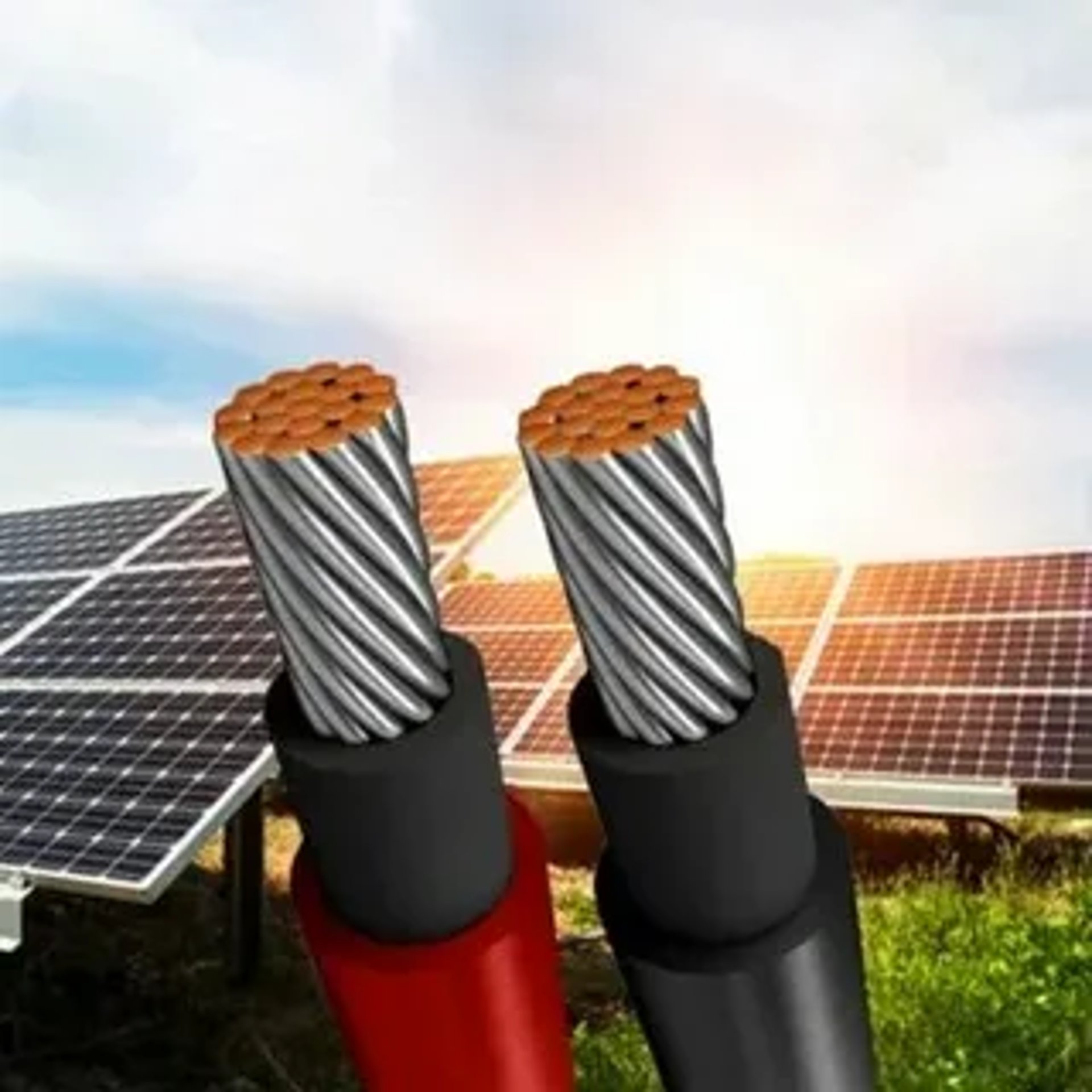
TECSUN(PV) H1Z2Z2-K 1.5kV DC Solar Cable Guide: EN 50618 Certified PV Cables for High-Voltage, Extreme-Weather Solar Installations in South Africa
Explore the engineering, materials, standards, and real-world performance of TECSUN(PV) H1Z2Z2-K solar cables. Designed for 1500V DC systems and harsh environments, this guide explains why it is the trusted choice for long-life, low-maintenance PV projects across South Africa.
Li Wang
7/6/202615 min read
Introduction
The global solar energy sector has undergone a major transformation over the past decade, moving from small-scale, low-voltage installations to large utility-scale plants operating at higher DC voltages. In South Africa, this shift is particularly pronounced. With one of the highest solar irradiance levels in the world, the country is rapidly expanding its renewable energy capacity to meet growing demand and reduce reliance on fossil fuels. However, the environmental conditions across South Africa present unique and severe challenges for electrical infrastructure. From the scorching heat and wide temperature swings of the Northern Cape to the corrosive salt-laden air along the coast and the chemical exposure in agricultural and mining regions, standard electrical cables often fail prematurely.
This guide focuses on the TECSUN(PV) H1Z2Z2-K, a solar cable specifically engineered to address these challenges. It is not merely a modified version of a general-purpose electrical cable; it is a purpose-built solution designed from the ground up for photovoltaic systems. The evolution of solar cabling reflects a broader shift in the industry—moving from “good enough” components to systems built for reliability over decades. The TECSUN(PV) H1Z2Z2-K represents this transition, offering specifications, materials, and construction that enable it to perform reliably for 25 to 30 years, even under the most demanding conditions.
This article provides a detailed technical overview, explaining the standards it meets, the science behind its materials and structure, its performance characteristics, and its proven track record in South African projects. It also compares it to conventional cables, discusses equivalent alternatives, and offers practical guidance for selection and installation.
Global and Local Standards: Why EN 50618 Matters
When selecting cables for solar installations, understanding the applicable standards is critical. Many electrical cables are designed for alternating current (AC) distribution systems, operating at lower voltages and under more stable conditions. Photovoltaic systems, however, generate direct current (DC) and operate under fluctuating loads, high temperatures, and continuous exposure to the elements. This difference in operating conditions requires cables tested and certified to specific standards.
The TECSUN(PV) H1Z2Z2-K is manufactured in full compliance with DIN EN 50618, the European standard specifically developed for cables used in photovoltaic power systems. Unlike general standards such as IEC 60502 or national standards for building wiring, EN 50618 defines rigorous requirements for voltage rating, temperature resistance, insulation stability, and environmental endurance. It sets the baseline for cables intended to remain in service for a quarter-century or more.
Under this standard, the cable is rated for 1.5/1.5 kV DC, with a maximum continuous operating voltage of 1.8/1.8 kV DC. This rating is essential as the industry moves from 1000V DC systems to 1500V DC architectures. Higher system voltages reduce the required current for the same power output, which in turn reduces resistive losses and allows longer cable runs with smaller conductor sizes. EN 50618 also mandates strict testing protocols, including long-term water immersion, thermal cycling, and resistance to ozone and ultraviolet radiation.
In South Africa, the adoption of EN 50618 is becoming standard practice. The South African Bureau of Standards (SABS) recognises this specification, and many large renewable energy tenders now require cables to meet this standard. Local regulations increasingly demand that cables for utility-scale solar plants support a minimum DC voltage of 1500V and offer a design life of no less than 25 years. The TECSUN(PV) H1Z2Z2-K fully satisfies these requirements.
Additional certifications further confirm its quality. It carries VDE approval and TÜV certification (Certificate No. 60103637), demonstrating compliance with European safety and performance benchmarks. It also meets the Construction Products Regulation (CPR) classification Eca, indicating acceptable fire performance, and is manufactured to be halogen-free in accordance with EN 50525-1 Annex B. This means that in the event of a fire, the cable will not release toxic or corrosive smoke, reducing risks to personnel and equipment. Furthermore, it complies with the RoHS directive 2011/65/EU, ensuring it contains no restricted hazardous substances.
Technical Specifications and Electrical Ratings
The performance of any cable begins with its fundamental electrical and thermal characteristics. The TECSUN(PV) H1Z2Z2-K is engineered to operate within parameters that far exceed those of standard low-voltage cables.
Electrical Parameters
The cable has a rated voltage of 1.0/1.0 kV AC and 1.5/1.5 kV DC, with a maximum permissible operating voltage of 1.2/1.2 kV AC and 1.8/1.8 kV DC. To verify its insulation integrity, it undergoes stringent testing: it withstands an AC voltage of 6.5 kV and a DC voltage of 15 kV for a duration of five minutes. This high test margin ensures that the insulation can handle voltage spikes and transient surges common in solar systems.
Insulation resistance is another critical factor. At 20°C, the insulation resistance is extremely high, and it remains stable even when subjected to long-term exposure. Tests conducted according to EN 50618 confirm that after ten days of immersion in water at 85°C while energised at 1.8 kV DC, the insulation properties remain within specification. Internal testing also confirms stable insulation resistance at 120°C in air, proving its ability to maintain electrical separation under thermal stress.
Thermal Parameters
Temperature tolerance is central to the cable’s long service life. The maximum continuous operating temperature at the conductor is 90°C, with a design life calculated using the Arrhenius model. This model predicts that operating at 90°C allows a service life of up to 30 years. The cable is also permitted to operate at 120°C for a total of 20,000 hours, providing a significant safety margin during periods of high irradiance and ambient heat. In the event of a short circuit, the conductor can withstand temperatures up to 250°C for a maximum of five seconds without permanent damage.
For installation and operation, the ambient temperature range is wide. During handling and installation, the cable can tolerate temperatures from -25°C to +60°C. Once in service, it functions reliably from -40°C up to +90°C, making it suitable for the extreme temperature variations found across South Africa.
Dimensions and Configurations
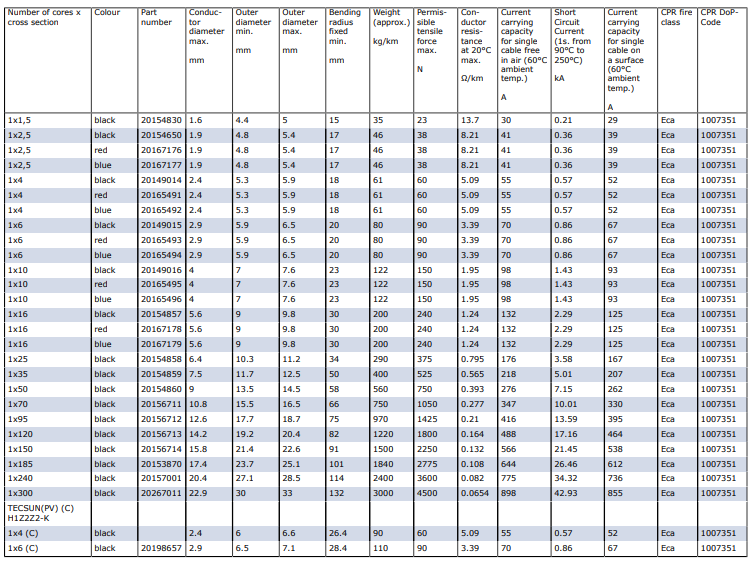
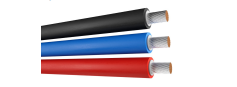
The TECSUN(PV) H1Z2Z2-K is available as a single-core cable in cross-sections ranging from 1.5 mm² up to 300 mm², covering all requirements from small off-grid systems to large central inverters. Standard colours include black, red, and blue, allowing for clear polarity identification. The standard delivery length is 500 metres, though custom lengths can be supplied upon request.
A special variant, designated TECSUN(PV)(C), includes an additional protective braid made of tinned copper wires with a coverage of more than 80%. This layer provides enhanced protection against rodent damage and mechanical impact, which is particularly useful in rural areas, farms, and industrial sites.
Mechanical specifications include minimum bending radii, which vary by size, and maximum tensile loads of 15 N/mm² during operation and 50 N/mm² during installation, ensuring the cable can be pulled and routed without damaging its internal structure.
Structure and Material Science: Engineering for Durability
The superior performance of the TECSUN(PV) H1Z2Z2-K is not accidental; it is the result of careful material selection and structural design. Every layer serves a specific purpose, chosen based on principles of electrical engineering, chemistry, and physics.
Layer-by-Layer Construction
1. Conductor
At the core of the cable is the conductor, made from electrolytic tinned copper, finely stranded to Class 5 as defined by IEC 60228. Class 5 stranding consists of many small-diameter wires twisted together, which gives the cable excellent flexibility. This flexibility reduces the effort required during installation and allows the cable to bend repeatedly without work hardening or breaking.
The use of tinned copper is a deliberate choice. While bare copper offers high conductivity, it oxidises rapidly in humid or chemically active environments. The thin layer of tin acts as a barrier, preventing oxidation and ensuring low contact resistance at terminations over decades. This is particularly important in direct burial applications or coastal installations where moisture and salts are present.
From an electrical perspective, fine stranding also reduces the skin effect, a phenomenon where current tends to flow along the outer surface of a conductor at higher frequencies. Although DC systems do not experience this effect, the structure still provides more consistent conductivity and greater mechanical strength compared to solid conductors.
2. Insulation Layer
Surrounding the conductor is the insulation, manufactured from cross-linked High-Modulus Ethylene Propylene Rubber (HEPR) rated for 120°C. Unlike thermoplastic materials such as PVC or polyethylene, which soften and deform when heated, cross-linked polymers have a three-dimensional molecular structure formed by chemical bonds. This structure prevents the material from melting or flowing at high temperatures.
HEPR is selected for its outstanding electrical properties. It has a low dielectric constant and low power factor, meaning it loses very little energy as heat when exposed to high electric fields. It also exhibits high resistance to partial discharge, a process that can degrade insulation over time under high DC voltage. This property is essential for 1500V systems, where the electrical stress on insulation is much higher than in lower-voltage AC systems.
3. Bonded Interface
One of the most distinctive features of this cable is that the insulation and outer sheath are solidly bonded together during manufacturing. This creates a monolithic two-layer system rather than two separate layers. The engineering principle behind this design is to eliminate air gaps. If voids exist between layers, the electric field becomes concentrated within these gaps, leading to partial discharge, tracking, and eventually insulation failure. By bonding the layers, the design ensures a uniform electric field distribution and prevents water or moisture from wicking between the layers, which would otherwise lead to creepage currents and corrosion.
4. Outer Sheath
The outer protective layer is made from cross-linked Ethylene Vinyl Acetate (EVA) rubber, also rated for continuous use at 120°C. EVA is chosen for its excellent resistance to environmental degradation. It remains flexible and elastic at temperatures as low as -40°C, avoiding the brittleness that causes other cables to crack during cold nights. It also has high resistance to ultraviolet radiation, ozone, and chemical attack.
Cross-linking transforms the EVA from a thermoplastic into a thermoset material. Once formed, it cannot be remelted, ensuring that it retains its shape and protective properties even under prolonged exposure to high temperatures. This is why the cable exhibits a maximum shrinkage of less than 2% when tested according to EN 60811-503, compared to much higher shrinkage rates seen in uncross-linked materials.
5. Protective Braid (Type C)
In the (C) version, a braid of tinned copper wires is applied over the sheath. This layer acts as a physical shield. It absorbs impacts and prevents rodents from gnawing through the insulation. The high coverage ensures that no single point is exposed, and the metallic structure also provides a path for equipotential bonding if required.
Design Philosophy
The overall construction follows the principle of Class II protection, also known as reinforced insulation. This means the cable provides protection against electric shock through two independent layers of insulation, eliminating the need for an earth connection. This is ideal for photovoltaic systems, where the array may operate at a floating potential relative to ground. The design ensures safety while maintaining flexibility and durability.
Core Performance and Competitive Advantages
To understand the true value of the TECSUN(PV) H1Z2Z2-K, it is helpful to compare it to standard cables commonly used in electrical installations. The differences are not minor; they represent fundamental changes in how the cable functions and how long it will last.
Electrical and Thermal Performance
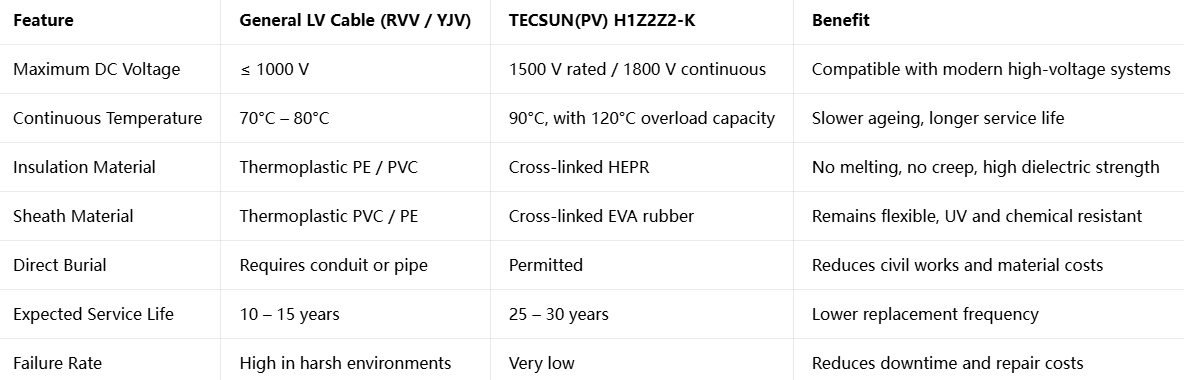
Standard low-voltage cables are typically rated for 70°C or 80°C and up to 1000V AC. When used in solar systems, they often operate close to their maximum temperature limit, accelerating the ageing process. The TECSUN(PV) H1Z2Z2-K, with its 90°C continuous rating, operates well within its thermal envelope even in hot climates. This reduces the rate of chemical degradation in the insulation and extends its lifespan.
The high DC voltage rating is another key advantage. A cable rated only for 1000V DC will experience higher electrical stress when used in a 1500V system. Over time, this stress leads to the formation of electrical trees—microscopic channels that propagate through the insulation, eventually causing failure. The higher dielectric strength of HEPR and the design voltage of 1800V maximum ensure this does not happen.
Environmental and Chemical Resistance
The cable’s ability to withstand harsh environments is demonstrated through extensive testing. It passes water absorption tests, showing minimal uptake of moisture. It is resistant to acids, alkalis, and oils, as confirmed by 7-day immersion tests in oxalic acid and sodium hydroxide. Perhaps most importantly for South African agricultural applications, it withstands 30 days of exposure to a saturated ammonia atmosphere without deterioration. Ammonia is a by-product of fertiliser use and animal waste, a common cause of sheath cracking in farm environments.
In terms of weathering, the sheath material maintains its integrity after prolonged exposure to UV radiation and temperature cycling. While a standard cable may show signs of brittleness, cracking, or surface powdering after just two to three years outdoors, the TECSUN(PV) H1Z2Z2-K retains its physical properties for over a decade.
Mechanical and Installation Benefits
Mechanically, the cable is designed to handle the rigours of installation and operation. It has high tensile strength, low elongation under load, and excellent abrasion resistance. The small bending radius allows for easy routing around obstacles and through tight conduits.
One of the most significant advantages is its suitability for direct burial. Based on more than 15 years of field experience and internal testing, the manufacturer confirms that the cable can be buried directly in the ground without additional protective ducts or conduits, provided standard installation guidelines are followed. This capability changes the economics of a project.
Comparison Summary
While the initial purchase price of the TECSUN(PV) H1Z2Z2-K is higher than that of a standard cable, the total cost of ownership tells a different story. Over the life of a plant, the failure rate is reduced by approximately 70%, and maintenance costs fall by roughly 50%. This results in a significantly lower Levelised Cost of Energy (LCOE), making it a more economical choice in the long run.
Applications and South African Case Studies
South Africa presents one of the most demanding environments for solar infrastructure. The country’s geography and climate create a unique set of conditions that test the limits of electrical equipment. The TECSUN(PV) H1Z2Z2-K is designed specifically to perform in these conditions.
Suitable Installation Scenarios
The cable is versatile enough for nearly every application within a solar power system. It is approved for indoor and outdoor use, suitable for installation in industrial facilities, agricultural complexes, and remote sites. It meets the requirements for equipment with Class II protection and can be used in potentially explosive atmospheres, having passed relevant internal and third-party tests.
It can be installed in multiple ways: fixed on structures, freely suspended, or allowed to move with thermal expansion. It fits easily into cable trays, conduits, or wall cavities. As previously noted, it is approved for direct burial, which simplifies routing across large sites.
Operating Conditions in South Africa
In the Northern Cape, home to many of South Africa’s largest solar parks, ambient temperatures can exceed 40°C, while the ground surface can reach 60°C. The difference between day and night temperatures can be as much as 30°C, causing materials to expand and contract repeatedly. The region also has some of the highest UV radiation levels in the world. Along the Western and Eastern Cape coasts, salt spray carried by the wind creates a highly corrosive atmosphere. In Limpopo and Mpumalanga, agriculture and mining introduce chemical contaminants such as ammonia, sulphur compounds, and dust.
Real-World Project Examples
Kenhardt Solar and Storage Project
Located in the Northern Cape, this large-scale solar facility operates in an arid, high-temperature environment. The project required long cable runs across open land. Installing cables in protective conduits would have required extensive excavation and material costs. Engineers chose the TECSUN(PV) H1Z2Z2-K for its direct burial capability. The cable was laid in trenches with a sand bed for protection, without additional piping. Eight years after commissioning, inspections show no signs of sheath degradation or insulation failure. The installation method reduced overall civil engineering costs by approximately 18% compared to traditional methods.
Mafube Coal Mine Off-Grid PV
Mining operations in South Africa are increasingly turning to solar power to reduce energy costs and carbon emissions. At the Mafube Coal Mine, the solar array is situated in an environment with high levels of dust, vibration, and potential exposure to flammable gases. The TECSUN(PV) H1Z2Z2-K was selected because it meets the safety criteria for hazardous areas and maintains stable electrical properties even in dusty conditions. The reinforced insulation ensures that leakage currents remain negligible, and the cable has operated reliably for over six years without issues.
Limpopo Agri-PV Irrigation System
In the agricultural sector, solar power is widely used to drive irrigation pumps. One installation in Limpopo combines crop cultivation with power generation. Here, the air contains high concentrations of ammonia from fertiliser and animal waste. Standard cables in similar environments often show surface cracking and discoloration within two years. The TECSUN(PV) H1Z2Z2-K, however, has been in service for seven years. Periodic checks confirm that the sheath remains intact and flexible, and electrical tests show no increase in resistance or leakage.
Lessons Learned
These projects illustrate three key benefits. First, the durability of the cable means it does not need replacement every few years, eliminating costly shutdowns and labour. Second, the ability to bury it directly reduces both installation time and material expenses. Third, the higher current-carrying capacity at elevated temperatures means the cable operates cooler, reducing energy losses and improving system efficiency.
Equivalent Option: Feichun H1Z2Z2-K
While the TECSUN(PV) H1Z2Z2-K is a benchmark product, project planners sometimes face challenges regarding lead times, availability, or budget constraints. In such cases, it is important to know that there are certified equivalents that offer identical technical performance.
The Feichun H1Z2Z2-K is one such alternative. It is manufactured strictly according to the same EN 50618 specification and follows the same design principles. The construction mirrors that of the TECSUN version: tinned Class 5 copper conductor, cross-linked HEPR insulation, cross-linked EVA sheath, and a bonded double-layer structure. It carries the same TÜV, CE, and CPR certifications, confirming compliance with international standards.
From a technical standpoint, the Feichun cable matches the electrical ratings, temperature range, and environmental resistance. It is also available in the same size range and offers the same direct burial capability.
The advantages of choosing Feichun lie in logistics and economics. The pricing is typically 15% to 25% lower than premium European brands, allowing for better cost control without compromising quality. Delivery lead times are generally shorter, often within 15 to 25 days, which is crucial for keeping construction schedules on track. The supplier also provides full documentation, including Declarations of Performance and test reports, which are required for project approvals and warranty claims.
Selection Guide and Installation Best Practices
Choosing the right cable involves more than just picking a size; it requires matching the cable’s characteristics to the specific conditions of the site.
Sizing and Configuration
Cable cross-section should be selected based on calculations according to IEC 60364 or EN 50618, considering factors such as ambient temperature, altitude, grouping of cables, and the length of the run. The current-carrying capacity values provided in the technical data sheet are based on a reference ambient temperature of 25°C. As temperatures rise, the current capacity decreases, but the high thermal rating of this cable ensures that the derating factor is much smaller than for standard cables.
For general rooftop or ground-mount systems, the standard version is usually sufficient. However, if the site is known to have rodent activity, rocky terrain, or heavy machinery traffic, the (C) version with the copper braid offers extra protection.
Installation Guidelines
During installation, the minimum bending radius must be observed to avoid stressing the insulation. For fixed installation, the radius should be at least six times the outer diameter, while during movement and pulling, it should be at least eight times the diameter. When burying the cable, it should be placed at a minimum depth of 300 mm, on a bed of fine sand, and covered with a protective layer or warning tape to prevent damage from digging.
Terminations should be made using appropriate compression lugs, and care must be taken to seal the ends to prevent moisture ingress. Over-tightening terminals can deform the conductor and increase resistance, so torque specifications should be followed.
Maintenance
One of the benefits of this cable is its low maintenance requirement. Visual inspections every two to three years are sufficient to check for physical damage. Electrical testing, including insulation resistance measurements, can be performed periodically to confirm condition. Given the material stability, the cable will not degrade rapidly, so trends over time will be slow and predictable.
Frequently Asked Questions
Q: Can I use this cable in a 1000V system?
A: Yes. The 1500V rating means it has a much higher safety margin. Using it in lower-voltage systems reduces electrical stress and further extends its lifespan.
Q: Is direct burial allowed in South Africa?
A: Yes, provided it is done in accordance with SABS wiring rules and the manufacturer’s installation guidelines. The long-term field experience supports this application.
Q: How does EN 50618 compare to UL 4703?
A: Both are standards for PV cables, but EN 50618 is the preferred specification in Europe, Africa, and parts of Asia. While both support 1500V operation, the test protocols for temperature and long-term ageing differ. EN 50618 is widely accepted in South African grid connection requirements.
Q: What does Class II protection mean?
A: It means the cable provides double insulation, eliminating the need for an earth connection. This is ideal for PV systems where the DC side is not earthed.
Q: Does Feichun provide all necessary documentation?
A: Yes. Feichun supplies full technical data sheets, test reports, and Declarations of Performance, which are identical in format and compliance to those of leading brands.
Conclusion
The TECSUN(PV) H1Z2Z2-K stands as a prime example of how specialised engineering can solve complex challenges in the renewable energy sector. It is more than just a cable; it is a system designed to deliver reliability over decades.
In terms of specifications, it raises the bar from the 1000V limit to a robust 1500V DC rating, supporting the industry’s shift toward higher efficiency systems. In terms of materials, the transition from thermoplastics to cross-linked rubber compounds changes the ageing profile of the cable, moving it from a product with a 10-year lifespan to one designed to last 25 to 30 years. Structurally, the bonded double insulation ensures electrical integrity and resistance to moisture and mechanical stress.
Its application range extends far beyond the traditional confines of cable trays and indoor installations. In South Africa, it has proven itself in the heat of the desert, the humidity of agricultural areas, and the corrosive environment of the coast. The case studies show that it solves three critical problems: rapid degradation of sheaths, high installation costs, and energy losses due to overheating.
While the initial investment may be higher, the reduction in failures, maintenance, and downtime delivers a strong return on investment. When viewed through the lens of total cost of ownership, the TECSUN(PV) H1Z2Z2-K is the more economical choice.
For project owners, engineers, and procurement teams in South Africa and across Sub-Saharan Africa, selecting cables that meet EN 50618 is no longer optional; it is a requirement for building sustainable, profitable solar assets. The TECSUN(PV) H1Z2Z2-K, and its certified equivalents like Feichun, represent the right choice for the future.
If you would like to obtain pricing, technical specifications, or arrange for delivery, please contact the Feichun team at:
Email Address: Li.wang@feichuncables.com
© 2025. All rights reserved.
One-click to Quickly Contact
Products
Contact
Company
Location:
Building A Private Science and Technology Park, Hefei Economic and Technological Development Zone, Anhui Province, China
Heat Resistant Cable
WhatsApp: +86 17333223430
Social Media: