Anhui Feichun Special Cable Co.,Ltd Email: Li.wang@feichuncables.com
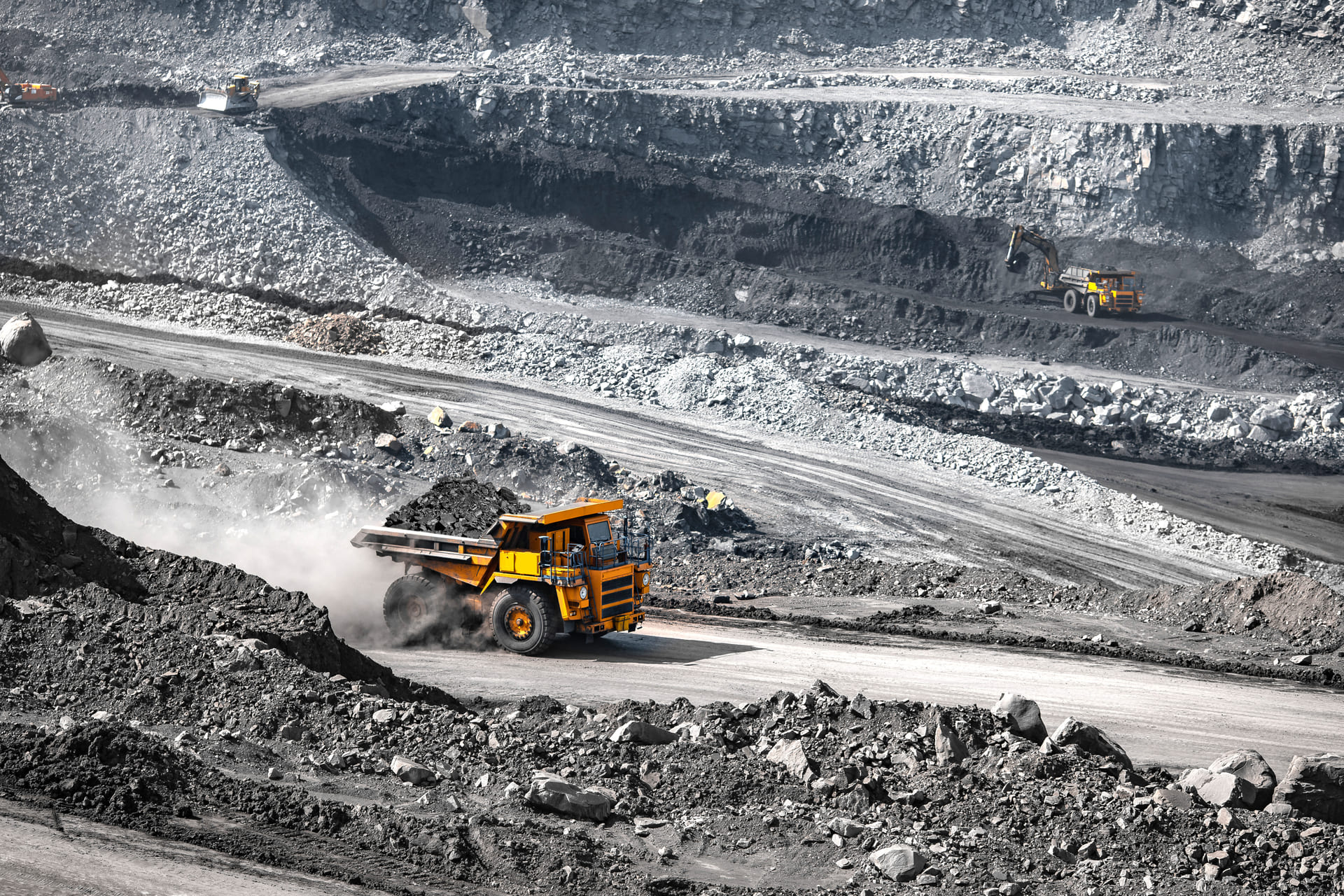
SANS 1520 Type 633 & 633 ECC 19/33kV Flexible Electric Trailing Cables for Opencast Mining: Heavy-Duty Feeder Cable Solution for High-Mobility Mining Equipment
For South African opencast coal, iron, platinum and manganese mines: SANS 1520-compliant Type 633 / 633 ECC 19/33 kV trailing cables solve high-frequency movement, heavy tension, repeated bending, corrosion and strict safety requirements. Combines Class 5 flexible conductors, EPR insulation, individual screening, ECC continuous earth and CR heavy-duty sheathing. Proven in South African sites, compliant with the Minerals Act 1991 and Mine Health and Safety Act 29 of 1996. Feichun equivalents offer full performance parity, shorter lead times and competitive pricing. Contact Li.wang@feichuncables.com for enquiries.
Li.Wang
7/20/202616 min read
Introduction
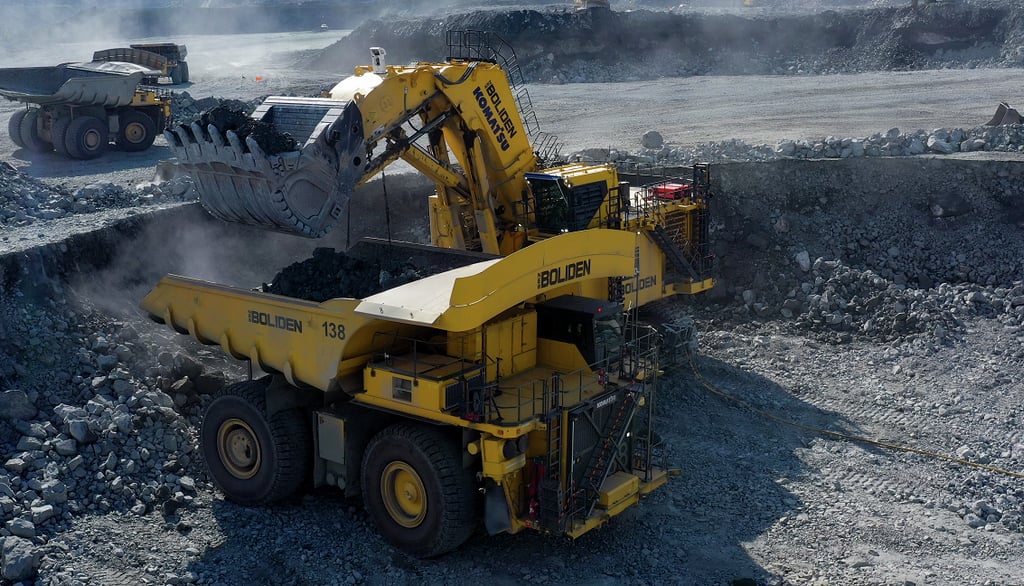
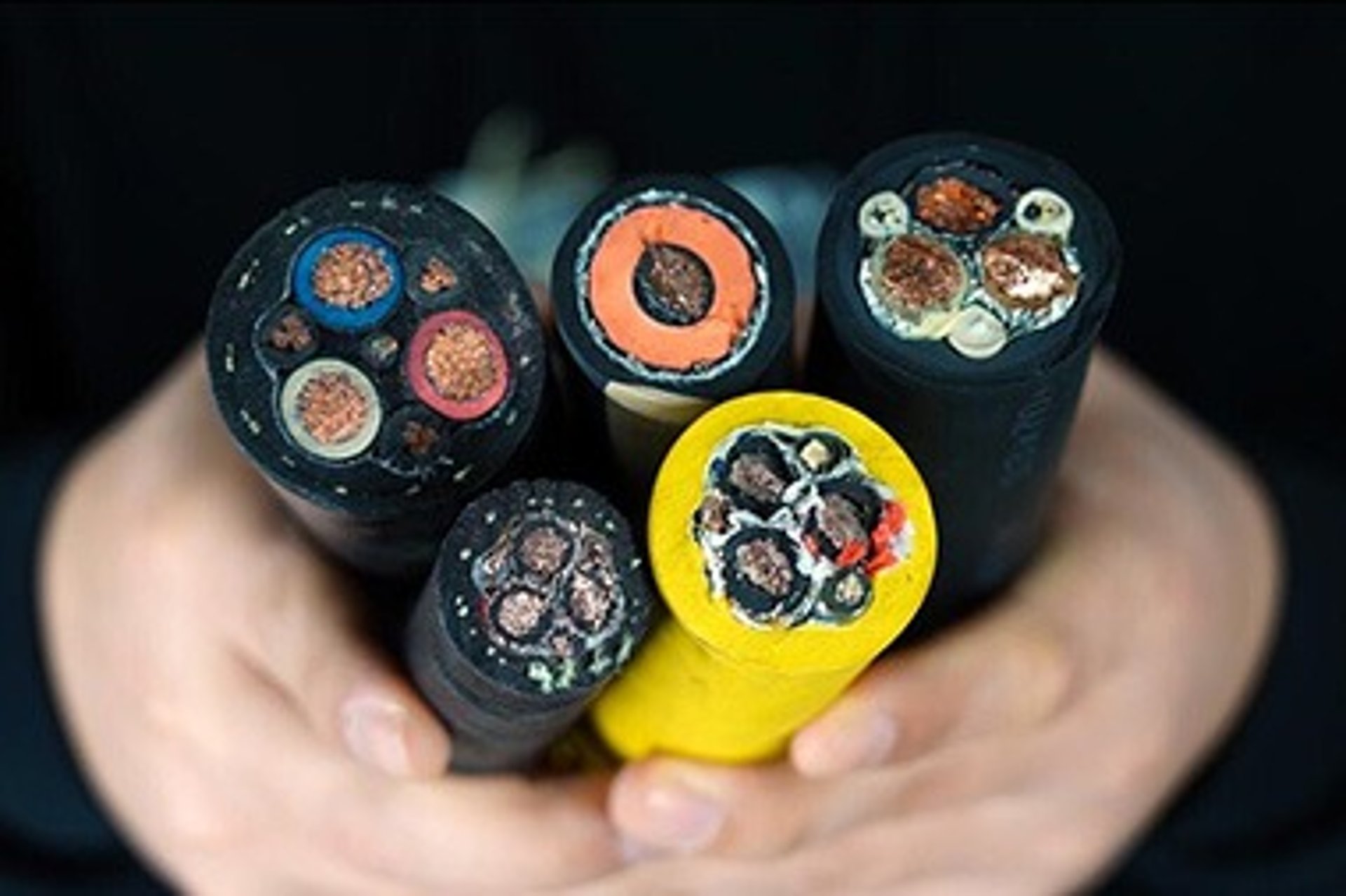
When engineers and procurement teams in South Africa’s mining sector look for power solutions for large mobile equipment, they often start by comparing standard medium-voltage cables. But there is a critical difference between a cable built to sit fixed in a trench or tunnel, and one that must travel, flex, stretch and withstand the harshest conditions every single day. Type 633 and Type 633 ECC 19/33 kV flexible electric trailing cables are not ordinary high-voltage power cables. They are purpose-engineered mobile power transmission systems designed exclusively for the dynamic operating environment of opencast mines and dredging projects.
Most standard 33 kV cables are designed around one core function: delivering stable power to a stationary load. They perform well when installed once and left undisturbed, but they begin to fail rapidly when asked to cope with the five most common pressures found in mining operations. These pressures include constant high-frequency movement as machines travel across the pit, repeated heavy mechanical tension from reeling and dragging, thousands of sharp bending cycles that strain every layer of the cable, continuous exposure to corrosive substances from dust and slurry to UV radiation and mineral oils, and the strict safety requirements that apply in hazardous areas where fire or explosion risks are ever present.
Type 633 and Type 633 ECC were developed specifically to resolve these five challenges that standard cables cannot overcome. Their design follows a clear technical logic that brings together five key elements: flexible Class 5 tinned copper conductors, EPM/EPR rubber insulation, individual braided screening for each power core, an optional dedicated Earth Continuity Conductor (ECC), and reinforced extra-heavy-duty chloroprene rubber (CR) sheathing. This combination creates a rare balance between electrical performance, mechanical durability and operational safety that few other cables can match.
For South Africa’s opencast coal mines in Mpumalanga, iron and manganese operations in the Northern Cape, platinum sites in Limpopo, and dredging projects along the coast and inland waterways, Type 633 has become the benchmark for high-voltage trailing cables. It is not simply another component in the power chain; it is a critical piece of infrastructure that keeps the largest and most valuable mining equipment running reliably.
From an engineering perspective, the difference between Type 633 and standard cables comes down to one fundamental question. Standard cables are built to answer how to transmit 33 kV power from point A to point B. Type 633 answers the far harder question of how to keep that 33 kV power flowing safely, continuously and reliably when point A and point B are constantly moving, and the environment between them is among the most destructive on earth. That is the core value that sets this product apart from general-purpose medium-voltage cables.
Every choice made in its construction reflects this priority. The flexible conductors, rubber insulation, individual screens, ECC option and reinforced outer layer all work together to meet the demands of moving power rather than static power. It is this integrated approach that makes Type 633 and Type 633 ECC the gold standard for high-mobility mining applications.
Regulatory Framework and Compliance for South African Mines
In South Africa, no electrical equipment used in mining can be selected without first addressing the strict legal and safety standards that govern the industry. Type 633 and Type 633 ECC are designed and certified to meet every requirement that applies to movable high-voltage apparatus, making them the compliant choice for operators across the country.
The primary standard covering these cables is SANS 1520 Part 11, which sets out specifications for flexible trailing cables rated up to and including 33 kV. Supporting standards include SANS 1411‑1 for conductor materials and construction, SANS 10142‑1 for electrical installation requirements, and SANS 10086 for hazardous area equipment protection. The cables carry full SABS certification under permit number 3660/6352, and are listed on the National Regulator for Compulsory Specifications (NRCS) compulsory product register. This means they have been independently tested and approved for use in South African mines, and meet the minimum legal requirements for supply and operation.
Two key pieces of South African legislation define the rules for this type of equipment: the Minerals Act 1991 and the Mine Health and Safety Act 29 of 1996. The Minerals Act 1991 classifies self-propelled machines, portable devices and movable electrical equipment in hazardous zones as requiring purpose-built trailing cables, rather than repurposed fixed wiring. The Mine Health and Safety Act goes further, setting out mandatory requirements for continuous earth continuity, robust mechanical protection, fire resistance, and the ability to carry high fault currents without failing.
These requirements are not just recommendations. Mine operators, contractors and safety officers are legally responsible for ensuring all equipment meets these standards, and non-compliance can lead to production shutdowns, fines, or even liability in the event of an incident. This is where the ECC version of Type 633 becomes particularly important. Standard cables often rely only on metallic screens to provide an earth path, which may not offer the consistent continuity or fault capacity required by law. Type 633 ECC includes a dedicated earth conductor that guarantees a reliable path under all operating conditions, directly addressing one of the most common compliance gaps found on mine sites.
Today, Type 633 and Type 633 ECC are accepted for use by all major mining houses operating in South Africa, including Anglo American, BHP, Seriti Resources and Exxaro. They are also specified by leading dredging contractors working at ports such as Richards Bay, Saldanha and Durban, as well as on inland waterway and dam projects. Choosing these cables removes the uncertainty around compliance, and ensures that electrical systems meet the expectations of both site safety officers and regulatory inspectors.
Core Technical Specifications and Performance Data
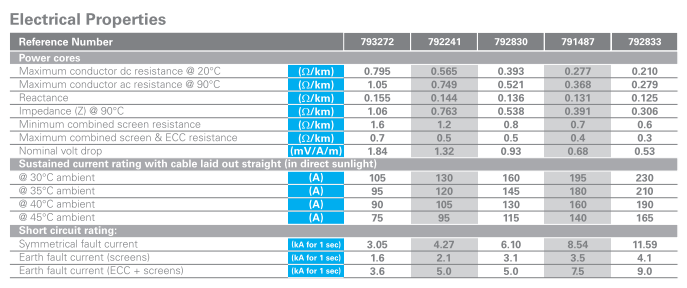
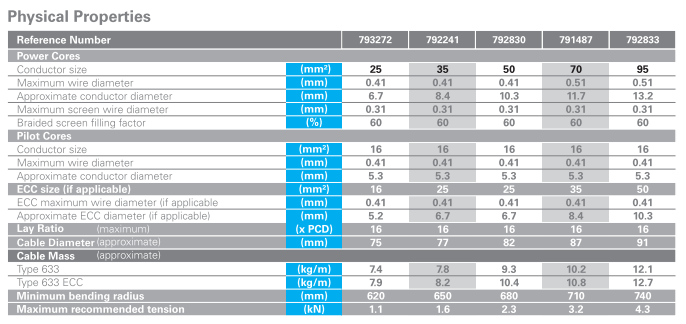
All specifications for Type 633 and Type 633 ECC are derived directly from the official Aberdare product data sheet, with five standard reference numbers covering the most common sizes used in South African operations: 793272, 792241, 792830, 791487 and 792833.
General Specifications
The cables carry a rated voltage of 19/33 kV, with a maximum system voltage of 36 kV. They are designed for continuous operation at temperatures between ‑25 °C and +90 °C, making them suitable for both high-altitude winter conditions and the intense summer heat found in many Northern Cape and Mpumalanga mines. The minimum bending radius ranges from 620 mm to 740 mm depending on size, which is approximately nine times the cable’s overall diameter — a critical factor for operation on cable reels and around sharp corners. Maximum recommended tensile load varies from 1.1 kN for the 25 mm² size up to 4.3 kN for the 95 mm² size, providing a clear limit for safe reeling and pulling during operation.
Physical Properties
Electrical Properties
All current ratings apply to cables laid straight and exposed to direct sunlight, which is the standard operating condition for opencast mining sites. Versions with extensible pilot cores are also available on request for applications where extra flexibility for control signalling is required.
When compared to standard fixed 19/33 kV cables, the differences are clear. Standard cables typically use Class 2 solid or stranded conductors that become brittle under repeated bending, and offer maximum tensile loads of less than 0.5 kN — less than half the capacity of the smallest Type 633 size. Their sheathing is usually made from PVC or polyethylene, which wears through roughly eight times faster than the CR material used here. Most importantly, their combined earth fault capacity rarely exceeds 3 kA for one second, compared to up to 9 kA for the largest Type 633 ECC, leaving standard systems vulnerable to protection failure during ground faults.
Layer-by-Layer Construction, Materials and Engineering Principles
Every layer in Type 633 and Type 633 ECC is selected and engineered to work with the rest of the system, rather than as an isolated component. The design follows a clear logic that balances electrical requirements with the physical demands of mining operations.
Conductor: Class 5 Tinned Copper
At the very centre of each power core sits a Class 5 tinned annealed copper conductor, built to SANS 1411‑1 standards. The wires are extremely fine, with maximum individual diameters of 0.41 mm for 25 mm² to 50 mm² sizes and 0.51 mm for 70 mm² and 95 mm².
The choice of tinned copper is rooted in both electrical and material science principles. Tin plating creates a protective barrier that prevents oxidation and sulphidation when copper is exposed to damp mine air, acidic dust or sulphur compounds found in coal and platinum ores. This means contact resistance remains consistent over decades, rather than rising as corrosion builds up.
From a mechanical perspective, fine-stranded Class 5 conductors distribute stress much more evenly than the thicker strands used in fixed cables. When the cable bends or twists, each individual wire moves slightly rather than carrying the full load alone. This drastically reduces the risk of metal fatigue, allowing the cable to withstand millions of bending cycles without breaking. This is the single most important factor in preventing the open circuits and short circuits that often shut down mining equipment.
Triple-Extruded Insulation System
Above each conductor lies a three-layer system applied in a single triple-extrusion process: a semiconductive conductor screen, EPM/EPR rubber insulation, and a strippable semiconductive core screen. All three layers are bonded together during vulcanisation, so they move as one unit when the cable flexes.
The semiconductive screens serve a critical electrical purpose. They eliminate the tiny air gaps that would otherwise form between the copper strands and the insulation, and between the insulation and the outer screen. Air gaps distort the electric field around the conductor, creating localised high-voltage stress that leads to partial discharge, insulation treeing and early failure. By smoothing the electric field, the screens ensure voltage is distributed evenly across the insulation layer.
EPM and EPR (ethylene-propylene rubber) were chosen over materials like cross-linked polyethylene (XLPE) for two key reasons. First, EPR retains its flexibility even at temperatures as low as ‑25 °C, while XLPE becomes stiff and prone to cracking in cold conditions. Second, EPR has excellent resistance to water treeing and electrical ageing, which is essential for cables exposed to moisture and ground movement. With a relative permittivity of roughly 2.4 and dielectric strength of around 25 kV/mm, it offers stable performance at 33 kV while remaining far more flexible than thermoplastic alternatives.
Individual Phase Screening
Outside the insulation system, each power core is wrapped in its own separate screen made from tinned copper wire and textile fibres, with a coverage of 60 % and maximum wire diameter of 0.31 mm. This is a major difference from many cables that use only a single overall screen around all three cores.
Electrically, individual screening confines the electric field of each phase to its own core, reducing interference with control signals and nearby equipment. It also provides a primary return path for fault currents, ensuring protection relays can detect and isolate faults quickly.
Mechanically, the textile fibres woven into the copper braid add tensile strength and flexibility. Pure copper braid can break or unravel when twisted repeatedly; the textile reinforcement keeps the screen intact even under high torsion, so it continues to function as a shield and fault path throughout the cable’s life.
Core Assembly: Pilots and ECC Option
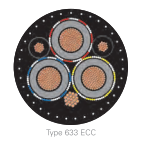
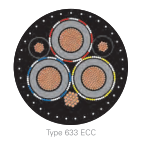
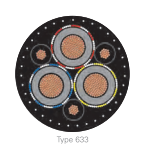
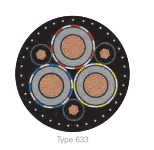
The three screened power cores are laid up together with pilot cores, using a maximum lay ratio of 16 times the pitch circle diameter. This short lay length minimises the amount of twist each core experiences when the whole cable is bent or pulled, preventing internal strain and keeping the cable flexible enough to wrap tightly around a reel.
Standard Type 633 cables include three EPM-insulated pilot cores each sized at 16 mm², placed in the gaps between the power cores. These carry control and monitoring signals between equipment and the power supply. Type 633 ECC replaces one pilot core with a dedicated tinned copper Earth Continuity Conductor, available in sizes from 16 mm² up to 50 mm² depending on the cable rating.
This dedicated ECC is one of the most important safety innovations in the design. Even if the outer sheath is damaged or the metallic screens become disconnected, the ECC maintains a continuous low-resistance path to earth. This satisfies the Mine Health and Safety Act requirement for guaranteed earth continuity, and ensures that even severe ground faults will trigger rapid disconnection rather than creating dangerous touch voltages or sparking.
Reinforced Sheath System
The entire assembled core is protected by a two-part outer sheath system: an inner reinforcement layer made from nylon textile braid, and an outer layer of extra-heavy-duty chloroprene rubber (CR).
Chloroprene rubber was selected for its outstanding material properties. It offers excellent resistance to UV radiation, ozone, mineral oils, greases, acids and alkalis — all common hazards in opencast mining and dredging. It meets the flame-retardant requirements of IEC 60332‑1, and has high tear and abrasion resistance, so it does not easily tear or wear through when dragged over rock, ore or steel surfaces.
The nylon braid adds another layer of mechanical protection. It acts like a flexible armour, absorbing impact and distributing tension so that the outer sheath does not stretch or tear under load. This combination creates a tough but flexible outer shell that can survive years of dragging, reeling and exposure without compromising the cores inside.
Why This Design Solves Problems Ordinary Cables Cannot
The reason Type 633 and Type 633 ECC have become the standard in South African mining is that they address the root causes of failure in standard cables, rather than simply adding more thickness or strength.
Standard medium-voltage cables are designed around a set of trade-offs that work well for fixed installations. They prioritise electrical performance and cost efficiency, but treat flexibility and mechanical strength as secondary concerns. For moving mining equipment, those trade-offs become fatal. A cable that is too stiff will break when bent; one that lacks tensile strength will stretch and snap; one that relies on a single earth path will become unsafe if damaged; and one with poor sheathing will wear through before it reaches its expected electrical service life.
Type 633 rebalances these priorities to create a system that performs reliably under motion. The flexible Class 5 conductors and short lay ratio eliminate the risk of conductor breakage from repeated movement. The reinforced CR sheath and nylon braid allow the cable to be reeled and pulled without exceeding safe tension limits. The EPR insulation and triple-extruded screens withstand bending without cracking or creating electrical defects. The tinned copper and chloroprene materials resist the full range of corrosive substances found on mine sites, from sun and dust to slurry and fuel. And the dedicated ECC guarantees compliance with safety rules and removes the risk of hidden earth failure.
While the upfront purchase price of Type 633 is higher than standard alternatives, the total cost of ownership tells a very different story. Most operators find that Type 633 lasts three to five times longer than standard cables, reducing replacement costs. Fewer failures mean fewer unplanned shutdowns, which can cost a large mine tens of thousands of rand per hour in lost production. Most importantly, it removes the risk of legal penalties and safety incidents associated with non-compliant equipment, making it the most cost-effective choice over the full lifecycle of the cable.
South African Field Cases and Real-World Performance
The value of Type 633 and Type 633 ECC is best demonstrated by how they perform in real South African operations, where conditions are often more demanding than laboratory test environments.
Opencast Coal: Large Shovel Upgrade
At a major coal-to-power complex in eastern Mpumalanga, the site’s 220‑tonne electric shovel was originally fitted with standard 12/20 kV trailing cables. These cables were replaced every six to eight months, after the outer sheath had worn through and moisture had caused insulation breakdown. Each failure meant several hours of downtime, and the cumulative loss of production ran into thousands of hours per year.
The site switched to Type 633 ECC in the size 3×95 mm² + 1×50 mm². After three years of continuous operation across thousands of shovel movements, the cable showed no signs of sheath failure or electrical breakdown. Unplanned downtime related to the feeder cable fell by roughly 90 %, and the system met all hazardous‑area safety requirements without further modification.
Iron and Platinum Mines: Long-Distance Draglines and Stackers
In Northern Cape iron mines and Limpopo platinum operations, draglines and overland stackers often operate up to 800 m away from the main substation. Standard cables experienced voltage drops of more than 10 % over this distance, which meant the equipment could not start under full load, or ran with reduced efficiency. The original cables also relied entirely on metallic screens for earthing, which did not meet site safety standards for fault current capacity.
After switching to Type 633 in the size 3×70 mm² + 1×35 mm², the measured voltage drop was just 0.68 mV/A/m, well within acceptable limits for reliable motor starting. The combined resistance of the screens and ECC fell to less than 0.4 Ω/km, meeting the strict requirements of the Mine Health and Safety Act. The equipment now starts reliably even at maximum load, and the site has eliminated the risk of protection failure during ground faults.
Harbour and Inland Dredging
Dredging projects present their own unique set of challenges. At Richards Bay harbour and on inland river and dam projects, cables must withstand constant movement from tidal shifts, abrasion from sand and sediment, contact with hydraulic oils and fuels, and immersion in salt or fresh water. Standard cables typically lasted less than 12 months before failing.
Operators that switched to Type 633 ECC found that the CR sheath resisted saltwater, oil and abrasion far better than the original materials. Cable service life doubled, and the dedicated ECC ensured that safety systems remained operational even when the cable was partially damaged by floating debris or heavy loads.
Feichun Type 633 / 633 ECC Equivalent — Reliable Alternative for South African Buyers
For South African operators looking for a trusted alternative to premium brands, Feichun offers a fully equivalent version of Type 633 and Type 633 ECC that matches all key specifications and performance requirements.
The Feichun range is fully aligned with SANS 1520 Part 11 standards, with independent test data confirming identical electrical and mechanical performance to the original specification. Construction follows the same proven design: Class 5 tinned copper conductors, triple‑extruded EPR/EPM insulation, individual braided screens, reinforced CR sheathing, and the option of a dedicated ECC conductor. This means the Feichun cable is a direct drop‑in replacement, requiring no changes to existing connectors, reel systems or protection settings.
There are several practical advantages for South African buyers. Feichun equivalents are typically priced 15 % to 30 % lower than premium European or local brands, while maintaining full compliance and performance. Standard sizes are often available from stock, with lead times measured in weeks rather than months — a major benefit for sites facing urgent replacement or expansion projects. The range has already been used successfully in mining and dredging projects across Africa, Australia and Latin America, and comes with full documentation ready for NRCS and mine safety inspections.
Feichun also offers customisation options, including extensible pilot cores and bespoke marking to match site requirements. The engineering team can provide voltage‑drop calculations, fault‑current coordination support and sizing advice to help operators select the most appropriate cable for their specific equipment and layout.
Selection Guide and Configuration Options
Choosing between Type 633 and Type 633 ECC, and selecting the right size, depends on the specific requirements of each application.
Type 633 is suitable for standard applications where control signalling is the main function of the pilot cores, and where the existing earth path meets site requirements. Type 633 ECC is recommended for all hazardous areas, long feeder runs, high‑fault‑current locations, and any site where the Mine Health and Safety Act requires a guaranteed continuous earth path. Most South African mining safety departments now specify the ECC version for all high‑voltage trailing cables used on self‑propelled equipment.
When selecting conductor size, start with the continuous current rating required by the equipment, using the derated values for ambient temperatures above 30 °C. Next, check the nominal voltage drop to ensure it stays within acceptable limits over the full length of the feeder. Finally, verify that the short‑circuit and earth‑fault capacity exceeds the maximum expected fault current at the point of connection. You should also confirm that the maximum recommended tension is greater than the pull force the cable will experience during reeling, and that the minimum bending radius fits the dimensions of the cable reel and site routing.
The most common configurations follow the standard reference sizes: 3×25 mm² with 3×16 mm² pilots or 1×16 mm² ECC, up to 3×95 mm² with 1×50 mm² ECC. Custom core arrangements are available on request.
Frequently Asked Questions
Is Type 633 suitable for underground mining as well as opencast use?
Type 633 is optimised for opencast trailing and surface dredging applications. For underground workings that require additional crush resistance or flame‑retardant properties beyond the standard specification, consult with your engineer or supplier to confirm whether extra armouring or modified sheathing is needed.
Can I replace existing 19/33 kV trailing cables directly with Type 633 ECC?
Yes, Type 633 and Type 633 ECC share the same overall dimensions and electrical characteristics as the original standard, so they fit existing connectors and equipment without modification. The ECC version simply adds an extra safety margin rather than changing interface requirements.
How does EPR insulation compare to XLPE for moving cables?
XLPE is widely used for fixed cables because of its high electrical strength and low cost, but it becomes stiff and brittle at low temperatures. EPR remains flexible over a much wider temperature range, resists water treeing better under cyclic bending, and is less likely to develop defects when the cable is twisted or pulled. This makes it the preferred choice for trailing applications.
Are Feichun equivalents accepted by South African mine safety inspectors?
Yes, when supplied with full SANS 1520 test reports, certification documentation and traceable manufacturing records, Feichun cables are accepted by safety officers and regulatory inspectors across South Africa.
What service life can I expect in typical opencast conditions?
With proper installation and routine checks, Type 633 and Type 633 ECC typically last between eight and twelve years. In moderate conditions with good maintenance, service life can extend to 15 years — three to five times longer than standard trailing cables.
Conclusion
Type 633 and Type 633 ECC are far more than just another type of power cable. They represent a complete approach to delivering high‑voltage power to equipment that must keep moving in the most demanding environments. Every element of their design — from the fine‑stranded conductors to the reinforced CR sheath — exists to solve the problems that standard cables cannot address.
For South African mines, this means compliance with national legislation, fewer unplanned shutdowns, reduced maintenance costs, and most importantly, a safer system for people working in hazardous areas. The combination of flexible construction, EPR insulation, individual screening, dedicated ECC and heavy‑duty protection creates a balance that no single‑material or single‑layer improvement can match.
Feichun’s equivalent range now makes this proven technology more accessible, with shorter lead times and competitive pricing that does not compromise on performance or compliance. For any operator managing large mobile machines, long feeder runs or high‑risk sites, these cables offer a reliable, well‑proven and cost‑effective solution that meets the real‑world demands of South African mining and dredging.
If you are planning a new installation, replacing ageing cables or upgrading your equipment to meet current safety standards, the Feichun team can provide detailed support tailored to your project. You can request full datasheets, compliance certificates, voltage‑drop calculations or a custom quotation by contacting the engineering and sales team directly at Li.wang@feichuncables.com.
Email Address: Li.wang@feichuncables.com
© 2025. All rights reserved.

One-click to Quickly Contact
Products
Contact
Company
Location:
Building A Private Science and Technology Park, Hefei Economic and Technological Development Zone, Anhui Province, China
Heat Resistant Cable
WhatsApp: +86 17333223430
Social Media: