Anhui Feichun Special Cable Co.,Ltd Email: Li.wang@feichuncables.com

SANS 1520-2 Type 622 & 622 ECC Flexible Trailing Cables 12.7/22kV: The Ultimate Heavy-Duty Power Solution for South African Open-Cast Mining, Dredgers & Mobile Equipment
For South African mining engineers, procurement teams, and site safety officers: discover why SANS 1520‑2 certified Type 622 and Type 622 ECC 12.7/22 kV trailing cables outperform standard XLPE/PVC medium‑voltage cables in open‑cast coal, iron, platinum, and manganese mines, dredging operations, and hazardous‑area mobile plant. This article covers full construction science, material selection, compliance with the Minerals Act 1991, real‑world South African case studies, complete technical data, and how Feichun’s equivalent Type 622 ECC offers trusted performance with shorter lead times and better value.
Li.Wang
7/17/202612 min read
Introduction
South Africa ranks among the world’s top producers of platinum group metals, manganese, iron ore, and coal, with most high‑volume operations relying on large open‑cast fleets that run increasingly on 11 kV to 22 kV power systems. Yet for decades, engineers have faced a persistent gap: standard medium‑voltage cables are designed for fixed installations, not for the punishing combination of high voltage, constant movement, and extreme environmental exposure that defines modern mining.
Type 622 and Type 622 ECC 12.7/22 kV Flexible Electric Trailing Cables are purpose‑built to close that gap. Fully certified under SANS 1520‑2, the South African standard specifically for heavy‑duty mine trailing cables, they represent the gold standard for mobile 22 kV power delivery in the country. Unlike general‑purpose cables that simply meet voltage ratings, these two variants are engineered as an integrated system: Class 5 tinned copper conductors, triple‑extruded semi‑conducting screens, EPR insulation, reinforced chloroprene rubber (CR) sheathing, and—for the ECC version—a dedicated Earth Continuity Conductor. Together they resolve four long‑standing limitations of ordinary mine cables: insufficient flexibility, poor electrical screening, unreliable fault grounding, and rapid degradation from weather and abrasion.
Three core problems make standard MV cables unsuitable for South African mining conditions. First, they cannot maintain reliable performance over years of repeated flexing, dragging, and reeling at 22 kV. Second, they fail to withstand the mechanical punishment of rock, ore, mud, and UV radiation typical of open‑cast sites. Third, they rarely meet the strict safety and fault‑protection requirements set out in national mining legislation, putting crews and assets at risk.
The true competitive advantage of Type 622 ECC lies not merely in its 22 kV rating, but in balancing four critical capabilities that no ordinary XLPE or PVC cable can deliver together: efficient high‑voltage power transmission, heavy‑duty mechanical drag and reel endurance, certified fault‑current grounding, and proven resistance to South Africa’s harshest climates and contaminants. That is why it has become the irreplaceable choice for open‑cast coal, iron, platinum, and manganese operations, as well as dredgers and large mobile equipment across the country.Regulatory & Standard Framework: Built for South African Mine Law
Any cable used to power mobile equipment in South African mines must satisfy strict legal and technical requirements, starting with the Minerals Act 1991 (Act No. 50 of 1991) and the Mine Health and Safety Act regulations that follow it. These rules state clearly that trailing cables for hazardous‑area mobile plant must carry independent certification, provide continuous ground monitoring, handle specified fault currents, resist flame spread, and withstand mechanical abuse without failing prematurely. Non‑compliance can lead to site shutdowns, heavy fines, and serious safety risks.
The technical benchmark for these cables is SANS 1520, divided into three parts by voltage and application. SANS 1520‑2 governs flexible trailing cables rated 3.8/6.6 kV up to 19/33 kV, making it the exact standard for Type 622 and Type 622 ECC at 12.7/22 kV. Additional supporting standards include SANS 1411‑1 for conductors and SANS 1411‑3 for insulation and sheathing materials, with full SABS certification under permit number 3660/6352 confirming compliance.
Standard MV cables often meet IEC or basic SANS voltage standards but fall short of SANS 1520‑2 on flexibility, screening, grounding, and abuse resistance. Many lack the dedicated ECC conductor required for hazardous‑area fault protection, or use stiff XLPE that cracks under repeated bending, or PVC sheathing that degrades rapidly in direct sun, oil, and cold—issues that Type 622 and Type 622 ECC were designed from the start to solve.
Core Design & Material Science: Solving Four Critical Pain Points
Ordinary mine cables typically suffer from four linked weaknesses: stiff construction that breaks after repeated flexing, poor screening that lets electrical stress build up and cause early failure, unstable grounding that slows fault clearing and raises shock risk, and weak outer protection that cannot survive UV, oil, abrasion, or temperature swings. Type 622 and Type 622 ECC address each one through a layered architecture grounded in both electrical and mechanical science.
Layer‑by‑Layer Construction and Engineering Principles
Every layer is chosen and shaped to work with the others, rather than as separate components.
Power Conductors
The core uses Class 5 tinned annealed copper, matching IEC 60228 and SANS 1411‑1 requirements. Strands are fine—0.41 mm for sizes up to 50 mm², 0.51 mm for larger sections—so mechanical stress spreads across hundreds of wires instead of concentrating in a few thick ones, drastically improving fatigue life under thousands of reel cycles. Tinning prevents oxidation, reduces friction between strands, and keeps contact resistance stable even in damp or corrosive ground conditions. Electrically, this copper delivers ≥97 % IACS conductivity, ensuring consistent current flow and low heat buildup across the full rated load range.
Conductor Semi‑Conducting Screen
Extruded directly over the conductor as part of a triple‑extruded assembly with insulation and the next screen, this EPR‑based semi‑conducting layer eliminates air gaps and sharp edges around the conductor surface. At 22 kV, even tiny gaps can create intense local electric fields that trigger partial discharge and eat away insulation over time. By smoothing the field right at the conductor boundary, this layer extends insulation life and lowers failure risk.
EPM/EPR Insulation
Ethylene‑propylene rubber (EPM/EPR) is chosen over XLPE or PVC for its balance of properties: high dielectric strength (~20 kV/mm), stable performance from –25 °C to +90 °C, natural flexibility, and strong resistance to ozone, moisture, and chemical attack. Unlike rigid XLPE, EPR bends easily without cracking, and unlike PVC, it does not become brittle in cold high‑altitude nights or soften excessively in summer heat. It also resists water treeing, a common failure mode in cables dragged through mud and mine water.
Insulation Semi‑Conducting Screen
Co‑extruded with the insulation so the interface is seamless, this strippable semi‑conducting layer forms a uniform equipotential surface that contains the electric field entirely within the insulation. It also allows clean, damage‑free stripping during jointing—critical for site crews working under pressure in rough conditions—so poor preparation does not introduce new field distortions or weak points.
Individual Core Screen
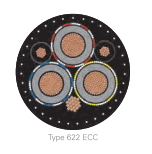
Each insulated power core gets its own braided screen made of tinned copper wire mixed with textile yarn, with a braid filling factor of 60 %. The copper provides a low‑resistance path for fault current and suppresses electromagnetic interference that could disrupt control gear or signals. The textile yarn adds flexibility and prevents the braid from becoming too stiff or chafing through layers during movement. Unlike a single overall screen, per‑core screening contains faults to one phase and keeps phase‑to‑phase interference low.
Pilot Cores and Earth Continuity Conductor
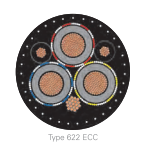
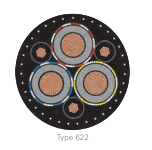
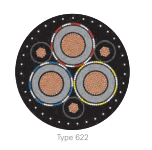
Three EPM‑insulated pilot cores fill the cable interstices in the standard Type 622 design. These monitor cable integrity and carry control signals. In Type 622 ECC, one pilot is replaced with a dedicated tinned copper ECC conductor, sized to match the power core—16 mm² for 25 mm² power, rising to 95 mm² for 150 mm² power. This dedicated ground path is never shared with screening or signal functions, ensuring it remains continuous even if other parts degrade, and delivers the high fault‑current capacity required by the Minerals Act for hazardous areas.
Core Assembly and Fill
Power cores, pilots, and the ECC (where fitted) are laid up in a right‑hand helix with a maximum lay ratio of 16 times the pitch circle diameter, and filled with semi‑conductive rubber strips to keep the profile round. A round shape avoids stress concentrations at corners and prevents the cable from twisting uncontrollably when reeled, while semi‑conductive fill maintains electrical symmetry and stops air pockets from forming between cores.
Reinforced CR Sheath
The final layer is an extra‑heavy‑duty chloroprene rubber (CR) sheath with integrated textile reinforcement. CR stands up to UV radiation, ozone, mineral oils, seawater, and most mine chemicals; it is flame‑retardant and self‑extinguishing per SANS 1411‑3, and retains flexibility well below freezing. The reinforcement boosts tensile and tear strength so the cable can be dragged over sharp rock, ore piles, and uneven ground without splitting or tearing—common failure points for standard rubber or PVC alternatives.
Why This Architecture Works Better
This design delivers three key advantages that no single‑material or simpler construction can match. First, flexibility and strength are not traded off: fine stranding and EPR/CR give easy bending, while braided screens, round assembly, and reinforced CR take heavy drag loads. Second, high voltage and safety are built in together, not bolted on later—field control, per‑core screening, and ECC fault capacity are all sized for 22 kV from the start. Third, compliance and longevity align: every material and layer meets SANS 1520‑2 and Minerals Act requirements, so the cable lasts longer and passes every regulatory audit.
Full Technical Specifications (12.7/22 kV Type 622 & Type 622 ECC)
All values below come directly from the official datasheet and apply to both variants where not stated.
Physical and Mechanical Properties
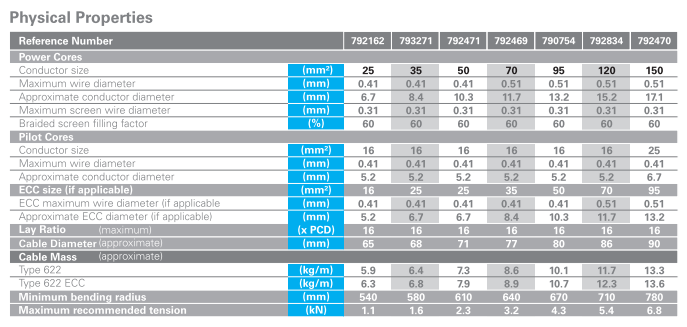
Seven standard power‑core sizes are available: 25 mm², 35 mm², 50 mm², 70 mm², 95 mm², 120 mm², and 150 mm², with reference numbers 792162 through 792470. Approximate conductor diameters range from 6.7 mm for 25 mm² up to 17.1 mm for 150 mm². Pilot cores are 16 mm² for all sizes except 150 mm², which uses 25 mm². ECC sizes scale from 16 mm² to 95 mm² to match the power core.
Overall cable diameter runs from 65 mm (25 mm²) to 90 mm (150 mm²). Mass per metre ranges from 5.9 kg/m to 13.3 kg/m for Type 622, and from 6.3 kg/m to 13.6 kg/m for Type 622 ECC. Minimum bending radius is roughly nine times the diameter—540 mm for the smallest, 780 mm for the largest—while maximum recommended pulling tension goes from 1.1 kN up to 6.8 kN.
Electrical Performance
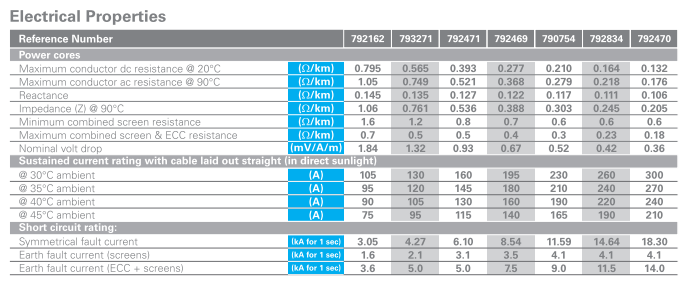
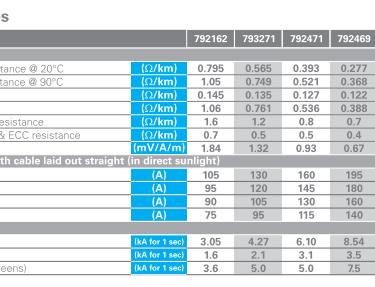
DC resistance at 20 °C drops from 0.795 Ω/km for 25 mm² to 0.132 Ω/km for 150 mm². AC resistance at 90 °C ranges from 1.05 Ω/km down to 0.176 Ω/km, with reactance falling gradually from 0.145 Ω/km to 0.106 Ω/km. Impedance at 90 °C follows the same downward trend, and nominal voltage drop improves from 1.84 mV/A·m for the smallest section to just 0.36 mV/A·m for the largest—important for long trailing runs.
Continuous current ratings apply to cables laid straight and exposed to direct sunlight, as typical in open‑cast mining. At 30 °C ambient, values span 105 A to 300 A; at 35 °C, 95 A to 270 A; at 40 °C, 90 A to 240 A; and at 45 °C, 75 A to 210 A.
Short‑circuit ratings are critical for mine protection coordination. Symmetrical fault current capacity rises from 3.05 kA for 1 second at 25 mm² to 18.30 kA at 150 mm². Earth fault capacity via the screens alone is 1.6 kA to 4.1 kA for 1 second, while the combined screen plus ECC system delivers 3.6 kA up to 14.0 kA for 1 second—enough to ensure fast tripping even on long, high‑impedance ground loops.
Configuration Options
Standard Type 622 carries three pilot cores and suits semi‑mobile equipment, shorter trailing runs, and sites with robust, dedicated grounding systems. Type 622 ECC replaces one pilot with a full‑size ECC conductor and is recommended for all hazardous areas, long‑distance trailing, frequent reeling, or sites with poor or variable grounding—especially where the Minerals Act demands guaranteed earth continuity. “Extensible” pilot cores can also be supplied on request for extra‑long reel travel.
South African Case Studies: Real‑World Performance
Mpumalanga Open‑Cast Coal Mine – Large Electric Shovel
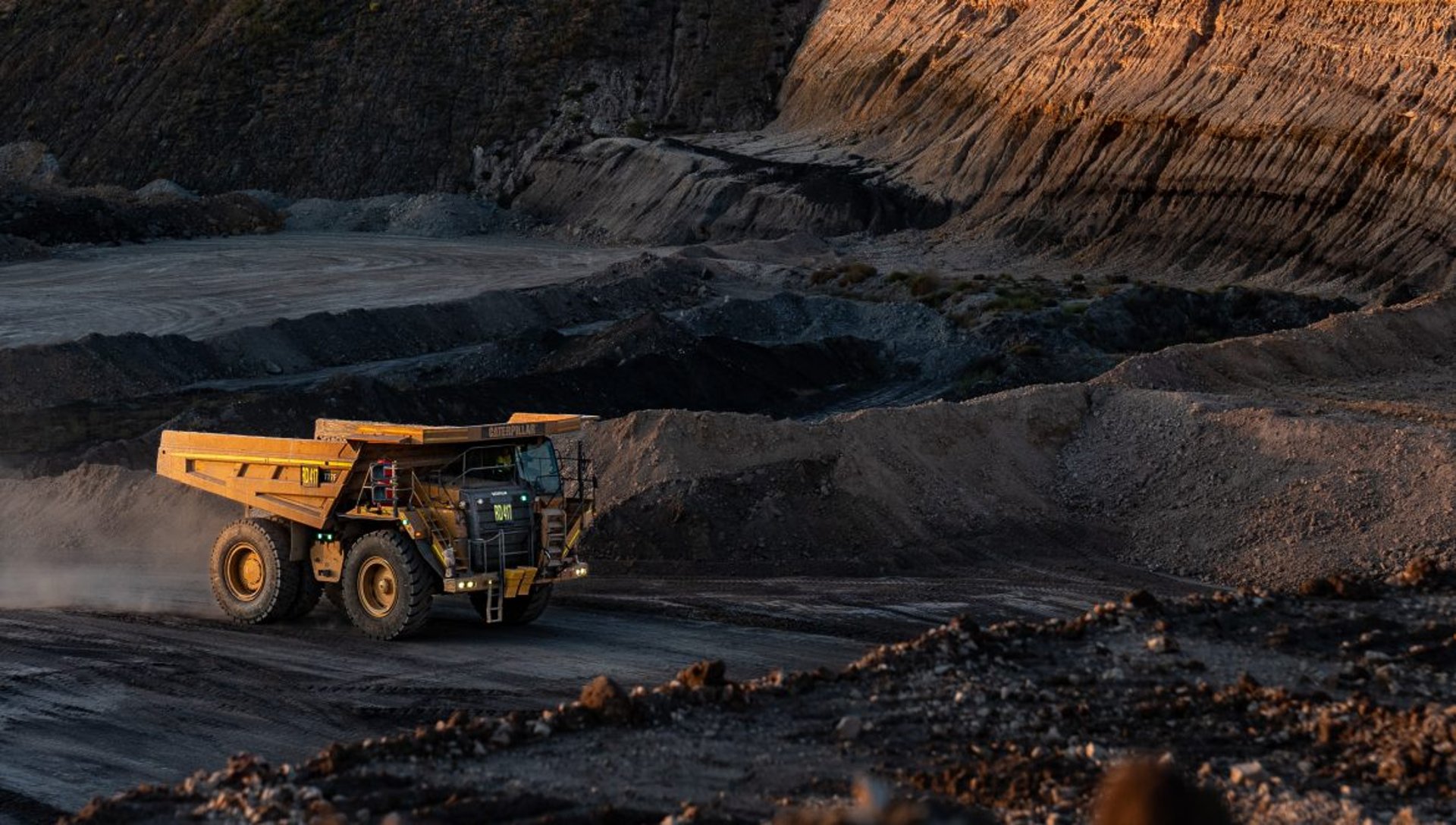
This site operates in the highveld, with intense summer sun, heavy thunderstorms, coal dust, and freezing winter nights. The 22 kV electric shovel moves forward, reverses, and swings more than twenty times daily, dragging its cable over uneven coal seams, exposed rock, and standing mud. Standard MV cables stiffened in cold weather, kinked when pulled sideways, and wore through the sheath in eight to ten months, causing unplanned shutdowns and safety inspections.
After switching to Type 622, the EPR insulation stays flexible year‑round, and the reinforced CR sheath resists abrasion and UV degradation. On‑site records show service life extended by more than 30 %, and cable‑related downtime fell by nearly half—meaning fewer interruptions to coal haulage and less time spent replacing damaged cable in difficult terrain.
Northern Cape Iron Ore Mine – Mobile Feeder and Crusher
Located near Kathu and Sishen, this iron ore operation sees extreme heat, sharp abrasive ore, and shifting ground from active blasting. The semi‑mobile feeder and primary crusher draw high current from a 22 kV trailing supply, and standard cables repeatedly developed sheath cuts and intermittent ground faults. These faults were hard to locate and created dangerous conditions for maintenance crews working near high‑voltage equipment.
Type 622 ECC was chosen for its combined screen and dedicated ECC path. The CR sheath now withstands dragging over sharp iron ore, while the ECC provides a consistent low‑resistance fault path that triggers protection within milliseconds. Fault‑related incidents dropped by over 60 %, and the setup fully satisfies Group I hazardous‑area requirements for the site’s methane‑monitoring zones.
Richards Bay and Durban Dredging and Port Operations
Cutter dredgers and floating slurry lines in KwaZulu‑Natal require 22 kV power that can survive salt spray, hydraulic oil, tidal movement, and thousands of reel cycles. Standard rubber cables swelled in seawater, cracked under UV, and often twisted tight when reeled, while PVC alternatives softened in tropical heat and tore easily.
Type 622 ECC’s CR sheath resists both saltwater and oil, its balanced lay prevents twisting, and its mechanical strength holds up to continuous winding. Operators report stable performance after years of service, with far fewer replacements and no compliance issues with port safety or SANS 1520‑2 inspections.
Limpopo Platinum Mine – Hazardous‑Area Development
This platinum site operates in an area with fine metallic dust and occasional methane pockets, falling under strict Group I safety rules. Roadheaders and feeder breakers need trailing power that can be dragged quickly but must never compromise fault protection or earth continuity.
Type 622 ECC’s separate ECC conductor guarantees that fault current can flow even if part of the screen braid becomes damaged or corroded, satisfying the Minerals Act’s requirement for uninterrupted ground paths in explosive atmospheres. Crews also benefit from the cable’s lighter handling and longer intervals between testing and replacement.
Feichun Type 622 / 622 ECC: A Trusted Equivalent Alternative
Feichun’s Type 622 and Type 622 ECC cables are built strictly to SANS 1520‑2 and match all key dimensions, electrical values, and mechanical ratings from the original datasheet. They use the same core design principles: Class 5 tinned copper conductors, triple‑extruded semi‑conducting screens, EPR‑grade insulation, tinned copper‑textile braid screening, optional ECC, and heavy‑duty CR‑equivalent sheathing—so they are fully interchangeable with existing installations, joints, and hardware.
For South African buyers, Feichun offers three practical advantages. First, shorter lead times compared to traditional European suppliers mean faster delivery to Mpumalanga, Northern Cape, Limpopo, or coastal sites. Second, competitive pricing helps lower total ownership cost without cutting safety or performance margins. Third, full test reports and compliance documentation are provided for regulatory audit and site approval.
Selection Guide: Which Version Do You Need?
Choose Type 622 for semi‑mobile plant with shorter trailing runs, well‑established fixed grounding systems, and non‑hazardous or low‑risk zones. Choose Type 622 ECC for all hazardous‑area work under the Minerals Act, long‑distance trailing, frequent reeling or drum winding, sites with poor or uncertain grounding, and high‑priority assets such as shovels, crushers, dredgers, and main feeders.
When sizing, always select the conductor cross‑section based on your site’s highest ambient temperature and continuous current requirement—for example, derate from 30 °C figures if operating at 40 °C or above. Match short‑circuit ratings to your protection relay settings to ensure coordination, and never exceed the minimum bending radius or maximum pulling tension during installation and reeling.
Frequently Asked Questions
Is Type 622 ECC approved for all South African mines?
Yes, it carries full SANS 1520‑2 certification and aligns with Minerals Act 1991 and Mine Health and Safety Act requirements for Group I hazardous areas.
Can I replace an existing brand directly with Feichun Type 622 / 622 ECC?
Yes, dimensions, resistance values, and connection compatibility match exactly—no changes to joints, plugs, or reel equipment are needed.
How long should it last in open‑cast service?
Typical service life runs three to five years under heavy dragging and reeling, around 30 % longer than standard MV cables in similar conditions.
What is the difference between the screen and the ECC?
The braided screen contains the electric field and provides basic fault return; the ECC is a dedicated, full‑size ground conductor that delivers higher fault capacity and guaranteed continuity, independent of screen condition.
Can I get custom pilot or ECC sizes?
Yes, Feichun can supply “extensible” pilots or modified configurations on request.
Conclusion
Type 622 and Type 622 ECC 12.7/22 kV Flexible Trailing Cables are more than just another mining cable—they are the standard‑setting solution for South Africa’s most demanding mobile 22 kV power applications. By resolving flexibility, screening, grounding, and environmental durability in one integrated design, they address the exact limitations that keep ordinary XLPE/PVC cables from performing reliably in open‑cast coal, iron, platinum, manganese, and dredging work.
Built to SANS 1520‑2 and fully aligned with the Minerals Act 1991, they combine electrical precision with mechanical toughness and proven real‑world results across provinces and industries. Feichun’s equivalent Type 622 ECC brings this trusted performance within reach of more projects, with shorter delivery and better value without compromise on safety or compliance.
If you need to specify, source, or upgrade trailing cables for your mine, dredger, or port project, the Feichun team can provide full datasheets, quotation, and compliance documentation. Contact us at Li.wang@feichuncables.com.
Email Address: Li.wang@feichuncables.com
© 2025. All rights reserved.

One-click to Quickly Contact
Products
Contact
Company
Location:
Building A Private Science and Technology Park, Hefei Economic and Technological Development Zone, Anhui Province, China
Heat Resistant Cable
WhatsApp: +86 17333223430
Social Media: