Anhui Feichun Special Cable Co.,Ltd Email: Li.wang@feichuncables.com

RHEYFESTOON®(C) (N)3GRDGC5G Flexible Screened Festoon Cable 0.6/1 (1.2) kV – HEPR Insulation, EMC Shielding & Tensile Strength for African Heavy Industry
For South African mining engineers, port procurement teams, steelworks maintenance managers and project planners: this detailed guide breaks down the RHEYFESTOON®(C) (N)3GRDGC5G flexible screened round festoon cable, purpose-built for high tensile loads, harsh UV and dust conditions, and reliable EMC protection for parallel control cables. It includes local South African application cases, the science behind its materials and structure, full performance data, equivalent alternatives from Feichun, and practical advice for specification and installation.
Li.Wang
7/21/202613 min read
Introduction
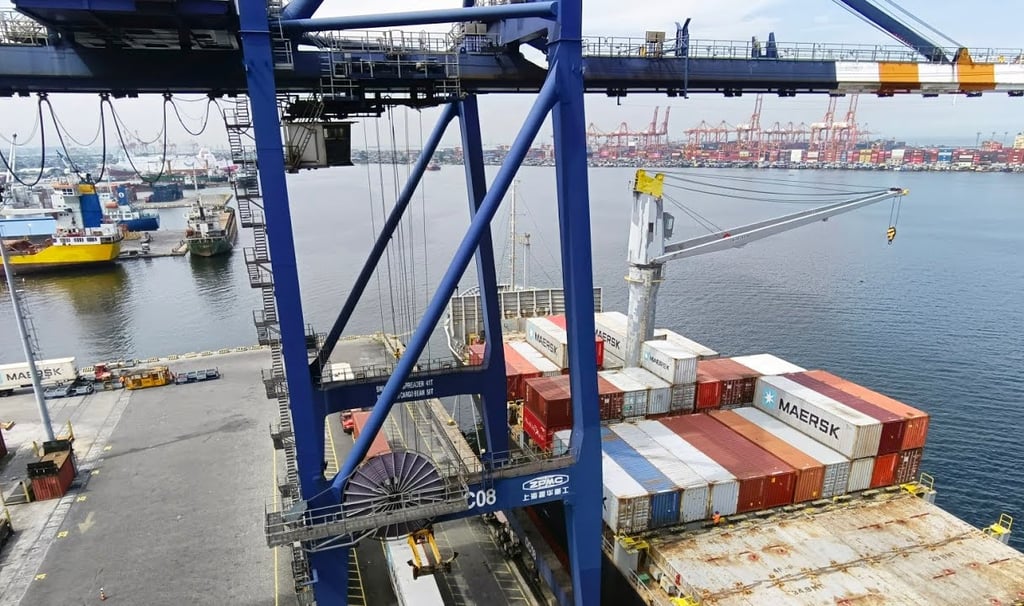
Across South Africa’s mining belt, coastal ports and inland steel facilities, few components are as critical or as overlooked as the festoon cables that power moving equipment. Stacker-reclaimers in the Northern Cape, ship unloaders in Durban, overhead cranes in Newcastle steelworks – all rely on these cables to deliver consistent power and clear control signals over long, constantly changing distances. Too often, however, operations teams select general-purpose rubber cables that fail to match the actual demands of festoon systems, leading to snapped conductors, signal dropouts, premature weathering and costly unplanned downtime. Industry data shows that in South African bulk handling and mining operations, up to 22% of unplanned outages on mobile equipment can be traced back to under-specified or poorly performing power and control cables.
The RHEYFESTOON®(C) (N)3GRDGC5G Flexible Screened Round Festoon Cable is not another general-purpose mobile power cable. It is an engineering solution designed from the ground up specifically for festoon applications, where mechanical tensile stress is the dominant load, rather than the high-frequency bending seen in robotic drag chains. It represents a clear shift in European industrial cable design philosophy: instead of simply boosting current carrying capacity, it prioritises long-term reliable operation in complex, demanding environments. Through its carefully balanced combination of FSC high-flex copper conductors, RHEYCLEAN-HEPR insulation, composite EMC shielding and EM7-grade outer jacketing, it resolves the three most common pain points of standard festoon cables: insufficient tensile strength, unmanaged electromagnetic interference, and rapid degradation under South Africa’s harsh climate.
This article explores every aspect of the cable, from its core design logic and material science principles to its proven performance in real South African operations. It also outlines how Feichun’s equivalent offering delivers identical technical performance with faster lead times and more competitive pricing for Southern African projects, and provides clear guidance on when and how to specify this cable for your site.
Core Technical Specifications and Compliance Standards
To understand how this cable delivers its performance, it helps to start with its official designation and verified technical parameters, all of which align strictly with documented product data and recognised international standards.
The full product name is RHEYFESTOON®(C) (N)3GRDGC5G Flexible Screened Round Festoon Cable, with a rated nominal voltage of 0.6/1 kV. It is approved for use in AC systems with a maximum operating voltage of 1.2 kV, and DC systems up to 1.8 kV. For quality assurance, power cores undergo an AC withstand test at 3.0 kV, while control and protective cores are tested at 2.0 kV, confirming robust insulation integrity even under fault conditions.
Compliance is central to its design. It is fully certified to DIN VDE 0250 Part 812, with official VDE registration number 7891. Its conductor performance exceeds the requirements of IEC 60228 Class 5, its insulation outperforms IEC 60502-1, and both inner and outer sheaths meet prEN 50363 standards for EM6 and EM7 rubber compounds respectively. Core colour coding follows DIN VDE 0293 Part 308 and HD 308 S2, ensuring consistency with wiring practices widely used across South African industrial sites. It also meets IEC 60332 Part 1 for flame retardancy, and is constructed as a low-smoke halogen-free (LSHF) assembly for enhanced safety in confined spaces.
Its mechanical ratings are tailored directly to festoon loading: static tensile stress capacity reaches 15 N/mm², while dynamic tensile stress under moving conditions is rated at 30 N/mm². It operates reliably at festoon travel speeds up to 240 metres per minute, with higher speeds available on request. Thermal performance is equally impressive: the conductor can run continuously at 90 °C, and withstand short-circuit temperatures up to 250 °C for up to five seconds. For surface exposure, it tolerates temperatures from -50 °C to +80 °C when fixed, and -35 °C to +80 °C during mobile operation. Chemically, it resists mineral oils, moisture, ultraviolet radiation and ozone, making it suitable for both indoor and outdoor deployment.
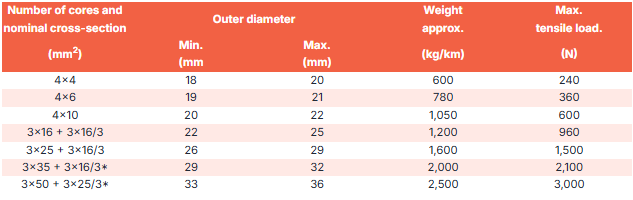
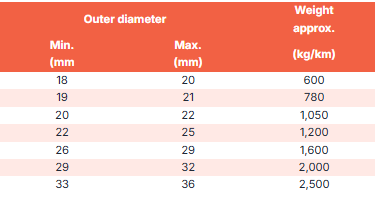
The full range of standard configurations includes the dimensions, weights and maximum allowable tensile loads listed below:
4×4 mm²: outer diameter 18–20 mm, weight 600 kg/km, max tensile load 240 N
4×6 mm²: outer diameter 19–21 mm, weight 780 kg/km, max tensile load 360 N
4×10 mm²: outer diameter 20–22 mm, weight 1050 kg/km, max tensile load 600 N
3×16 + 3×16/3 mm²: outer diameter 22–25 mm, weight 1200 kg/km, max tensile load 960 N
3×25 + 3×16/3 mm²: outer diameter 26–29 mm, weight 1600 kg/km, max tensile load 1500 N
3×35 + 3×16/3 mm²: outer diameter 29–32 mm, weight 2000 kg/km, max tensile load 2100 N
3×50 + 3×25/3 mm²: outer diameter 33–36 mm, weight 2500 kg/km, max tensile load 3000 N
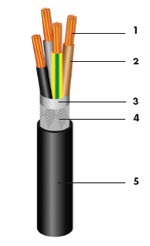
Layer-by-Layer Structure, Material Science and Engineering Principles
Every layer of this cable follows a clear three-part design logic: mechanical suitability for the actual load profile, electrical reliability under stress, and long-term durability in harsh environments. Unlike many alternatives that are built for general use and then adapted for festoon systems, this cable starts from the specific realities of festoon operation – where tension is constant and dominant, while sharp, repeated bending is far less frequent – and avoids unnecessary features that add cost and weight without real benefit.
Conductor: FSC High-Flex Plain Copper
At its core lies the conductor, made from fine-stranded plain copper graded as “FSC”, with flexibility and mechanical strength exceeding the requirements of IEC 60228 Class 5. This choice is not simply about flexibility: it balances two key engineering principles. Mechanically, using many fine strands rather than fewer thick ones distributes tensile force evenly across the entire cross-section, preventing stress concentrations that cause individual wires to snap and eventually lead to full conductor failure. The controlled lay length of the strands also reduces work hardening, meaning the conductor retains its ductility even after years of being pulled and relaxed as equipment moves along its track. Electrically, high-purity copper delivers excellent conductivity to minimise resistive losses, while the stranded construction reduces skin effect – a phenomenon that increases resistance at high frequencies – making the cable far more efficient when powering variable-frequency drives common on modern mining and port equipment.
Insulation: RHEYCLEAN-HEPR Special Ethylene Propylene Rubber
Surrounding each conductor is insulation made from RHEYCLEAN-HEPR, a proprietary hard-grade ethylene propylene rubber that exceeds the specifications set out in IEC 60502-1. This material is selected for its combination of electrical, thermal and environmental performance. Electrically, HEPR has a low dielectric constant of roughly 2.3 to 2.5, and a dielectric breakdown strength exceeding 25 kV per millimetre. These properties reduce the risk of partial discharge, and slow the growth of electrical trees and water trees – the microscopic damage that gradually weakens insulation and causes premature failure, especially in humid or conductive environments like South African mines. Thermally, its fully crosslinked saturated polymer backbone remains stable at continuous operating temperatures up to 90 °C, and does not soften or melt even at short-circuit peaks of 250 °C. Unlike PVC or standard EPR, it contains no halogens, so it produces almost no toxic or corrosive smoke if exposed to fire, a critical safety feature in enclosed conveyor tunnels or ship holds.
Inner Sheath: Special Synthetic Rubber
Between the insulated cores and the shielding layer sits an inner sheath made from a special synthetic rubber formulated to perform better than the EM6 grade defined in prEN 50363. This layer is often overlooked, but it serves two vital purposes. First, it fills the gaps between the round insulated cores, forming a smooth, compact circular profile for the entire cable. This prevents the braided shielding layer from pressing directly into the insulation at sharp angles, which would create local stress points and eventually wear through the insulation over time. Second, it acts as a secondary barrier against moisture, dust and minor chemical splashes, and reduces friction between the moving cores and the outer shielding as the cable flexes under tension.
EMC Composite Shield: Tinned Copper and Synthetic Thread Braid
The electromagnetic compatibility shield is one of the cable’s most distinctive features, constructed as a braid of tinned copper wires and high-strength synthetic threads, with a minimum optical coverage of more than 80%. It operates on the well-established Faraday cage principle: the continuous conductive copper layer reflects external electromagnetic fields and absorbs interfering energy, while also containing electrical noise generated by the cable itself – such as harmonic distortion from variable-frequency drives – so it does not disrupt parallel control or communication cables running along the same festoon rail. Many standard shielded cables use copper braid alone, but copper is relatively soft and can pull apart or develop gaps under repeated tension, which breaks the shield’s continuity and renders it ineffective. By braiding high-tensile synthetic threads alongside the copper, this design shares the mechanical load, keeping the braid tight and intact even at full dynamic tensile capacity. The tinned coating on the copper also resists oxidation, ensuring the shield remains fully conductive even in humid coastal air or high-dust mining sites.
Outer Sheath: EM7 Rubber Compound
The outermost layer is an EM7-grade rubber compound meeting prEN 50363 requirements, coloured black for UV resistance. This material is engineered to withstand the full range of physical and environmental hazards found on South African industrial sites. It has high tensile strength, excellent tear resistance and strong abrasion resistance, so it survives contact with festoon pulleys, guide rails and occasional debris without scuffing or splitting. Its formulation includes stabilisers that block harmful ultraviolet radiation – a major cause of premature cracking and brittleness in standard rubber cables exposed to the intense Highveld sun – and it resists ozone, mineral oils and hydraulic fluids. It remains flexible down to -35 °C, so it does not stiffen or crack during cold winter nights on the plateau, while also coping with summer temperatures exceeding 40 °C in coastal yards. Like the insulation, it is halogen-free and flame retardant, so it does not contribute to fire spread or release dangerous fumes.
Core Identification
The standard six-core configuration follows DIN VDE 0293 Part 308 and HD 308 S2, with three phase cores coloured brown, black and grey, and three protective or earthing cores in the standard green-yellow combination placed in the gaps between the phase cores. This layout ensures earthing cores are protected from direct mechanical pressure, while the colour coding matches the conventions used by most South African electrical contractors and maintenance teams, reducing the risk of wiring errors during installation or repairs.
Performance Advantages: How It Solves Problems Standard Cables Cannot
To appreciate the value of this cable, it helps to look at where standard festoon cables fall short in South African conditions, and how this design addresses those gaps directly.
Standard rubber cables are often designed for light to moderate flexing, not the consistent pulling force of long-travel festoon systems. On South African sites with runs of 100 metres or more, the tension required to keep cables clear of the ground and aligned with pulleys regularly exceeds the 5 to 10 N/mm² rating of general-purpose cables, leading to snapped conductors within two or three years. Shielded alternatives usually use copper-only braids that pull apart under tension, leaving gaps that let interference through, while standard jacketing often cracks within 18 months under high UV exposure. Many operations also find that unexplained control signal trips – which can halt a 5000-tonne-per-hour ship unloader for hours – trace back to interference from adjacent power cables, a problem that standard cables offer no defence against.
The RHEYFESTOON®(C) (N)3GRDGC5G avoids these issues by prioritising what actually matters for festoon systems, rather than trying to be all things to all applications. It does not carry the extra weight and cost of the extreme bending resistance needed for high-cycle robotic drag chains, a feature that offers no benefit for equipment moving slowly over long distances. Instead, it directs its engineering effort where it counts most: delivering 30 N/mm² of dynamic tensile strength, enough to handle the longest runs on South African mines and ports without needing extra tension stations.
Electrically, its HEPR insulation resists thermal ageing far better than EPR or PVC, so it maintains its full current rating for longer even when running at maximum load in hot conditions. Its 80%+ coverage composite shield eliminates the interference that plagues parallel power and control runs, preventing false stop signals, incorrect load readings and calibration drift on precision weighing equipment. Environmentally, its EM7 sheath and UV-stabilised materials last four to six times longer than standard rubber in open-pit mining or coastal port settings, cutting the frequency of full cable replacements and the labour cost involved in swapping out heavy festoon cables.
Real-World Applications: South African Industry Case Studies
The design of this cable aligns almost perfectly with the operating conditions found across South Africa’s key heavy industries, where long travel distances, strong electromagnetic fields and harsh weather combine to challenge even the most robust equipment.
Open-Pit Mining
In the open-pit platinum and iron ore mines of Limpopo, Mpumalanga and the Northern Cape, stacker-reclaimers, mobile crushing plants and spreaders often travel 150 to 300 metres along a single rail, with cables under constant tension. These sites see intense UV radiation year-round, fine dust that settles into every gap, and banks of variable-frequency drives that generate strong electrical noise. At one large iron ore operation, replacing standard rubber cables with this model reduced conductor breakages by 70% over a four-year monitoring period, and eliminated the random control trips that had been disrupting automated stockpile management. The UV-stabilised jacketing also showed no signs of cracking after six years of exposure, compared to the 18-month lifespan of the previous cables.
Bulk Ports
At Durban and Richards Bay harbours, ship unloaders and quay cranes operate in salt-laden coastal air, with frequent temperature swings and strict requirements for accurate bulk weighing. Power and control cables almost always run side-by-side on the same festoon, and interference can throw off cargo weight readings by several tonnes, leading to disputes and delays. At one coal terminal, the composite shield maintained full continuity after six years of coastal operation, with no measurable signal drift in the load cell or anti-collision systems. The cable also resisted corrosion from salt spray, with no visible degradation to conductors or braid during scheduled inspections.
Steel and Metal Production
In the steelworks of Pretoria and Newcastle, overhead cranes and ladle transfer cars operate in high ambient heat, with significant harmonic distortion from large rectifiers and motors. Here, the cable’s 90 °C continuous rating and 250 °C short-circuit capacity allow it to run at full load without thermal derating, even when positioned close to casting lines or hot metal transfer routes. One facility reported a 40% drop in annual cable replacement costs after switching, as well as more consistent performance from automated crane positioning systems that had previously been prone to interference-related errors.
Across all these settings, the cable’s “tension-first” design matches the reality of South African festoon systems, where most equipment moves slowly over long distances rather than bending sharply thousands of times a day. This means operations pay only for the performance they actually need, without subsidising features designed for very different applications.
Feichun Equivalent Cable: Same Performance, Better Availability
For many South African projects, especially fast-track expansions or tight-budget tenders, the lead times and landed cost of importing directly from European manufacturers can present challenges. Feichun produces a fully equivalent festoon cable that meets every core specification and performance requirement of the RHEYFESTOON®(C) (N)3GRDGC5G, offering a reliable alternative for local supply chains.
This equivalent cable matches the original in all critical areas: it complies with DIN VDE 0250 Part 812, exceeds IEC 60228 Class 5 and IEC 60502-1, and meets prEN 50363 EM6 and EM7 standards. It carries the same 15/30 N/mm² tensile ratings, over 80% shield coverage, HEPR-grade insulation and EM7 jacketing, and passes all the same electrical, thermal and chemical tests. For project planning, it offers significantly shorter lead times for Southern African orders, and typically costs 20% to 30% less when all import duties and logistics costs are factored in. Feichun also works with South African contractors to deliver custom configurations, higher speed ratings or special jacketing where required, making it a practical choice for both new builds and retrofits.
Selection, Installation and Best Practice Guidance
Choosing the right cable is only half the work – correct application and installation ensure it delivers its full design life.
This cable is the ideal choice for any festoon run longer than 50 metres, where the system applies a rated tension of 15 N/mm² or more, or where power and control cables share the same festoon rail. It is also the clear preference for sites exposed to high UV, dust, moisture or chemical splashes, and for equipment running at speeds up to 240 m/min. It is not the best option for very short, low-tension runs, or for drag chain applications requiring millions of sharp bending cycles – in those cases, high-cycle drag chain cables are more appropriate.
During installation, the composite shield should be grounded at one end only for most long runs, to avoid creating ground loops that can degrade shielding performance. For sites with exceptionally high electrical noise, double-end grounding can be used, but this should be assessed alongside your site’s earthing system design. Always follow the minimum bend radius set out in DIN VDE 0298, and avoid pulling the cable over sharp edges or setting initial tension above the rated maximum. If you need to operate at speeds above 240 m/min, or require non-standard core configurations or flame ratings, contact your supplier early in the project planning stage.
Frequently Asked Questions
Can this cable be used in underground coal mines?
Yes, its halogen-free construction and flame retardant properties make it suitable for underground use, provided it meets any additional local mine safety requirements for specific regions.
What service life can I expect in open-pit mining conditions?
With correct installation and tension management, typical service life ranges from five to eight years, compared to one to three years for standard rubber cables.
How does it compare to (N)SHOEU or NSSHCGEU cables?
Those cables are designed for general mobile use, with higher bending resistance but lower tensile strength and limited or no shielding. This model is purpose-built for festoon tension loads and EMC protection, making it more cost-effective and reliable for this specific use case.
Does the shield work for both magnetic and electrical interference?
Yes, the dense copper braid blocks high-frequency electrical noise, while the combined mechanical strength and coverage also suppresses low-frequency magnetic fields common near large motors and transformers.
Can I use Feichun’s equivalent without changing cable sizing?
Absolutely – all current ratings, dimensions and mechanical limits match the original exactly, so it can be swapped in without recalculating or modifying supports and pulleys.
Conclusion
The RHEYFESTOON®(C) (N)3GRDGC5G Flexible Screened Round Festoon Cable stands as a benchmark for purpose-built festoon power delivery, and its design aligns closely with the realities of South Africa’s heavy industry. It does not try to be everything to every application, but focuses its engineering on the tensile loads, interference risks and environmental exposure that define festoon operation. By combining high-performance materials with a clear understanding of how these systems actually work, it solves the three biggest problems that plague standard cables: early failure from tension, signal loss from interference, and rapid degradation from local weather. For operations looking to reduce downtime, cut maintenance costs and keep control systems running reliably, it offers a level of performance that general-purpose alternatives simply cannot match. Feichun’s equivalent offering extends these benefits to more projects, with the same technical assurance and better supply chain flexibility for the Southern African market.
If you need full datasheets, pricing, custom configuration support or bulk supply quotations for your mining, port or steel project, contact the Feichun team directly at: Li.wang@feichuncables.com
Email Address: Li.wang@feichuncables.com
© 2025. All rights reserved.
One-click to Quickly Contact
Products
Contact
Company
Location:
Building A Private Science and Technology Park, Hefei Economic and Technological Development Zone, Anhui Province, China
Heat Resistant Cable
WhatsApp: +86 17333223430
Social Media: