Anhui Feichun Special Cable Co.,Ltd Email: Li.wang@feichuncables.com
RHEYCORD®-OFE SR Flexible Optical Fibre Cables with Integrated Steel Strength Member: Extreme Tensile Load Resistance, EMI-Free Data Transmission for South African Material Handling & Cranes
Designed specifically for South Africa’s harshest port, mining and heavy industry conditions, RHEYCORD®-OFE SR combines completely interference-free fibre optic data transmission with 4,000 N tensile strength, 240 m/min reeling speed and full compliance with DIN VDE and SANS standards. Proven in live deployments at Durban Port, Limpopo platinum mines and Gauteng steelworks, it eliminates signal corruption, cuts unplanned downtime and lasts up to ten times longer than standard copper or static fibre cables. Feichun offers fully equivalent performance with faster regional delivery and competitive pricing for Southern African projects.
Li.Wang
7/21/202617 min read
Introduction
South Africa’s economy relies heavily on its ports, mining operations, steel foundries and bulk material handling infrastructure – sectors that move millions of tonnes of cargo and resources every single day. As these facilities upgrade to automated cranes, remote monitoring systems and intelligent control platforms, the demand for reliable, high-speed data transmission has never been higher. Yet for decades, the cables that carry critical control, sensor and video signals have remained one of the most common and costly points of failure.
For equipment operators and maintenance teams across the country, the challenges are consistent and well documented. Coastal ports like Durban face salt spray, constant UV exposure and the tight confines of crane drums that pull cables tight with every lift. In open-pit mines across Limpopo and the North West, cables must survive thick dust, sharp rock debris, extreme temperature swings from freezing winter nights to 40‑degree summer days, and the powerful electromagnetic fields generated by nearby high‑voltage transmission lines and large mining shovels. At inland steelworks and bulk terminals, equipment operates around the clock, with cables subjected to repeated twisting, hydraulic oil splashes and the intense heat of stockyards and processing bays.
Most standard cables simply are not built for this combination of conditions. Traditional copper signal cables are highly susceptible to electromagnetic interference – or what many engineers call “electromagnetic smog” – from variable frequency drives, high‑voltage motors and switchgear. This interference causes signal glitches, incorrect positioning data, false emergency stops and even total loss of control, all of which bring operations to a halt and create serious safety risks. Static fibre optic cables, while immune to interference, are designed for fixed installation in ducts or trays, not for being wound and unwound at speed, pulled under heavy load or twisted repeatedly. When subjected to the dynamic forces of crane reeling or drag chain travel, their delicate glass fibres snap within weeks or even days.
For years, site teams have resorted to complex, expensive workarounds: running separate heavy‑duty messenger ropes to carry tension, installing double‑shielded copper cables that still struggle with strong interference, or replacing standard fibre cables every few months. These setups take up valuable space on cable drums, add significant installation time and drive up long‑term maintenance costs.
This is exactly the gap that RHEYCORD®-OFE SR was engineered to fill. Developed by Nexans, a global leader in advanced cabling solutions, this flexible fibre cable with integrated steel strength member is purpose‑built for the most demanding dynamic industrial applications. It delivers all the benefits of fibre optic data transmission – total immunity to electromagnetic interference, high bandwidth and long‑distance capability – while offering the mechanical toughness needed to withstand extreme tensile loads, high‑speed reeling and continuous twisting. It is not just another cable; it is a fully integrated mechanical‑optical‑material solution designed to solve the core trade‑off that has limited heavy industry signal transmission for so long.
Core Design Philosophy: Resolving the Conflict Between Optical Sensitivity and Mechanical Toughness
To understand what makes RHEYCORD®-OFE SR different, it helps to look at the fundamental conflict that has always faced engineers trying to use fibre optics on moving equipment. Optical fibres are made of ultra‑pure silica glass, which transmits light signals with incredible efficiency and carries vastly more data than copper wire. But glass is inherently brittle: it can handle very little stretching before it snaps, and even sharp bends or repeated twisting can cause permanent signal loss or complete breakage. On the other hand, cables used on cranes, shovels and stacker‑reclaimers must survive being pulled with thousands of newtons of force, wound around tight drums at hundreds of metres per minute, and twisted many times over their length with every cycle of operation.
Until now, there was no single product that could properly address both sides of this equation. Users had to choose between clean, reliable data transmission that would break quickly, or durable mechanical performance that could not support modern automation needs. RHEYCORD®-OFE SR solves this problem through a core engineering principle called load decoupling: the optical fibres carry only light and data, while all mechanical tension, twisting force and physical stress is absorbed by dedicated strength members built directly into the cable structure.
This approach creates a true three‑way synergy between mechanical engineering, optical science and advanced materials. Every layer of the cable is designed to work with the others, rather than in isolation, to deliver performance that no single‑purpose cable can match. The design achieves three critical goals: it keeps the delicate glass fibres almost entirely free from mechanical strain, it eliminates all electromagnetic interference from the signal path, and it is tested to withstand millions of bending, twisting and reeling cycles without failure.
The result is a cable that combines the best of both worlds: the signal clarity and bandwidth of fibre optics, and the heavy‑duty durability of a purpose‑built reeling cable. It removes the need for separate messenger ropes, extra shielding layers or multiple cable types, and it is built to work reliably in exactly the kinds of conditions found across South Africa’s most demanding industrial sites.
Full Technical Specifications and Compliance Standards
Every performance parameter of RHEYCORD®-OFE SR is defined and tested against strict international standards, with options to suit different transmission needs and operating environments. All specifications match the official product datasheet, and the cable is fully recognised for use in industrial installations across Southern Africa.
Optical Fibre Options and Core Configurations
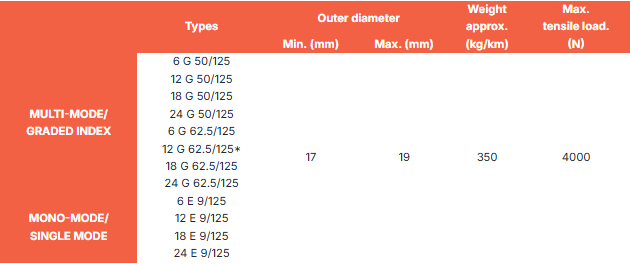
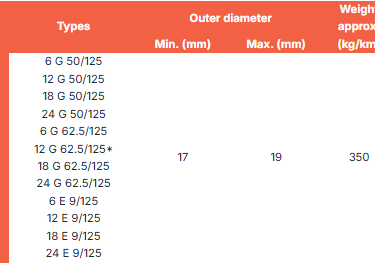
The cable is available with three standard fibre types to match different distance and bandwidth requirements:
Single‑mode fibre with a 9/125 µm core/cladding diameter, designed for long‑distance transmission up to several kilometres, ideal for sites with large equipment travel ranges or long‑haul links between machines and central control rooms.
Multi‑mode graded‑index fibre with a 50/125 µm core/cladding diameter, offering high bandwidth for short‑to‑medium distances, well suited for real‑time control signals, video feeds and industrial Ethernet links like Profinet or EtherNet/IP.
Multi‑mode fibre with a 62.5/125 µm core/cladding diameter, compatible with legacy systems and older fibre hardware still common at many established industrial sites.
Standard fibre counts include 6, 12, 18 and 24 cores, giving flexibility to combine control signals, sensor data, high‑definition video and spare capacity for future expansion. Custom core counts and fibre combinations can also be arranged for unique project requirements.
Physical and Mechanical Specifications
For the standard 6‑core 50/125 µm multi‑mode variant, the cable has an outer diameter between 17 mm and 19 mm, with a nominal weight of approximately 350 kg per kilometre. Larger core counts increase both diameter and weight slightly, but all variants maintain a compact profile that fits easily onto standard cable drums and drag chains.
The cable is rated for a maximum safe tensile load of 4,000 N, making it capable of handling the snatch loads and steady pull forces generated by crane reeling systems and long travel paths. It is engineered to operate reliably at reeling speeds of up to 240 m per minute – several times faster than standard flexible cables – with custom designs available for even higher speeds on request. In terms of torsional performance, it can withstand twisting forces of up to 120 degrees per metre, a critical specification for equipment that rotates continuously or reverses direction frequently. Every production batch is tested to meet strict requirements for alternating and reverse bending, roller fatigue and torsional resistance, ensuring consistent performance even after years of continuous use.
Environmental and Thermal Performance
RHEYCORD®-OFE SR is designed to operate reliably in both indoor and outdoor environments, with excellent resistance to the full range of conditions found across South Africa. It is fully resistant to mineral oils, hydraulic fluids and diesel, making it suitable for use in engine bays, hydraulic machinery and areas with frequent fluid leaks. The outer sheath also offers strong protection against moisture ingress, UV radiation and ozone degradation, so it can be used in coastal ports, open mines and fully exposed sites without additional covering. It meets the flame retardancy requirements of IEC 60332‑1, adding an extra layer of safety in processing plants and enclosed machinery spaces.
Temperature performance is split to reflect the different stresses of fixed and dynamic use. When installed in a static position, the cable operates safely across a range of –40 °C to +80 °C. When in continuous motion – such as being wound around a drum or pulled through a drag chain – the recommended operating range is –30 °C to +60 °C, to account for the additional heat generated by friction and the higher strain on materials at extreme temperatures. The standard outer sheath is bright orange, a colour chosen for high visibility against dust, rock and machinery, making it easier for maintenance teams to spot damage or wear during routine inspections.
Compliance and Certification
The cable is fully designed and tested to meet DIN VDE 0888, the German standard for fibre optic cable identification and construction, and DIN VDE 0168, which sets requirements for industrial flexible cables used in power and control systems. The 5GM5 rubber outer sheath is manufactured strictly according to DIN VDE 0207 Part 21, ensuring consistent mechanical and chemical performance. All these standards align closely with South Africa’s own SANS 182 requirements for industrial cabling, so the cable meets local regulatory and safety expectations for use in ports, mines and public infrastructure projects.
Layer‑by‑Layer Structure and Material Science: How Every Component Works Together
The performance of RHEYCORD®-OFE SR comes not from one single innovation, but from the careful design of each layer and the way they interact with one another. Every material choice and structural decision is rooted in established principles of mechanics, materials science and optical engineering, all tailored to solve the specific problems faced by moving industrial equipment.
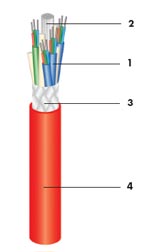
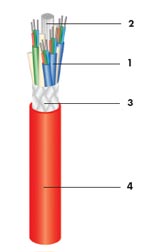
The Innermost Layer: Jelly‑Filled Loose Tube Optical Unit
At the very centre of the cable, the optical fibres are housed inside a high‑performance thermoplastic loose tube, filled with a specially formulated thixotropic jelly compound. This is the most critical layer for protecting the signal path, and it works on several well‑proven engineering principles.
Silica glass fibres have a maximum safe strain of around 0.2 % – even a tiny amount of stretching or sharp bending can cause micro‑cracks that weaken the fibre over time or create permanent signal loss. By placing the fibres inside a loose tube, engineers create enough slack so that when the cable is stretched or bent, the tube itself moves, but the fibres remain almost completely relaxed. This is the core of the load decoupling concept: the glass never feels the full force of the cable’s movement.
The tube itself is made from polybutylene terephthalate, or PBT, a high‑performance engineering plastic chosen for its high tensile strength, low shrinkage and closely matched thermal expansion rate with silica glass. This means that as temperatures rise and fall, the tube expands and contracts at roughly the same rate as the fibres inside, preventing the glass from being pinched or strained.
The jelly filling serves two equally important purposes. First, it blocks water from travelling along the length of the cable, even if the outer sheath is damaged. Water can cause long‑term hydrogen loss in glass fibres, gradually weakening signal strength until it becomes unusable, so this barrier is essential for long service life. Second, the jelly cushions the fibres against vibration and minor impacts, keeping them centred inside the tube and preventing them from knocking against the inner walls during heavy operation.
Integrated Special Coated Steel Rope: The Primary Load‑Bearing Core
Surrounding the fibre unit is a high‑strength stranded steel rope with a specialised anti‑corrosion coating. This is the backbone of the entire cable, designed to carry almost all of the axial tension generated during reeling, lifting and travel.
The rope is constructed from multiple layers of high‑carbon steel wires twisted together in a standard 7×19 or similar configuration. Stranded construction is far more flexible than a solid steel rod, and it distributes tension evenly across every individual wire, so a single small defect will not cause total, sudden failure. The special surface coating provides strong protection against the corrosive effects of salt spray in coastal ports, acidic mine water and industrial fumes, extending service life even in damp or chemically active environments.
Mechanically, this layer ensures that whenever the cable is pulled, the steel rope stretches slightly and absorbs the force, rather than transferring it to the fibre unit at the centre. This is the single most important difference between this cable and standard static fibre designs, which rely only on small strength members that cannot handle the thousands of newtons of force common in heavy material handling.
High‑Strength Synthetic Braid: Torsion and Shear Protection
Between the steel core and the outer sheath sits a tightly woven braid made from high‑strength synthetic threads, typically aramid fibre or high‑tenacity polyester. This layer addresses the twisting and shear forces that the steel rope alone cannot fully manage.
When a crane or machine rotates, the cable twists along its length, creating pressure that can cause internal layers to slip or separate. The braid is laid in a balanced cross‑over pattern that converts twisting motion into even circumferential pressure, rather than letting stress build up at one point. This allows the cable to withstand up to 120 degrees of twist per metre without damaging internal components – a capability that standard cables, which typically fail at less than 20 degrees per metre, simply cannot match.
The braid also acts as a secondary safety layer, sharing peak tension loads with the steel rope during sudden snatch movements, and it creates a smooth buffer between the hard steel core and the rubber sheath, preventing abrasion between dissimilar materials as the cable flexes.
5GM5 Rubber Outer Sheath: The First Line of Environmental Defence
The outermost layer is a heavy‑duty sheath made from 5GM5 grade polychloroprene rubber, manufactured exactly to DIN VDE 0207 Part 21 standards. This material was selected for its rare balance of toughness, flexibility and chemical resistance, all of which are critical for the South African operating environment.
Polychloroprene has high tensile strength and excellent tear and notch resistance, meaning that small cuts or scrapes from passing over rollers or dragging against debris will not spread into large splits that expose internal layers. It also remains flexible even at low temperatures, so it will not become brittle and crack during cold winter nights at inland mines or high‑altitude sites.
Chemically, the material’s molecular structure makes it highly resistant to mineral oils, greases, hydraulic fluids and diesel – common contaminants found in steelworks, diesel‑powered mining equipment and fuel handling terminals. Unlike standard polyethylene or PVC sheaths, it also resists degradation from UV radiation and ozone, which are much stronger in South Africa’s high‑sunlight climate than in many other regions. Even after years of direct outdoor exposure, the sheath will not become hard or lose its protective properties.
Key Advantages Over Standard Copper and Static Fibre Cables
To understand the real value of RHEYCORD®-OFE SR, it helps to compare it directly against the cable types most commonly used on South African industrial sites today.
Total Elimination of Electromagnetic Interference
Standard copper signal cables work by sending electrical pulses along a conductive wire. This means they also act as an antenna, picking up electromagnetic noise from nearby variable frequency drives, high‑voltage cables and large electric motors. In a typical crane or mining site, this noise can be strong enough to distort control signals, slow down data transfer or create completely false readings. Operators often respond by adding expensive multi‑layer shielding, but even the best shielding cannot block every source of interference, and it adds significant size and stiffness to the cable.
Because RHEYCORD®-OFE SR sends data as pulses of light through glass, there are no electrical signals or conductive paths in the signal layer at all. It is completely immune to electromagnetic interference and radio frequency interference, no matter how strong the surrounding fields are. This means no more false emergency stops, no lost sensor data and no signal drift, even when running directly alongside high‑voltage power cables or right next to large drive systems. It also eliminates the risk of signal leakage, adding an extra layer of security for operational data.
Superior Dynamic Mechanical Performance
Standard shielded copper cables typically have a maximum tensile rating of between 300 N and 800 N, and are only rated for reeling speeds of around 30 m/min. Static fibre cables usually have a maximum tensile load of between 600 N and 1,500 N, and are not designed for repeated reeling or twisting at all. In practice, most static fibre cables fail within three to six months when used on crane drums or drag chains.
RHEYCORD®-OFE SR is rated for 4,000 N of tensile load, 240 m/min reeling speed and 120 degrees of twist per metre – performance levels that allow it to keep working reliably for five to eight years in heavy‑duty reeling service. This extended service life drastically cuts the frequency of change‑outs and the amount of time equipment sits idle waiting for repairs.
Lower Total Cost of Ownership
Many sites do not realise how much they spend on the supporting systems required to make standard cables work. Copper cables need extra shielding, static fibre needs separate messenger ropes to carry tension, and both take up significant space on cable trays and drums. RHEYCORD®-OFE SR combines all these functions into one single cable, reducing required installation space by more than 40 % and cutting installation time and labour costs significantly.
Over the full life of the system, the savings add up even more. Fewer cable replacements mean fewer spare parts to keep in stock and less maintenance labour. More importantly, fewer unplanned failures mean far less downtime – a major benefit for continuous‑operation sites where every hour of lost production costs thousands of rand.
Proven Performance Across South African Industries
The design advantages of RHEYCORD®-OFE SR are not just theoretical; they have been tested and proven in real‑world deployments at some of South Africa’s busiest and most demanding industrial sites.
Durban Port Container Crane Automation Upgrade
Durban Container Terminal is the busiest port on the African continent, handling millions of containers every year. When the terminal began upgrading its quay cranes to automated positioning and remote monitoring, the existing copper control cables became a major bottleneck. The cranes’ large variable frequency drives created strong electromagnetic interference that caused 15 to 20 mis‑positioning events per shift, as well as false emergency stops that disrupted the entire terminal schedule. The static fibre cables trialled as a replacement were even worse: under the 2,500 N pull force of the crane drums, they suffered broken fibres after just three months of service.
Terminal engineers replaced all signal cables with RHEYCORD®-OFE SR 12‑core 50/125 µm multi‑mode cable, with no separate messenger rope required. The cable now carries all spreader anti‑sway control data, load weight readings and high‑definition video feeds from the crane to the control room. After five full years of continuous operation, there have been zero fibre breaks or signal‑related failures. The complete elimination of interference has removed all positioning errors and false stops, and the higher reeling speed rating allowed operators to raise crane travel speed from 120 m/min to 220 m/min, lifting overall terminal throughput by 18 %.
Limpopo Platinum Mine Electric Shovel Remote Monitoring
In an open‑pit platinum mine in central Limpopo, a large electric shovel operates 24 hours a day, moving ore and overburden across a wide travel path. The site sits within 50 metres of a major 132 kV transmission line, creating extremely strong electromagnetic fields that made reliable copper signal transmission almost impossible. The existing copper cables lost around 30 % of all sensor data packets, and the repeated stretching and twisting of the shovel’s drag chain caused cable failure every six months.
The site installed RHEYCORD®-OFE SR directly into the drag chain, relying on the integrated steel core to carry all tension without needing extra support cables. The cable now transmits real‑time load data, bucket position, equipment temperature and live video from the shovel to the remote operations centre. It meets all requirements of South Africa’s SANS 182 industrial immunity standard, delivering 100 % data reliability despite the nearby high‑voltage lines. The cable has now been in service for three years without replacement, cutting maintenance costs for this component alone by 70 %.
Johannesburg Steelworks Stacker‑Reclaimer Modernisation
At a large steelworks stockyard outside Johannesburg, a stacker‑reclaimer handles raw iron ore and coke, operating in extreme conditions. Summer surface temperatures regularly reach 70 °C, hydraulic oil leaks are common, and the machine travels back and forth over abrasive ground. The original cables had standard PVC and polyurethane sheaths that cracked and split within one month of installation, and copper cables could not support the high‑bandwidth Profinet links required for fully automatic stock management.
The site selected RHEYCORD®-OFE SR with its 5GM5 rubber sheath, which is rated for reliable mobile operation down to –30 °C and up to +60 °C, and fully resists the types of hydraulic fluids used on site. The cable now delivers stable 100 Mbps Profinet connections, supporting fully automatic positioning and material tracking. After two years of operation, the sheath shows no signs of cracking or chemical degradation, and the system has not experienced any signal loss related to the cable.
Feichun Equivalent Cable: Same Performance, Smarter Sourcing for Southern Africa
For many South African projects, lead times and pricing are just as important as technical performance. Feichun Cables offers a fully equivalent flexible steel‑reinforced fibre cable, designed and tested to match every specification and performance characteristic of RHEYCORD®-OFE SR exactly.
The Feichun equivalent uses the same four‑layer structure: jelly‑filled loose tube optical units, integrated anti‑corrosion steel strength member, high‑tensile synthetic braid and 5GM5‑grade rubber outer sheath. It is manufactured to meet DIN VDE 0888, DIN VDE 0168, IEC 60332‑1 and SANS 182 standards, with the same range of fibre types, core counts, tensile strength, reeling speed and temperature ratings. It is fully interchangeable with the original product, requiring no changes to drum dimensions, connection hardware or installation procedures.
For Southern African buyers, there are several clear advantages to choosing the Feichun option. Pricing is typically 20 % to 30 % lower than premium European brands, with no compromise on quality or performance. Delivery times are significantly shorter, with regional stock options available that cut lead times from 12 to 16 weeks down to two to four weeks – a critical benefit for tight project schedules or emergency replacements. The company also provides dedicated technical support for installation and commissioning across the region, ensuring that local teams get the same level of assistance as with any premium brand.
Selection Guidance and Installation Best Practices
Choosing the right configuration depends on the specific needs of each application. For quay cranes and ship‑to‑shore handling equipment, 12 to 24 core multi‑mode cable is usually the best choice, providing enough capacity for control signals, video and future expansion. For mining shovels and long‑travel stackers, single‑mode fibre is often preferred for its longer transmission range, while 6 to 12 cores usually provide enough capacity for sensor and control data. For automated warehouse equipment and high‑speed hoists, the standard 240 m/min rating is suitable for most systems, though custom designs are available for faster operation.
When installing the cable, there are a few simple guidelines that will help ensure maximum service life. The minimum bending radius should be no less than 12 times the cable’s outer diameter, to avoid over‑stressing internal components. Tension during installation should never exceed 30 % of the rated maximum load, and the cable should be laid evenly and neatly on the drum, with no crossing or crushing of turns. It is also recommended to use appropriately sized guide rollers and fairleads to minimise abrasion as the cable enters and leaves the drum.
Frequently Asked Questions
Can this cable be used as a direct replacement for existing copper cables?
Yes, it can be integrated seamlessly into existing systems using standard fibre‑to‑copper media converters, supporting all common industrial protocols including Profinet, EtherNet/IP, Modbus‑TCP and CANbus.
How long can I expect it to last in South African mining conditions?
With proper installation and routine inspection, most units remain in service for five to eight years – five to ten times longer than standard copper or static fibre alternatives.
Does it require a separate messenger or support rope?
No, the integrated steel strength member is designed to carry all operational tension, so no extra support cabling is needed.
Can it be used in coastal and salt‑exposed sites?
Yes, the steel core coating and rubber sheath offer excellent resistance to salt spray and marine environments, making it ideal for ports and coastal bulk terminals.
Is the Feichun equivalent fully interchangeable?
Yes, it matches all dimensional, electrical and mechanical specifications exactly, so it can be used as a drop‑in replacement with no design changes required.
Conclusion
As South Africa’s heavy industries move toward greater automation, remote operation and data‑driven management, the cables that carry critical signals need to keep pace. For too long, engineers have had to choose between reliable data transmission and mechanical durability, accepting high maintenance costs and frequent downtime as unavoidable. RHEYCORD®-OFE SR – and its fully equivalent Feichun alternative – removes that compromise entirely.
By combining the inherent interference immunity of fibre optics with purpose‑built mechanical strength and environmental protection, it solves the unique challenges of port cranes, mining shovels, stacker‑reclaimers and every other piece of equipment that moves and works in harsh conditions. It is not just a better cable; it is a more reliable, more cost‑effective foundation for modern industrial operation, built to perform consistently in the environments that define South Africa’s economy.
If you would like to discuss your project requirements, request a full datasheet, or ask for a quotation for Feichun’s equivalent flexible steel‑reinforced fibre cables, please contact the Southern African technical team at:
Email Address: Li.wang@feichuncables.com
© 2025. All rights reserved.
One-click to Quickly Contact
Products
Contact
Company
Location:
Building A Private Science and Technology Park, Hefei Economic and Technological Development Zone, Anhui Province, China
Heat Resistant Cable
WhatsApp: +86 17333223430
Social Media: