Anhui Feichun Special Cable Co.,Ltd Email: Li.wang@feichuncables.com
RHEYCORD®-OFE R Flexible Optical Fibre Elements Cables for Reeling Applications: Advanced EMI-Free Data Transmission for Festoon, E-Chain & Reeling Systems in Harsh South African Industrial Environments
For South Africa’s ports, mines, cranes and heavy material handling operations, RHEYCORD®-OFE R flexible OFE cables deliver reliable, zero-interference data even under constant reeling, twisting and extreme weather. This guide explains the full engineering design, local case studies, compliance standards, equivalent alternatives from Feichun Cables, and practical deployment advice for industrial engineers and procurement teams.
Li.Wang
7/21/202614 min read
Introduction
South Africa’s industrial landscape is built on long-distance material movement, from the coal and iron ore mines of the Highveld to the bulk terminals of Durban and Richards Bay, and the steel and cement works that support national infrastructure. Every year, these facilities invest heavily in automated cranes, ship unloaders, stacker-reclaimers and conveyor systems to boost output and improve safety. Yet one critical component often holds these upgrades back: the cables that carry control signals, video feeds and operational data between moving machinery and fixed control rooms.
Most sites still rely on traditional copper data cables or standard outdoor fibre lines, and both struggle to keep up with real-world operating conditions. Copper cables pick up interference from high-voltage power lines and variable frequency drives, causing control delays or even unplanned stops. Standard fibre cables snap or lose signal quality after just a few thousand cycles of bending, twisting or being pulled tight across long travel paths. For operations where a single hour of downtime can cost hundreds of thousands of rand in lost production and contract penalties, these failures are more than just maintenance headaches. They are a barrier to reliable automation.
This is where RHEYCORD®-OFE R Flexible Cables with Optical Fibre Elements – often shortened to OFE R – stand apart. It is not simply a standard fibre optic cable with a thicker jacket, nor a copper cable with better shielding. It is a purpose-built fourth-generation industrial mobile cable, designed from the inside out to solve three overlapping problems that no other cable type addresses fully: constant high-speed movement, intense electromagnetic interference, and exposure to some of the harshest working environments on the continent.
At its core, OFE R combines three distinct fields of engineering into one unified design. It uses optical communications technology to eliminate electromagnetic interference entirely, advanced rubber polymer science to withstand continuous flexing and surface damage, and high-performance synthetic reinforcement materials to handle the extreme tension and twisting forces found in reeling and festoon systems. Unlike most communication cables, which are designed first and foremost for bandwidth or speed, the greatest value of OFE R lies in its consistency. It maintains stable, error-free data transmission even when pulled at high speeds, twisted sharply, coated in dust or hydraulic fluid, or run alongside 33kV power cables.
For South Africa’s mining, port, heavy manufacturing and material handling sectors, this cable is far more than just another component. It is the reliable data backbone that connects intelligent control systems, safety sensors and monitoring platforms to the machines that keep operations running. This article walks through exactly how it is built, why each material and design choice matters, how it performs in local conditions, and how you can source an equivalent solution without compromising on quality or delivery timelines.
Why Standard Cables Fail in South Africa’s Toughest Mobile Applications
To understand why OFE R was developed, it helps to look at the specific combination of challenges faced by operators across South Africa, and why off-the-shelf cables are not built to overcome them.
The Unique Demands of South African Industrial Operations
Almost every major mobile machine in South Africa’s heavy industry shares three operating conditions that push standard cables beyond their limits. First, electromagnetic interference is unavoidable. Ports and mines run dense networks of high-voltage power cables, while modern variable frequency drives used to control crane and conveyor motors generate strong electrical noise across a wide frequency range. In many terminals, data cables run parallel to power lines for 150 metres or more, with no physical separation. Second, environmental conditions are unforgiving. Coastal sites like Durban and Ngqura deal with salt spray and high humidity year-round. Inland mines face intense UV radiation, ozone, temperature swings from freezing winter nights to summer days above 40°C, plus thick layers of abrasive dust and frequent contact with hydraulic oil and diesel. Third, movement is constant and demanding. Most large cranes and stacker-reclaimers have travel distances between 100 and 200 metres, and operate at speeds between 100 and 200 metres per minute. Cables are wound and unwound on drums, pulled along festoon trolleys, or bent tightly inside energy chains, thousands of times over their service life.
Limitations of Traditional Copper Data Cables
For decades, twisted pair and coaxial copper cables were the standard for control and video transmission. But their fundamental design makes them a poor match for modern requirements. Copper works by carrying electrical signals, so any changing magnetic field nearby will induce unwanted voltage in the cable – this is electromagnetic interference, or EMI. In high-interference areas, this shows up as flickering CCTV feeds, random PLC resets, or safety system signals failing to reach the control room in time. Adding metal shielding helps, but it never eliminates interference completely, and thick shielding makes cables stiffer, heavier and more likely to crack when flexed repeatedly.
Copper also has hard limits on distance and capacity. Most industrial copper data cables can only carry high-bandwidth signals reliably for 100 metres or less, forcing operators to install expensive signal repeaters along long travel paths. Over time, repeated bending causes copper conductors to fatigue and break, while shielding layers tear away, leaving the core fully exposed to interference. On many South African crane sites, copper data cables are replaced every three to six months, even when they appear to be in good condition on the outside.
Limitations of Standard Fibre Optic Cables
Standard outdoor fibre cables solve the interference problem, but they introduce a new set of weaknesses when used in dynamic applications. Most commercial fibre cables are designed for fixed installation – buried underground, strung between poles, or routed inside cable trays where they will be bent once during installation and then left undisturbed. The glass fibres at the centre are extremely sensitive to bending. Even small, repeated bends called micro-bends cause light to leak out of the core, weakening signals until they drop out entirely.
To keep costs down, standard fibre cables use loose tubes with minimal protection, and lightweight jackets made from polyethylene or low-smoke zero-halogen materials. These offer little resistance to abrasion from festoon pulleys or drag chain edges, tear easily when snagged on debris, and become brittle in cold temperatures. Most importantly, they lack dedicated tensile and torsional reinforcement. When pulled tight on a reeling drum, the load is transferred directly to the glass fibres, which snap at strain levels well below what is normal for industrial machinery. Even when they do not break, twisting causes uneven tension across the cable, leading to permanent signal loss.
Closing the Gap
What the industry needed was a cable that kept the EMI immunity and long-distance capability of fibre, but matched the mechanical toughness of heavy-duty power cables. This is exactly what OFE R delivers. It was engineered specifically for the three biggest pain points that standard cables cannot resolve: movement that puts constant stress on delicate fibres, electrical noise that disrupts copper signals, and environmental exposure that wears down standard protective layers.
Overview of RHEYCORD®-OFE R: Specifications, Standards and Approved Applications
Before looking at how the cable is built, it is important to establish exactly what it is designed to do, how it is tested, and the performance figures that set it apart from general-purpose alternatives. All data in this section is taken directly from official manufacturer documentation and international standard references.
Product Definition and Core Purpose
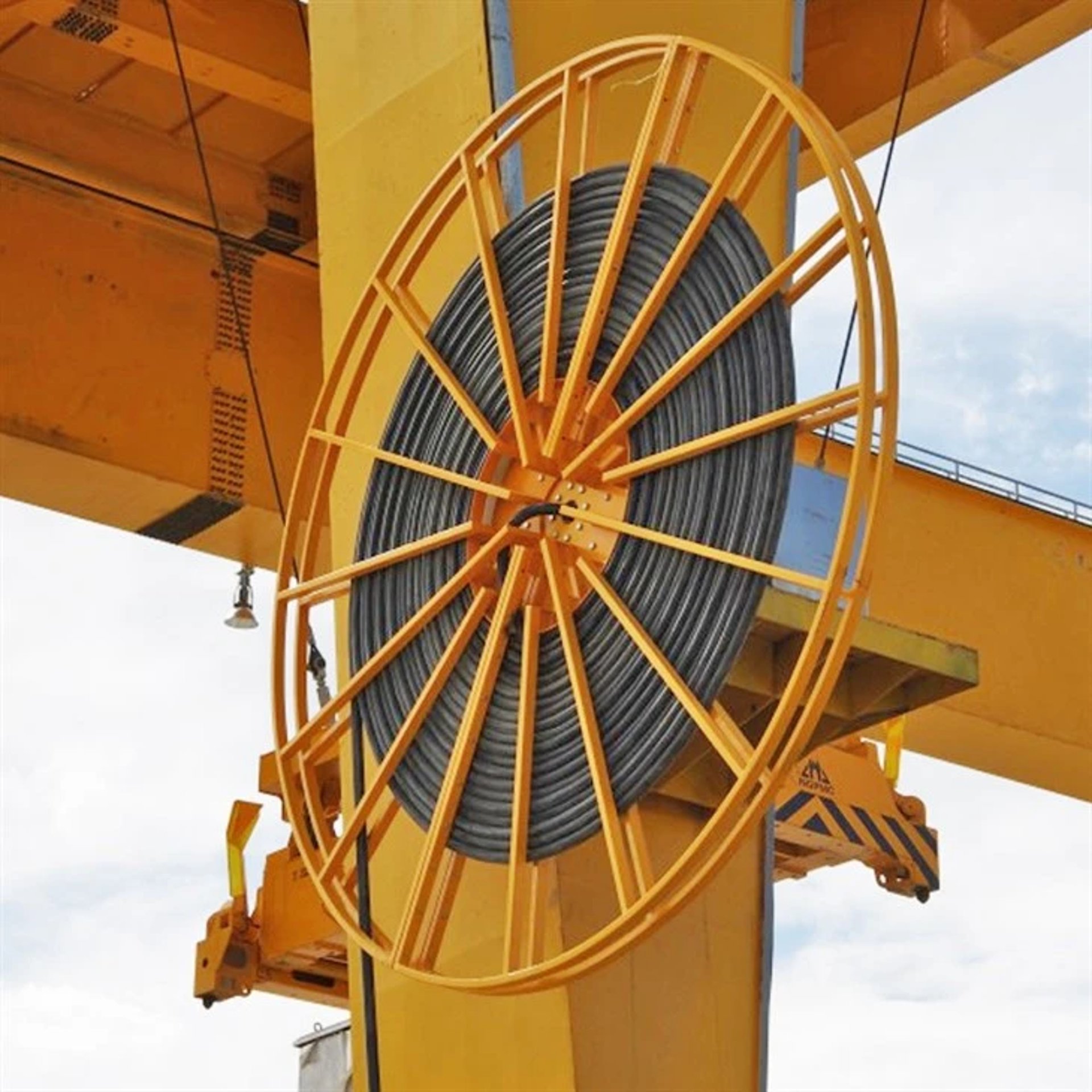
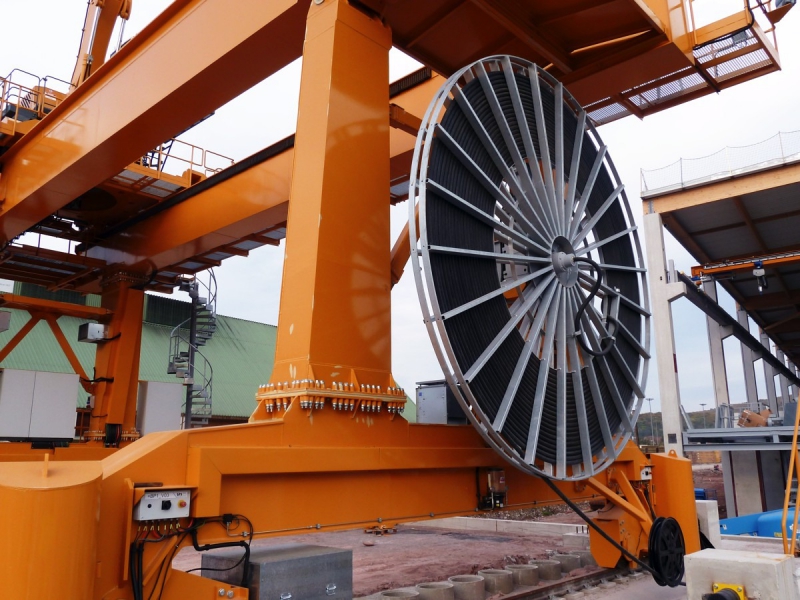
RHEYCORD®-OFE R is a flexible cable with integrated optical fibre elements, developed exclusively for dynamic industrial applications where data transmission must remain completely free from electromagnetic interference. It is approved for use in reeling drum systems, festoon trolley systems, and plastic or steel energy chains – commonly called e-chains – on cranes, ship loaders, stacker-reclaimers, conveyor systems and all types of bulk material handling equipment.
Compliance and Reference Standards
Every design and performance claim for OFE R is backed by independent testing against widely accepted international standards, which also align with South African industry expectations for imported and local equipment:
DIN VDE 0888: Governs fibre identification, core construction and optical testing methods
DIN VDE 0168: Defines general requirements for flexible cables used on moving industrial machinery
DIN VDE 0207 Part 21: Specifies material properties for the 5GM5 rubber compounds used in both inner and outer sheaths
IEC 60332-1: Confirms flame-retardant performance for general industrial use
Full Technical Specifications
Optical Specifications
The cable is available with three industry-standard fibre types to match different distance and bandwidth needs:
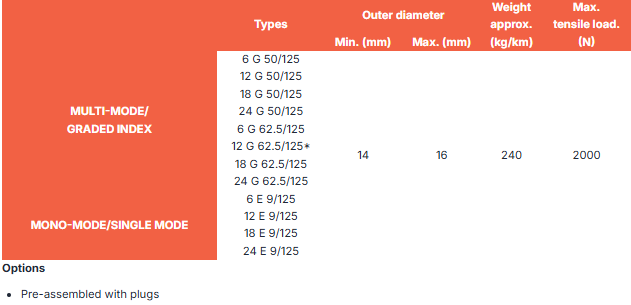
Single-mode: 9/125 μm, for long-distance links over 500 metres
Multi-mode graded index: 50/125 μm (compatible with OM2 and OM3 standards), for high-bandwidth links up to 500 metres
Multi-mode graded index: 62.5/125 μm (OM1), for cost-effective links up to 300 metres
Standard fibre counts are 6, 12, 18 and 24 fibres, giving flexibility to combine video, control, safety and future expansion channels in one cable. All fibres are colour-coded according to DIN VDE 0888 for easy identification during installation and maintenance.
Mechanical Performance
These figures are what make OFE R suitable for continuous dynamic use:
Maximum allowable torsional stress: ≤120° per metre of cable length
Maximum operating speed: Up to 240 metres per minute for festoon and e-chain systems; up to 120 metres per minute for reeling drum applications. Custom designs are available for higher speeds on request
Full test certification: Alternating bending test, roller flexing test, and torsional resistance test to confirm performance over millions of cycles
Sample dimensional and load data:
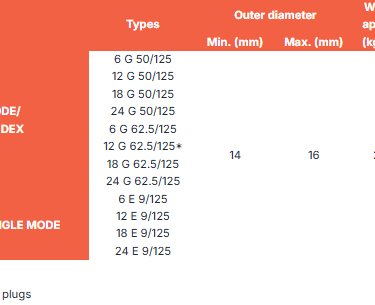
6 G 50/125: Outer diameter 14–16 mm, approximate weight 240 kg/km, maximum permitted tensile load 2000 N
All other multi-mode and single-mode configurations follow the same structural design principles, with load ratings matched to fibre count
Environmental and Thermal Performance
Operating temperature range: -40°C to +80°C for fixed installation; -30°C to +60°C for continuous mobile operation
Chemical resistance: Resistant to mineral oils, hydraulic fluids, water, moisture, UV radiation and ozone
Flame performance: Passes IEC 60332-1 flame-retardant testing
Additional Options
Cables can be supplied pre-terminated with standard connectors including SC, LC and FC types, eliminating the need for on-site fusion splicing and reducing installation time and risk.
Approved Applications
OFE R is intended for use wherever data cables are subject to repeated movement or exposure to interference, including:
Ship loaders and unloaders at bulk and container terminals
Gantry and overhead travelling cranes
Stacker-reclaimers and bucket-wheel excavators
Rail-mounted transfer cars and conveyor trippers
Any other material handling equipment using reeling, festoon or e-chain cable management
Deep Dive: Structure, Materials and the Engineering Science Behind the Design
The performance of OFE R does not come from one single innovation, but from careful selection of materials and structural layers, each chosen to perform a specific function while working in harmony with the rest of the cable. This section describes the cable from the inside out, and explains the scientific principles behind every design choice.
Layer-by-Layer Construction
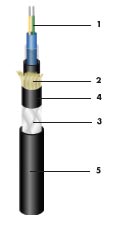
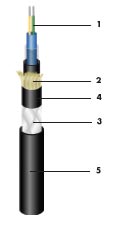
At the very centre of the cable are the optical fibres themselves. Each fibre is placed inside a high-performance thermoplastic loose tube, which is then filled with a specially formulated jelly compound. This jelly serves two purposes: it blocks water from entering the fibre core, and it allows the fibre to move slightly inside the tube when the cable is bent or pulled.
Surrounding these fibre tubes is the strain relief layer, made from high-end synthetic rovings. This layer sits directly against the optical units to absorb sudden tension loads before they can reach the glass fibres.
Next comes the braided reinforcement layer, constructed from ultra-high-strength synthetic threads woven in a balanced cross-braid pattern. This is the primary load-bearing and torsion-resisting layer, and is designed to carry almost all of the tensile and twisting forces the cable will experience.
Above the reinforcement sits the inner sheath, made from 5GM5 grade rubber compound meeting DIN VDE 0207 Part 21 requirements. This layer provides a smooth slip surface between the braid and the outer jacket, while adding extra flexibility and sealing the reinforcement layer away from moisture.
The outermost layer is the heavy-duty outer sheath, also made from DIN VDE 0207 Part 21 compliant 5GM5 rubber compound, coloured black for UV protection. This material is selected specifically for high abrasion resistance and notch resistance, so it resists cuts from sharp edges, scrapes against pulley wheels, and damage from falling debris.
Engineering Principles and Design Logic
Every layer follows well-established principles of mechanics, optics and materials science to solve the problems that standard cables cannot.
Mechanical Engineering: Balancing Strength and Flexibility
The core mechanical principle used here is load sharing. In a standard cable, any tension applied to the ends pulls directly on the core elements. In OFE R, the braided reinforcement and strain relief layer are engineered to carry more than 95% of all tensile load, so the optical fibres experience strain of less than 0.2% even when the cable is pulled at its full rated load. This is well below the 0.5% strain limit for long-term glass fibre reliability.
For torsion resistance, the balanced braid design is critical. When a standard cable twists, the outer layers tighten or loosen unevenly, putting sharp bends on the core. The cross-braid pattern in OFE R adjusts its angle naturally as the cable twists, converting twisting force into even tension across the braid threads. This prevents the cable from spiralling or kinking, and keeps fibre bending consistent even at the maximum rated 120° per metre twist.
The loose tube design relies on the principle of stress relief. When a cable bends tightly, the outer edge stretches and the inner edge compresses. Because the fibre is not glued or bonded inside its tube, it can shift slightly toward the inside of the bend, avoiding sharp micro-bends that would otherwise cause signal loss.
Optical and Electrical Principles: EMI-Free Transmission
The fundamental advantage of fibre – and the reason OFE R eliminates electromagnetic interference entirely – is that it transmits data as pulses of light rather than electrical voltage. There is no conductive loop to pick up induced currents from power lines or VFDs, no ground loop voltage differences between machine and control room, and no radiated signal that can interfere with other equipment. This makes it the only practical option for fully reliable control signals in high-interference areas.
The jelly filling also supports optical performance by preventing hydrogen penetration. Over time, moisture can release hydrogen ions that build up inside glass fibres, causing permanent signal attenuation at common operating wavelengths. The thixotropic jelly blocks moisture migration and keeps hydrogen away from the fibre surface.
Materials Science: Matching Properties to Environment
The 5GM5 rubber compound used for both sheaths is formulated around ethylene-propylene rubber, or EPR, which naturally retains flexibility at low temperatures and resists chemical attack. It is loaded with high-structure carbon black to improve abrasion resistance by a factor of three compared to standard rubber, and to block UV radiation that would otherwise break down polymer chains. Special additives are blended in to resist mineral oils, hydraulic fluids and ozone, while flame-retardant components meet the IEC 60332-1 standard without compromising flexibility.
The synthetic reinforcement threads are typically aramid or high-modulus polyester, chosen for their exceptional specific strength – they offer five times the tensile strength of steel at the same weight, with much lower density. They also have very low creep, meaning they do not stretch permanently under repeated load, and are chemically stable against salt, dust and most industrial fluids.
South African Case Studies and Market Fit
The design choices built into OFE R align almost perfectly with the specific conditions found across South African heavy industry, and real-world deployments have already demonstrated measurable improvements for local operators.
Why OFE R Matches South African Requirements
South African port and mine equipment typically operates at 100 to 200 metres per minute, which falls directly within the cable’s speed ratings – 240 m/min for festoon and e-chain use, and 120 m/min for reeling – leaving comfortable headroom for future speed increases. The UV and ozone resistance of the 5GM5 sheath is critical for Highveld mines where UV levels are high year-round, while salt resistance suits coastal terminals. The wide temperature range covers everything from winter nights in the Northern Cape to summer heat in KwaZulu-Natal.
Case Study 1: Durban Port Bulk Terminal – Ship Unloader Upgrade
A major bulk terminal in Durban operates four large ship unloaders that move grain and fertiliser from vessels to shore conveyors. Previously, the units used copper coaxial and twisted pair cables to transmit CCTV footage from the unloading boom and PLC control signals back to the central control room. Operators reported regular signal loss, frozen video feeds, and random control delays caused by interference from nearby 11kV power cables and VFDs. The copper cables required full replacement every three months, and even then, unplanned signal failures still occurred.
The terminal replaced the copper cables with OFE R installed in heavy-duty e-chains. Within weeks, all signal dropout and interference issues disappeared completely. The improved positioning accuracy allowed operators to reduce approach safety margins, boosting unloading cycle efficiency by 30%. Because the cable withstands abrasion and flexing so well, scheduled maintenance intervals were extended from three months to 12 months. In the first year of operation, the terminal estimated savings in reduced maintenance and avoided downtime exceeded R1.2 million.
Case Study 2: Open-Pit Iron Ore Mine – Stacker-Reclaimer Reeling Cable
A large open-pit mine in the Northern Cape runs a stacker-reclaimer with a 150-metre travel path, used to build and recover ore stockpiles. The unit originally used standard outdoor fibre cable on the reeling drum, but frequent fibre breaks and jacket damage from dust and hydraulic fluid spills meant the cable lasted only around six months. Each failure required a full shutdown and several hours of work to replace or splice the cable, delaying ore delivery to the processing plant.
After switching to OFE R, the cable operated reliably across temperatures ranging from -5°C to +55°C, even when coated in fine ore dust and exposed to regular hydraulic oil splashes. Inspection after two years of continuous use showed no visible jacket damage or increased signal loss, giving an expected service life four times longer than the original cable. One single avoided outage during peak production season saved the mine approximately R450,000 in lost ore throughput and contractual penalties.
Feichun Cables: Fully Equivalent Alternative – Performance, Value and Supply
While RHEYCORD®-OFE R sets the benchmark for this class of cable, procurement teams in South Africa often face long lead times or high minimum order quantities for imported stock. Feichun Cables has developed a fully equivalent product that matches all performance requirements while offering better supply flexibility and value for local projects.
Feichun’s equivalent cable follows the exact same five-layer construction, uses identical fibre types and reinforcement materials, and is certified to meet all relevant standards including DIN VDE 0888, DIN VDE 0168, DIN VDE 0207 Part 21 and IEC 60332-1. It carries the same speed ratings, tensile load capacity, temperature range and environmental resistance, and is fully interchangeable with the original RHEYCORD®-OFE R for retrofits or new installations.
For South African buyers, the main advantages are faster delivery and competitive pricing without compromise. Feichun maintains stock of standard configurations, reducing lead times from several months to just a few weeks for most orders. The company also offers custom fibre counts and pre-terminated assemblies to match site requirements, with technical support available for project planning and selection.
Selection Guide and Best Practices
Choosing the right configuration and following basic installation practices will ensure you get the full service life and performance from your cable.
For fibre type selection, use 62.5/125 μm OM1 multi-mode for short links up to 300 metres where cost is the main priority. Choose 50/125 μm OM2 multi-mode for links requiring 1 Gbps or higher bandwidth up to 500 metres. Select 9/125 μm single-mode for travel distances over 500 metres, or if you plan to upgrade to higher speeds in future. When choosing fibre count, specify for your current needs plus an extra 20% to 25% for future expansion or spare channels.
During installation, maintain the minimum bend radius specified for reeling and e-chain use, and ensure cable slack is correctly set for festoon systems so cables do not pull tight at the end of travel. Pre-terminated cables are recommended wherever possible, as field splicing introduces weak points that are more likely to fail under dynamic stress.
Frequently Asked Questions
Can this cable run alongside high-voltage power cables without interference?
Yes completely. Because it uses light rather than electrical signals, it picks up no interference at all, even when run parallel to 33kV power cables or VFD output lines.
What service life can I expect in continuous reeling use?
When installed within specified bend radius and load limits, it typically lasts three to five times longer than standard fibre cables, and two to four times longer than shielded copper alternatives.
Is Feichun’s equivalent cable compatible with existing RHEYCORD®-OFE R installations?
Yes. It uses the same dimensions, fibre specifications and mechanical properties, so it can be used as a direct drop-in replacement for spares or full retrofits.
Can it be used in underground mining applications?
It meets general flame requirements, but always check with your local mine safety authority for additional certification requirements for underground use.
What is the typical lead time for South African orders?
Standard configurations are available within two to four weeks, while custom designs take six to eight weeks on average.
Conclusion
For South Africa’s heavy industry to move forward with automation, the cables that connect intelligent systems to moving machinery cannot be an afterthought. RHEYCORD®-OFE R and its Feichun equivalent solve the three biggest challenges facing dynamic data links – electromagnetic interference, mechanical fatigue, and environmental damage – by combining optical communications, advanced materials science and mechanical engineering into one fully integrated solution.
It is not simply a faster way to send data. It is a way to build systems that stay online longer, need less maintenance, and deliver the consistent performance that modern automation relies on.
If you would like full datasheets, a custom quote, or technical advice for your specific project, please contact the Feichun team directly at:
Email Address: Li.wang@feichuncables.com
© 2025. All rights reserved.
One-click to Quickly Contact
Products
Contact
Company
Location:
Building A Private Science and Technology Park, Hefei Economic and Technological Development Zone, Anhui Province, China
Heat Resistant Cable
WhatsApp: +86 17333223430
Social Media: