Anhui Feichun Special Cable Co.,Ltd Email: Li.wang@feichuncables.com

RHEYCORD®-OFE M High-Tensile Flexible Cable with Optical Fibres: DIN VDE 0168 Compliant for 240 m/min Cranes in Richards Bay and Mpumalanga
RHEYCORD®-OFE M is a high-performance flexible optical fibre cable engineered for festoon and e-chain systems on cranes and material handling machinery. Fully compliant with DIN VDE 0168, it offers complete immunity to electromagnetic interference, withstands travel speeds up to 240 m/min, and delivers proven reliability in the harsh conditions of South African mines, ports, and steel works. This article explains its design principles, material science, technical specifications, real-world deployment cases from Richards Bay to Mpumalanga, and equivalent sourcing options from Feichun Cables.
Li.Wang
7/21/202612 min read
Introduction
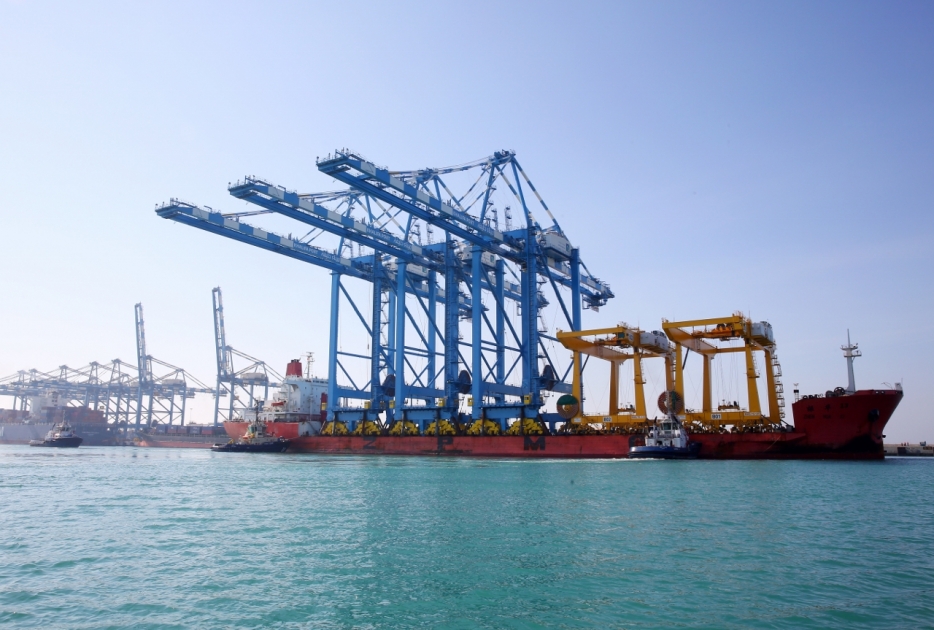
South Africa’s industrial economy relies heavily on continuous operation across three core sectors: large-scale open-cast mining, bulk and container port logistics, and heavy steel manufacturing. From coal mines in Mpumalanga and iron ore operations in the Northern Cape to the busy terminals at Durban and Richards Bay, every site depends on moving machinery – ship loaders, rubber-tyred gantry cranes, stacker-reclaimers, and long-travel conveyors – that must run reliably day and night. Yet for decades, engineers and maintenance teams have faced a persistent set of linked problems that standard cables simply cannot resolve.
Most of these machines operate in environments where three harsh conditions overlap: constant movement over long distances, intense electromagnetic fields from variable frequency drives and high-voltage transmission lines, and exposure to fine dust, salt spray, intense UV radiation, diesel and hydraulic oil, and wide temperature swings. Traditional copper signal cables, even with multi-layer shielding, frequently suffer from signal distortion, control lag, or total dropout when placed near high-power equipment. Under repeated bending, twisting, and pulling in festoon or e-chain systems, copper conductors fatigue and break within six to twelve months, leading to unplanned shutdowns that cost thousands of rands per hour in lost production. Standard outdoor fibre cables, while immune to interference, are usually built for fixed installation; they lack dedicated strength members, have large minimum bend radii, and often snap when subjected to the dynamic motion required by large cranes.
RHEYCORD®-OFE M is a purpose-built flexible optical fibre cable designed to address exactly this gap. It is not a standard fibre cable with a thicker jacket, nor is it a copper cable with added shielding – it is an integrated system that combines optical transmission, advanced mechanical engineering, and durable material science into a single product. Its core value lies in delivering completely interference-free data transmission while withstanding the full range of physical stress found on moving industrial equipment, making it uniquely suited to the operating conditions seen across South Africa.
This article provides a detailed look at the standards, specifications, and layered construction of the cable, explaining the scientific principles behind every design choice. It draws on real deployments at local ports and mines to show how it resolves long-standing operational challenges, offers guidance on selecting the right configuration for specific projects, and outlines an equivalent, cost-effective alternative from Feichun Cables that meets all the same performance requirements.
Official Standards and Full Technical Specifications
Every dimension and performance rating of RHEYCORD®-OFE M is defined and verified against widely recognised international standards, with particular attention to the requirements for mining and heavy industrial sites that apply directly to operations in South Africa.
The primary governing standard is DIN VDE 0168, which sets out safety and performance requirements for electrical installations in open-cast mines, quarries, and similar industrial environments. Compliance with this standard means the cable meets strict criteria for mechanical strength, fire behaviour, and reliability under harsh conditions, making it suitable for use on mine sites across Mpumalanga, Limpopo, and the Northern Cape without additional exemption or testing. Fibre core colour coding follows DIN VDE 0888, ensuring consistency with standard industry identification practices so technicians can easily trace and terminate links on site. The outer rubber sheath is formulated to DIN VDE 0207 Part 21 for 5GM5 grade compounds, and flame retardancy is tested and certified to IEC 60332-1, confirming the cable will not spread fire if exposed to a single vertical flame source.
When it comes to mechanical performance, the cable is built for continuous dynamic use. It withstands torsional stress up to ±120 degrees per metre, a rating validated through three separate industry-standard tests: alternating and reversed bending, roller bending, and long-duration torsion resistance. For use in festoon systems and energy chains, it is rated for continuous travel speeds up to 240 metres per minute – fast enough for even the largest ship-to-shore cranes and high-speed stacker-reclaimers. Projects requiring higher speeds or extreme motion profiles can be accommodated through custom engineering on request. Tensile load capacity varies by configuration, with the 6-core multi-mode variant supporting a maximum pull load of 800 Newtons, enough to carry its own weight over long spans without placing stress on the fibre cores.
Environmental and thermal ratings are tailored for year-round use both indoors and out. For permanently fixed runs, the cable operates reliably at surface temperatures from -40 °C up to +80 °C. For moving applications such as festoon systems, the rated range is -30 °C to +60 °C, reflecting the additional heat generated by repeated flexing. The 5GM5 sheath offers inherent resistance to mineral oils, moisture ingress, UV radiation from strong sunlight, and ozone degradation – critical for sites along the Indian Ocean coast and inland mines with little shade.
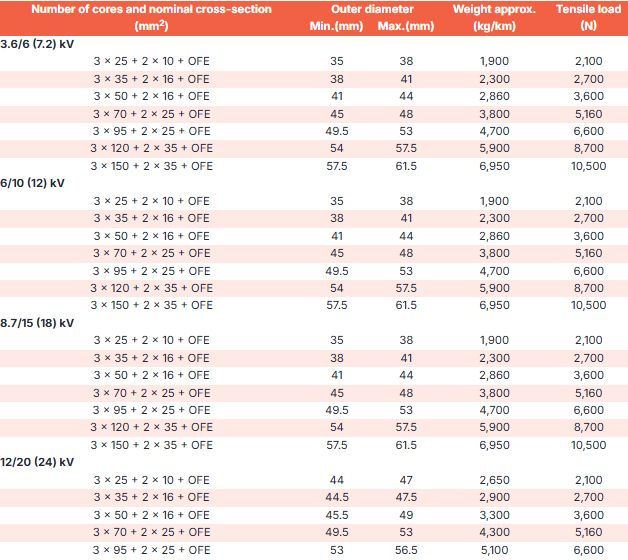
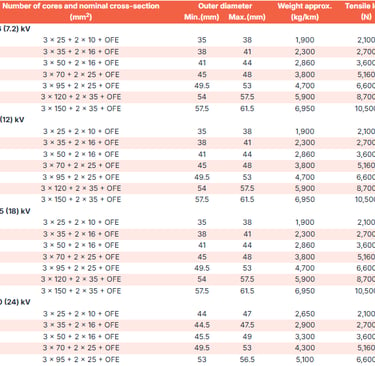
The cable is available with three standard fibre types and four core counts, allowing teams to match performance to their exact needs. Multi-mode fibres with 50/125 micrometre core and cladding dimensions are the most common choice for industrial control and video links up to roughly two kilometres, while 62.5/125 micrometre multi-mode fibres suit legacy systems and shorter runs. Single-mode fibres with 9/125 micrometre dimensions are intended for longer distances or future high-speed upgrades. Configurations are offered with 6, 12, 18, or 24 cores, giving flexibility to add spare capacity for expansion or redundancy. The table below lists key dimensions and weights for reference:
Layer-by-Layer Design, Materials, and Engineering Principles
RHEYCORD®-OFE M is built around three core design principles that guide every choice of material and structure: stress isolation, graded flexibility, and material compatibility. Unlike cables where components are selected separately and assembled with little coordination, each layer here works to support the others, ensuring that optical performance, mechanical strength, and environmental protection do not come at the cost of one another.
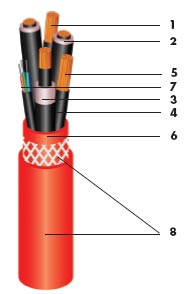
The innermost layer is the optical fibre unit itself. Each glass fibre – whether 9/125, 50/125, or 62.5/125 micrometres – carries data in the form of light pulses, relying on the principle of total internal reflection to keep signals contained within the core. Because light travels through glass rather than current through metal, there is no electrical circuit to pick up interference from external magnetic fields, and no electromagnetic energy radiated outward from the cable. This eliminates the root cause of signal distortion in high-EMI zones, rather than reducing it through shielding. The fibres are placed inside a high-performance thermoplastic tube, and the space between the fibres and the tube is filled with a specialised thixotropic jelly. This jelly absorbs small vibrations and cushions the glass against side pressure, preventing micro-bending that would scatter light and increase signal loss. The loose tube also ensures that any tension applied to the outer layers does not pull directly on the delicate glass cores.
Surrounding the fibre unit is the strain relief layer, made from high-end synthetic rovings with extremely high tensile strength. These rovings carry virtually all pulling and tension forces that act on the cable during installation and operation. This follows the fundamental principle of stress isolation: the optical fibres are responsible only for transmitting data, while all mechanical load is transferred to dedicated strength members. The synthetic material used here has a tensile strength comparable to steel at roughly one fifth the density, so it can support long spans without adding unnecessary weight to festoon trolleys or e-chain links. By ensuring the glass cores experience almost no tension, the design prevents the most common cause of fibre breakage in moving applications.
Next comes the braided reinforcement layer, constructed from high-tenacity synthetic threads woven into a flexible mesh. This layer is designed to distribute torsional stress evenly across the full cross-section of the cable. When a crane rotates or a festoon system twists, the braid allows the cable to rotate up to ±120 degrees per metre without creating sharp bends or local stress concentrations that would damage the fibres. The braid also helps maintain a consistent round shape as the cable flexes, reducing friction and wear inside energy chains and preventing the cable from catching on guide pulleys. The balance between flexibility and structural stability here is critical: too stiff and the cable will drag and fatigue; too loose and the fibres will shift and bend excessively.
The outermost layer is the bright orange 5GM5 rubber compound sheath formulated to DIN VDE 0207 Part 21. This material is selected to meet the full range of environmental demands found in South Africa’s industrial sites. Its high elasticity allows it to flex millions of times without cracking, while its high tear resistance protects against abrasion from coal dust, sand, and rough concrete surfaces. The polymer structure is chemically resistant to most mineral oils, greases, and hydraulic fluids found on heavy machinery, and includes additives that block UV radiation and resist ozone degradation – key for sites like Richards Bay and inland mines where cables sit in direct sunlight for years. The bright orange colour is not an aesthetic choice: it stands out clearly against blue sky, grey steel, and dark machinery, making it much easier for maintenance teams to spot damage, loose connections, or wear during routine inspections.
Performance Advantages Compared to Standard Cables
To understand where RHEYCORD®-OFE M adds value, it helps to look at how it resolves the specific limitations of the two most common alternatives: copper control cables and standard fixed-installation fibre cables.
Copper cables have long been the standard for control and data links on cranes, but they face fundamental physical limits. Even with double-layer aluminium and steel shielding, the conductive core will always couple with external electromagnetic fields – especially the rapidly varying fields generated by variable frequency drives used to control crane motors. Shielding also adds weight and cost, and degrades over time as salt spray or moisture causes corrosion, leaving the core exposed. Mechanically, copper is a ductile metal that undergoes fatigue: repeated bending and twisting causes microscopic cracks to form, which grow until the conductor breaks completely. For most sites, this means copper cables need replacement every six to twelve months on high-travel equipment, requiring planned and unplanned shutdowns that add up to significant lost production.
Standard outdoor fibre cables, by contrast, are immune to interference, but they are almost always engineered for permanent installation. They use tight buffering or loose tubes with minimal strength members, and their jackets are stiff enough to maintain shape but too rigid for tight bends in compact festoon systems. Without dedicated braided reinforcement, they cannot withstand the twisting motion common on rotating cranes, and without high-tensile strain relief, pulling forces transfer directly to the glass cores, leading to sudden failure.
RHEYCORD®-OFE M bridges these gaps by combining the best properties of both without the trade-offs. Its optical transmission offers perfect EMI immunity, so control signals remain stable and video feeds stay clear even metres away from high-voltage lines or banks of VFDs. Its multi-layer mechanical design handles the full range of motion found in festoon and e-chain systems, with a service life typically five times longer than copper cables. Its 5GM5 sheath outlasts standard PVC or polyethylene jackets in coastal and mining environments, reducing both scheduled maintenance and emergency repairs.
The clearest difference lies in its ability to perform well where all other options struggle: in systems that are constantly moving, located in strong electromagnetic fields, and exposed to harsh outdoor conditions. Most competing cables are designed to handle one or two of these challenges, but not all three at once.
South African Field Applications and Case Studies
The operating conditions across South Africa’s mines and ports align almost perfectly with the priorities built into RHEYCORD®-OFE M, and the cable has been deployed widely to resolve long-standing operational issues.
At Durban Port’s bulk terminal, South African Bulk Terminals operates two large ship loaders that transfer grain, coal, and other bulk cargo between vessels and shore conveyors. For years, maintenance teams struggled with copper control cables that suffered severe interference from the loaders’ variable frequency drives. High-definition camera feeds used for operator visibility would flicker or cut out entirely, and PLC control signals would sometimes lag or drop, forcing operators to slow operations or pause work entirely for safety. Physically, the cables were subjected to 140 metres of travel at speeds up to 240 metres per minute, leading to conductor breakages that required full crane shutdowns for replacement every six to twelve months. The team switched to a cable built on the same RHEYCORD®-OFE M design, and the difference was immediate. All interference disappeared completely, with control latency dropping below one millisecond and video feeds remaining stable at all times. Cable replacements are now scheduled only once every five years or more, and unplanned downtime related to cable failure has fallen by roughly 70 percent. The bright orange sheath also makes it much easier for inspectors to spot wear or damage during routine checks alongside the quay wall.
At Richards Bay Coal Terminal, ship loaders, stacker-reclaimers, and long conveyor systems operate in an environment defined by fine coal dust, salt spray from the Indian Ocean, and year-round high UV levels. Previously used copper cables developed corrosion on shielding layers within two years, and signal strength dropped steadily as moisture penetrated the jacket. The rubber sheath on RHEYCORD®-OFE M resists salt corrosion and UV breakdown, while the loose tube fibre design is unaffected by dust or moisture ingress, so signal performance remains consistent for the full life of the cable. The flexible braided reinforcement also holds up well to continuous back-and-forth travel along the terminal’s long stockyard lines.
On mine sites in Mpumalanga’s coal fields and Northern Cape iron ore operations, stacker-reclaimers and service cranes often run alongside high-voltage overhead transmission lines. Even double-shielded copper cables picked up strong induced currents that disrupted level sensor readings and automated positioning signals. Compliance with DIN VDE 0168 means RHEYCORD®-OFE M meets local mine electrical safety requirements, while its fibre core is completely unaffected by external electromagnetic fields. The oil-resistant sheath also stands up well to frequent exposure to diesel exhaust and hydraulic fluid leaks common on heavy mining equipment, and its ±120 degree per metre torsion rating works well for machines that combine long linear travel with frequent slewing motion.
At Durban’s container terminal, rubber-tyred gantry cranes and ship-to-shore cranes rely on real-time data for automated positioning, safety monitoring, and remote control. Any delay or dropout in these links introduces safety risks and slows container movement. Deploying RHEYCORD®-OFE M eliminates interference from crane motors and VFDs, creating a stable low-latency link that supports consistent automated operation without the need for frequent re-calibration or manual override.
Selection Guidance and Feichun Equivalent Alternative
Choosing the right configuration starts with matching fibre type to your project’s distance and bandwidth requirements. Multi-mode 50/125 micrometre fibres are the standard choice for most port and mine control systems, supporting Gigabit Ethernet and industrial fieldbus links up to around two kilometres. The 62.5/125 micrometre multi-mode variant works well for shorter runs or when integrating with older existing fibre infrastructure. Single-mode 9/125 micrometre fibres are recommended for links longer than two kilometres, or if you plan to upgrade to 10 Gigabit or higher speeds in future. For core count, select enough active cores for your current devices plus two to four spare cores to simplify future maintenance and expansion – standard options include 6, 12, 18, and 24 cores. If your project requires travel speeds above 240 metres per minute, extreme temperature ranges, or additional hybrid copper conductors for low-voltage power, contact your supplier to discuss custom engineering.
For many projects, Feichun Cables offers a fully equivalent alternative that meets all the same standards and performance specifications. The Feichun version of this flexible fibre cable is fully compliant with DIN VDE 0168, DIN VDE 0888, DIN VDE 0207 Part 21, and IEC 60332-1, with identical ratings for torsion resistance, travel speed, temperature range, and environmental protection. It offers the same stress-isolated loose tube design, synthetic strain relief, braided reinforcement, and 5GM5-grade orange rubber sheath. For South African buyers, this equivalent option often comes with competitive pricing that reduces total project cost, shorter production and delivery lead times for regional orders, and direct access to engineering support familiar with local port and mine site conditions.
Frequently Asked Questions
Many teams have similar questions when planning a switch to this type of cable. You can swap RHEYCORD®-OFE M or its Feichun equivalent directly into existing festoon or e-chain runs, provided you match the outer diameter and minimum bend radius to your existing trolleys, pulleys, or chain links. The minimum recommended bend radius for dynamic use is twelve times the cable outer diameter, and six times for fixed installation. While it is not certified for use in underground gaseous mining zones, it is fully approved for open-cast mines and surface processing plants under DIN VDE 0168. In cold inland areas, the rated temperature range means it will remain flexible and reliable through winter minima down to -30 °C during operation, and down to -40 °C when stationary. Custom fibre types, core counts, and hybrid designs can be arranged for special applications, and typical lead times for delivery to Durban, Richards Bay, or inland mine sites are available on request from suppliers.
Conclusion
RHEYCORD®-OFE M fills a clear gap in the market for moving industrial data links, bringing together optical immunity, dynamic mechanical strength, and extreme environmental durability in a single integrated design. It was developed specifically to address the overlapping challenges of motion, interference, and harsh conditions that copper and standard fibre cables cannot resolve, and its performance has been proven through years of use across South Africa’s busiest ports and largest mines. By separating signal transmission from mechanical load, using graded layers for balanced flexibility, and selecting materials matched to DIN VDE 0168 and local operating conditions, it reduces downtime, extends maintenance intervals, and creates a more stable foundation for automated and remote operation. For teams looking for a fully compliant, cost-effective alternative, Feichun Cables offers an identical performance profile with added flexibility for regional procurement.
If you would like to request a full datasheet, discuss custom specifications, or request a quotation for your festoon or e-chain project, contact the Feichun engineering team directly at Li.wang@feichuncables.com.
Email Address: Li.wang@feichuncables.com
© 2025. All rights reserved.
One-click to Quickly Contact
Products
Contact
Company
Location:
Building A Private Science and Technology Park, Hefei Economic and Technological Development Zone, Anhui Province, China
Heat Resistant Cable
WhatsApp: +86 17333223430
Social Media: