Anhui Feichun Special Cable Co.,Ltd Email: Li.wang@feichuncables.com
R-(N)TSCGEWÖU + FO: The Ultimate Medium Voltage Flexible Reeling Cable with Fiber-Optics for High-Speed Torsional Stress in African Mining & Material Handling
Designed to DIN VDE 0250-813 and aligned with SANS/IEC mining standards, R-(N)TSCGEWÖU + FO integrates power transmission and fiber-optic communication into one compact, anti-torsion cable. Proven in South Africa’s gold, coal, and platinum mines, it outperforms conventional 611/633 trailing cables, extending service life, reducing downtime, and enabling predictive maintenance under extreme mechanical, electrical, and environmental conditions.
Li.Wang
7/7/202611 min read
Introduction: The Cable Challenge in Modern Heavy Industry
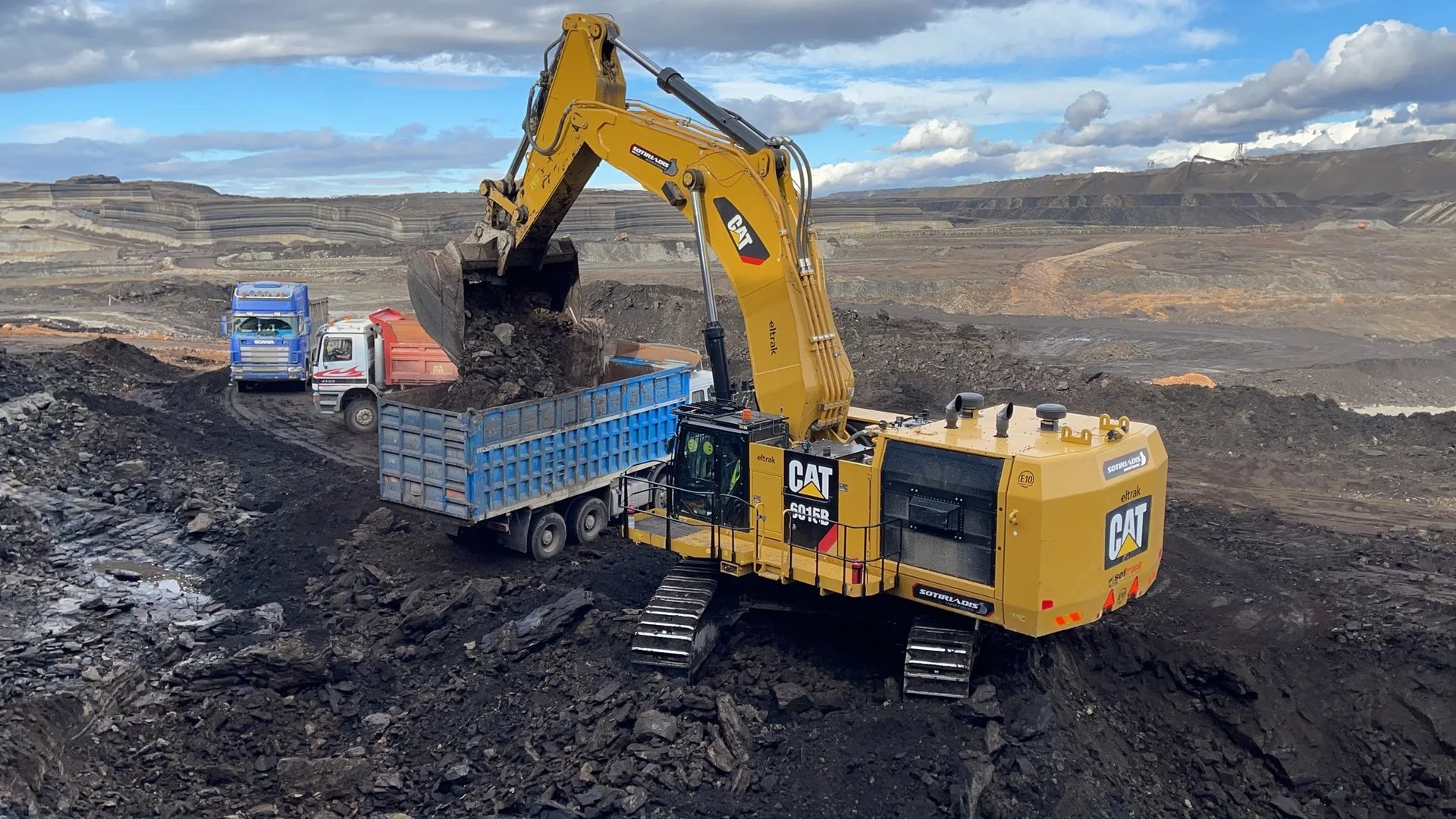
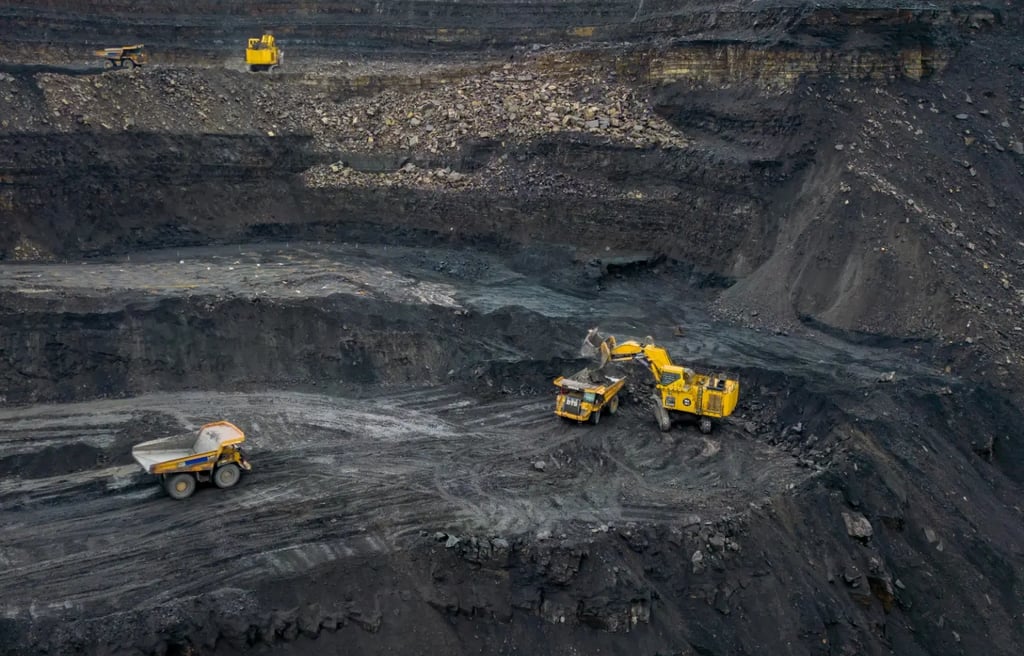
Mining and bulk material handling are among the most demanding industrial sectors on the planet. Nowhere is this truer than in Southern Africa, where South Africa stands as a global leader in gold, platinum, coal, and chrome production. In these operations, heavy machinery such as draglines, hydraulic excavators, mobile crushers, stacker-reclaimers, and large dump trucks operate around the clock, often in environments that combine extreme heat, abrasive dust, moisture, corrosive chemicals, and potentially explosive atmospheres. The cables that supply power and control signals to these machines face a unique set of conditions: they are not fixed in place, but rather subjected to continuous winding and unwinding on cylindrical or mono-spiral reels, bending over pulleys, stretching under tension, and twisting repeatedly as the equipment moves forward and backward.
For decades, standard trailing cables—such as the widely used SANS Type 611, 622, and 633—have served these applications. However, as equipment grows larger, travel distances increase, and operating speeds rise, these conventional designs begin to show their limits. They tend to be bulky, heavy, prone to corkscrewing under torsion, and susceptible to insulation fatigue and conductor breakage. Furthermore, they rarely include integrated communication capacity, requiring separate signal or fiber-optic cables that add complexity, increase installation time, and introduce more potential failure points.
This is where the R-(N)TSCGEWÖU + FO cable enters the picture. It is not merely an upgraded version of a standard cable, but a completely re-engineered system built specifically for dynamic extreme-duty applications. It combines the rigorous requirements of German DIN VDE standards with advanced materials science and a carefully optimized mechanical structure. By separating electrical, mechanical, and environmental functions into distinct layers, it allows each component to perform only its intended task, rather than asking a single structure to do everything. The result is a cable that remains compact, flexible, and reliable even at reeling speeds up to 180 m/min, under continuous torsion, and in temperatures ranging from -40°C to +90°C. In South Africa and across the African mining belt, this design has proven capable of doubling or tripling service life while reducing operational costs and improving safety and data visibility.
Standards, Nomenclature & Basic Technical Specifications
Design Standards & Compliance
The R-(N)TSCGEWÖU + FO is engineered to DIN VDE 0250-813, the primary German specification for medium-voltage reeling and trailing cables subjected to high mechanical stress. This standard sets strict requirements for flexibility, tensile strength, torsion resistance, and electrical integrity. Supporting standards include DIN VDE 0298-3 for minimum bending radii, DIN VDE 0298-4 for current-carrying capacity, IEC 60228 for conductor construction, IEC 60332-1-2 for flame propagation, IEC 60811 series for material testing, IEC 60079 for explosive atmospheres, and SANS 1520, the South African national standard for mining cables. This alignment means the cable is fully accepted by South African Mine Health and Safety Inspectorate (MHSA) and can be used in Zone 21 and Zone 22 hazardous dust areas.
Cable Code Decoded
The long name follows a standardized European coding system, each letter describing a specific feature:
R: Reduced outer diameter and optimized weight
N: National/regional adaptation for local standards
T: Trommel – designed specifically for drum/winding applications
S: Heavy mechanical stress construction
C: Copper conductor
G: Rubber-based insulation and bedding
E: Ethylene Propylene Rubber (EPR) insulation
W: Weather and water resistant
Ö: Oil and chemical resistant
U: Flame-retardant outer sheath
+ FO: Integrated optical fibers for data transmission
Electrical Ratings & Key Parameters
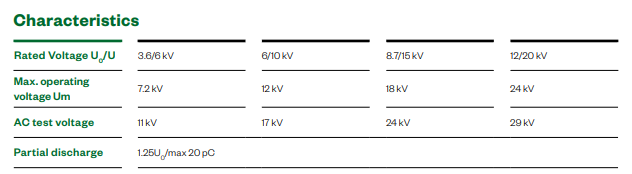
The cable is available in four medium-voltage classes, matching typical mine distribution systems:
Thermal and mechanical specifications are defined as follows:
Continuous operating temperature: +90°C
Short-circuit temperature: +250°C (max 5 seconds)
Minimum ambient temperature: -40°C fixed installation; -25°C mobile operation
Minimum bending radius: 6×D (fixed), 12×D (on drums), 15×D (over pulleys), 10×D (free movement)
Maximum travel speed: 180 m/min
Torsion resistance: ±100°/meter
Design tensile load: 20 N/mm² of conductor cross-section
Standard Sizes & Dimensions
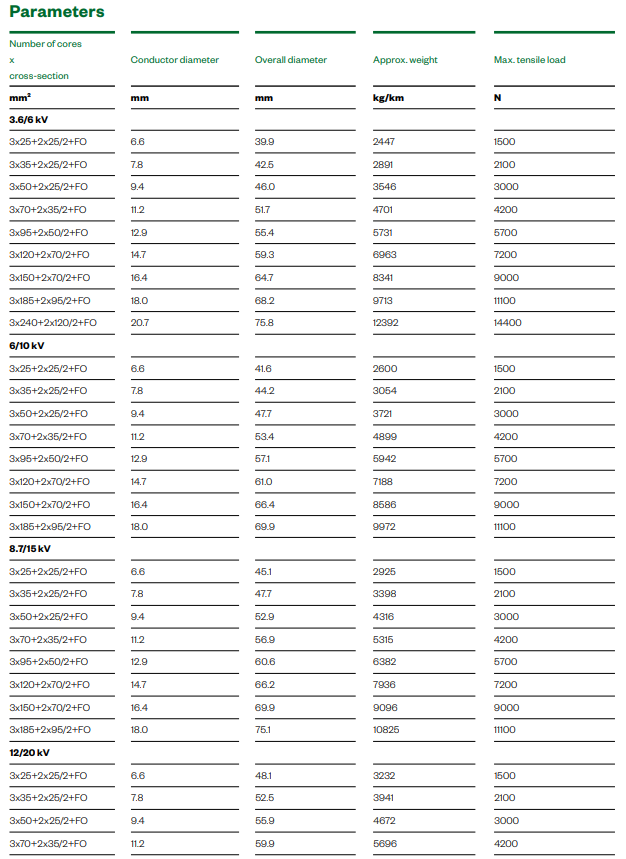
The construction follows a standard format: 3 power cores + 2 reduced-section earth cores + fiber optics. Available cross-sections range from 3×25 mm² up to 3×240 mm², with corresponding earth conductors from 2×25/2 mm² to 2×120/2 mm². Fiber options include 6, 12, or 24 cores, using types A-DZN3Y, G.652D, G.657A, or 62.5/125 μm, suitable for both short-haul and long-distance data transmission.
Below is a sample of the parameter table taken directly from the technical data sheet:
Standard supply length is 500 meters per wooden drum, with custom lengths available upon request.
Engineering Design: Structure, Materials & Scientific Principles
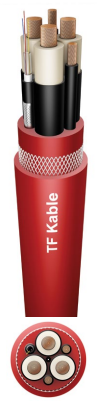
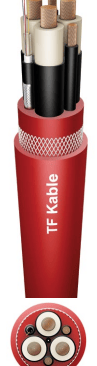
The R-(N)TSCGEWÖU + FO follows a layered philosophy that strictly separates electrical, optical, and mechanical functions. This design principle is the core reason it outperforms conventional cables.
Layer-by-Layer Construction
Central Fiber Optic Unit
Located at the very center is the A-DZN3Y loose-tube optical fiber assembly. It consists of individually color-coded fibers housed inside a thermoplastic buffer tube filled with water-blocking gel. The tube is stranded centrally to minimize bending stress.
Material principle: The loose-tube design mechanically decouples the glass fibers from the surrounding structure. As the cable bends, stretches, or twists, the fibers remain free to move slightly within the tube, eliminating tensile strain. The filling compound prevents water ingress and protects against hydrogen-induced attenuation.
Flexible Tinned Copper Conductors
Three power conductors are laid around the central unit, constructed as Class 5 fine-stranded tinned copper per IEC 60228. The strands are twisted in multiple layers with optimized lay lengths.
Electrical principle: Fine stranding gives the conductor high flexibility without sacrificing conductivity. Tinning prevents oxidation and corrosion in humid or chemically active environments.
Mechanical principle: Short lay lengths distribute bending stress evenly, reducing fatigue. Importantly, these conductors are not designed to carry the full tensile load—this is a key difference from standard cables.
Conductor Screen + EPR Insulation + Insulation Screen
Each conductor is covered first with an extruded semi-conductive rubber layer, then a thick layer of EPR (Ethylene Propylene Rubber) type 3GI3, and finally an outer semi-conductive screen.
Electrical principle: The double semi-conductive layers create a smooth, uniform electric field. Without them, air gaps or irregularities would cause localized stress, leading to partial discharge and eventual insulation failure. EPR offers a dielectric constant of ~2.5, high dielectric strength (>20 kV/mm), and extremely low loss factor, making it far more stable than PVC or natural rubber at medium voltage.
Thermal principle: EPR retains its elasticity and insulation properties continuously at 90°C, and even at 250°C for short-circuit events, preventing melting or cracking.
Symmetric Earth Conductors
Two reduced-section earth conductors, also sheathed in semi-conductive rubber, are placed in the interstices between the insulated power cores.
Electrical principle: Provides a low-resistance path for fault current and maintains an equipotential surface around the cable core.
Structural principle: Symmetric placement ensures the cable remains perfectly round, preventing deformation under pressure and torsion.
Inner Sheath
A red extruded layer of thermosetting rubber type 5GM1b forms a smooth barrier over the assembled cores.
Function: Acts as a mechanical buffer, sealing the core against moisture and providing a stable base for the anti-torsion reinforcement. It does not carry tension but maintains internal geometry.
Anti-Torsion Reinforcement Braid
This is the most critical mechanical feature: a high-strength braid of polyester or aramid fibers applied at a lay angle between 45° and 55°.
Mechanics principle: When a cable twists, it tends to shorten or lengthen. The braid angle is calculated so that any torsional force is converted into circumferential tension rather than axial compression. This prevents the “corkscrew” effect. The braid bears the majority of tensile and torsional loads, isolating the electrical core from these forces entirely.
Outer Sheath
The outermost layer is a proprietary TFKable 5GM5 thermosetting synthetic rubber compound, colored bright red for visibility.
Material science: Cross-linked polymer chains create a 3D molecular structure that is highly abrasion-resistant, tear-resistant, ozone-resistant, UV-resistant, and oil-resistant. It meets EN 60811-404, ISO 1431-1, and UL 2556 standards. Unlike thermoplastics, it does not soften in heat or become brittle in cold.
Triple-Layer Design Philosophy
The entire construction follows three distinct functional zones:
Electrical Zone: Conductors, screens, and EPR insulation ensure stable voltage control and zero partial discharge.
Mechanical Zone: Central fiber unit, earth fillers, and anti-torsion braid absorb tension, bending, and torsion.
Environmental Zone: Inner and outer sheaths block water, dust, oil, ozone, and UV radiation.
This separation ensures that every component operates within its design limits, which is why the cable can last three to four times longer than conventional designs.
Performance Advantages vs. Conventional Mining Cables
To understand its value, it helps to compare the R-(N)TSCGEWÖU + FO directly with the SANS Type 611/633 cables commonly used in South African mines.
Mechanical Superiority
Reduced dimensions: Same electrical rating but 15–20% smaller outer diameter. For example, a 6/10 kV 3×70 mm² Type 611 cable typically measures ~62 mm, while the R-(N)TSCGEWÖU + FO is only 53.4 mm. This reduces weight, increases reel capacity, and lowers the torque required to wind the cable.
Torsion resistance: The anti-torsion braid allows continuous operation at ±60° to ±100° per meter, whereas standard cables usually fail above ±30°/m.
Tensile capacity: Rated at 20 N/mm², with a safety factor of at least 4 against breaking strength. Standard cables often use the copper conductors as the main load-bearing element, leading to metal fatigue and elongation over time.
Electrical Integrity
Partial discharge control: Limited to <20 pC, ensuring the insulation ages slowly and predictably. Standard mining cables rarely specify this parameter, leading to gradual deterioration under medium voltage.
Thermal stability: EPR insulation maintains its dielectric properties even at peak operating temperatures, reducing risk of breakdown during high-load cycles.
Environmental & Safety Compliance
Flame retardancy: Passes EN/IEC 60332-1-2, self-extinguishing if ignited.
Oil and chemical resistance: Volume change <40% after 24 hours immersion at 70°C.
Explosion safety: Meets IEC 60079 and SANS 1520, suitable for dust and gas hazardous areas.
Integrated Fiber Optic Benefit
This is perhaps the most transformative feature. Traditional installations require three separate cables: power, control, and communication. With R-(N)TSCGEWÖU + FO, all three are combined. This reduces the number of cable entries, junction boxes, and connectors, which are the most common sources of failure. Operators can transmit real-time data on motor temperature, vibration, equipment position, and power quality, enabling predictive maintenance rather than reactive repairs.
Real-World Application: South African Mining Case Study
South Africa’s mining sector offers the perfect proving ground for this technology. Mines in the Rustenburg platinum belt, Mpumalanga coalfields, and Free State goldfields present a combination of challenges found almost nowhere else.
Typical Operating Conditions
Open-pit draglines and excavators: Cables must travel 200 to 400 meters horizontally or vertically, at speeds up to 150 m/min. As the machine swings and moves, the cable twists repeatedly up to ±60° per meter. Surfaces are exposed to dust, acidic rain, direct sun, and temperatures from 0°C to 45°C.
Underground crushers and conveyors: High humidity, potential methane presence, and limited space mean cables must be narrow, flexible, and certified safe.
Operational demands: Machines run 22–24 hours a day, 7 days a week. Any downtime due to cable failure results in massive production losses.
The Problem with Traditional Cables
Before adopting this advanced design, most mines relied on Type 611 or 633 cables. The typical lifespan was only 8 to 12 months. Common failures included:
Corkscrewing and twisting, making the cable too large to fit on the reel.
Outer sheath cracking due to ozone and UV exposure.
Conductor breakage caused by fatigue under constant tension.
Separate fiber cables often broke at connectors, leading to loss of machine control.
Large diameter required bigger reels and more powerful motors, increasing energy consumption.
Proven Results in Operation
After switching to R-(N)TSCGEWÖU + FO, operators report measurable improvements:
Size reduction: 18% smaller diameter, allowing 20% more cable length per reel, eliminating the need for reel upgrades.
Energy saving: Lower cable weight reduces drive power consumption by approximately 12%.
Extended service life: Operating life increases from under 1 year to over 36 months.
Reduced downtime: Maintenance stops for cable replacement drop by 70%, significantly improving equipment availability.
Predictive maintenance: Integrated fiber optics allow remote diagnostics, cutting fault response time by 90% and avoiding unplanned outages.
In one platinum mine near Rustenburg, operators calculated that switching to this cable reduced total ownership costs by more than 40% over a three-year period, even accounting for a slightly higher initial purchase price.
Feichun Cables: Equivalent Alternative to European Brands
While TFKable and other European manufacturers are well-known, many operators in Africa are looking for reliable alternatives that offer the same quality but better lead times and pricing. This is where Feichun Cables offers a compelling solution.
Same Standards, Same Construction
Feichun produces its R-(N)TSCGEWÖU + FO strictly according to DIN VDE 0250-813, using identical materials and processes: Class 5 tinned copper, EPR insulation, double semi-conductive screening, anti-torsion polyester braid, and 5GM5 equivalent outer sheath. All electrical, mechanical, and thermal parameters match the original specification exactly. The cables also meet SANS 1520 and IEC standards, making them fully acceptable for South African mining projects.
Key Advantages
Competitive pricing: Typically 20–35% lower than European imports, reducing capital expenditure.
Shorter lead times: Standard deliveries are available in 4–6 weeks, compared to 12–16 weeks from Europe.
Flexible customization: Feichun can adjust fiber counts, sheath colors, and lengths to meet specific project requirements.
Full documentation: Each cable is supplied with factory test reports, type test certificates, and compliance documents required for regulatory approval.
Selection Guide & Configuration Options
Choosing the correct cable requires matching the specification to the application:
Determine voltage: 3.6/6 kV for low-voltage distribution, 6/10 kV for most mine equipment, 8.7/15 kV or 12/20 kV for longer distances or larger machines.
Calculate current: Use DIN VDE 0298-4 tables to select conductor size based on ambient temperature, burial, and grouping.
Check reel size: Ensure the minimum bending radius (12×D) is larger than the drum diameter.
Define communication needs: Select 6, 12, or 24 fiber cores depending on data, video, and control requirements.
Verify environment: Confirm temperature range, moisture, oil, and explosion classification.
Standard marking example:
FEICHUN R-(N)TSCGEWÖU + FO 3×70+2×35/2+12FO 6/10 kV 2026 00450 m
Installation best practices include avoiding sharp edges, ensuring proper tension control, and providing sufficient slack to accommodate thermal expansion and mechanical movement.
Frequently Asked Questions
Can this cable be used underground with methane or gas risks?
Yes. It meets IEC 60079 and SANS 1520, is flame-retardant, and does not propagate fire. It is suitable for Zone 21 and Zone 22 hazardous areas.
What is the maximum length per reel?
Standard supply is 500 meters, but lengths up to 1,000 meters are possible for smaller cross-sections upon request.
How long does the fiber-optic component last?
The fiber has the same design life as the power conductors, typically 15–20 years. The loose-tube construction prevents mechanical fatigue.
Can it be repaired if damaged?
Yes. Repairs are possible using certified heat-shrink joints and fiber-splicing kits, allowing the cable to be reused rather than replaced entirely.
What warranty is offered?
Feichun provides a standard 24-month warranty, with extended terms available for long-term mining contracts.
Conclusion
The R-(N)TSCGEWÖU + FO represents a fundamental shift in how we design industrial cables. It moves away from the old approach of “make it bigger and thicker” toward a science-driven design that assigns specific functions to specific layers. By separating electrical, mechanical, and environmental duties, it achieves higher performance in a smaller package.
Electrical performance is secured through EPR insulation and controlled partial discharge, ensuring decades of safe medium-voltage operation. Mechanical reliability comes from the anti-torsion braid and load-bearing design that protects the copper and glass fibers. Environmental protection is guaranteed by advanced rubber compounds that resist everything from ozone to oil. The integration of fiber optics turns a simple power cable into a smart data highway, supporting modern mining automation and Industry 4.0.
In South Africa and across the African continent, where mining is the backbone of the economy, this cable solves problems that standard cables cannot. It reduces downtime, lowers total ownership costs, and improves safety. Whether you choose the original European brand or the equivalent Feichun version, the engineering principle remains the same: when the environment gets extreme, the cable must be designed to match, not just survive.
If you are specifying or sourcing cables for heavy-duty mining, port, or material handling projects and need a reliable solution that combines power and data, the R-(N)TSCGEWÖU + FO is the answer.
Contact the Feichun Special Cable technical team today for full data sheets, pricing, and engineering support:
Email Address: Li.wang@feichuncables.com
© 2025. All rights reserved.
One-click to Quickly Contact
Products
Contact
Company
Location:
Building A Private Science and Technology Park, Hefei Economic and Technological Development Zone, Anhui Province, China
Heat Resistant Cable
WhatsApp: +86 17333223430
Social Media: