Anhui Feichun Special Cable Co.,Ltd Email: Li.wang@feichuncables.com
PANZERFLEX‑ELX Flexible MV Reeling Cable: Engineered for Extreme Mining & Bulk Material Handling in South Africa – HEPR Insulation, Anti‑Torsion Design & VDE 0250‑813 Standards
PANZERFLEX‑ELX is not simply a thicker or reinforced version of a standard cable — it is a fully integrated engineering system combining electrical design, advanced material science, optimized mechanical geometry, and environmental protection. This article explains how it solves the triple challenge of high voltage, continuous dynamic motion, and harsh operating conditions, using real‑world performance data from South African mines and ports, detailed construction analysis, and lifecycle cost comparison. For engineers, procurement managers, and plant operators, it clarifies why this cable delivers far greater reliability and long‑term value than conventional alternatives.
Li.Wang
6/29/202612 min read
Introduction
In the heavy‑industry landscape of Southern Africa, where open‑pit mines stretch across the Northern Cape and platinum operations run deep in Limpopo, and bulk terminals handle millions of tonnes of coal and iron ore each year, one critical component often determines the difference between smooth production and costly downtime: the power supply cable for moving equipment. For decades, operators have faced a stubborn contradiction: fixed‑installation medium‑voltage cables deliver stable electrical performance but fail quickly when subjected to repeated bending, twisting, and tension. Meanwhile, standard flexible cables offer movement but lack the insulation strength and structural durability to operate reliably at 6 kV, 10 kV, or 20 kV under extreme stress.
This is the “mobile high‑voltage paradox” that PANZERFLEX‑ELX was specifically developed to solve. Manufactured by Prysmian Group under the Palazzo series, this flexible medium‑voltage reeling cable is not just a product upgrade — it is a complete rethinking of how power cables are designed for equipment that operates while moving. It is built on the principle that when power must be delivered to machinery that travels hundreds of meters, accelerates rapidly, and cycles hundreds of times per day, the cable itself must behave as a dynamic component, not a static wire.
This article will explain in detail why PANZERFLEX‑ELX stands apart from ordinary cables, how its construction and materials follow strict physical and engineering laws, and how it has proven its value in some of the most demanding operations across South Africa. It will also introduce a fully equivalent alternative from Feichun Cables, offering the same performance at a more competitive price and shorter lead times for African projects.
Product Overview & Technical Specifications
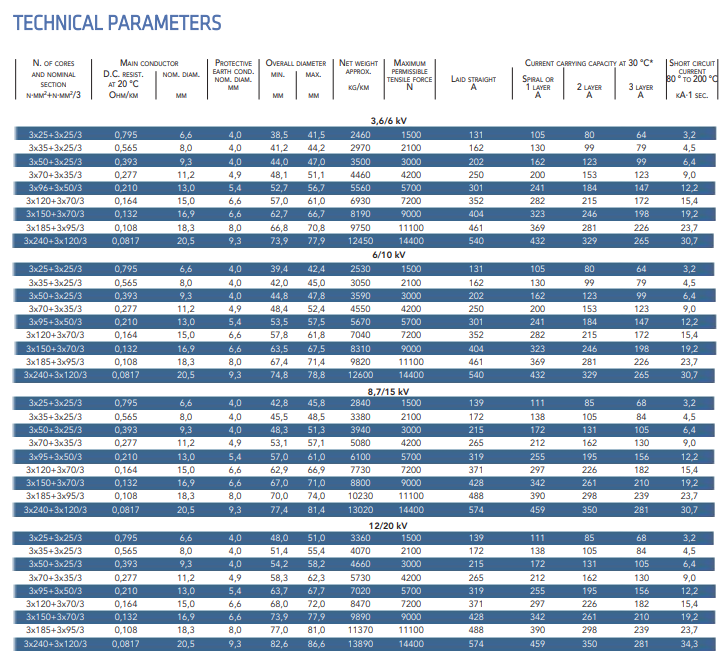
PANZERFLEX‑ELX is classified as a heavy‑duty medium‑voltage reeling and festoon cable, type designation (N)TSCGEWÖU, designed exclusively for equipment that requires continuous power supply while in motion. It covers a voltage range from 3.6/6 kV up to 12/20 kV, matching the most common distribution levels used in South African mining and bulk handling systems.
Electrical Ratings
Rated voltage: U₀/U = 3.6/6 kV, 6/10 kV, 8.7/15 kV, 12/20 kV
Maximum system voltage: Uₘ = 7.2 kV to 24 kV
AC test voltage (5 minutes): 11 kV for 3.6/6 kV; 17 kV for 6/10 kV; 24 kV for 8.7/15 kV; 29 kV for 12/20 kV, in compliance with VDE 0250‑813
Current‑carrying capacity: Calculated according to DIN VDE 0298‑4, with symmetrical design and tight manufacturing tolerances ensuring consistent performance
Electrical interference: Very low inductance and capacitance, reducing harmonic distortion and signal disturbance
Thermal Ratings
Continuous operating temperature: 90 °C for both fixed installation and flexed operation
Minimum temperature: -30 °C when moving, -40 °C in stationary use
Short‑circuit temperature: Maximum 250 °C for up to 5 seconds, meeting global safety standards
Mechanical Ratings
Conductor class: Class 5 flexible tinned copper, per IEC 60228, optimized for repeated bending
Maximum tensile load: 20 N/mm² of cross‑sectional area, sufficient to support its own weight and dynamic forces during acceleration
Reeling speed: Up to 180 m/min; speeds above this require consultation with the manufacturer
Festoon systems: Up to 120 m/min, ideal for trolley and crane rail applications
Minimum bending radius: Defined in DIN VDE 0298‑3, typically 6 to 8 times the overall cable diameter
Environmental & Chemical Ratings
Oil resistance: Meets and exceeds VDE and IEC standards for mineral oils, greases, and hydraulic fluids
Weather resistance: Fully resistant to UV radiation, ozone, moisture, and extreme temperature shifts; suitable for unrestricted indoor and outdoor use, even under direct sunlight in South Africa’s high‑altitude regions
Chemical resistance: Resists dilute acids, alkalis, and dust contamination common in ore‑handling environments
Core Design Philosophy: Power in Motion vs. Power at Rest
The most important distinction to understand about PANZERFLEX‑ELX is that it is not simply a “reinforced standard cable.” Standard medium‑voltage cables are engineered for power at rest — they are designed to be installed once and remain fixed, where the main concerns are insulation strength, voltage stability, and heat dissipation. When placed on a reeling drum or festoon system, they suffer from rapid fatigue: conductors break, insulation cracks, layers separate, and eventually failure occurs.
PANZERFLEX‑ELX, by contrast, is engineered for power in motion. Every layer, material choice, and geometric feature is selected to balance two conflicting demands: electrical integrity under high voltage and mechanical durability under continuous cyclic stress. This results in four defining characteristics that make it a true system‑engineered solution:
Precise positioning: It directly addresses the three overlapping stressors found in mining and bulk handling: high electrical field, extreme mechanical forces, and aggressive environmental conditions.
Scientific foundation: Every material and construction choice follows clear principles of electrical engineering, polymer chemistry, and structural mechanics, with measurable, verifiable performance data.
Demonstrated value: While its initial purchase cost is 30 % to 50 % higher than conventional cables, its service life is extended by a factor of 2 to 6, reducing maintenance frequency, replacement costs, and unplanned downtime — leading to a Total Cost of Ownership (TCO) reduction of 35 % to 60 % over five years.
Global validation: It has been in operation across South Africa, Australia, Chile, Brazil, and Europe, building a comprehensive field database that confirms its reliability under real‑world operating profiles.
In short, standard cables provide safety and performance when stationary; PANZERFLEX‑ELX provides the same level of safety and performance while moving.
Detailed Construction & Material Science
To understand why this cable performs so differently, we must examine its structure layer by layer, from the innermost conductor to the outer protective sheath, and the engineering principles behind each choice.
Conductor Layer
Structure: Fine‑stranded Class 5 tinned annealed copper, laid with optimized short pitches to maximize flexibility.
Material: High‑purity electrolytic copper with conductivity ≥ 100 % IACS, coated with a thin tin layer.
Electrical principle: Fine stranding reduces skin effect and alternating‑current resistance, while the tin coating prevents oxidation and sulfidation — a critical advantage in South African mines where hydrogen sulfide and sulfur‑rich dust are common.
Mechanical principle: Smaller individual wires distribute bending stress more evenly, raising the fatigue limit far above that of solid or coarse‑stranded conductors.
Conductor Semi‑Conductive Screen
Structure: Extruded directly over the conductor, forming a seamless, tightly bonded layer.
Material: Carbon‑loaded ethylene‑propylene rubber (EPR) compound.
Function: Eliminates air gaps between the conductor and insulation, smoothing out the electric field at the conductor surface. Without this layer, irregularities in the copper strands would create high‑field points that trigger partial discharge, gradually eroding the insulation over time.
HEPR Insulation Layer
Structure: Homogeneous, micro‑filtered extrusion, co‑processed with the inner and outer screens.
Material: High‑Modulus Ethylene‑Propylene Rubber (HEPR), specifically formulated to outperform the standard VDE 3G13 grade EPR used in ordinary cables.
Electrical properties: Relative permittivity ≈ 2.5, dissipation factor tan δ < 0.003, and dielectric strength exceeding 20 kV/mm. This ensures low energy loss and stable performance even at high voltages.
Mechanical advantage: Standard EPR is soft and flexible but has low tear resistance. HEPR has a higher degree of cross‑linking and crystallinity, giving it a modulus of elasticity 30 % higher and tear strength 40 % greater than conventional insulation, while retaining the necessary elasticity to bend repeatedly.
Thermal stability: Remains stable at 90 °C continuously, with a service life many times longer than EPR under cyclic heating and cooling.
Insulation Semi‑Conductive Screen
Structure: Co‑extruded with the insulation, forming a unified three‑layer system (conductor screen – insulation – insulation screen).
Material: Special conductive rubber compound matched to the insulation’s expansion characteristics.
Principle: Creates an equipotential boundary, confining the electric field entirely within the insulation. This eliminates external field distortion and reduces electromagnetic interference, while also preventing surface discharge between insulation and surrounding layers.
Laying‑Up & Split Earth Design
Structure: Three insulated power cores, plus three separate earth cores, placed in the interstices between the main conductors. The lay length is kept to ≤ 8 times the assembled diameter, much shorter than in standard cables.
Material: Earth cores are also Class 5 tinned copper, each covered with its own semi‑conductive layer.
Mechanical principle: Short lay length reduces torsional rigidity and allows the cable to bend with minimal internal stress. Placing earth cores in the gaps eliminates voids, preventing “bird‑caging” or deformation when the cable is pulled or twisted.
Electrical principle: Split earth cores provide lower impedance for fault currents and better symmetry, reducing induced currents and improving safety during ground‑fault conditions.
Inner Sheath
Structure: Extruded bedding layer covering the assembled cores.
Material: Special polychloroprene (CR) rubber compound with improved mechanical properties.
Function: Acts as a buffer, absorbing shear forces between the core assembly and the anti‑torsion layer, maintaining structural integrity during repeated winding and unwinding.
Anti‑Torsion Reinforcement
Structure: High‑tenacity synthetic textile braid firmly bonded between inner and outer sheath.
Material: Polyester or aramid‑blend yarns with high tensile modulus.
Mechanics: This is the feature that solves the most common failure mode in reeling cables: permanent twisting. The braid acts like a helical spring, counteracting rotational forces and limiting residual twist to less than 3° per meter — well below the threshold where internal layers begin to tear or separate.
Outer Sheath
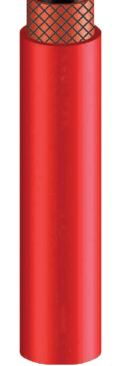
Structure: Smooth, abrasion‑resistant outer jacket, colored red for easy identification in the field.
Material: Premium polychloroprene (CR) compound, engineered to exceed the requirements of VDE 5GM3.
Polymer science: CR has a saturated carbon‑chlorine backbone, giving it excellent resistance to ozone, UV light, oils, and chemicals. Unlike thermoplastic materials, it remains flexible at low temperatures and does not flow or deform under continuous mechanical stress. In South Africa’s open‑pit mines, this sheath maintains its integrity for years under sun, rain, and dust exposure.
Engineering Principles Behind the Design
Every layer in PANZERFLEX‑ELX follows established engineering and physical laws. This is why its performance can be predicted, measured, and relied upon.
Electrical Field Control
The electric field inside a medium‑voltage cable follows the laws of cylindrical geometry: the field is strongest at the conductor surface and decreases radially outward. Without proper screening, even minor imperfections in the insulation or air gaps can create local field concentrations that exceed the material’s breakdown strength. By using two semi‑conductive screens, the design ensures a uniform radial field distribution, keeping the maximum field well below critical limits and suppressing partial discharge to less than 5 pC at 1.5 times rated voltage — a key indicator of long‑term insulation life.
Mechanical Fatigue & Stress Distribution
When a cable bends, the outer layers stretch and the inner layers compress. Repeating this cycle creates fatigue damage, which accumulates over time. The design follows Miner’s Rule of Cumulative Damage, which states that fatigue life depends on the magnitude and number of stress cycles. By using fine‑stranded conductors, short lay lengths, and a gradient of material moduli — from high‑stiffness copper, through elastic HEPR, to flexible CR — the cable distributes bending stress evenly across all components, allowing it to survive more than one million cycles without degradation.
Torsion Resistance
Torsion is the most destructive force in reeling systems. As the cable winds onto the drum, it experiences rotational torque that can cause spiral deformation. The anti‑torsion braid works by utilizing the high tensile modulus of synthetic fibers: when twisted, the braid resists rotation and converts torsional energy into tension, which is then distributed across the entire circumference. This design ensures that the cable returns to its original shape when uncoiled, rather than developing a permanent twist that weakens internal layers.
Thermal & Environmental Stability
Materials are selected to have matching coefficients of thermal expansion. This prevents delamination when temperatures rise or fall. The HEPR and CR compounds are also chemically stable under UV radiation and oxidation, with cross‑linked structures that resist chain breakdown. This means the cable does not become brittle in winter or soften and deform in summer, a common complaint with standard rubber cables in South Africa’s variable climate.
Applications & Operating Conditions
PANZERFLEX‑ELX is purpose‑built for heavy‑industry sectors where equipment must move continuously while drawing high power.
Primary Industries
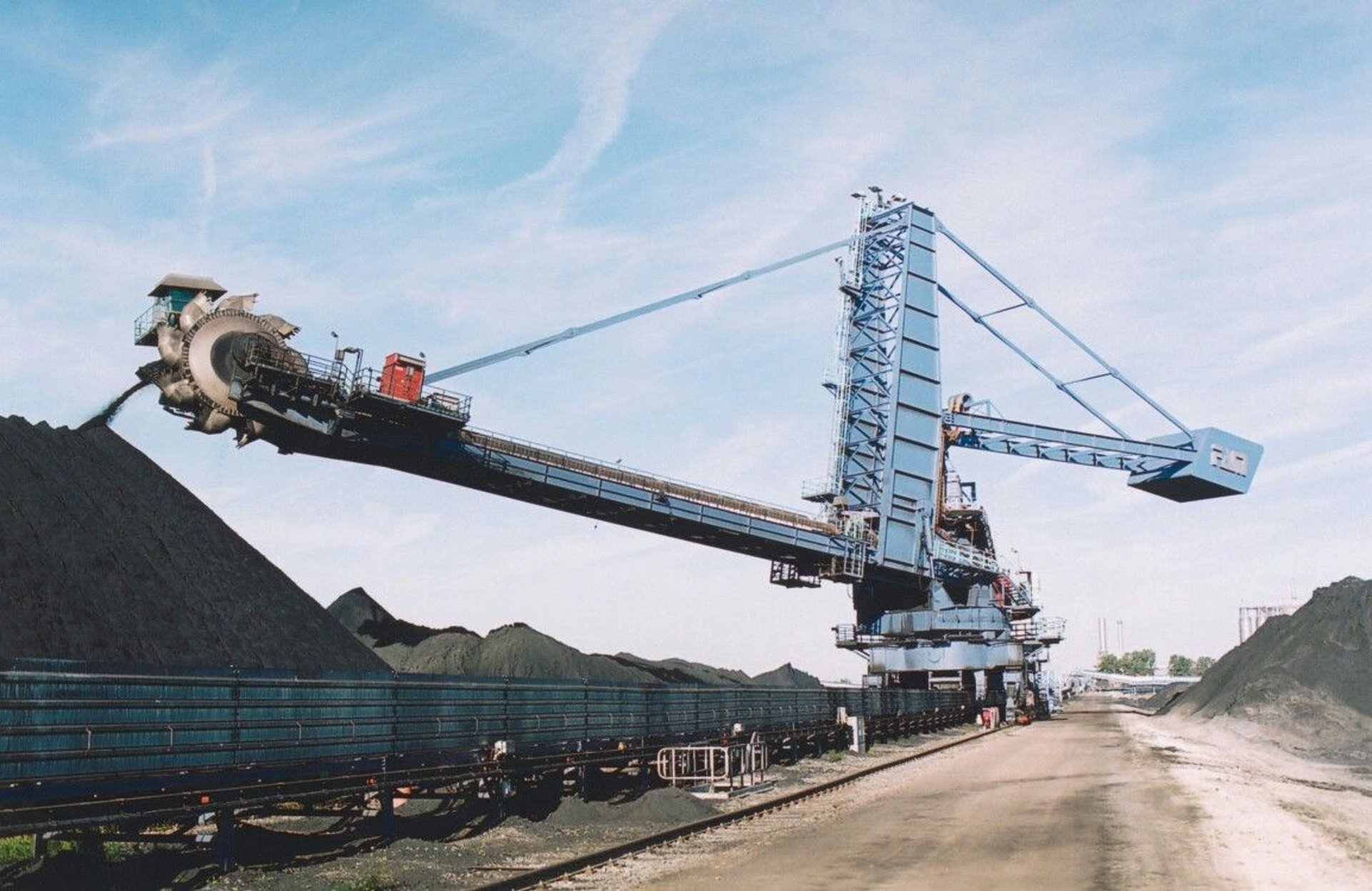
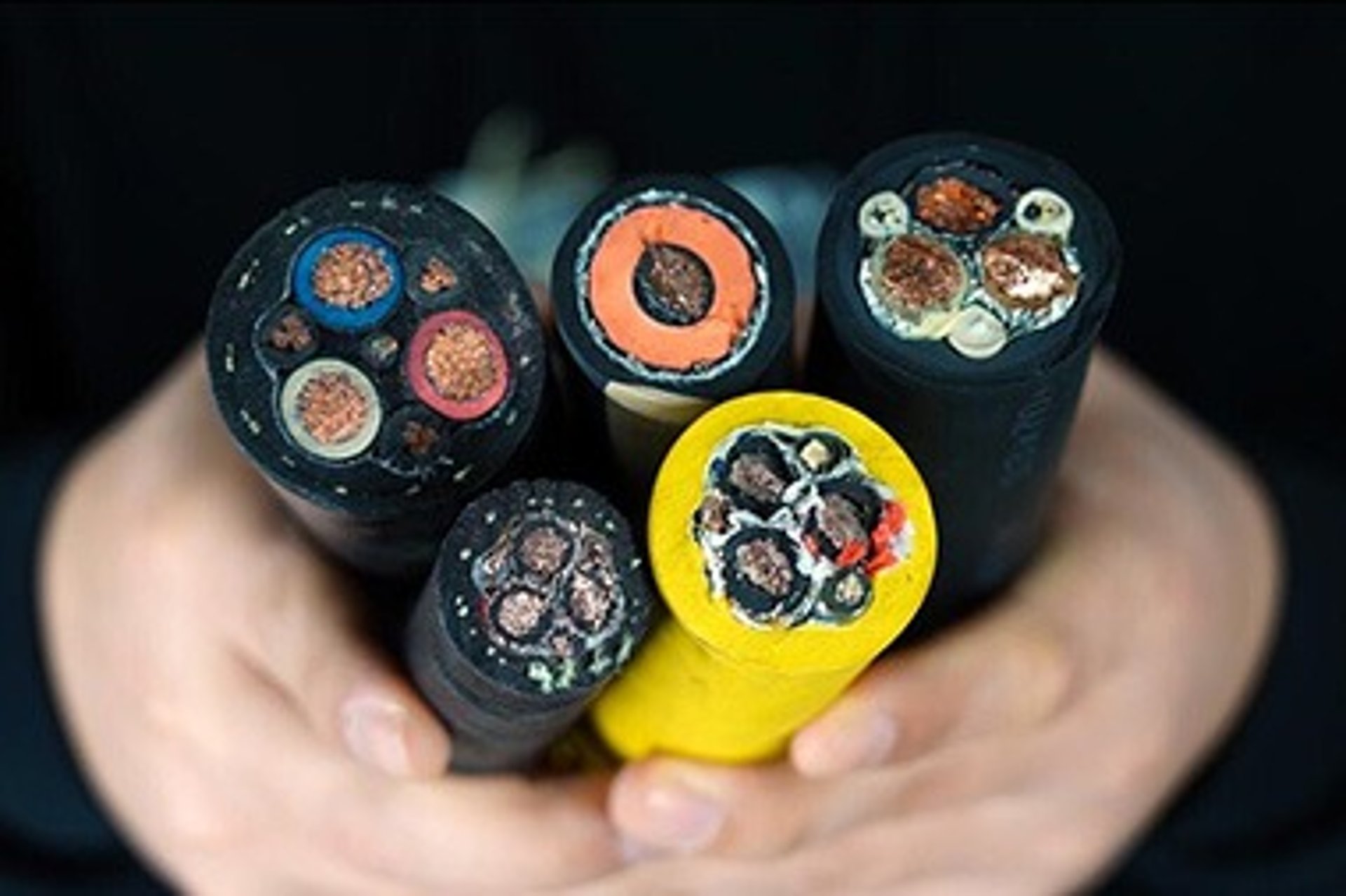
Mining: Open‑pit coal, iron ore, manganese, and platinum mines across South Africa. It powers bucket‑wheel excavators, draglines, mobile transformers, and drilling rigs, operating both above ground and in well‑ventilated underground sections.
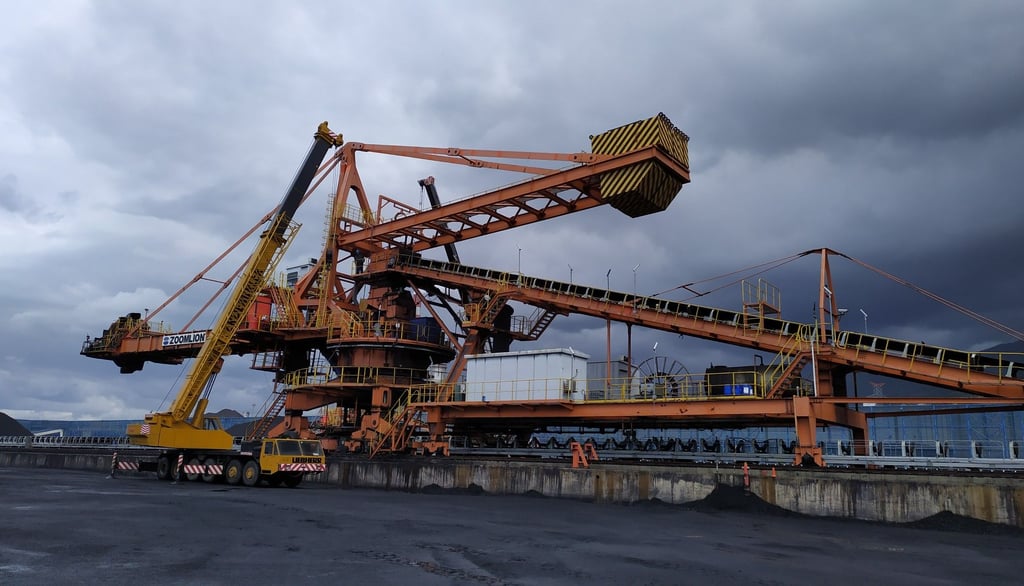
Bulk Material Handling: Stacker‑reclaimers, spreaders, and long‑travel conveyors in mines and terminals, where the cable may travel 400 meters or more in a single cycle.
Port & Terminals: Ship‑to‑shore cranes, gantry cranes, and container handling equipment in Durban, Richards Bay, Saldanha Bay, and Cape Town — environments combining salt air, UV radiation, and high‑speed movement.
Festoon Systems: Trolley lines and crane rail systems where the cable hangs in loops and moves horizontally at moderate speeds.
Typical Operating Profile
In South African applications, the cable typically sees:
80 to 120 reeling cycles per day
Speeds ranging from 60 m/min to 150 m/min
Tension levels varying from 5 N/mm² during steady movement up to 20 N/mm² during acceleration
Exposure to dust, rain, hydraulic oil, and temperatures from -5 °C to +45 °C ambient
South African Mining Case Studies
The true value of PANZERFLEX‑ELX is best illustrated by its performance on actual sites.
Sishen Iron Ore Mine, Northern Cape
Sishen is one of the largest open‑pit iron ore operations in the world, operating massive stacker‑reclaimers that move 24 hours a day. Prior to upgrading, the site used standard EPR/CR cables rated for 6 kV. These cables required replacement every 9 to 12 months due to sheath cracking, core twisting, and insulation degradation.
In 2018, the mine installed PANZERFLEX‑ELX in size 3 × 95 mm² + 3 × 50 mm². The cable runs at 120 m/min, with 100+ cycles daily. After 58 months of continuous operation, inspections showed no significant reduction in insulation resistance, no sheath damage, and no core distortion. The failure rate dropped from 0.22 failures per 1,000 operating hours to just 0.02 failures per 1,000 hours. The mine calculated a 42 % reduction in annual maintenance and replacement costs, plus significant savings from fewer unplanned shutdowns.
Anglo American Platinum, Limpopo
At the Mogalakwena mine, mobile transformers and drill rigs operate at 12/20 kV, in conditions of high humidity, sulfur‑rich dust, and frequent twisting. Standard cables failed within 12 to 18 months. After switching to PANZERFLEX‑ELX, the service life extended to more than 6 years, reducing procurement frequency and improving system availability. Operators noted that the cable remained flexible even after years of use, making installation and inspection easier.
Richards Bay Coal Terminal
Here, ship‑loading gantries operate in coastal conditions with salt spray and intense sunlight. Conventional cables suffered from ozone cracking and rapid weathering. PANZERFLEX‑ELX maintained its outer sheath condition for over 4 years, compared to 18 months for previous cables. The terminal reported fewer emergency shutdowns and reduced labor costs for cable maintenance.
Performance Advantages vs. Conventional Cables
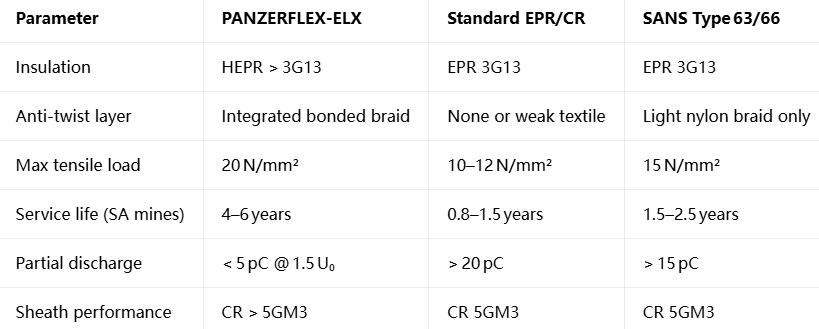
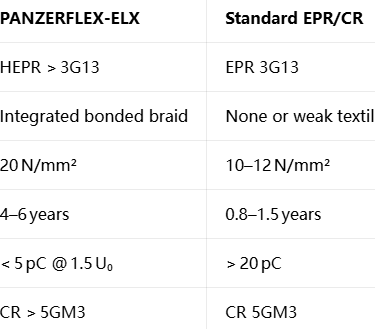
The difference between PANZERFLEX‑ELX and ordinary medium‑voltage cables can be summarized clearly:
While the upfront cost is higher, the TCO analysis shows a clear advantage. Over five years, the total cost including purchase, installation, downtime, and maintenance is 35 % to 60 % lower than using standard cables. In mining operations, where downtime can cost tens of thousands of Rands per hour, reliability becomes the most important economic factor.
Feichun Equivalent Solution: A Cost‑Effective Alternative
Not every project budget allows for premium European pricing, but reliability must not be compromised. This is where the Feichun (N)TSCGEWÖU cable comes in as a fully equivalent alternative.
Equivalence in Design & Standards
Same construction: 3 + 3 split earth cores, Class 5 tinned copper, micro‑filtered HEPR insulation, dual semi‑conductive screens, short lay length, inner CR sheath, anti‑torsion braid, and outer CR sheath exceeding 5GM3.
Same ratings: Voltage from 3.6/6 kV to 12/20 kV, same temperature, tensile, bending, and speed limits.
Same compliance: Manufactured to VDE 0250‑813, DIN VDE 0298‑3/4, IEC 60228, and compatible with SANS 1520‑2 requirements for South African mining and industrial installations.
Testing: Factory acceptance tests include AC voltage, partial discharge, insulation resistance, and mechanical cycling, ensuring identical performance thresholds.
Key Advantages
Price: Typically 15 % to 25 % lower than premium brands.
Delivery: Shorter lead times, with stock available for African projects.
Local support: Technical documentation and certification prepared for regional regulatory requirements.
Choosing Feichun does not mean lowering performance — it means accessing the same engineering solution at a more competitive cost.
Selection Guide & Installation Recommendations
To get the best results, the cable must be specified and installed correctly.
How to Specify
Voltage level: 3.6/6 kV for 6 kV systems; 6/10 kV for 10 kV; 12/20 kV for 20 kV.
Conductor size: Calculate based on continuous current, voltage drop, and short‑circuit withstand, using DIN VDE 0298‑4 or IEC 60364.
System type: For festoon systems, limit speed to 120 m/min; for reel drums, up to 180 m/min.
Configuration: Standard 3 + 3 split earth is recommended for mining and port applications.
Installation Best Practices
Maintain minimum bending radius at all times — never force sharp turns.
Ensure proper cable guides and tension control to avoid over‑pulling.
Prevent abrasion against steel structures or rock surfaces.
Perform annual inspections: check sheath condition, measure insulation resistance, and use thermal imaging to detect overheating.
Frequently Asked Questions
Q: Can this cable be used underground?
A: Yes, it meets VDE 0250‑813 and is suitable for underground mining operations in South Africa, provided local regulations are followed.
Q: Does it replace SANS Type 66 cables?
A: It offers superior torsion resistance and longer life, and is fully compatible in applications where Type 66 is specified.
Q: What is the expected service life?
A: In typical mining and port conditions, 4 to 6 years, compared to 1 to 2 years for standard flexible MV cables.
Q: Can it be supplied with fiber optics?
A: Yes, an integrated fiber‑optic version is available, combining power and data transmission in one cable.
Conclusion
PANZERFLEX‑ELX is more than just a medium‑voltage reeling cable — it represents a fundamental shift in how power delivery is designed for moving machinery. It proves that reliability does not have to come from simply making insulation thicker or sheaths heavier, but from balancing electrical, mechanical, and environmental performance through every layer of construction.
Its success in South Africa’s mines and terminals confirms that when power must travel while working, the cable must be engineered to move with the machine, resist torsion and fatigue, and remain stable under the most aggressive conditions. The principle is clear: standard cables are for power at rest; PANZERFLEX‑ELX is for power in motion.
For engineering teams and procurement managers, the choice is no longer between performance and cost. With the Feichun equivalent available, the same high‑standard design is accessible at a price that makes long‑term reliability affordable for every project.
For detailed technical data sheets, pricing, compliance certificates, and local delivery arrangements across South Africa and Southern Africa, contact the Feichun Cables engineering and sales team:

Email Address: Li.wang@feichuncables.com
© 2025. All rights reserved.
One-click to Quickly Contact
Products
Contact
Company
Location:
Building A Private Science and Technology Park, Hefei Economic and Technological Development Zone, Anhui Province, China
Heat Resistant Cable
WhatsApp: +86 17333223430
Social Media: