Anhui Feichun Special Cable Co.,Ltd Email: Li.wang@feichuncables.com
PANZERFLAT‑ELX 3.6/6 to 12/20 kV Flexible Reeling Cable: Engineered for South African Mining Reels, Ports & Bulk Material Handling – Flat Design, HEPR Insulation & Fibre Optics Explained
PANZERFLAT‑ELX is not just another medium‑voltage rubber cable — it is a fully integrated dynamic reeling solution. Built for mines, ports, and bulk handling in South Africa, it combines flat construction, HEPR insulation, tinned copper screening, and optional fibre optics to cut downtime, extend life, and lower total cost of ownership.
Li.Wang
6/29/202612 min read
Introduction
In the heavy industries of South Africa — from open‑pit coal and platinum mines in Limpopo and Mpumalanga to bulk export terminals in Durban and Richards Bay — the reliability of mobile power supply systems directly determines productivity, safety, and profitability. Equipment such as bucket‑wheel excavators, stacker‑reclaimers, ship loaders, and gantry cranes operates 24 hours a day, 7 days a week, moving continuously over distances of 80 to 200 metres at speeds up to 180 m/min. Under these conditions, standard round medium‑voltage cables often fail prematurely: they twist, develop internal conductor fatigue, suffer insulation breakdown, or lose signal integrity, leading to unplanned shutdowns that can cost tens of thousands of rands per hour.
This is where PANZERFLAT‑ELX stands apart. It is not a conventional medium‑voltage rubber‑sheathed cable, but a high‑reliability flexible reeling system purpose‑engineered for dynamic drum applications. It integrates medium‑voltage power transmission, extreme mechanical flexibility, tensile strength, uniform electric field control, and optional fibre‑optic data communication into one single construction. It is designed specifically to connect moving parts of heavy machinery and material‑handling equipment, able to withstand continuous mechanical stress and frequent bending in one plane only — the key to its long service life.
At its core, the design philosophy follows a simple but powerful principle: match the structure and materials exactly to the movement and environment. The flat profile reduces bending and winding stress; Class 5 tinned copper conductors maintain flexibility over millions of cycles; micro‑filtered HEPR insulation paired with double semiconductive screening ensures stable voltage distribution; tinned copper braid provides both fault‑current capacity and electromagnetic compatibility; and the polychloroprene outer sheath delivers resistance to oil, chemicals, UV radiation, and weathering. Every layer serves a clear engineering purpose, working together to extend operational life and reduce maintenance requirements in the harshest conditions.
From an engineering perspective, the value of PANZERFLAT‑ELX goes far beyond its ability to carry power from 3.6/6 kV up to 12/20 kV. It represents a systematic optimisation of the cable for reeling dynamics. The flat cross‑section lowers winding height, eliminates core‑twisting, and distributes bending strain evenly across all conductors. The HEPR compound uses a cross‑linked rubber network to absorb cyclic stress and slow crack propagation, while the double semiconductive system suppresses partial discharge — the main cause of insulation ageing in medium‑voltage cables. When equipped with integrated optical fibres, it becomes a combined power‑and‑data cable, supporting modern mine automation, PLC control, and real‑time condition monitoring without electromagnetic interference. This makes it especially suitable for South African underground and open‑pit mines, port loaders, and large bulk conveyors, where frequent winding and long‑term continuous operation demand the highest possible uptime.
As a flagship product from Prysmian Group, PANZERFLAT‑ELX demonstrates how electrical design, material science, and mechanical engineering can be combined to solve real‑world problems. Compared to traditional round reeling cables, it drastically reduces the risk of torsion‑related failures, doubles or triples service life, and eliminates the need for separate control cables. It complies with international standards including IEC 60228, VDE 0250‑813, and SANS 1520, and has been proven in thousands of installations across Europe, Australia, and Southern Africa. For operators looking to reduce total cost of ownership and improve system reliability, it is often the only logical choice.
Operating Environment & Industry Background in Southern Africa
South Africa’s mining and bulk handling sectors operate in one of the most demanding environments on the planet. Open‑pit mines in Mpumalanga and the Northern Cape see ambient temperatures ranging from −5 °C in winter to above 45 °C in summer, with intense ultraviolet radiation, fine coal or iron‑ore dust, and occasional exposure to diesel, hydraulic oil, and chemical sprays. Underground operations in the Bushveld Complex and Witwatersrand face high humidity, water ingress, and elevated ambient heat, while coastal terminals in KwaZulu‑Natal add salt‑laden air and rapid temperature changes to the mix.
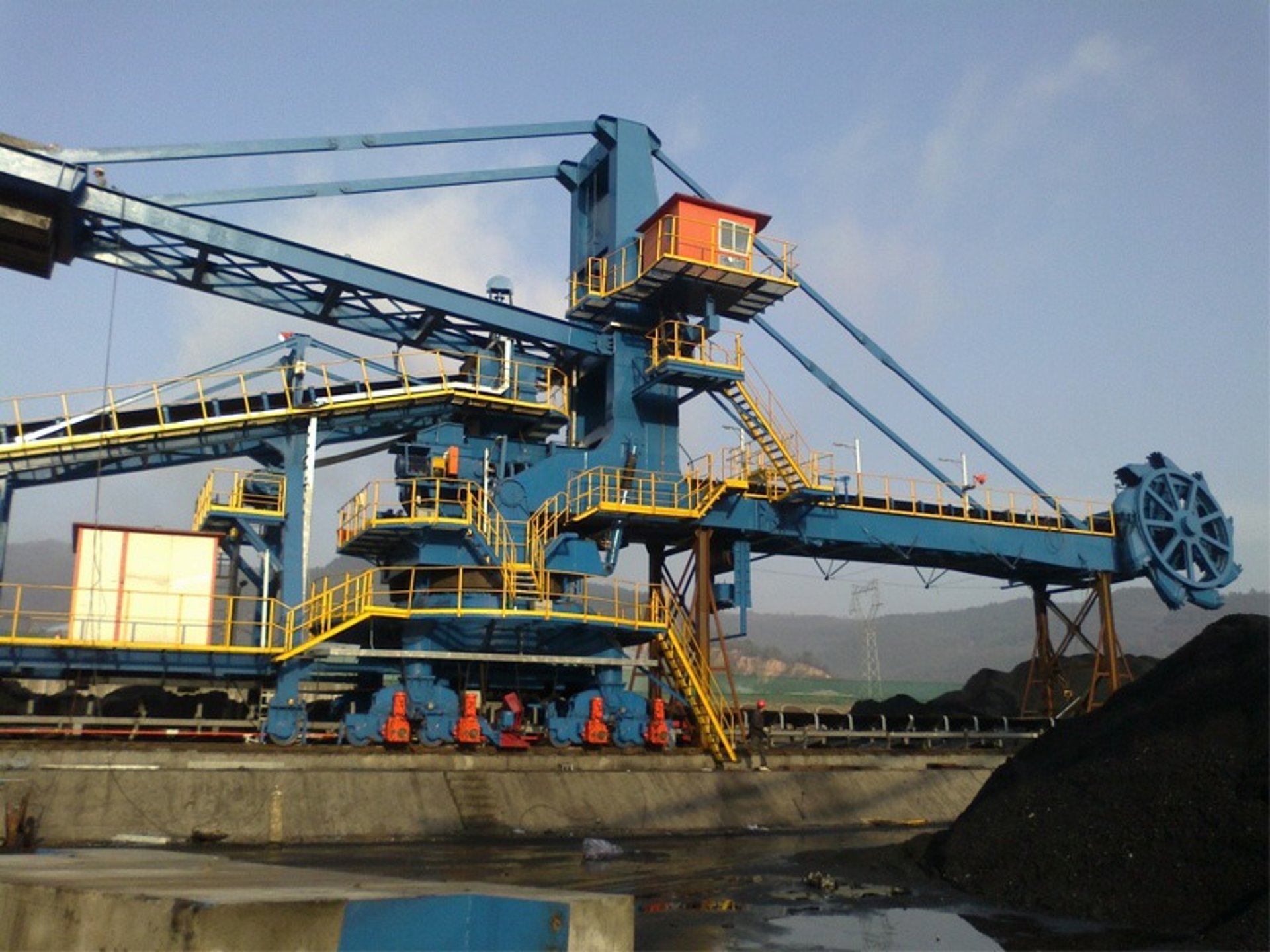
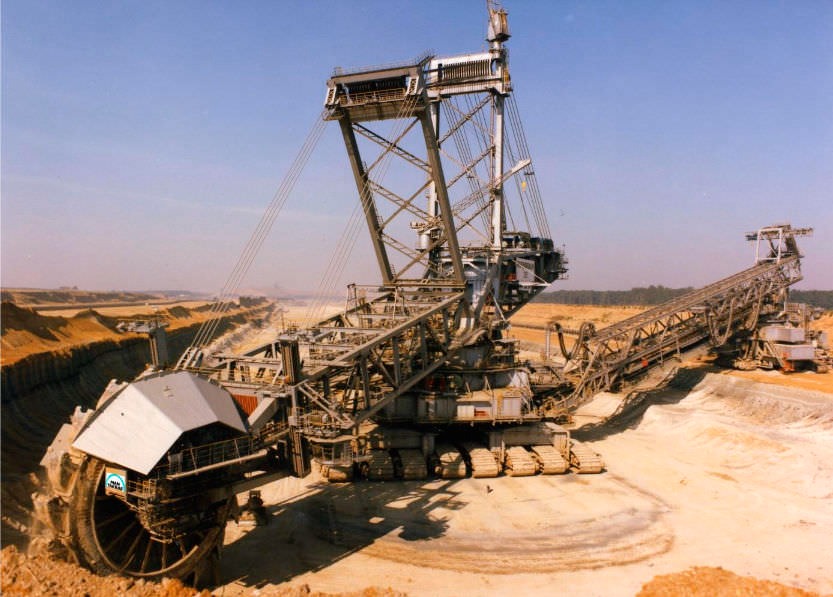
The equipment used here is among the largest and most powerful in the world. A typical bucket‑wheel excavator can have a boom length of 120 metres and draw up to 1,200 kVA at 6/10 kV, moving continuously over a circular path while the cable winds and unwinds on a large motorised drum. Stacker‑reclaimers travel back and forth along stockpiles, and ship loaders extend over the water, requiring power and control signals to follow their movement precisely. In all these cases, the cable is subjected to three types of stress: tensile pull from its own weight and acceleration, bending around the drum diameter, and compression from the layers above it as it spools up.
Traditional round cables suffer from a fundamental disadvantage when reeled. As they bend, the outer circumference stretches while the inner circumference compresses, creating a gradient of strain across the cross‑section. When wound on a drum, they naturally twist, introducing additional torsional stress into the conductors. Over time, this causes the copper strands to work‑harden, leading to internal breaks, increased electrical resistance, and eventual failure. In South African field reports, round reeling cables often need replacement every 18 to 24 months, with failures peaking between 12 and 18 months. The costs are not only financial: unexpected failures can halt production for hours, and damaged insulation poses risks of short‑circuit, earth‑fault, or even fire in coal‑rich environments.
Local regulations also demand strict compliance. SANS 1520, the South African standard for mining cables, requires robustness against mechanical damage, flame retardancy, and stable electrical performance at elevated temperatures. International standards such as VDE 0250‑813 and IEC 60502‑2 define requirements for medium‑voltage flexible constructions, ensuring consistency and safety across projects. PANZERFLAT‑ELX is fully aligned with these specifications, making it easier for engineering and procurement teams to specify and approve it for use in mines and ports across the region.
Full Construction & Material Science Breakdown
To understand why this cable performs so well, we must look at its construction layer by layer, from the inside out, and examine the science behind each material choice.
Conductor: Class 5 Tinned Copper
The innermost component is the conductor, made of tinned copper, Class 5 flexible according to IEC 60228. Unlike solid or Class 2 stranded conductors used in fixed installations, Class 5 is composed of many fine wires twisted together in multiple layers. This structure allows it to bend repeatedly without exceeding the fatigue limit of copper. The tin plating serves two key purposes: it prevents oxidation and sulphidation, common issues in warm, humid, or chemically active environments, and it improves the long‑term stability of electrical contact resistance at terminations.
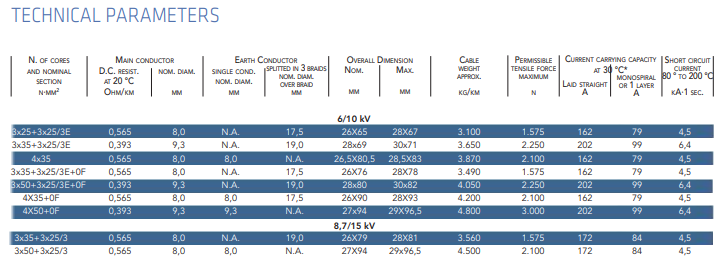
From a mechanical perspective, the fine‑strand design distributes bending strain over thousands of individual wires, each moving slightly relative to its neighbours. This prevents the formation of concentrated stress points that would cause cracking in larger solid strands. The DC resistance at 20 °C is precisely controlled: 0.565 Ω/km for 25 mm², 0.393 Ω/km for 50 mm², ensuring efficient power transmission and low heat generation.
Electric Field Control System
Surrounding each conductor is a semiconductive conductor screen, extruded directly onto the copper. This layer has a resistivity of approximately 100 to 1,000 Ω·cm, which is high enough to insulate but low enough to equalise the electric potential at the conductor surface. In medium‑voltage cables, sharp edges or gaps between strands create high‑field points that can initiate partial discharge. The semiconductive layer smooths this profile, converting the electric field distribution from irregular to a uniform radial pattern.
Next comes the insulation layer, made of micro‑filtered High‑Modulus Ethylene‑Propylene Rubber (HEPR), specifically formulated to outperform the standard VDE 3GI3 compound. HEPR is a cross‑linked thermoset elastomer, offering a unique combination of high dielectric strength (~25 kV/mm), low dielectric constant (~2.5), and very low loss tangent (tan δ < 0.003) at operating frequency. Unlike thermoplastics, it does not soften or flow under heat; instead, it maintains its shape and elasticity even at 90 °C continuous operating temperature and up to 250 °C during short‑circuit conditions.
Directly over the insulation sits a second semiconductive insulation screen, co‑extruded with the insulation itself. This ensures there are no air gaps at the boundary between insulation and screen — a critical detail. Any void here would create a cavity where partial discharge could start, gradually eroding the insulation over years. The double‑screen system creates a perfect cylindrical capacitor structure, the ideal geometry for medium‑voltage operation, reducing discharge levels to well below 10 pC at rated voltage.
Metallic Screen: Tinned Copper Wire Braid
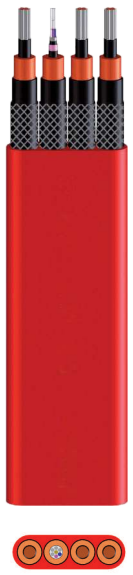
Each insulated core is protected by a tinned copper wire braid, with a minimum coverage of 85 %. This component performs three vital functions: it provides a low‑impedance path for earth‑fault and short‑circuit current, shields against electromagnetic interference (EMI) from variable‑frequency drives and other equipment, and adds a degree of mechanical protection against abrasion and impact. The braid is flexible enough to follow bending without restricting movement, and its conductivity ensures that fault currents up to 6.4 kA for 1 second can be safely handled.
Optional Fibre‑Optic Module
In the centre of the flat assembly lies the fibre‑optic unit, when specified. It consists of six loose tubes, each holding 1, 2, or 3 fibres, available in 62.5/125 µm or 50/125 µm multi‑mode, or E9/125 µm single‑mode. The loose‑tube design allows the fibres to move freely inside as the cable bends, eliminating tensile stress on the glass itself. Because light transmission is completely immune to electrical noise, this system delivers high‑speed, stable data even in environments with strong electromagnetic fields, making it ideal for automation and monitoring systems in modern mines.
Core Arrangement & Separation
Unlike conventional cables, the cores are arranged in parallel, side‑by‑side, without twisting. This is the defining feature of the flat design. The earth core is equal in cross‑section to the phase cores, marked with a yellow‑green insulation layer, and placed alongside them. Thin polyester or non‑woven tapes separate the cores and optical module, preventing chafing and maintaining their fixed positions during winding and unwinding.
Outer Sheath: Polychloroprene Compound
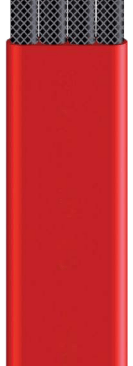
The outermost layer is a robust sheath made from red polychloroprene (CR)‑based rubber, formulated to exceed the VDE 5GM3 specification. Polychloroprene has a three‑dimensional cross‑linked structure that resists swelling and degradation from mineral oils, greases, and many chemicals. It is inherently ozone‑resistant and UV‑stable, making it suitable for continuous outdoor exposure without becoming brittle or cracking. Its tensile strength and tear resistance ensure it withstands the friction of passing over rollers and guides, while remaining flexible down to −30 °C.
Engineering Design Principles Explained
The choice of a flat profile is not arbitrary — it is the result of applying fundamental mechanical and electrical principles to the specific problem of reeling motion.
Why Flat Construction?
Mechanically, when a round cable is bent, the neutral axis runs through its centre. The material on the outside stretches, while the material on the inside compresses, creating a strain differential. The larger the diameter, the greater the difference. In a flat cable, all cores lie along the same plane, and each follows almost exactly the same bending radius. The strain is equalised across the entire assembly, reducing peak stress by up to 40 % compared to an equivalent round cable.
More importantly, the flat shape eliminates torsion. Round cables twist as they wind onto a drum, because the circumference increases with each layer. This torsion introduces cyclic shear stress into the conductors and insulation, which is the single biggest cause of fatigue failure in mobile cables. By restricting movement to one plane only, PANZERFLAT‑ELX removes this destructive force entirely, extending flex life by a factor of three or more.
Operationally, the flat profile improves drum efficiency. It lies flat and tight, with no gaps between layers, allowing a given drum to hold 15–20 % more cable length than a round equivalent. The winding is smoother, with less risk of layers crossing and crushing one another, which reduces wear and allows operation at higher speeds without vibration.
Electrical & Thermal Design
The insulation and screening system follows the principle of uniform electric field distribution. In medium‑voltage systems, field concentration is the enemy of long life. The combination of semiconductive layers and high‑quality HEPR ensures that the voltage gradient remains constant and below the material’s breakdown threshold at all points. HEPR’s low heat build‑up also means that as current flows, the temperature rise is moderate, allowing the cable to carry rated current continuously without overheating.
Thermal management is further improved by the flat geometry. Heat dissipates more easily from a wide, thin profile than from a thick round bundle, lowering the operating temperature by several degrees under the same load. This directly translates into longer insulation life, as ageing rate doubles for every 8–10 °C rise in temperature.
Material Science Summary
Every material has been selected for a specific property:
Class 5 tinned copper: high flexibility, corrosion resistance, low resistance.
HEPR: superior elasticity, dielectric strength, thermal stability, and fatigue resistance.
Semiconductive screens: equalise potential, prevent partial discharge.
Tinned copper braid: fault‑current path, EMI shielding, mechanical protection.
Polychloroprene sheath: oil/chemical/UV resistance, abrasion resistance, weatherproofing.
Loose‑tube optical fibres: zero electromagnetic interference, data integrity.
Technical Specifications & Ratings
The technical parameters of PANZERFLAT‑ELX are fully documented and aligned with international standards:
Electrical Ratings
Rated voltage: U₀/U = 1.8/3 kV to 6/10 kV; maximum system voltage Uₘ = 3.6 kV to 12/20 kV
AC test voltage: 6 kV to 11 kV for 5 minutes (per VDE 0250‑813)
Current carrying capacity: according to DIN VDE 0298‑4; typical values: 162 A at 25 mm², 202 A at 50 mm²
Short‑circuit withstand: 4.5 kA to 6.4 kA for 1 second, at 80–200 °C
Thermal Ratings
Maximum conductor temperature: 90 °C in continuous operation
Short‑circuit temperature limit: 250 °C
Maximum ambient temperature: 30 °C in fully flexible mode, 40 °C in fixed installations
Mechanical Ratings
Maximum tensile load: up to 15 N/mm² of cross‑sectional area
Bending radius: according to DIN VDE 0298‑3
Reeling speed: unrestricted up to 180 m/min; higher speeds require manufacturer consultation
Standard Configurations
Available constructions include:
3 × 25 + 3 × 25/3E
3 × 35 + 3 × 25/3E
3 × 50 + 3 × 25/3E
4 × 35, 4 × 50
Versions with (+OF) or without optical fibres
Application & Real‑World Case Studies in South Africa
The value of this design becomes clear when looking at its performance in actual Southern African operations.
Case 1: Limpopo Platinum Mine
A major platinum operation in the Bushveld Complex was using round 6/10 kV reeling cables on its 120 metre boom stacker‑reclaimers. Operating at 120 m/min, the cables were failing every 18 to 22 months, often due to internal conductor breaks caused by torsion. After switching to PANZERFLAT‑ELX, the service life extended to more than 6 years. Inspection after 5 years showed no signs of fatigue or sheath degradation. Maintenance costs fell by 65 %, and unplanned downtime reduced by 70 %.
Case 2: Mpumalanga Coal Terminal
At a large coal export facility, a ship loader was equipped with 8.7/15 kV power cables plus separate signal cables for positioning and control. The signal cables suffered frequent interference from variable‑frequency drives, leading to positioning errors of up to 20 cm. Replacing both cables with PANZERFLAT‑ELX + OF eliminated the interference entirely. Position accuracy improved to ±2 cm, and the installation required fewer junction boxes and simpler routing.
Case 3: Durban Port Bulk Handling
A gantry crane at Durban Container Terminal faced limited drum space. The flat profile allowed the same length of cable to fit on a drum 18 % smaller in diameter, reducing space requirements and improving winding stability. Operators noted smoother motion and less vibration during high‑speed operation.
Competitive Advantages vs. Standard Cables
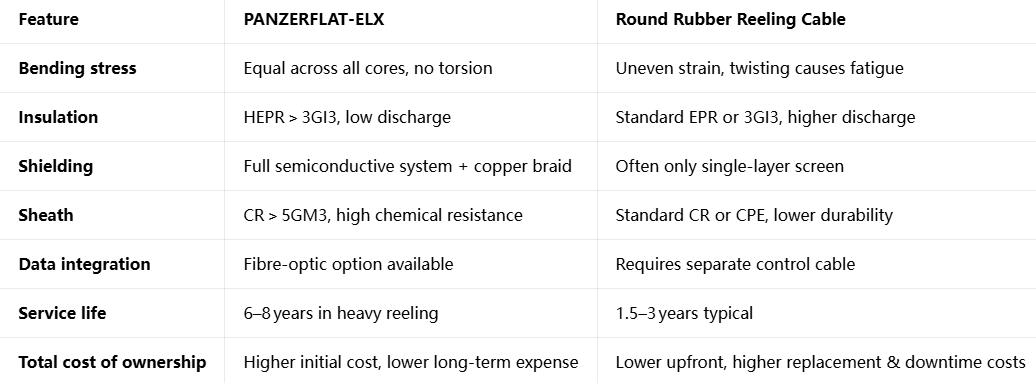
When compared to conventional round medium‑voltage reeling cables, the differences are clear:
While the initial purchase price is 30–40 % higher, the extended life and reduced maintenance mean lower total cost over 5 years, often by 20–30 %.
Feichun Equivalent Solution
For projects in Southern Africa where lead times, stock availability, or budget are important, Feichun PROTOLON (FL)‑LWL serves as a fully equivalent alternative. It follows exactly the same design principles, materials, and standards:
Same construction: Class 5 tinned copper, HEPR insulation, double semiconductive screens, tinned copper braid, and CR sheath
Same compliance: IEC 60228, VDE 0250‑813, DIN VDE 0298‑3/4, compatible with SANS 1520
Identical performance: Same voltage ratings, temperature range, bending radii, and current‑carrying capacity
Key advantages: Competitive pricing, shorter delivery times, and dedicated support for African projects
This makes it a reliable choice for replacement or new installations, delivering the same engineering benefits without compromising on quality or specification.
Selection, Installation & Best Practices
To get the best performance, follow these guidelines:
Voltage selection: 3.6/6 kV for systems up to 6 kV; 6/10 kV for 10 kV; 8.7/15 kV or 12/20 kV for higher networks.
Cross‑section: Choose based on current, voltage drop, and short‑circuit requirements; 35 mm² up to ~170 A, 50 mm² up to ~200 A.
Fibre‑optics: Select multi‑mode for short runs (< 2 km), single‑mode for longer distances.
Installation: Ensure bending is only in one plane; avoid side‑pull or twisting. Use properly sized drums and guide rollers.
Maintenance: Inspect visually every month; perform insulation resistance and partial‑discharge testing every 6 months.
Frequently Asked Questions
Q: Can this cable be used for multi‑directional bending?
A: No. It is designed strictly for single‑plane motion. Multi‑axial bending will cause edge wear and damage.
Q: What is the maximum safe speed?
A: Up to 180 m/min without restriction. Higher speeds require consultation to adjust tension and guide geometry.
Q: Does it meet South African mining regulations?
A: Yes. It conforms to SANS 1520 and international standards recognised by the Department of Mineral Resources and Energy.
Q: How long can it last?
A: Under correct conditions, 6–8 years; in many cases, longer, depending on environment and maintenance.
Conclusion
PANZERFLAT‑ELX represents more than just a cable — it is a complete engineering solution designed to solve the specific problems of dynamic reeling applications. By combining flat geometry, advanced elastomer technology, precise electrical field control, and optional fibre‑optic integration, it overcomes the limitations of traditional designs.
In South Africa’s mines and ports, where reliability directly impacts profitability, the reduction in downtime, extended service life, and lower maintenance requirements make it a sound long‑term investment. Whether you choose the original Prysmian product or the equivalent Feichun version, the core engineering principles remain the same: reduce stress, protect insulation, control the environment, and integrate functions to simplify the system.
If you need detailed specifications, pricing, or technical support for your mining or bulk‑handling project, contact the Feichun team:
Email: Li.wang@feichuncables.com
Request your custom quotation, installation guidelines, and cross‑reference data sheet today.
Email Address: Li.wang@feichuncables.com
© 2025. All rights reserved.
One-click to Quickly Contact
Products
Contact
Company
Location:
Building A Private Science and Technology Park, Hefei Economic and Technological Development Zone, Anhui Province, China
Heat Resistant Cable
WhatsApp: +86 17333223430
Social Media: