Anhui Feichun Special Cable Co.,Ltd Email: Li.wang@feichuncables.com
(N)SHTÖU‑J 3xCS+2xCS/2+FO Fiber Optic Reeling Cable: Engineered for Extreme Mechanical Stress in South African Ports & Mines – DIN VDE 0250‑814 Rubber Flexible Power + Data Solution
Designed to withstand the most demanding operating conditions in South Africa’s heavy industry, the (N)SHTÖU‑J 3xCS+2xCS/2+FO reeling cable represents a breakthrough in integrated power and communication technology. Manufactured in compliance with DIN VDE 0250‑814 and aligned with SANS and international standards, this low‑voltage rubber flexible cable combines electrical power transmission with embedded optical fibers, allowing it to perform reliably under continuous winding, unwinding, tension, torsion, abrasion, temperature fluctuation, and chemical exposure. Proven in major operations at Durban, Richards Bay, and Cape Town, it addresses the limitations of conventional cables, reduces operational downtime, lowers maintenance costs, and enables modern smart monitoring and automation. This article explores its construction, material science, engineering principles, technical specifications, real‑world performance, and application benefits.
Li.Wang
7/7/202614 min read
Introduction
South Africa is home to one of the world’s most robust mining and port sectors. It ranks among the largest producers of gold, platinum, and coal, while its coastal hubs – including Durban, Richards Bay, Cape Town, and Saldanha Bay – handle millions of tons of cargo annually. These industries operate in environments that place extreme demands on electrical and communication infrastructure. Equipment such as container cranes, shiploaders, stacker‑reclaimers, and underground mining conveyors must move continuously, often over long distances, while exposed to dust, salt mist, high humidity, intense sunlight, and wide swings in temperature.
In these applications, standard electrical cables often fail prematurely. They may develop conductor breaks, insulation cracks, or jacket wear after only a few months of service. When separate power and data cables are used, installation becomes more complex, space requirements increase, and the risk of failure multiplies at connection points. Even dedicated reeling cables frequently struggle to manage the combined forces of tension, bending, and torsion that occur during repeated winding and unwinding cycles.
The (N)SHTÖU‑J 3xCS+2xCS/2+FO cable was developed specifically to solve these challenges. Built according to the strict requirements of DIN VDE 0250‑814, it integrates power cores, protective earth conductors, and optical fibers into a single, robust construction. Its design follows three core objectives: the uniform distribution of mechanical stress, resistance to a wide range of environmental conditions, and the simultaneous delivery of electrical energy and high‑speed data. For operators in South Africa and across the African continent, this cable offers a way to improve reliability, extend service life, and support the transition to more automated and digitally connected operations.
Nomenclature, Standards & Basic Technical Specifications
Understanding the model designation and applicable standards is essential for selecting and applying this cable correctly. The full name, (N)SHTÖU‑J 3xCS+2xCS/2+FO, contains detailed information about its construction, function, and performance capabilities.
The prefix (N) indicates compliance with German VDE standards, which are widely recognized and accepted in South Africa and many other regions. S denotes a heavy‑duty flexible construction, while H refers to rubber insulation. Ö signifies a weather‑resistant jacket based on chloroprene or similar elastomeric compounds, and U marks it as a cable specifically engineered for reeling and winding applications. The suffix J confirms the inclusion of a dedicated protective earth conductor.
The structure description 3xCS+2xCS/2+FO explains the internal arrangement. Here, CS stands for cross‑section. The cable contains three main power cores, each sized to carry the required operating current. Two additional cores, each with half the cross‑sectional area of the main cores, serve as the earth conductor or auxiliary circuit. FO indicates the presence of integrated optical fibers, which allow data transmission alongside electrical power.
The cable is built to DIN VDE 0250‑814, the primary specification for reeling cables subject to high mechanical stress. It also complies with a comprehensive set of supporting standards:
HD 60228 / VDE 0293‑308: Governs conductor construction and dimensions.
VDE 0207‑20 / 21: Defines material requirements for insulation and outer sheaths.
PN‑EN / IEC 60332‑1‑2: Ensures resistance to flame propagation.
PN‑EN / IEC 60811‑404: Confirms resistance to mineral oils and greases.
PN‑ISO 1431‑1: Verifies resistance to ozone degradation.
UL 2556 / ASTM D4892‑2: Establishes resistance to ultraviolet radiation.
SANS alignment: Meets the requirements of South African National Standards for use in mining and port environments.
CE and RoHS: Certified for safety and environmental compliance.
In terms of electrical and thermal performance, the cable is rated for 0.6/1 kV, with a maximum continuous operating voltage of 1.2 kV. It undergoes a factory acceptance test at 3 kV AC to confirm insulation integrity. The maximum permissible operating temperature for the copper conductors is +90°C, while under short‑circuit conditions, the temperature can rise to +250°C for a maximum duration of five seconds. For fixed installations, the cable remains functional at temperatures as low as ‑40°C. For mobile operation, the minimum recommended ambient temperature is ‑25°C, correcting a typographical error in the original documentation.
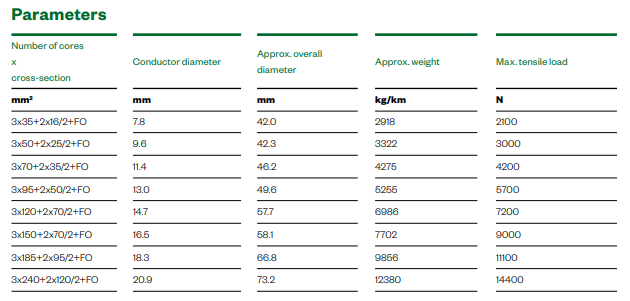
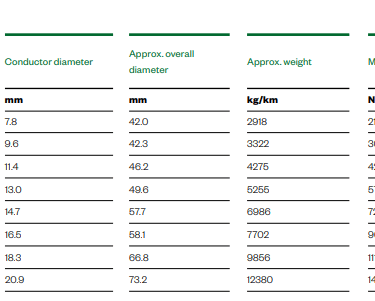
Mechanically, the cable is designed to handle significant dynamic loads. It is rated for a continuous tensile load of 20 N/mm², with maximum breaking forces ranging from 2,100 N for the smallest cross‑section up to 14,400 N for the largest. It can withstand a maximum twist angle of ±50° per meter and operate at travel speeds of up to 250 meters per minute. The minimum bending radius varies according to the cable diameter and application:
Fixed installation: 4 × cable diameter (D)
Wound on drums: 5D
Passing over deflection pulleys: 7.5D
Free‑moving conditions: 5D
Available cross‑sections cover a broad range: 3×35 mm² up to 3×240 mm² for power cores, paired with 2×16/2 mm² up to 2×120/2 mm² for the earth/auxiliary cores. Optical fiber options include G50/125 µm and G62.5/125 µm multimode fibers, as well as E9/125 µm single‑mode fibers, with configurations ranging from 6 to 24 fibers. Optical performance is precisely defined: for G50/125 µm, attenuation is ≤3.0 dB/km at 850 nm and ≤1.0 dB/km at 1300 nm; for G62.5/125 µm, it is ≤3.5 dB/km at 850 nm and ≤1.0 dB/km at 1300 nm; and for E9/125 µm single‑mode, attenuation is ≤0.4 dB/km at 1310 nm and ≤0.26 dB/km at 1550 nm.
Structural Design & Material Science: How It Works
The performance of the (N)SHTÖU‑J cable is not accidental; it results from a carefully engineered structure and the selection of materials matched to the physical and chemical demands of the application. Each layer serves a specific purpose, and together they create a system that operates reliably under changing loads and environmental conditions.
Layer‑by‑Layer Construction
Conductors
At the core of each electrical circuit are Class 5 finely stranded tinned copper conductors, manufactured according to HD 60228 and VDE 0293‑308. Fine stranding increases flexibility, allowing the cable to bend repeatedly without work‑hardening or breaking. Tinning the copper strands provides protection against oxidation and corrosion, particularly in humid or salt‑laden air. It also ensures consistent electrical contact over time, reducing the risk of overheating at connections. The cross‑section is sized to carry the required current while maintaining a temperature rise well below the maximum limit.
Insulation
Each conductor is insulated with 3GI3 grade heat‑resistant elastomeric rubber, formulated to meet VDE 0207‑20 specifications. This material offers a dielectric strength of at least 20 kV/mm and a volume resistivity greater than 10¹² Ω·cm, ensuring effective electrical isolation. Its mechanical properties are matched to those of the copper conductor, so that when the cable bends or stretches, the insulation deforms in harmony with the metal rather than separating or cracking. It remains stable at continuous operating temperatures up to +90°C.
Core Arrangement & Optical Fiber Integration
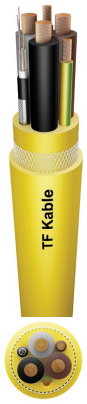
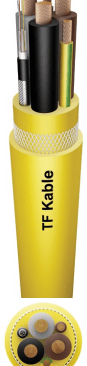
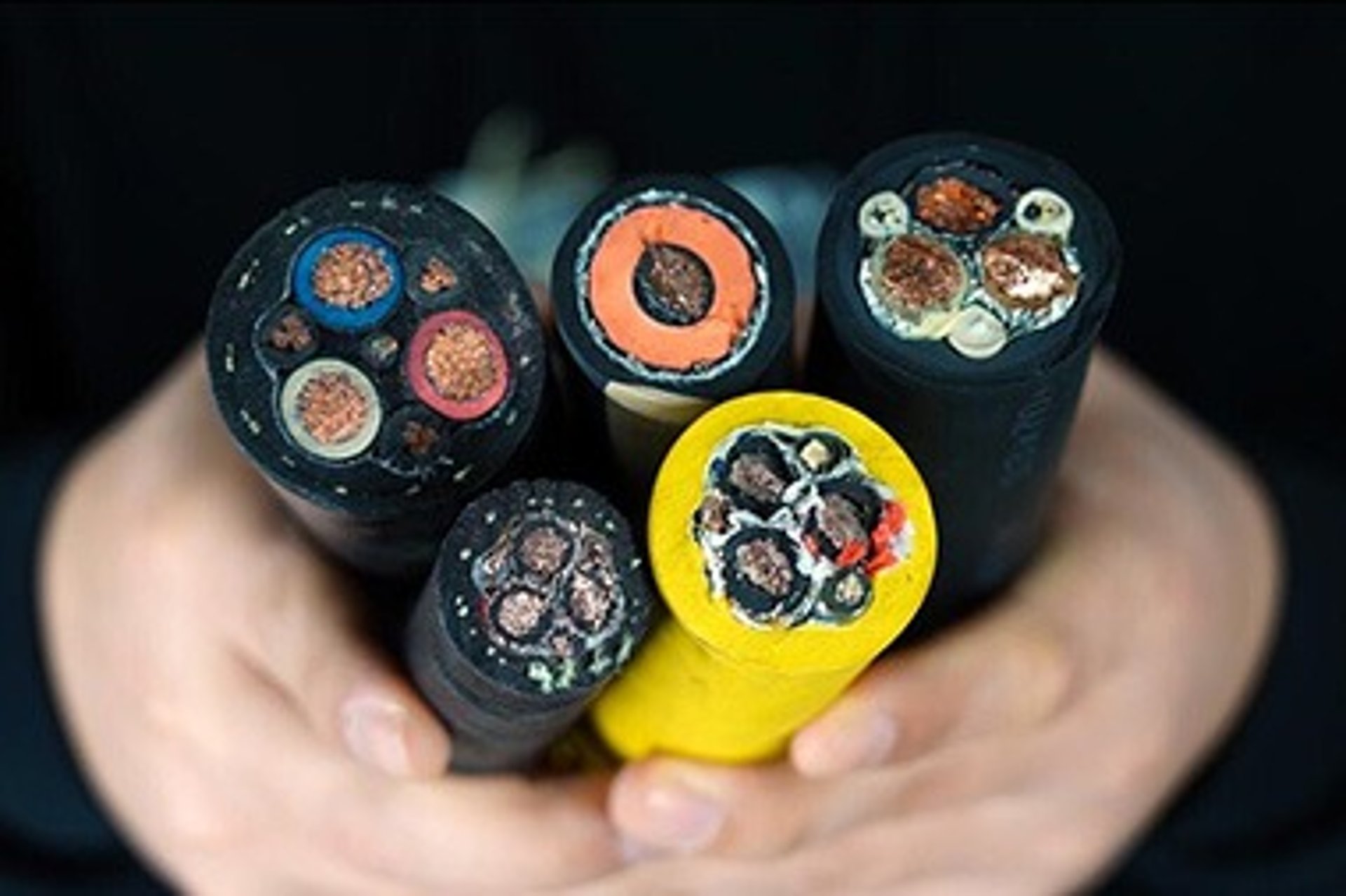
The three power cores and the earth core are laid up in a symmetrical configuration. The optical fiber unit, designated as A‑DZN13Y6, is placed in the interstitial space between the power cores. This location is critical: it positions the fibers close to the cable’s neutral axis, where bending forces are minimal. This arrangement greatly reduces micro‑bending loss, which can degrade signal quality over time. The fibers themselves are housed in a protective buffer tube, which allows them to move slightly without being subjected to direct compressive or tensile forces.
Inner Sheath
Surrounding the assembled cores is an inner sheath made of 5GM3 grade synthetic thermosetting elastomer, colored yellow for identification. This layer holds the cores in a fixed formation, distributing radial pressure evenly and preventing internal abrasion between components as the cable flexes. It also provides a secondary level of insulation and mechanical protection.
Anti‑Torsion Reinforcement
A high‑strength braided layer is applied over the inner sheath. This reinforcement is typically constructed from high‑modulus polyester or aramid fibers. It acts as the primary load‑bearing element, carrying most of the tensile force when the cable is pulled. At the same time, the braid angle is engineered to resist torsion, limiting rotation to the specified maximum of 50° per meter. This prevents the internal components from becoming twisted or crushed, which would damage both electrical conductors and optical fibers.
Outer Jacket
The outermost layer is a 5GM5 grade thermosetting rubber compound, specifically developed for this application and conforming to VDE 0207‑21. This material is cross‑linked during manufacturing, giving it a tightly bonded molecular structure that resists abrasion, tearing, impact, oil, ozone, and ultraviolet radiation. Carbon black and other additives are incorporated to block UV light and improve weathering resistance. The jacket remains flexible at low temperatures and does not soften or flow at high operating temperatures. It is supplied in yellow, a highly visible color that improves safety in industrial environments.
Scientific Principles Behind the Design
The construction of the cable follows well‑established principles of electrical engineering, mechanics, and material science.
From a mechanical perspective, the design aims for equal stress distribution. In a well‑engineered cable, no single component carries an excessive share of the load. The braided reinforcement absorbs tension, the elastomeric layers absorb bending and compression, and the stranded conductors flex without exceeding their elastic limit. This prevents fatigue failure, the most common cause of breakdown in cables used on reels.
In terms of electrical engineering, the cable is sized according to IEC 60287 and VDE 0298‑4. Special consideration is given to heat dissipation when the cable is wound on a drum, where airflow is restricted. The allowable current is de‑rated appropriately to ensure the conductor temperature does not exceed +90°C, even in stacked layers. This protects the insulation from thermal degradation over decades of service.
For optical performance, the placement of fibers in the neutral axis follows the laws of beam mechanics. When a cable bends, one side stretches while the other compresses; the center line remains at constant length. By locating the fibers there, the design ensures that signal attenuation remains stable, even after thousands of bending cycles.
In material science, the choice of cross‑linked elastomers is central. Unlike thermoplastics, which soften when heated, thermoset materials retain their shape and mechanical properties. The addition of antioxidants, UV stabilizers, and ozone inhibitors extends the service life of the jacket in aggressive outdoor environments.
Performance Advantages vs. Conventional Cables
In heavy‑industry applications, the difference between a standard rubber cable and a specialized reeling cable becomes apparent after just a few months of operation. The (N)SHTÖU‑J 3xCS+2xCS/2+FO offers several distinct advantages over conventional solutions.
Longer service life is the most visible benefit. Under identical operating conditions, this cable typically lasts three to five times longer than standard flexible cables. The combination of high‑quality materials, optimized stranding, and anti‑torsion reinforcement reduces the rate of mechanical fatigue. Operators in South Africa have reported that while ordinary cables may require replacement every six to twelve months, the (N)SHTÖU‑J remains in service for three to four years or more.
Simplified system design is another major advantage. By integrating power, earth, and optical fibers into one cable, the need for multiple separate cables is eliminated. This reduces the required space in cable trays, conduits, and festoon systems. Installation time and labor costs are lower, and there are fewer components to manage and maintain. It also reduces the risk of interference between electrical circuits and communication lines, as the optical fibers are immune to electromagnetic noise.
Greater reliability under combined loads is where the design truly excels. Most standard cables are rated for tension or bending, but not for both simultaneously, and certainly not when torsion is added. In reeling applications, all three forces act at once. The anti‑torsion braid and balanced core construction ensure that forces are distributed so that neither the copper conductors nor the glass fibers are overstressed. This results in fewer unexpected failures and fewer emergency shutdowns.
Compatibility with modern operations is increasingly important. The embedded optical fibers support high‑speed data transmission, allowing operators to install CCTV cameras, condition monitoring sensors, and automation systems without running additional cables. This enables predictive maintenance, reduces the need for physical inspections in hazardous areas, and supports the digital transformation of ports and mines.
Compliance with safety standards is assured. The cable meets flame‑retardant and low‑smoke requirements, making it suitable for use in underground mines and areas classified as explosion‑risk zones. It does not support combustion and does not release toxic fumes when exposed to heat, which is a critical safety consideration in confined spaces.
Real‑World Applications in South Africa
The performance of the (N)SHTÖU‑J cable is best illustrated by its application in some of South Africa’s most demanding industrial environments.
Durban Multi‑Purpose Terminal (SABT) – Bulk Carrier Shiploaders
At the South African Bulk Terminals facility in Durban, shiploaders travel up to 140 meters along the dock to load coal, grain, and mineral ores. The environment is harsh: high humidity, salt spray from the Indian Ocean, and temperatures ranging from 25°C to 38°C. The equipment operates continuously, with the cable winding and unwinding many times per day under significant tension.
Prior to upgrading, the terminal used separate power and signal cables. The power cables suffered frequent conductor breaks and overheating at joints, while the signal cables often failed due to abrasion and tension. Maintenance crews had to inspect and repair cables on a weekly basis, and full replacements were required roughly every eight months.
After switching to (N)SHTÖU‑J 3x50+2x25/2+FO, the situation changed dramatically. The integrated design eliminated the need for separate cables, and the reinforced construction easily handled the dynamic loads. The service life of the cable extended to 3.5 years, reducing replacement costs significantly. The optical fibers allowed the installation of remote monitoring and CCTV systems, removing the need for workers to inspect the equipment in person while it was in operation. Overall downtime was reduced by 65%, and vessel turnaround times improved as the equipment became more reliable.
Richards Bay Coal Terminal (RBCT) –Stacker‑Reclaimers
Richards Bay is one of the largest coal export terminals in the world, and its stacker‑reclaimers operate in open‑air yards exposed to extreme conditions. Temperatures can drop to ‑10°C in winter nights and rise above +42°C during summer days. Strong winds carry fine coal dust that is highly abrasive. The equipment travels at speeds up to 180 meters per minute, and the cable must withstand constant movement and friction.
In the past, standard rubber cables lasted only about three months before the outer jacket was worn through. Even when cables were replaced, the separate fiber‑optic lines often snapped under tension or suffered signal loss due to bending. This limited the ability to automate operations.
With the installation of (N)SHTÖU‑J 3x70+2x35/2+FO, the terminal saw immediate improvements. The 5GM5 grade outer jacket has proven highly resistant to abrasion; after two years of service, measured wear was less than 5%. The tensile‑load rating of 20 N/mm² and anti‑torsion design ensured that the cable did not stretch or twist excessively. The optical signal remained stable, and maintenance costs for the cable system fell by approximately 70%.
Port Container Terminals – Rubber‑Tired Gantry Cranes
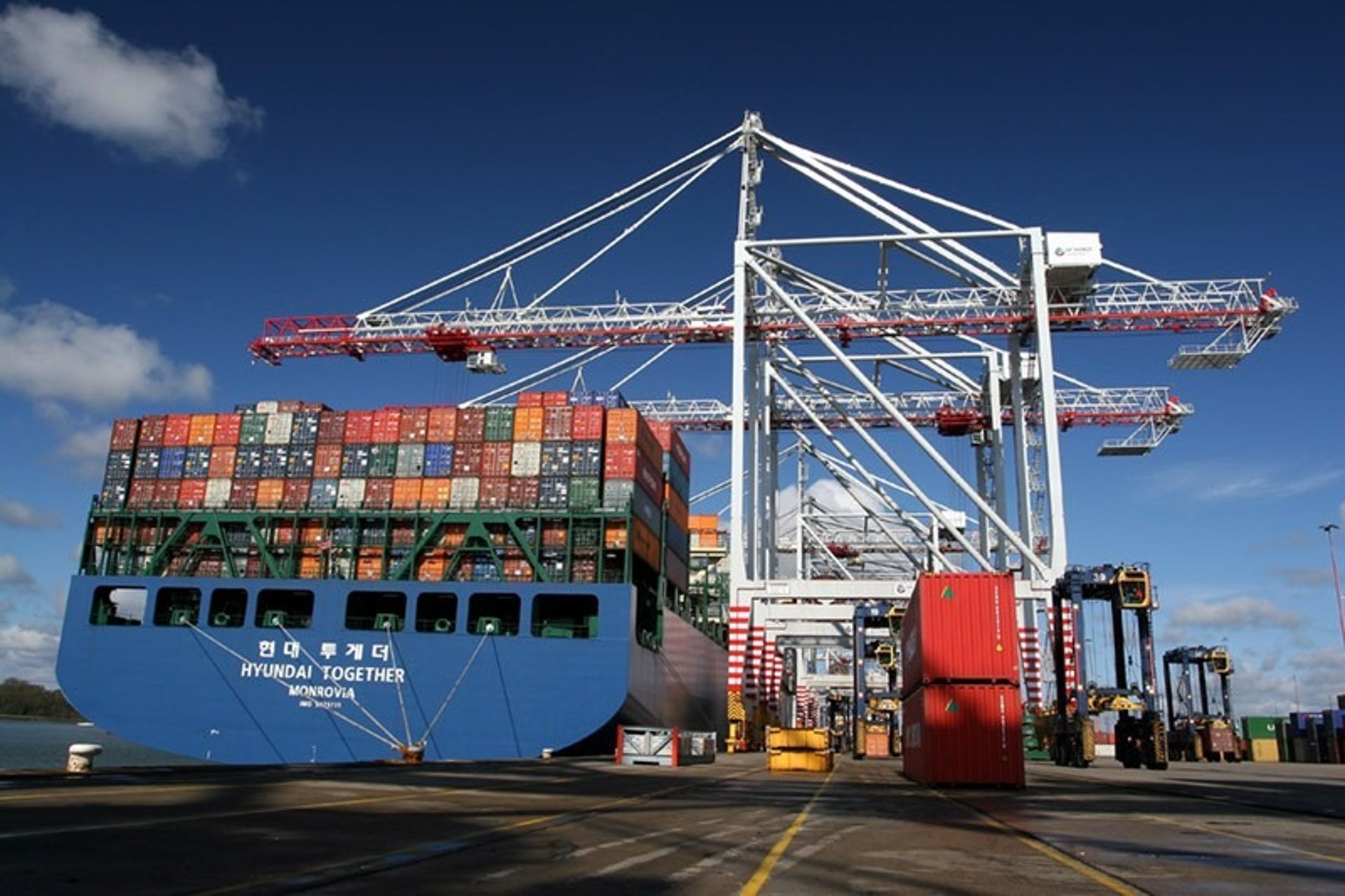
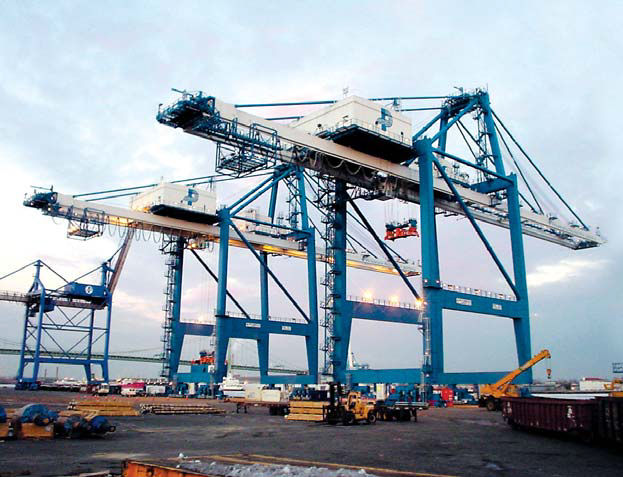
Across container terminals in Durban and Cape Town, rubber‑tired gantry cranes (RTGs) and rail‑mounted gantry cranes (RMGs) operate around the clock. These machines use cable reels with a diameter of about 1.2 meters, and the cable is wound and unwound up to 80 times per day. The coastal environment exposes the equipment to salt‑laden air, which accelerates corrosion and degradation.
Comparative trials showed that the (N)SHTÖU‑J cable could withstand 30% higher dynamic stress than standard NSHTÖU cables without fiber integration. It maintained its electrical and optical performance even after years of cyclic loading. The cable meets the requirements of SANS 10108 and IEC standards for hazardous areas, ensuring compliance with local safety regulations.
Underground & Open‑Cast Mines
In South Africa’s mining industry, the cable is used on conveyor systems, drilling rigs, and shuttle cars. Underground, it must resist moisture, rock dust, and the risk of fire. In open‑cast mines, it is exposed to direct sunlight, extreme temperatures, and heavy machinery. The cable’s flame‑retardant properties and low‑smoke emission characteristics make it suitable for use in zones classified as explosion‑risk. Its durability reduces the frequency of maintenance stops, which is particularly valuable underground where repairs are difficult and costly.
Configuration & Selection Guide
Selecting the correct specification of (N)SHTÖU‑J 3xCS+2xCS/2+FO requires matching the cable’s capabilities to the specific operating conditions.
Choosing the Right Cross‑Section
The size of the power cores must be calculated based on the load current, the length of travel, and the allowable voltage drop. For applications with a travel distance of up to 100 meters, cross‑sections from 3×35 mm² to 3×70 mm² are usually sufficient. For longer runs up to 250 meters, 3×95 mm² to 3×150 mm² is recommended. For heavy loads and maximum travel distances, 3×185 mm² or 3×240 mm² should be considered. The earth cores follow the standard ratio of half the main cross‑section, as specified in the model code.
Selecting Optical Fiber Type
The choice of fiber depends on the distance and data rate required:
G62.5/125 µm multimode: Best for short distances up to 500 meters and standard industrial data rates.
G50/125 µm multimode: Offers higher bandwidth, suitable for medium distances up to 2 kilometers and higher‑speed communication.
E9/125 µm single‑mode: Designed for long‑distance transmission, capable of reliable performance over 10 kilometers or more.
Feichun Brand: A Reliable Equivalent Solution
When sourcing this type of cable, operators often look for alternatives that offer the same quality and performance but with better availability and pricing. The Feichun brand provides a fully equivalent solution to established European‑manufactured cables.
Feichun’s (N)SHTÖU‑J 3xCS+2xCS/2+FO cable is manufactured to exactly the same DIN VDE 0250‑814 specification, using materials that meet the same VDE 0207‑20 and 21 standards. Electrical ratings, mechanical properties, and optical characteristics are identical to those of premium‑brand products.
The key advantages of choosing Feichun include:
Cost efficiency: Prices are typically 20–30% lower than European imports, without compromising quality.
Shorter lead times: Stock and production schedules are optimized to meet project timelines in Africa, reducing delays.
Technical support: Documentation, test reports, and engineering advice are tailored to the requirements of South African and regional markets.
Customization: Special lengths, marking, and fiber configurations can be produced to order.
Frequently Asked Questions
Can this cable be used in explosive atmospheres?
Yes. It is constructed with flame‑retardant, low‑smoke materials that comply with IEC and SANS standards for hazardous areas. It is suitable for Zone 1 and Zone 2 classifications in mines and chemical facilities.
How long will the optical fibers last compared to the power cores?
The fibers are protected within the cable’s neutral axis and designed to match the mechanical life of the electrical components. When installed and operated within the specified parameters, they will not degrade or fail before the rest of the cable.
Does it fit standard cable reel systems?
Yes. The dimensions, bending radii, and weight are calculated to be compatible with standard drum and pulley sizes used in the industry.
What is the maximum distance it can travel?
With proper tension control and correct cross‑section selection, it can be used for travel lengths up to 350 meters. Longer distances require engineering review.
Can additional control cores be added?
While the standard configuration is 3+2+FO, customized designs with extra cores for control or instrumentation are available upon request.
Conclusion
The (N)SHTÖU‑J 3xCS+2xCS/2+FO cable is more than just a combination of wires and fibers; it is a complete engineering solution designed to solve the specific problems of reeling applications in heavy industry. By integrating electrical power and communication into a single, robust structure, it addresses the limitations of traditional cabling methods.
Its design is based on sound principles of mechanics, electrical engineering, and material science. Each layer and material is selected to contribute to the overall goal of long‑term reliability under dynamic stress. In South Africa’s ports and mines, where equipment operates around the clock in some of the world’s harshest environments, this cable has proven its value. It extends service life, reduces maintenance, improves safety, and enables the digitalization of operations.
For engineers, procurement specialists, and facility managers, it represents a sound investment. While the initial purchase price may be higher than that of standard cables, the total cost of ownership is significantly lower when reduced downtime and fewer replacements are taken into account. It stands as a clear example of how advances in cable technology can support the efficiency and sustainability of critical infrastructure.
If you are looking for a reliable, cost‑effective reeling cable solution for your port, mine, or industrial project in South Africa or across the African continent, contact the Feichun Cables team. We can provide detailed technical specifications, certified test reports, and customized quotations tailored to your specific requirements.
Email: Li.wang@feichuncables.com
Email Address: Li.wang@feichuncables.com
© 2025. All rights reserved.
One-click to Quickly Contact
Products
Contact
Company
Location:
Building A Private Science and Technology Park, Hefei Economic and Technological Development Zone, Anhui Province, China
Heat Resistant Cable
WhatsApp: +86 17333223430
Social Media: