Anhui Feichun Special Cable Co.,Ltd Email: Li.wang@feichuncables.com
Multicore H05RR-F and H05RN-F Rubber Insulated Cables: High-Performance Flexible Power Solutions for South African Mining, Construction, and Industrial Applications
For South African mining engineers, construction project managers, industrial procurement officers, and electrical contractors: this detailed guide explains why H05RR-F and H05RN-F rubber insulated cables outperform standard PVC alternatives in South Africa’s harshest operating conditions. Fully aligned with SANS 1574-3 and SABS requirements, the article covers full technical specifications, material science and engineering principles, real-world local case studies, performance comparisons, and practical selection guidance. It also outlines how Feichun Cables delivers fully equivalent compliance and performance at better value and faster delivery times for local projects.
Li.Wang
7/15/202612 min read
Introduction
South Africa stands as one of the world’s most important mineral producing nations, leading global output of platinum, chrome, and manganese while remaining a major gold producer. The country also supports a vast construction pipeline, large-scale agriculture, and a growing industrial sector—all of which depend heavily on reliable temporary and mobile power supply. For decades, however, site teams across all these industries have faced persistent, costly challenges with standard flexible cables. Cables crack after just a few months of outdoor exposure, conductors snap from repeated dragging over rough ground, insulation softens and fails under high summer temperatures, and oil or chemical contact causes rapid degradation. These failures lead to unplanned downtime, lost production, costly replacement work, and serious safety risks for workers.
Multicore H05RR-F and H05RN-F rubber insulated cables represent the gold standard solution for these exact problems. They are purpose-built flexible power cords designed specifically for 300/500V mobile applications, combining advanced elastomer materials with precision structural engineering to deliver performance that standard PVC cables simply cannot match. Unlike general-purpose wiring that prioritises low cost over durability, these cables are engineered to thrive in dynamic, demanding environments—whether that means being dragged across rock in a platinum mine, exposed to full sun and rain on a construction site, or splashed with hydraulic fluid in a workshop.
The core strength of this product range lies in its thoughtful combination of material science and practical design. By pairing ethylene propylene rubber insulation with purpose-matched rubber sheaths and ultra-flexible Class 5 copper conductors, these cables solve the most common failure points of traditional wiring. H05RR-F and H05RN-F are not interchangeable, though: H05RR-F is optimised for light-duty indoor use, while H05RN-F adds heavy-duty resistance to oil, weather, and abrasion for outdoor and industrial work. This deliberate separation ensures you do not pay for protection you do not need, nor run the risk of under-specifying for your site conditions.
For South African operators, these cables also offer critical peace of mind through full compliance with local standards. They meet all requirements set out in SANS 1574-3, which adopts BS 6500 and BS 7919 specifications, and carry the SABS mark required for legal commercial use in the country. Across mines, building sites, farms, and public events, these cables have proven their ability to cut maintenance costs, reduce downtime, and keep workers safe. This guide walks through every aspect of their design, performance, and application, drawing on official datasheet values and real local experience to help you make the best choice for your project.
Basic Specifications, Standards, and Core Technical Data
All technical figures presented in this section are taken directly from the official Aberdare datasheet, and are fully matched by Feichun Cables’ equivalent product range. Every value is tested and certified to meet both international and South African regulatory requirements.
Model Codes and Compliance Standards
The letters and numbers in the model names carry specific meaning, and indicate exactly how the cable is built and what it is designed to do:
H05RR-F: This is a harmonised European standard cable. The “H” confirms it meets cross-border CENELEC requirements, “05” sets the rated voltage at 300/500V, the first “R” stands for rubber insulation, the second “R” stands for general-purpose rubber sheath, and “F” denotes Class 5 flexible fine-stranded conductors.
H05RN-F: Shares all the same base specifications as H05RR-F, but the final “N” indicates an oil-resistant polychloroprene (Neoprene) or equivalent sheath compound.
Both models are certified to the following standards, making them fully legal and fit for use across South Africa:
South Africa: SANS 1574-3, SABS certification (mandatory for all low-voltage trailing cables sold or used commercially in the country)
International: BS 6500, BS 7919, IEC 60228, IEC 60332-1
Conductor requirements: SANS 1411 Part 1, BS 6360, IEC 60228 Class 5
Insulation and sheath requirements: SANS 1411 Part III, with RD1 insulation and RS1/RS2 sheath grades
Rated Voltage and Temperature Limits
Both cables carry a nominal voltage rating of 300/500V (U₀/U), meaning they are suitable for low-voltage power supply up to 500V between phases. Every finished cable undergoes a strict 5-minute withstand test at 2000V to confirm insulation integrity. The maximum continuous operating temperature for the conductor is 85°C, based on a reference ambient temperature of 30°C. This is significantly higher than the 60°C limit of most PVC flexible cables, making them far more forgiving of hot days, enclosed installation, or sustained high load.
Available Sizes and Configurations
The range covers all common low-voltage mobile power requirements:
0.5mm²: 2-core, 3-core
0.75mm² to 2.5mm²: 2-core, 3-core, 4-core, 5-core
4mm² and 6mm²: 3-core, 4-core
Colour coding follows standard South African and international practice for low-voltage wiring:
2-core: Blue (neutral) and Brown (live)
3-core: Blue, Brown, and Green/Yellow (protective earth)
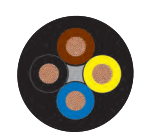
4-core: Black, Blue, Brown, and Green/Yellow
5-core: Black, Blue, Brown, Violet, and Green/Yellow
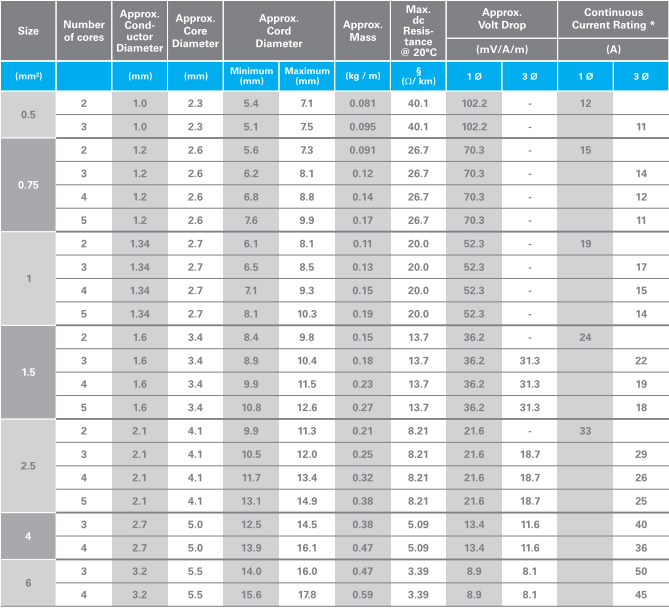
Full Technical Parameter Reference
The table below lists all key performance and dimensional values exactly as specified in the official datasheet:
These resistance values apply to plain or tinned annealed copper conductors at 20°C, and are used to calculate voltage drop for any given cable run length. Current ratings are valid for free-air installation at 30°C ambient; they must be adjusted for higher temperatures, grouped cabling, or enclosed spaces. It is also important to note that when the conductor runs at full 85°C temperature, the outer sheath can become hot enough to cause skin discomfort, so appropriate touch protection should be provided in accessible areas.
Structural Design, Material Science, and Engineering Principles
Every layer of these cables is chosen and shaped to solve specific real-world problems, rather than following a generic formula. The design process balances four core priorities: electrical safety, mechanical flexibility, environmental durability, and long service life.
Layer-by-Layer Construction
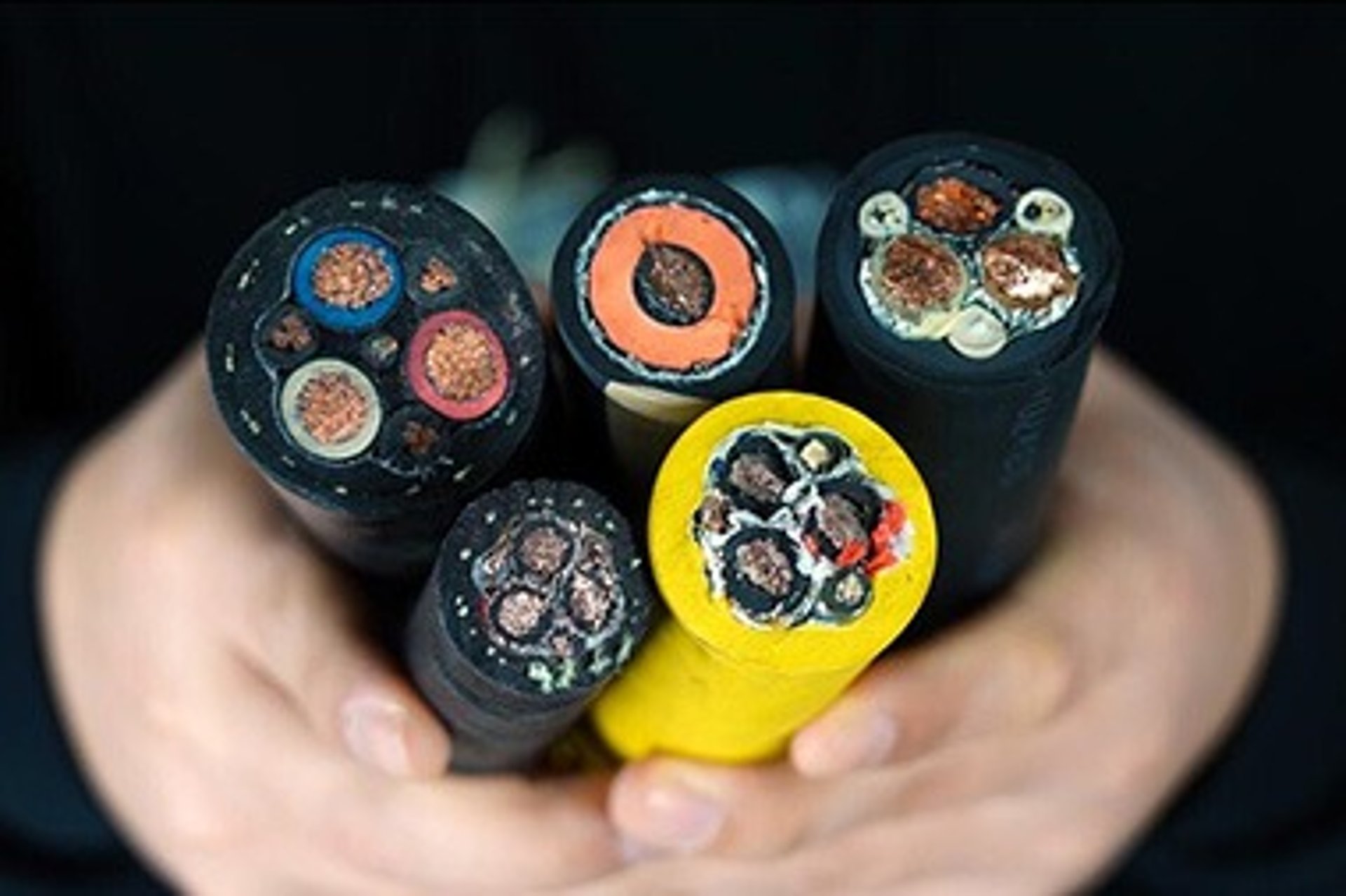
Unlike fixed wiring or heavy-duty mine trailing cables built for stationary or very high-power use, these cables have no overall metallic shield or steel armour. This is an intentional choice, not an omission: shield and armour add significant weight and stiffness, which defeats the purpose of a cable built to be moved, coiled, and carried regularly. The structure follows four distinct layers, from the centre outward:
Conductor Layer
At the heart of each core sits a conductor made from plain or tinned annealed soft copper, built to Class 5 specifications under IEC 60228. Instead of using a single solid wire or just a few thick strands, the conductor is formed from hundreds of extremely fine copper wires twisted together in carefully controlled layers. For example, a 1.5mm² Class 5 conductor contains more than 50 individual strands, each less than 0.2mm in diameter.
This design follows well-established principles of mechanical fatigue. When a cable is bent or flexed, the outer edge of the bend stretches while the inner edge compresses. A solid conductor concentrates all this stress in one place, leading to microscopic cracks that grow until the wire breaks completely after only a few thousand bends. Fine multi-strand construction spreads the stress across hundreds of individual wires, each moving independently rather than fighting against each other. This reduces the risk of complete breakage by more than 90%, and extends usable flex life to over 100,000 cycles. Tinned copper strands add further benefit: the thin tin coating prevents oxidation and corrosion in humid or dusty underground conditions, keeping contact resistance stable over years of use.
Core Insulation Layer
Each copper conductor is coated in a uniform layer of ethylene propylene rubber (EPR), meeting SANS 1411 Part III Type RD1 requirements. EPR is a thermoset elastomer, meaning it is chemically cross-linked during manufacturing to lock in its molecular structure—unlike thermoplastics such as PVC, which soften and flow when heated.
From an electrical perspective, EPR offers excellent insulating performance: it has a relative dielectric constant of less than 3.0, very low energy loss under alternating current, and an electrical breakdown strength of more than 20kV per millimetre. This means even a thin layer provides reliable protection against leakage and short circuits, while keeping the overall cable diameter manageable. Thermally, EPR remains stable at temperatures up to 85°C, with no softening or embrittlement, because its polymer backbone contains no reactive double bonds that break down under heat or oxygen exposure. It also conducts heat better than PVC, allowing the conductor to shed heat more effectively and maintain full current capacity even in warmer conditions.
Multi-Core Assembly
After insulation, individual cores are laid up together into the final cable configuration. The twisting angle and spacing between cores are calculated to a specific lay ratio, so that each core shifts position as the cable bends—no single core is permanently forced to stretch or compress on the outer edge. Small strips of compatible rubber filler are placed in gaps between cores to maintain a round cross-section, rather than leaving the cable lumpy or uneven.
This round profile is not just cosmetic: it reduces friction when the cable is dragged across rough surfaces, spreads wear evenly around the sheath, and prevents sharp edges from catching on rock, scaffolding, or machinery. It also simplifies installation and storage, as round cables coil neatly without twisting or kinking.
Outer Sheath Layer
The outer sheath is where H05RR-F and H05RN-F differ most clearly, and this choice defines where each cable should be used. Both meet SANS 1411 Part III standards, but use different rubber compounds:
H05RR-F uses a general-purpose synthetic rubber compound meeting RS1 requirements. It offers good abrasion resistance and flexibility for indoor use, but limited resistance to UV radiation, oils, and chemicals.
H05RN-F uses polychloroprene (commonly known as Neoprene) or an equivalent high-performance compound meeting RS2 requirements. This is the same material widely used in heavy-duty mine trailing cables and industrial hoses, chosen specifically for its ability to stand up to South Africa’s toughest conditions.
Polychloroprene’s performance comes directly from its molecular structure. Chlorine atoms bonded into the polymer chain create strong intermolecular forces that resist swelling and degradation from mineral oils, greases, and dilute chemicals—passing the demanding EN 60811-404 oil resistance test that PVC fails completely. The dense molecular structure also blocks UV and ozone from breaking chemical bonds, so the sheath does not become brittle or crack after months in direct sunlight, unlike PVC which often fails within three months. In the event of fire, polychloroprene is self-extinguishing: it releases low levels of non-flammable hydrogen chloride gas that displaces oxygen and slows flame spread, with no burning droplets that could ignite surrounding materials.
Performance Advantages and Comparison with Standard Cables
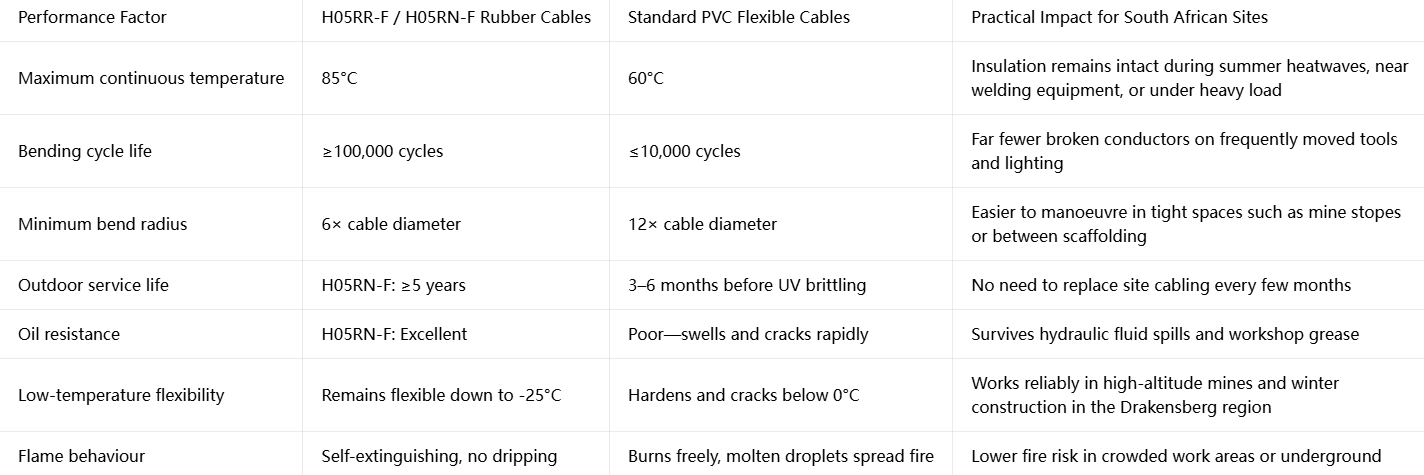
To understand why these cables have become the preferred choice for South African industry, it helps to compare them directly against the most common alternative: standard PVC flexible cables such as H05VV-F.
Key Performance Differences
Choosing Between H05RR-F and H05RN-F
The difference between these two models is not about quality—it is about purpose. H05RR-F is designed for light-duty indoor use where cost is a priority and exposure to harsh conditions is limited. It works well for fixed portable appliances, indoor temporary lighting, and tools used only in dry workshops. H05RN-F costs slightly more upfront, but delivers three to four times longer service life in any setting where the cable will be dragged, left outdoors, or exposed to fluids. For any site that does not want to replace cabling every few months, H05RN-F is almost always the more economical choice over time.
How They Solve Common South African Cable Failures
The most frequent complaint from site teams is that cables fail from the outside in: the sheath cracks, water or dust gets in, then the insulation degrades, and finally the conductor breaks or short circuits. H05RN-F addresses every stage of this failure chain: its tough sheath resists cuts and abrasion, its UV stability prevents cracking, and its oil resistance stops chemical weakening. Even if the sheath does get damaged, the heat-resistant EPR insulation holds up far longer than PVC, giving teams time to spot and repair faults before a dangerous failure occurs.
South African Industry Applications and Local Case Studies
South Africa’s unique combination of climate, geology, and industry regulations makes these cables particularly well suited to local use.
Regulatory and Climate Alignment
All low-voltage mobile cables sold or used commercially in South Africa must meet SANS 1574-3 and carry official SABS certification. Uncertified products are illegal, and insurance policies will not cover incidents or losses caused by unapproved wiring. H05RR-F and H05RN-F are fully tested and certified to these standards, so there is no risk of non-compliance on any project.
They are also engineered specifically for South Africa’s climate. Temperatures regularly exceed 45°C in inland provinces such as Limpopo, Mpumalanga, and the Free State, while coastal areas face high humidity and salt spray. High UV levels across the entire country cause rapid degradation of many imported cable types. These rubber cables are designed to handle all of this without the rapid brittling or softening seen with standard alternatives.
Real-World Use Cases
Mining and Heavy Industry
South Africa’s underground gold and platinum mines present some of the most demanding conditions for wiring anywhere in the world. Cables must be dragged over sharp rock, exposed to constant vibration from drilling equipment, coated in dust and moisture, and often splashed with hydraulic or cutting oil. Before switching to H05RN-F, many mine sites reported replacing flexible power cables for hand-held drills and pneumatic picks every two to three weeks. After adoption, replacement frequency fell by roughly 70%, and overall maintenance costs for mobile wiring dropped by 40% at several major operations. The cables also help reduce safety risks: fewer cable faults mean fewer unexpected power cuts in confined spaces, and flame-retardant materials slow fire spread if an incident does occur.
In automotive repair and heavy engineering workshops, H05RN-F cables power portable welders, grinders, and lifting equipment. Their oil resistance means they can be left on floors or workbenches without rapid degradation, and their flexibility lets mechanics move tools easily around vehicle chassis and machinery.
Construction and Infrastructure
During the construction of the 2010 FIFA World Cup stadiums across South Africa, H05RN-F was widely used for temporary power distribution, site lighting, and powering concrete mixers and compaction tools. Its resistance to rain, cement dust, and occasional light vehicle traffic made it ideal for fast-changing site layouts. The same properties have made it a preferred choice for power supply at large power station projects such as Medupi and Kusile, as well as rural electrification works in the Eastern Cape.
Agriculture and Agro-Processing
In the Western Cape’s wine growing regions, these cables power mobile irrigation pumps, pruning equipment, and harvest lighting. They stand up to fine dust, fertiliser and pesticide splashes, and wide swings between hot days and cool nights without cracking or stiffening. In abattoirs and food processing facilities, their smooth, non-porous surface resists build-up of dirt and grease, making them easier to clean and less likely to harbour bacteria.
Public Events and Municipal Works
Temporary power for festivals, outdoor markets, and municipal road works relies heavily on H05RN-F. Its self-extinguishing properties meet strict local fire safety regulations for public gatherings, and its UV resistance means it can be deployed for weeks at a time without needing replacement.
Localised Selection and Installation Guidance
To get the best performance and full compliance in South Africa, follow these practical rules:
Choose H05RR-F only for indoor, dry, light-duty use. For any outdoor work, oil exposure, or frequent dragging, select H05RN-F.
At altitudes above 1,500 metres—common in highveld mining areas—reduce the current rating by 5% as specified in SANS 1574-3.
For cable runs longer than 20 metres, select a cross-section of at least 1.5mm² to keep voltage drop below 5% and avoid power loss or overheating.
Never drag cables over sharp edges, and avoid driving vehicles over them wherever possible. Inspect the sheath regularly for cuts or abrasion, and replace damaged sections immediately.
Feichun Cables: Fully Equivalent Performance with Better Value
Feichun Cables manufactures H05RR-F and H05RN-F to exactly the same specifications and standards as the reference datasheet, making them a fully compliant drop-in alternative for South African projects. All dimensions, resistance values, and performance characteristics match exactly, so there is no need to revise designs or carry out new compliance testing.
For local buyers, Feichun offers three key advantages:
Cost efficiency: Prices are typically 20–30% lower than premium local or European brands, with no compromise on material quality or service life.
Supply reliability: Standard sizes are available with lead times of four to six weeks, compared to eight to twelve weeks for imported stock from Europe or Australia. This is critical for projects facing tight deadlines or unexpected cable failure.
Flexibility: Feichun can supply tinned copper conductors as standard, and can also provide non-standard lengths to match exact project requirements and reduce waste.
Frequently Asked Questions
Can I use H05RR-F for short-term outdoor work?
H05RR-F is not designed for outdoor exposure. Even short periods of direct sun or rain will accelerate sheath degradation, and it offers no resistance to oil or chemicals. Always use H05RN-F for any work outside enclosed buildings.
How do I adjust current ratings for temperatures above 30°C?
For every 5°C increase in ambient temperature above 30°C, reduce the rated current by roughly 5%. For example, at 40°C ambient, use 80% of the listed current capacity.
Are these cables approved for underground mining use?
Yes, when used within their voltage and current limits and carrying valid SABS certification, they are fully approved for low-voltage mobile power supply in South African mines.
What is the difference between plain and tinned copper conductors?
Plain copper offers excellent conductivity for dry, stable environments. Tinned copper adds a protective layer that resists corrosion in humid, underground, or coastal conditions, maintaining reliable performance over longer periods.
How long can I expect these cables to last on site?
With proper use and maintenance, H05RN-F typically lasts 12 to 18 months in heavy mining service, and three to five years in moderate construction or agricultural use.
Conclusion
H05RR-F and H05RN-F are more than just another type of flexible cable: they represent a carefully engineered solution built around the specific needs of mobile power supply in demanding conditions. Their design is rooted in proven principles of electrical insulation, mechanical fatigue, and polymer chemistry, and avoids the common pitfalls of both under-specification and unnecessary over-engineering. For South African operators, they offer full compliance with local regulations, proven performance in local climate and industry settings, and measurable reductions in downtime and maintenance costs.
If you would like to discuss your project requirements, request full certified datasheets, or ask for a custom quotation for delivery to any location in South Africa, contact the Feichun technical and sales team directly at Li.wang@feichuncables.com.
Email Address: Li.wang@feichuncables.com
© 2025. All rights reserved.
One-click to Quickly Contact
Products
Contact
Company
Location:
Building A Private Science and Technology Park, Hefei Economic and Technological Development Zone, Anhui Province, China
Heat Resistant Cable
WhatsApp: +86 17333223430
Social Media: