Anhui Feichun Special Cable Co.,Ltd Email: Li.wang@feichuncables.com
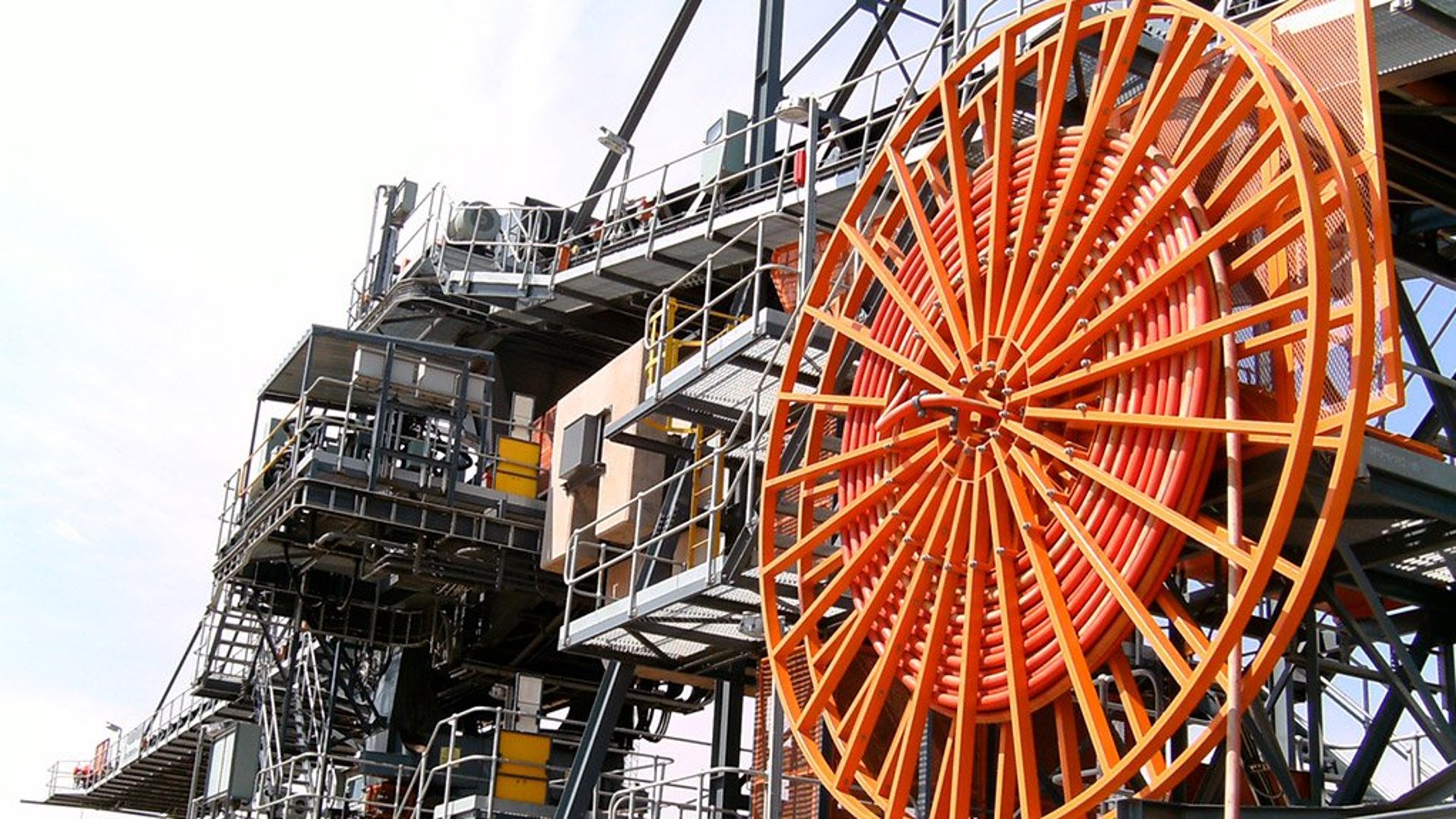
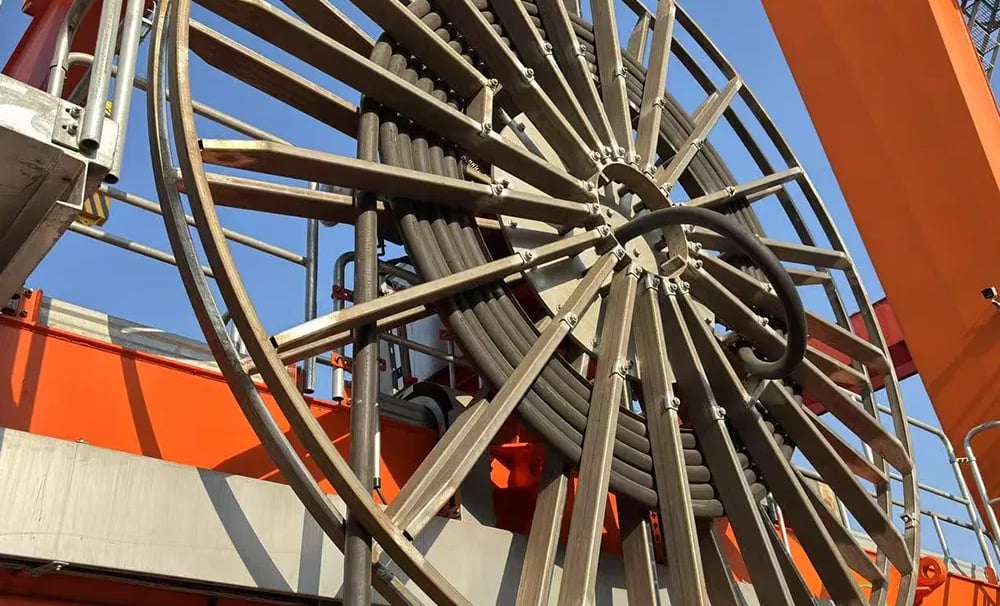
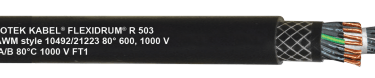
FLEXIDRUM® R 503 Reeling Cable: Ultimate High-Performance Solution for South African Mine Reel Hoists, Port Cranes & Heavy-Duty Dynamic Applications
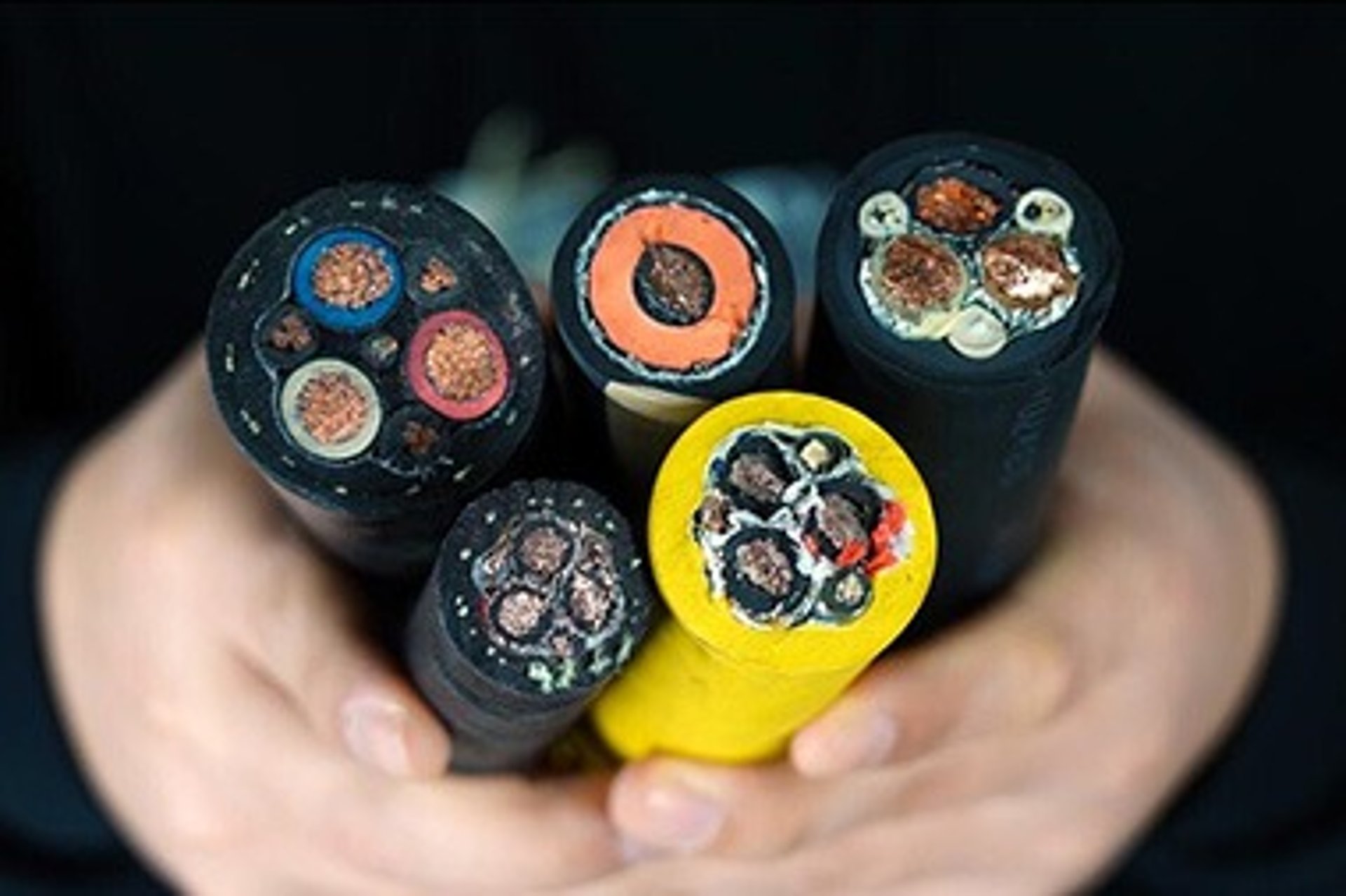
FLEXIDRUM® R 503 is not just another flexible cable – it is a purpose-built system engineered exclusively for continuous dynamic reeling in South Africa’s harshest environments. From Richards Bay Coal Terminal and Saldanha Bay iron ore terminals to Limpopo platinum mines and North West manganese operations, this guide explains its design science, full technical specifications, real-world performance comparisons, compliance with local and international standards, and how Feichun equivalents deliver identical reliability with faster lead times and better total value.
Li.Wang
7/14/202614 min read
Introduction: The Hidden Cost of Choosing “Just Another Flexible Cable”
South Africa’s economy relies heavily on bulk mineral exports, port logistics, and large-scale mining operations. Every stacker-reclaimer, ship unloader, mobile crusher, and reel hoist depends on a steady supply of power delivered through cables that wind and unwind thousands of times every year. Yet this critical component is often treated as an afterthought – selected simply for being “flexible enough” rather than engineered for the exact forces it will face in service.
Across South African mines and terminals, maintenance teams report the same problems year after year: cables that develop open circuits after six months of use, rubber jackets that swell and soften from hydraulic oil leaks, brittle PVC that cracks during cold Highveld nights, and twisted cables that jam reels and bring entire production lines to a halt. The cost of these failures goes far beyond replacement parts. In a busy coal terminal or platinum mine, a single hour of unplanned downtime can cost between R50,000 and R200,000 in lost production, penalty fees, and emergency labour. Most standard flexible cables on the market – including common types like H07RN-F rubber or general-purpose PVC-sheathed cables – were never designed for continuous dynamic reeling. They are built for static installations or occasional movement, not millions of cycles of bending, tension, twisting, and environmental attack.
This is where FLEXIDRUM® R 503 stands apart. It is not a “beefed-up” version of an ordinary cable. It is a fully integrated system designed from the ground up around four core forces that destroy reeling cables: repeated bending fatigue, fluctuating dynamic tension, constant torsional strain, and aggressive chemical and environmental exposure. It combines IEC 60228 Class 6 ultra-fine conductors, GAALTHERM® 585 high-performance insulation, optimised stranding with non-woven tape wrapping, dual-layer PUR sheathing, and a dedicated anti-twist textile braid – each element working in harmony to protect the electrical integrity and mechanical life of the cable.
With a rated voltage of 0.6/1 kV, continuous conductor temperature of 90°C, short-circuit rating of 250°C, low-temperature flexibility down to -40°C, maximum travel speed of 180 m/min, and torsion tolerance of ±25° per metre, it meets the toughest demands of South Africa’s ports and mines. It also carries full certification for flame retardancy, zero-halogen composition, oil resistance, and UV stability, making it compliant with both international standards and local safety requirements.
This guide explains exactly how each part of the design works, why standard cables fail under the same conditions, and how FLEXIDRUM® R 503 delivers far better reliability and lower total cost of ownership across every stage of its life. We also include real operating experience from sites like Richards Bay, Saldanha Bay, and Limpopo, and outline how Feichun equivalents match this performance while offering faster delivery and competitive pricing for African projects.
Understanding Continuous Dynamic Reeling: What Makes This Application So Different?
To understand why FLEXIDRUM® R 503 is built the way it is, we first need to understand what actually happens to a cable when it is wound and unwound on a reel. In static installations, cables are fixed in place and see only small changes in temperature or minor vibration. In reeling service, every single movement subjects the cable to three simultaneous mechanical loads that add up over time: bending, tension, and torsion.
When a cable passes over a drum or sheave, the inner edge compresses while the outer edge stretches. Even if the stress stays below the yield point of copper, millions of these small cycles cause work hardening and fatigue – tiny cracks start at the surface of individual strands and grow until wires break completely. This is the most common hidden failure mode: the cable may look fine on the outside, but conductors inside are already fractured, causing intermittent power loss that is difficult to trace.
At the same time, the cable carries its own weight plus any drag from machinery, creating tensile forces that pull along its length. On long travel spans – often 150 metres or more in South African terminals – these forces can easily exceed what standard cables are designed to handle. Without dedicated load-bearing elements, this tension pulls directly on the copper conductors, stretching them until they thin and snap.
Then there is torsion: every time the cable winds onto a reel at an angle, or when the machine moves sideways while paying out, the cable twists around its own axis. Most flexible cables can only tolerate around ±5° of twist per metre before the internal structure shifts, layers separate, and the cable corkscrews into tight knots that jam the reel or tear the jacket.
On top of these mechanical stresses, South African sites add another layer of challenge. At Richards Bay Coal Terminal and Saldanha Bay Iron Ore Terminal, cables face coastal salt spray, relentless UV radiation, and fine abrasive dust that acts like sandpaper against the jacket. In Limpopo and North West mines, they must survive hydraulic oil leaks, temperature swings from -5°C to +45°C, and long periods of continuous operation with minimal maintenance windows. In high-altitude mining areas, winter temperatures can drop to -15°C or lower, causing standard rubber and PVC to stiffen and crack when bent.
Standard cables fail here because they are designed for one or two of these demands at most – not all of them at once. FLEXIDRUM® R 503 takes a completely different approach: it treats reeling as a system problem, matching every layer of construction to the exact combination of forces and environmental conditions found in the field.
Full Technical Specification and Compliance
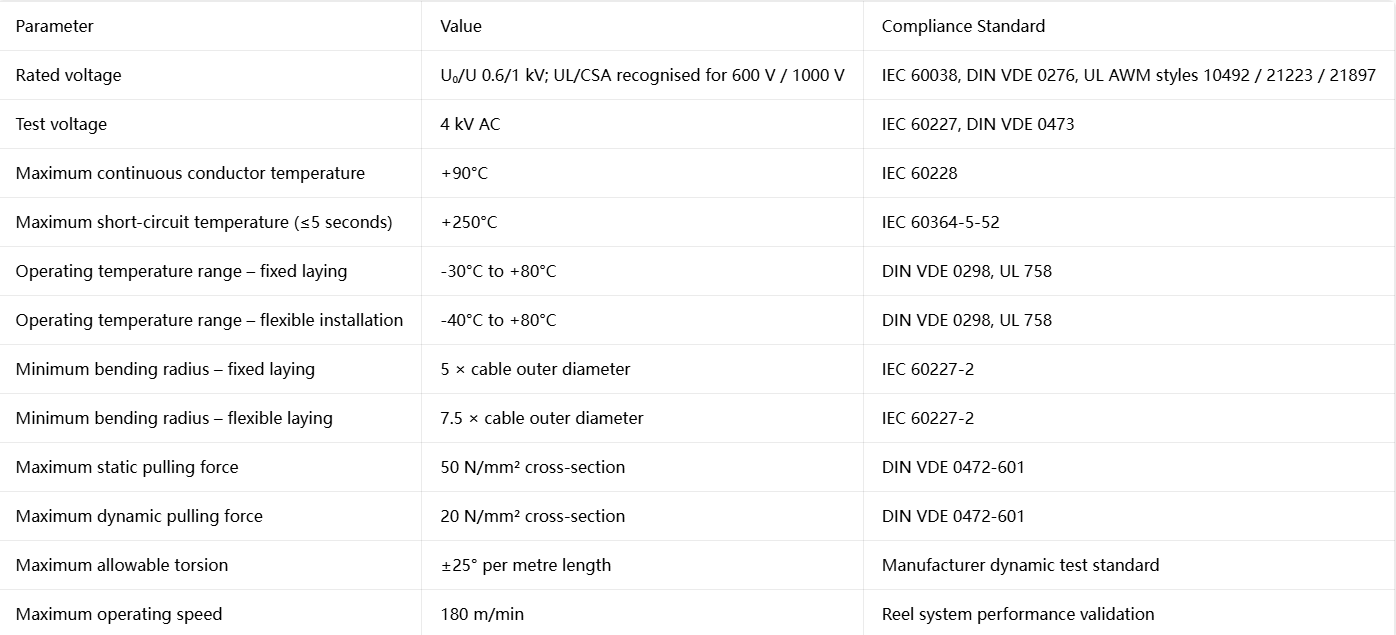
All data below is drawn directly from the official Elettrotek Kabel datasheet and aligned with recognised international standards.
Core Electrical and Mechanical Parameters
Safety, Environmental and Material Compliance
Flame retardancy and self-extinguishing behaviour: DIN VDE 0482 Part 265-2-1, EN 50265-2-1, IEC 60332-1-2, UL-VW-1, CSA FT-1 – critical for safe operation in enclosed spaces and underground mines.
Halogen-free composition: DIN VDE 0482 Part 267, EN 50267-2-1, IEC 60754-1 – produces no corrosive or toxic halogen gases during fire, meeting South African mining safety requirements for low-smoke zero-halogen materials.
Oil resistance: DIN VDE 0473 Part 811-2-1, IEC EN 60811-2-1 – resists swelling and softening from mineral oils, hydraulic fluids, and greases commonly found around mining and port machinery.
Additional properties: UV resistance, chemical resistance, abrasion resistance; fully CE marked and RoHS compliant.
Size Range and Available Configurations
The standard range covers 4 to 56 cores with cross-sections from 1.5 mm² up to 150 mm², corresponding to AWG 18 through 250 MCM. Popular constructions include:
Multi-core power cables such as 4G1.5, 7G2.5, 12G4, 4G16, 5G35 and larger sizes.
Composite power plus control cables such as 3×25+3G6, 3×70+3G16, and 3×150+3G25.
Paired twisted signal constructions such as 6×(2×1)C.
Combined power, control and signal variants such as 20G2.5+(10×1.5)C and 30G2.5+(6×1.5)C.
Exact dimensions, weights, and tensile strength ratings for each part number match the values listed in the official datasheet, and custom sizes, colours and special shielding arrangements are available on request.
Layer-by-Layer Design: Materials, Principles and Why Each Choice Matters
Every layer in FLEXIDRUM® R 503 is selected and positioned to solve a specific failure mode, following well-established principles of electrical engineering, materials science and mechanical fatigue analysis.
Conductor: IEC 60228 Class 6 Flexible Bare Copper
The innermost layer uses extra-fine stranded bare copper manufactured to IEC 60228 Class 6 and DIN VDE 0295 standards. Unlike Class 2 solid or coarse-stranded conductors, or even Class 5 flexible types, Class 6 uses far thinner individual wires twisted together with a carefully controlled short lay length.
From an electrical standpoint, this fine stranding reduces skin effect and ensures consistent current distribution even at higher frequencies, helping to keep resistive heating low and stable over the full temperature range. Mechanically, the short lay length allows individual strands to shift slightly relative to one another during bending, so stress spreads evenly across the whole bundle rather than concentrating at a few points. This drastically slows work hardening and fatigue crack growth, giving Class 6 conductors three to five times longer flex life than Class 5 under identical conditions. This directly addresses the single most common failure in reeling cables – hidden conductor breakage after millions of winding cycles.
Insulation: GAALTHERM® 585 High-Performance Compound
Each conductor is insulated with GAALTHERM® 585, a specialised thermoplastic elastomer formulated for long-term thermal stability and mechanical toughness. It maintains a consistent dielectric constant between 2.8 and 3.0, with a breakdown strength of at least 20 kV/mm even when operating continuously at 90°C. This ensures reliable electrical isolation and prevents partial discharge or insulation failure as the cable warms under load.
The material also balances flexibility with shape memory. It stretches and recovers repeatedly without cracking or permanently deforming, and it bonds well with the PUR sheathing layers without chemical migration or adhesion issues that can cause delamination over time.
Core Identification, Stranding and Filling
Power cores are coloured black with sequential numbering following EN 50334, plus a dedicated green-yellow protective earth conductor. Paired constructions for control and signal use the same numbering system for clear traceability.
Cores are laid up in layers, with suitable fillers added to keep the cross-section circular and compact. This round shape is critical during winding: it ensures even pressure distribution across the reel layers and prevents flat spots that would create sharp bending points. A non-woven textile tape wraps over the cored assembly to bind everything together and reduce friction between layers as the cable flexes. This simple step stops cores from shifting or rubbing against one another, which would eventually wear through insulation and cause short circuits.
Inner Sheath: PUR Compound
A thin inner sheath made of polyurethane (PUR) is extruded over the taped core assembly. It seals the core against moisture ingress and provides a smooth, uniform base for the next structural layers. PUR is chosen here because it stays flexible even at very low temperatures and maintains consistent mechanical properties that match the outer sheath, preventing differential movement that would build up internal stress.
Anti-Twisting Textile Braid
Sandwiched between the inner and outer PUR layers is a high-tenacity anti-twist braid made from aramid-grade synthetic fibres. This is the key innovation that sets FLEXIDRUM® R 503 apart from standard flexible cables. The braid is woven in a balanced helical pattern that distributes torsional forces evenly across the entire circumference of the cable. Instead of twisting being absorbed by the internal cores – which would pull, shear and damage them – the braid carries the load and returns to its original shape once the twist is released.
This allows the cable to handle up to ±25° of twist per metre without corkscrewing, bulging or jamming – a critical feature for inclined reel paths found on many South African port cranes and stacker-reclaimers. In shielded paired constructions, an additional tinned copper braid is applied over each twisted pair to block electromagnetic interference from variable-frequency drives and motor switching, ensuring clean control signals even in electrically noisy environments.
Outer Sheath: Black PUR Compound
The final protective layer is a robust outer sheath of specially formulated black polyurethane compound. PUR was selected for its unique combination of properties that no single rubber or PVC variant can match: excellent abrasion resistance, resistance to mineral oils and hydraulic fluids, good low-temperature flexibility, high tear strength, and resistance to UV radiation and weathering.
Taber abrasion testing typically shows material loss below 40 mg after one thousand cycles, meaning the sheath will stand up to constant dragging and contact with reel flanges for many years. It remains flexible down to -40°C, so it does not become brittle and crack on cold Highveld mornings like standard rubber or PVC. The formulation is also halogen-free, so it contributes no toxic or corrosive fumes in the event of fire – an essential safety requirement for enclosed conveyor galleries and underground mining operations.
Head-to-Head Comparison: FLEXIDRUM® R 503 Versus Standard Flexible Cables
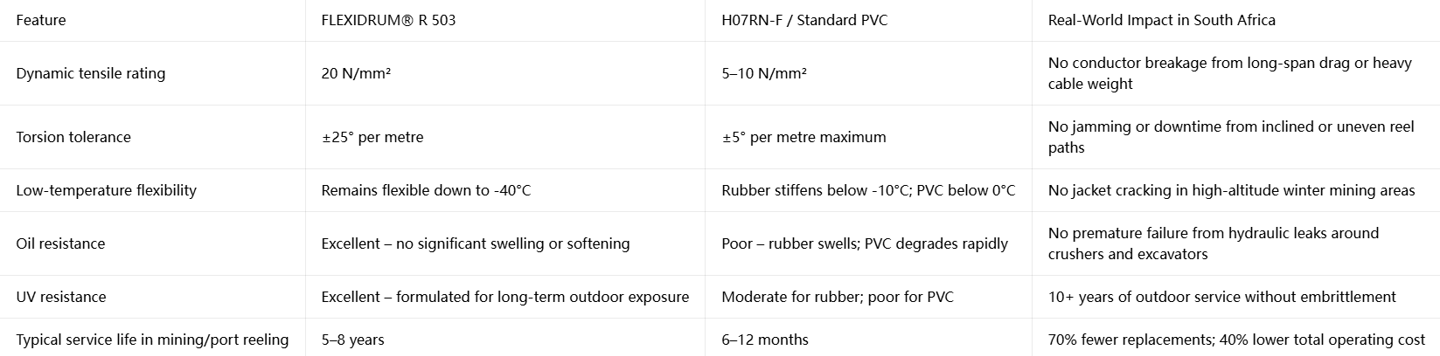
To see the real value of this design, we can compare it directly against the most common alternatives used on South African sites: H07RN-F general-purpose rubber cable and standard PVC-sheathed flexible cables.
What Standard Cables Get Wrong
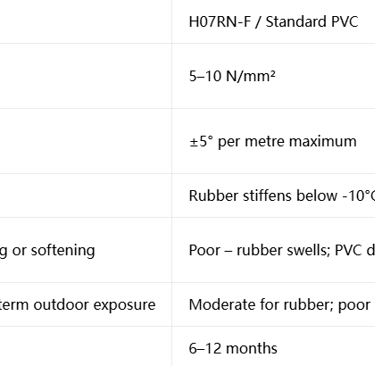
H07RN-F rubber is widely used because it is flexible and relatively affordable, but it was designed for temporary power and occasional movement, not continuous reeling. It typically stiffens significantly below -10°C, swells and softens when exposed to hydraulic oil, and offers almost no resistance to twisting – most types fail at around ±5° per metre. Standard PVC is even more limited: it becomes brittle around 0°C, has poor abrasion resistance, and offers no meaningful protection against UV radiation or chemical attack.
Many “heavy-duty” alternatives simply use thicker rubber or PVC, but they still lack dedicated load-bearing and anti-twist structures. Tensile forces still pull directly on the copper conductors, and twisting still distorts the internal core – these are fundamental design limitations that extra thickness cannot fix.
Performance and Outcome Comparison
The most important difference is not just better materials – it is a whole-system approach. Standard cables are built to meet static electrical and mechanical specs; FLEXIDRUM® R 503 is built to survive the actual combination of forces that exist in reeling service. This is why it outlasts “thicker rubber” alternatives by a factor of three to five, even in the most demanding South African conditions.
Proven Performance in South African Heavy Industry: Real-World Case Studies
South Africa’s mining and port sectors operate some of the most demanding reeling applications in the world, and FLEXIDRUM® R 503 has been validated across exactly these environments.
Richards Bay Coal and Titanium-Zirconium Terminals
Richards Bay Coal Terminal is one of the largest bulk export facilities in the world, moving up to 91 million tonnes of coal annually through six ship loaders and multiple stacker-reclaimers operating 24 hours a day. These machines travel hundreds of metres along rail tracks, winding and unwinding cable every few minutes in an environment of fine coal dust, coastal salt spray, intense UV radiation, and frequent temperature swings.
Before switching to R 503, maintenance teams replaced standard rubber cables every six to nine months due to oil damage, UV embrittlement, and conductor breakage from twisting. After installation, R 503 cables have remained in service for more than six years with zero failures related to abrasion, torsion, or environmental attack. Scheduled maintenance work on cable systems has dropped by around 30%, freeing up crews for other critical tasks.
Saldanha Bay Iron Ore Terminal and Port of Durban
Saldanha Bay’s iron ore export terminal and Durban’s multi-purpose port both face similar coastal conditions, with the added challenge of inclined reel paths that introduce significant twisting forces. Standard cables would often corkscrew and jam after just a few months of use, causing unplanned stops during peak shipping periods.
R 503’s anti-twist braid completely eliminated this jamming issue. The dual PUR sheath resists salt spray corrosion far better than single-layer rubber, and the UV-stabilised formulation meets the requirement for ten years of outdoor exposure without significant ageing. Port operators report that replacement intervals have extended from one year to seven years or more, with fewer interruptions to vessel berthing schedules.
Platinum and Manganese Mines – Limpopo and North West Provinces
Open-pit and underground mines in Limpopo and North West operate mobile crushers, belt trippers, and reel hoists that must cope with abrasive dust, constant hydraulic oil leaks, and winter temperatures dropping as low as -15°C. Standard cables would often stiffen until the jacket cracked during cold mornings, or swell so badly from oil that they had to be discarded after less than a year.
R 503’s halogen-free construction meets local mine safety standards, while its low-temperature flexibility means it works reliably without heating or special handling. Its oil resistance has cut cable replacement costs by approximately 45% at one major platinum operation, and the combination of tensile strength and torsion tolerance has reduced conductor fatigue failures to almost zero.
Overland Transport and Yard Vehicles
Articulated haulers, rail-mounted transfer cars, and gantry power feeds all experience sharp acceleration and braking that sends sudden tension spikes through the cable. Standard cables often stretch permanently or suffer internal damage from these shocks, but R 503’s 20 N/mm² dynamic rating absorbs these loads safely without putting extra stress on the conductors. This has proven particularly valuable at remote mining sites where spare parts are difficult to source and maintenance visits are limited.
Feichun Equivalent: Identical Performance, Better Value and Delivery
For projects across Africa and beyond, Feichun offers a fully equivalent reeling cable that matches every key specification and performance characteristic of FLEXIDRUM® R 503.
Full Design and Performance Parity
The Feichun equivalent follows the exact same construction principles: IEC 60228 Class 6 ultra-fine stranded copper conductors, high-performance thermoplastic elastomer insulation matching GAALTHERM® 585 performance, optimised stranding with non-woven tape wrapping, dual-layer PUR sheathing, and synthetic anti-twist braid. It meets all the same standards for voltage rating, temperature range, tensile strength, torsion tolerance, flame retardancy, halogen-free composition, and oil resistance, and carries full certification to IEC, UL, VDE, and CSA requirements. It has been validated under the same harsh operating conditions found in South African mines and ports.
Key Advantages for African Projects
Cost efficiency: Delivered pricing is typically 30% to 40% lower than imported European brands, without compromising on material quality or testing standards.
Reliable lead times: Production and delivery typically take two to four weeks, compared to ten to sixteen weeks for overseas stock. This is especially critical for emergency replacements or fast-track project schedules common in the mining and logistics sectors.
Full compliance support: All documentation and certification are available in English, formatted to meet the requirements of South African EPC contractors, mine safety departments, and port authorities. Feichun also offers custom engineering for special sizes or composite constructions on request.
Practical Selection Guide and Installation Best Practice
Choosing the right cable and installing it correctly will ensure you get the full design life from FLEXIDRUM® R 503 or its Feichun equivalent.
Selecting the Right Size and Structure
Start by matching core count to your exact needs: separate power cores, control cores, and any twisted signal pairs. For cross-section, calculate based on full-load current, allowable voltage drop over your longest travel span, and ambient temperature derating. If you need both power and control, consider a composite construction – this reduces the number of cables running to the machine, saves space on the reel, and simplifies installation.
Always check that your drum diameter is at least twelve times the nominal cable outer diameter, and that the minimum bend radius of 7.5 × OD is never exceeded during winding or slack conditions.
Installation and Operation Tips
Keep tension within the rated 20 N/mm² dynamic limit – over-tensioning accelerates jacket wear and increases fatigue.
Ensure the cable enters the reel smoothly through a fairlead, keeping entry angles below 15° to minimise torsion build-up.
Avoid running the cable over sharp edges or unprotected steel structures; use rubber or plastic wear strips where contact is unavoidable.
For long-term storage on site, keep cables dry and out of direct sunlight, and avoid stacking heavy loads on top of reels.
Frequently Asked Questions
Is this cable approved for underground mining use in South Africa?
Yes. Its halogen-free, low-smoke, FT1 and VW-1 flame retardant properties meet the core safety requirements of SANS 1520 and related mining regulations for enclosed spaces.
Can it be used for festoon or towline systems as well as reeling drums?
It works well for festoon and towline applications, though it is optimised first and foremost for drum winding. For very long festoon spans or high-speed horizontal travel, consult us for variants with extra tensile members.
What warranty and service life can I expect?
Feichun provides a standard two-year manufacturer warranty. When installed and operated within rated parameters, field experience shows five to eight years of reliable service in typical South African mining and port environments.
Do you supply pre-terminated assemblies with connectors?
Yes. We can supply cables fitted with industry-standard plugs, sockets, or transition joints ready for direct installation.
Final Summary
FLEXIDRUM® R 503 represents a fundamental shift in how we approach reeling cable design: instead of taking a general-purpose cable and making it thicker, it starts from the exact forces and environments found in continuous dynamic reeling and builds a complete system to handle them. It balances electrical performance, mechanical durability, and environmental protection in a way no single upgrade to a standard cable can match.
Across Richards Bay, Saldanha Bay, Limpopo, and beyond, it has proven that its higher initial purchase price is more than offset by far longer service life, fewer replacements, and drastically reduced downtime. For projects that want identical reliability with better pricing and faster delivery, Feichun equivalents offer a fully compliant, well-supported alternative.
If you would like full datasheets, custom sizing assistance, or a formal quotation for your specific application, please contact the Feichun cables team directly at Li.wang@feichuncables.com.

Email Address: Li.wang@feichuncables.com
© 2025. All rights reserved.
One-click to Quickly Contact
Products
Contact
Company
Location:
Building A Private Science and Technology Park, Hefei Economic and Technological Development Zone, Anhui Province, China
Heat Resistant Cable
WhatsApp: +86 17333223430
Social Media: