Anhui Feichun Special Cable Co.,Ltd Email: Li.wang@feichuncables.com
Engineering Guide to Type 611 & 611 ECC 6.35/11kV Flexible Trailing Cables – SANS 1520 Part 2 Compliance, Mechanical Strength & Safety for Open Cast Mining in South Africa
A complete engineering guide to Type 611 & Type 611 ECC 6.35/11kV flexible trailing cables – SANS 1520 Part 2 compliance, structural design, material science, performance data, real South African mine case studies, comparison with standard cables, and Feichun equivalent options for open cast and underground hazardous area applications.
Li.Wang
7/17/202613 min read
Introduction: The Critical Role of Trailing Cables in South African Mining
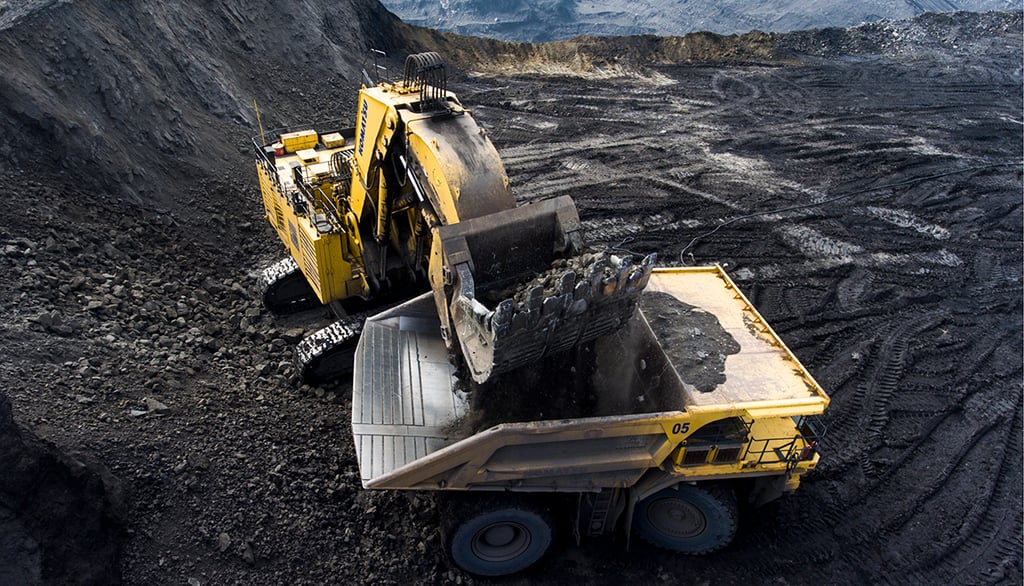
South Africa’s mining sector operates under some of the most demanding conditions on earth. From the highveld coalfields of Mpumalanga and Witbank to the platinum-rich Bushveld Complex around Rustenburg, the iron ore deposits of the Kalahari, and deep gold mines in Gauteng, every site faces unique challenges. Open cast operations endure intense year-round UV radiation, extreme temperature swings from -25°C to over 50°C, abrasive rock dust, constant mechanical impact, and frequent contact with mineral oils and chemicals. Underground sites contend with high ambient heat, moisture, corrosive gases, and restricted space for installation and maintenance. Across all operations, moving machinery – from massive draglines and electric shovels to blast-hole drills, mobile feeders, and crushing units – relies entirely on flexible trailing cables to deliver reliable power and control signals.
For decades, mine operators have struggled with a fundamental problem: standard medium-voltage cables are designed for fixed installation, not the relentless movement, bending, twisting, pulling, and abrasion that trailing cables must withstand every shift. Conductor fatigue breaks cores, insulation cracks under UV exposure or cold temperatures, shielding fails and allows interference or cross-phase faults, and earthing paths become unreliable when outer sheaths wear away. These failures are not just inconvenient – they cause costly unplanned downtime, increase maintenance workload, and create serious safety risks, including electric shock, arc flash, and non-compliance with national mining regulations.
This guide focuses on Type 611 and Type 611 ECC 6.35/11kV Flexible Electric Trailing Cables – purpose-built solutions that meet SANS 1520 Part 2 standards, aligned with SANS 1411-1 and SANS 1411-3 material specifications, and certified under SABS permit number 3660/6352. Developed specifically to answer the question “how can an 11kV cable operate safely and reliably in moving, polluted, sun-blasted mining environments for years instead of months?”, these cables combine high-voltage insulation technology, advanced rubber elastomer science, dynamic mechanical engineering, and rigorous mine safety principles into a single integrated system. They are not merely power transmission products – they form a critical link between heavy machinery and the protection of people and assets in some of South Africa’s highest-risk industrial settings.
Regulatory Framework & Compliance: Meeting South African Mining Standards
Any electrical equipment used in South African mines must meet strict legal and technical requirements, and trailing cables are no exception. The primary legislation governing this area is the Minerals Act 1991, which sets out general safety duties for mining operations, and the Mine Health and Safety Act No. 29 of 1996, which includes detailed regulations for electrical systems in hazardous locations. These laws require that cables supplying power to self-propelled, portable, or movable apparatus in hazardous areas meet four non-negotiable criteria: individual phase screening for medium-voltage circuits, a continuous and reliable earth path capable of carrying full fault current, high resistance to mechanical damage, and flame-retardant and anti-static properties. All such cables must also be certified by the South African Bureau of Standards (SABS) and comply with relevant national standards to be legally deployed.
The core technical standard applicable here is SANS 1520 Part 2, which covers flexible electric trailing cables for operating voltages from 3.8/6.6kV up to 19/33kV – including the 6.35/11kV rating of Type 611 and Type 611 ECC. This standard defines construction rules, material requirements, dimensional tolerances, and minimum performance thresholds, drawing on supporting standards: SANS 1411-1 for copper conductor specifications, and SANS 1411-3 for elastomeric insulation and sheathing compounds. Type 611 and Type 611 ECC were among the very first medium-voltage trailing cables to receive full SABS certification against SANS 1520 Part 2, confirming they satisfy every requirement set out in national regulations and industry best practice.
Compliance is not simply a formality – it carries practical consequences. The Department of Mineral Resources and Energy (DMRE) and National Regulator for Compulsory Specifications (NRCS) regularly audit mine sites, and use of non-compliant or uncertified cables can lead to stop-work orders, heavy fines, or legal liability in the event of an incident. For mine operators, selecting a cable that fully aligns with SANS 1520 Part 2 and the Minerals Act 1991 is not just a technical choice – it is a regulatory necessity for any equipment operating in hazardous zones.
Full Technical Specifications: Type 611 & Type 611 ECC
Core Electrical Ratings
These cables carry a rated voltage of U₀/U = 6.35/11kV, designed for three-phase 50Hz power distribution – the standard medium-voltage supply for heavy mining machinery in South Africa. They are built for continuous operation at a maximum conductor temperature of 90°C, with testing and validation performed in line with SANS 1520 Part 2 requirements.
Size Range and Physical Parameters
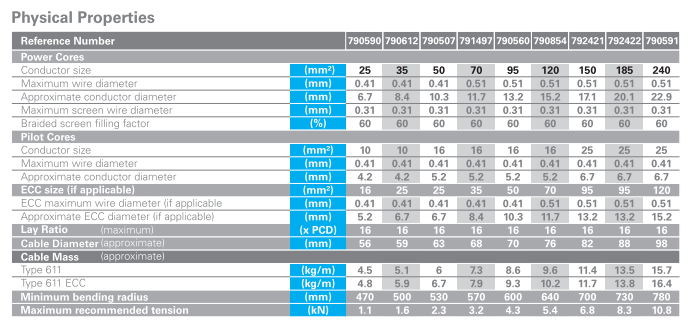
The range covers nine standard power core cross-sections: 25mm², 35mm², 50mm², 70mm², 95mm², 120mm², 150mm², 185mm², and 240mm². Pilot cores – used for control, interlocking, and insulation monitoring – range from 10mm² to 25mm², while the dedicated Earth Continuity Conductor (ECC) available in the Type 611 ECC variant runs from 16mm² to 120mm².
Detailed physical properties, verified against the official datasheet, include:
Conductor diameter: 6.7mm (25mm²) to 22.9mm (240mm²)
Maximum individual wire diameter in power cores: 0.41mm up to 50mm², 0.51mm for larger sections
Overall cable diameter: 56mm (25mm² Type 611) to 98mm (240mm² Type 611 ECC)
Weight per metre: 4.5kg to 15.7kg for Type 611; 4.8kg to 16.4kg for Type 611 ECC
Minimum bending radius: 470mm to 780mm (approximately nine times the cable diameter)
Maximum recommended pulling tension: 1.1kN to 10.8kN, increasing with conductor size
Electrical Performance Data
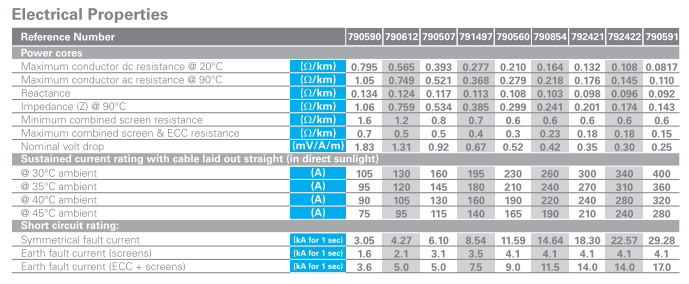
Electrical performance values are tested and documented to SANS standards, giving engineers reliable figures for load calculation and protection coordination:
DC resistance at 20°C: 0.795Ω/km for 25mm² down to 0.0817Ω/km for 240mm²
AC resistance at 90°C: 1.05Ω/km for 25mm² down to 0.110Ω/km for 240mm²
Reactance: 0.134Ω/km for 25mm² down to 0.092Ω/km for 240mm²
Total impedance at 90°C: 1.06Ω/km for 25mm² down to 0.143Ω/km for 240mm²
Nominal voltage drop: 1.83mV/A/m for 25mm² down to 0.25mV/A/m for 240mm²
Current ratings are calculated for cables laid straight and exposed to direct sunlight – typical for open cast trailing applications – with values adjusted for ambient temperature:
30°C ambient: 105A (25mm²) to 400A (240mm²)
35°C ambient: 95A to 360A
40°C ambient: 90A to 320A
45°C ambient: 75A to 280A
Short-circuit performance is critical for safety protection:
Symmetrical fault current (1-second rating): 3.05kA to 29.28kA
Earth fault capacity with screening only: 1.6kA to 4.1kA
Earth fault capacity with ECC plus screening: 3.6kA to 17.0kA
Structural Design & Material Science: Engineering Principles Explained
Every layer in Type 611 and Type 611 ECC is selected and arranged to solve specific challenges, drawing on established principles of electrical engineering, material science, and structural mechanics.
Conductor System
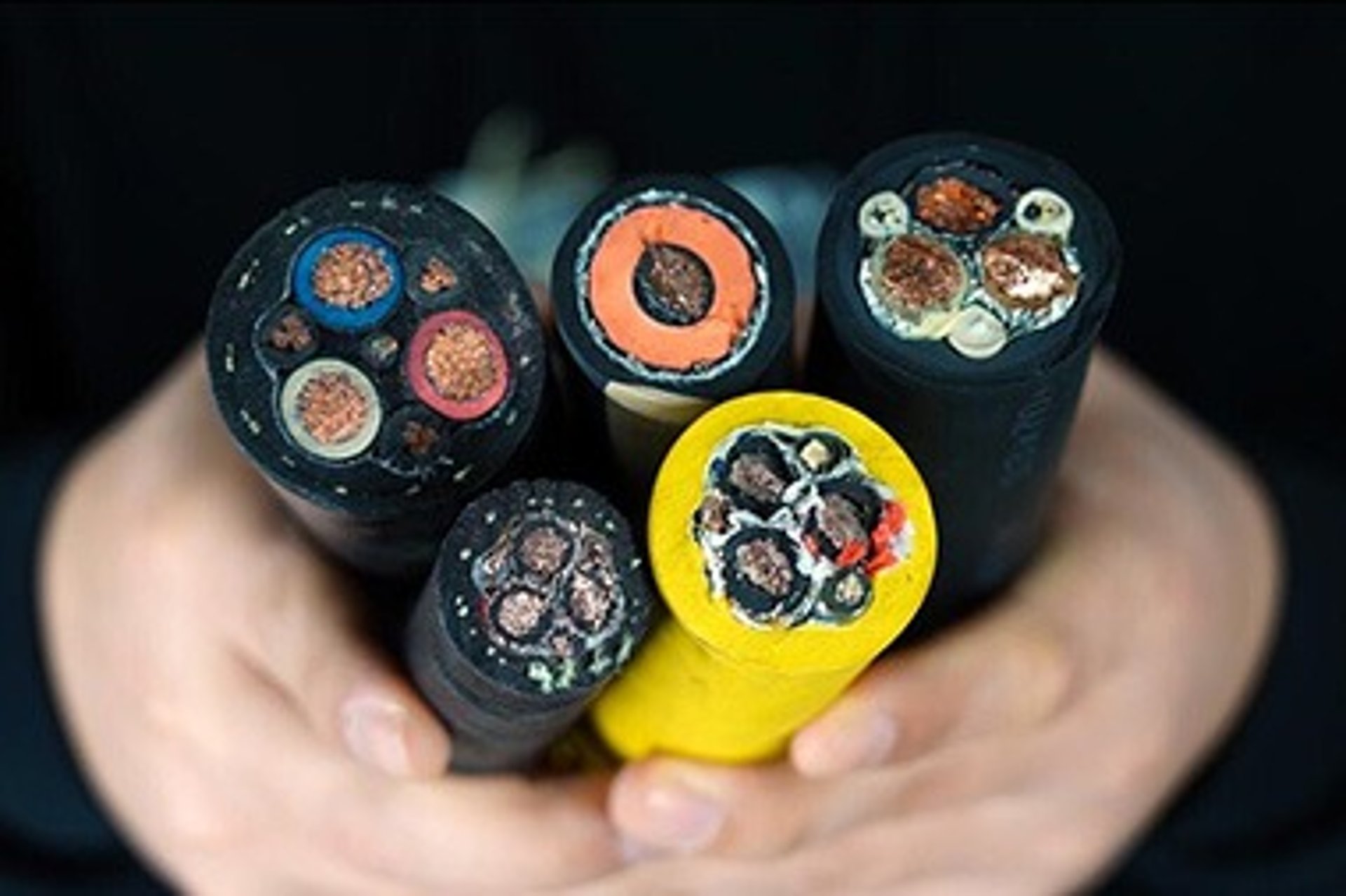
The power cores use Class 5 tinned annealed copper conductors, with individual wire diameters kept small – 0.41mm for sections up to 50mm² and 0.51mm for larger sizes. This choice is rooted in mechanical fatigue theory: fine-stranded conductors distribute bending and torsional stress across thousands of individual wires, rather than concentrating stress at a few thick strands. This reduces fatigue failure rates by three to four times compared to rigid Class 2 conductors, making the cable far more resistant to breaking when flexed thousands of times over its service life. Tinning the copper wires serves two purposes: it prevents oxidation in damp, acidic, or sulphide-rich mine environments, and it maintains consistently low contact resistance at terminations and joints, reducing heat buildup and connection failures over time.
Triple-Extrusion Insulation and Screening
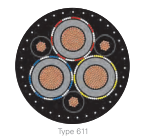
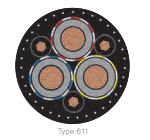
Each power core features a triple-extruded structure: an inner semi-conducting layer, an EPM (Ethylene Propylene Rubber) insulation layer, and an outer strippable semi-conducting layer. This design follows fundamental high-voltage electrical principles: without semi-conducting layers, air gaps between the conductor and insulation would create sharp electric field concentrations, leading to partial discharge, insulation erosion, and eventual breakdown. The semi-conducting layers smooth the electric field so stress is distributed evenly across the insulation surface, meeting Maxwell’s boundary conditions for reliable medium-voltage operation.
EPM/EPR insulation is chosen over alternatives like XLPE or PVC for its unique material properties: it retains excellent flexibility at temperatures as low as -25°C, resists ozone and UV degradation, and withstands continuous exposure to mineral oils and common mine chemicals. It also maintains stable electrical performance at the maximum operating temperature of 90°C, with low dielectric loss and high resistance to electrical tracking – all critical for long service life in harsh conditions. The outer semi-conducting layer is formulated to be stripped cleanly without special tools or solvents, speeding up jointing and termination work on site and reducing the risk of accidental insulation damage during installation.
Individual Phase Shielding
Every insulated power core is wrapped in a braided screen made from tinned copper wire combined with textile fibres, with a minimum coverage factor of 60%. Electrically, this individual screening contains the electric field within each phase, preventing cross-phase partial discharge and blocking electromagnetic interference that could disrupt pilot signals or sensitive equipment controls. Mechanically, the textile fibres add tear resistance and flexibility, preventing the copper braid from snapping when the cable is twisted sharply or dragged over sharp rock edges – a common failure point in cables with copper-only screening.
Pilot Cores and Earth Continuity Conductor (ECC)
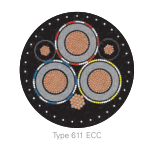
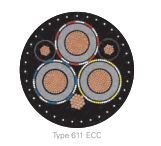
Pilot cores, insulated with EPM rubber, are laid in the gaps between power cores to maintain a circular overall shape and balanced mechanical loading. These carry control signals, interlocking commands, and insulation health monitoring data, allowing operators to detect faults before they escalate into dangerous conditions.
In the Type 611 ECC variant, one pilot core is replaced by a dedicated tinned copper Earth Continuity Conductor. This is one of the design’s most important safety innovations: unlike standard cables that rely only on the outer sheath or screening for earthing, the ECC provides a robust, low-resistance path that remains intact even if the outer sheath becomes worn, cut, or abraded. This directly addresses the Minerals Act 1991 requirement for guaranteed earth continuity in hazardous zones, ensuring fault current can flow freely to trigger protection relays and prevent dangerous touch voltages on equipment frames.
Laying and Reinforced Sheath System
Power cores, pilot cores, and ECC are laid up with a maximum lay ratio of 16 times the pitch circle diameter – a balance that keeps the cable flexible while preventing cores from bunching, crushing, or separating under tension. The entire assembly is then protected by an extra-heavy-duty reinforced CR (Chloroprene Rubber) sheath. Chloroprene is selected for its outstanding resistance to abrasion, UV radiation, flame spread, and chemical attack from oils and acids, meeting SANS 10406 requirements for mine cable sheathing. The reinforcement is integrated into the sheath structure to distribute pulling and impact loads evenly, reducing wear rates by two to four times compared to standard rubber sheaths and extending service life significantly in high-abrasion areas like open cast shovel faces and drill pads.
Performance Advantages vs Standard Mining Cables
The core challenge that Type 611 and Type 611 ECC resolve is the long-standing trade-off in cable design: flexibility versus strength, electrical performance versus mechanical durability, and regulatory compliance versus operational practicality. Standard 11kV mining cables typically use rigid conductors, single-layer insulation, overall rather than individual phase screening, and basic rubber sheathing – they work well for fixed or semi-static use but fail rapidly when subjected to the dynamic conditions of trailing service.
Key differences and solved problems include:
Flex life: Type 611 cables withstand over 100,000 flex cycles without conductor breakage, compared to fewer than 25,000 cycles for standard equivalents, eliminating frequent core failures on constantly moving equipment.
Earth fault capacity: Type 611 ECC handles up to 17kA of earth fault current for one second, while standard cables typically manage less than 5kA – this prevents protection relays from failing to trip during major faults, a common cause of serious incidents in hazardous areas.
Environmental resistance: EPR insulation and CR sheathing maintain integrity for over ten years in direct sunlight, compared to three to five years for standard rubber or XLPE, reducing replacement costs and compliance risks from degraded insulation.
Regulatory alignment: Type 611 and Type 611 ECC meet all four mandatory criteria set out in the Minerals Act 1991, whereas many standard cables only satisfy partial requirements, creating compliance gaps that expose mines to legal and safety risks.
Real-World Case Studies: South African Mine Applications
These performance gains translate directly to measurable improvements at mines across South Africa, with documented results in coal, iron ore, and platinum operations.
Open Cast Coal – P&H 4100XPC Dragline, Witbank Coalfield
A large coal mine in the Witbank area had been using standard 11kV trailing cables on its P&H 4100XPC dragline, with an average service life of just seven months. Failures occurred frequently due to conductor fatigue and sheath wear, leading to 1.8 unplanned outages every month, each halting production and disrupting downstream coal handling and rail loading. After switching to Type 611 ECC in the configuration 3×150mm² power + 1×35mm² pilot + 1×16mm² ECC, service life extended to 21 months – three times the previous figure. Monthly failures dropped to 0.3, and the mine calculated annual savings in downtime, labour, and replacement costs of approximately R3.2 million.
Iron Ore – Blast Hole Drills, Kalahari Iron Ore Operations
Drilling operations in the Kalahari face three distinct challenges: fine magnetic dust that interferes with control signals, winter temperatures that can drop well below freezing, and seasonal flooding that creates unreliable earthing paths. The mine’s original cable specification suffered from insulation cracking in cold weather and frequent signal dropouts, and earthing resistance often rose above safe limits during wet periods. Switching to Type 611 standard cables eliminated these issues: individual phase screening blocked magnetic interference, EPR insulation remained flexible at low temperatures, and the combined screening system maintained stable earthing resistance year-round. The installation recorded four full years of continuous service without a single insulation breakdown or earth-related fault.
Platinum – Mobile Feeders and Crushers, Rustenburg Platinum Mines
Mobile feeders and crushing units in the Rustenburg platinum fields operate in officially designated hazardous zones, where even partial loss of earthing can trigger automatic shutdowns or create shock hazards. The mine’s previous cables relied on the outer sheath for earthing; once the sheath wore by 20–30%, earth resistance increased beyond acceptable limits, forcing premature replacement. With Type 611 ECC, the dedicated ECC conductor maintained full fault current capacity even when the sheath showed 30% wear, extending replacement intervals and eliminating unexpected shutdowns from earth faults. The cable also fully complies with all DMRE hazardous area requirements, simplifying annual audits and reducing compliance administrative work.
Additional Use Cases
Beyond these well-documented examples, Type 611 and Type 611 ECC cables are widely deployed on stacker-reclaimers in heavy mineral sands operations, underground development drill rigs in methane-risk sections, and temporary mobile substations in quarries and remote construction sites across Mpumalanga, Gauteng, and Limpopo.
Selection Guide: Choosing Between Type 611 and Type 611 ECC
When to Use Standard Type 611
The standard Type 611 is ideal for non-hazardous open cast areas, semi-mobile equipment with limited travel or flexing, and distribution systems where fault levels are below 5kA and earthing is provided by separate permanent infrastructure. It is also suitable for auxiliary equipment like lighting towers, water pumps, and small service machinery where full ECC capacity is not required.
When to Use Type 611 ECC
Type 611 ECC is the recommended choice for all hazardous zones defined under the Minerals Act 1991, equipment operating in wet or corrosive conditions where sheath damage is likely, systems with fault levels exceeding 5kA, and machinery that cannot be easily accessed for frequent inspection or maintenance. It is also mandatory for new installations in many provinces to meet updated Mine Health and Safety Act regulations.
Sizing and Installation Best Practices
When selecting conductor size, balance three factors: continuous current requirement, maximum allowable voltage drop over the longest run, and short-circuit withstand capacity. During installation, never exceed the minimum bending radius or maximum pulling tension, as this can permanently deform cores or damage screening. For equipment with longer travel distances, “extensible pilot cores” can be ordered on request to maintain signal integrity even with extreme cable elongation during reeling operations.
Feichun Equivalent Trailing Cables: Compliance, Value and Supply Benefits
Feichun’s Type 611 and Type 611 ECC equivalents are fully engineered to match the original specification and meet all SANS 1520 Part 2 requirements, with identical material selection, construction, and performance figures validated against SABS test criteria. They are accepted by consulting engineers and mine operators across South Africa as a fully compliant alternative, with no compromise on safety or durability.
Key advantages of Feichun equivalents include:
Full performance parity: The same Class 5 tinned copper conductors, triple-extruded EPR insulation, individual copper/textile screening, ECC option, and reinforced CR sheathing deliver the same service life and fault capacity as premium brands, with testing confirming compliance with SANS 1411-1 and SANS 1411-3 material standards.
Cost efficiency: Total cost of ownership is typically 15–25% lower than imported alternatives, with competitive pricing that does not require sacrificing quality or compliance – an important factor for operators looking to optimise capital expenditure without compromising safety.
Reliable supply: Standard sizes are available with shorter lead times than many international suppliers, and Feichun can manufacture custom configurations for special projects. The company maintains stock for rapid delivery to major South African ports and inland logistics hubs, reducing project delays.
Local support: Engineering teams provide full assistance with sizing, compliance verification, and installation guidance, ensuring cables are selected and deployed correctly for each site’s specific conditions.
Frequently Asked Questions
Can Type 611 cables be used underground as well as open cast?
Yes – they meet all requirements for underground hazardous area use and are suitable for both surface and underground trailing applications.
What is the difference between ECC and a standard protective earth conductor?
A standard protective earth is usually integrated into the core assembly or sheath; ECC is a dedicated, robust conductor designed to carry full fault current independently, even if the sheath or screening is damaged or disconnected.
How do I calculate voltage drop for long trailing runs?
Use the nominal volt drop values provided in the datasheet, multiply by current and run length, and verify against the minimum operating voltage of your equipment – remember to account for temperature rise and conductor resistance changes.
Are these cables compatible with standard South African glands and connectors?
Yes – all dimensions follow SANS 1520 Part 2, so they fit standard mining cable glands, plugs, and connectors available from major suppliers.
What is the typical service life under normal conditions?
In open cast operations with good cable management, Type 611 and Type 611 ECC cables typically last 18 to 30 months, compared to six to ten months for standard equivalents – in well-managed platinum mine applications, many installations exceed three years of service.
Can I replace older cable types without changing protection settings?
In most cases, yes – short-circuit and earth fault capacities are equal or higher than legacy cables, so existing protection settings will remain valid. Always verify with your site electrical engineer before finalising replacements.
Conclusion
Type 611 and Type 611 ECC 6.35/11kV Flexible Trailing Cables represent far more than a standard power transmission product – they are a purpose-built solution to the unique challenges of South African mining. By aligning fully with SANS 1520 Part 2 and Minerals Act 1991 requirements, they remove compliance uncertainty for operators. Through a carefully engineered combination of fine-stranded conductors, triple-extruded insulation, individual phase screening, optional dedicated earthing, and reinforced elastomer sheathing, they resolve the three persistent limitations of standard cables: the conflict between flexibility and strength, the separation of earthing and shielding functions, and poor resistance to UV and chemical degradation.
Real-world deployment across coal, platinum, and iron ore operations confirms these cables deliver measurable improvements: extended service life, fewer failures, reduced downtime, and stronger protection for personnel and equipment. Whether you are operating a massive dragline on a Mpumalanga coalfield, a drill rig in the Kalahari, or mobile crushing units in the Rustenburg platinum belt, selecting Type 611 or Type 611 ECC is an investment that delivers both operational and safety returns. With Feichun’s fully compliant equivalent options, operators can also access these benefits with greater supply certainty and cost efficiency.
For full datasheets, custom sizing support, latest pricing, or lead time information for Feichun’s Type 611 and Type 611 ECC equivalent cables, contact the Feichun engineering team directly: Li.wang@feichuncables.com
Email Address: Li.wang@feichuncables.com
© 2025. All rights reserved.

One-click to Quickly Contact
Products
Contact
Company
Location:
Building A Private Science and Technology Park, Hefei Economic and Technological Development Zone, Anhui Province, China
Heat Resistant Cable
WhatsApp: +86 17333223430
Social Media: