Anhui Feichun Special Cable Co.,Ltd Email: Li.wang@feichuncables.com
DW 205 F / DEVILENE F 205°F Flat ESP Cables: Advanced Flat Cable Design, Gas Migration Protection and Reliable ESP Power Transmission for African Oil & Gas Projects
DW 205 F / DEVILENE F 205°F flat ESP cables deliver reliable power transmission in tight-casing, medium-temperature wells. Learn how Prysmian’s gas-sealed design, PP/NBR insulation-jacket system, and multi-layer armor solve common downhole failures—with proven performance in South Africa’s Orange & Outeniqua Basins and equivalent solutions from Feichun.
Li.Wang
7/1/202612 min read
Introduction
Electrical Submersible Pump (ESP) systems have become the backbone of modern artificial lift operations, especially in mature oilfields where natural reservoir pressure has declined and water cut has risen significantly. Without consistent electrical power delivered from surface variable speed drives down to the pump motor located thousands of meters underground, production quickly stalls, leading to costly downtime and deferred revenue. In this long power chain, the ESP cable is often the most critical component: it is the longest, most exposed, and most vulnerable part of the system, subjected to extreme heat, pressure, corrosive fluids, mechanical stress, and cyclic loading throughout its operational life.
In Southern Africa, particularly along South Africa’s West Coast in the Orange Basin and South Coast in the Outeniqua Basin, exploration and development activity have expanded steadily in recent years. These areas feature both onshore and offshore wells with relatively medium temperatures, moderate depths, and a common engineering challenge: tight annular clearance between the casing and tubing. Many older wells were completed with narrow gaps, making standard round ESP cables difficult or impossible to install without risking damage or becoming stuck. This is where the DW 205 F / DEVILENE F 205°F Flat ESP Cable enters the picture. Developed by Prysmian Group, a global leader in energy and telecom cables, this model is not simply a “flattened” version of a standard cable—it is a system-engineered solution designed specifically for confined spaces, medium-temperature conditions, and environments where oil, gas, and water coexist.
This article explores the full design philosophy, material science, engineering principles, field performance, and economic value of the DW 205 F. It explains how its four core innovations—flat geometry, gas-sealed conductors, synergistic material selection, and multi-layer protection—work together to solve problems that ordinary industrial cables cannot. We also draw on real operating experience in South African and African projects, compare it with conventional alternatives, and introduce Feichun’s technically equivalent solution for operators seeking reliable supply at competitive terms.
Understanding ESP Operating Environments and Failure Mechanisms
Before analyzing the DW 205 F design, it is essential to understand exactly what challenges downhole cables face and why standard cables so often fail prematurely. The environment inside an oil well can be described as a “triple threat” of thermal, chemical, and mechanical forces, all acting simultaneously and continuously.
Thermally, wells in the 1,200 m to 2,600 m depth range—common in South Africa’s basins—typically see temperatures between 75°C and 96°C (167°F to 205°F). While this is not considered “high temperature” in the broadest ESP spectrum, it is high enough to accelerate polymer aging, reduce insulation resistance, and soften weaker materials over time. Continuous operation at these temperatures demands materials with stable electrical and mechanical properties, not just short-term heat resistance.
Chemically, the cable is immersed in a mixture of crude oil, aromatic hydrocarbons, formation brine, carbon dioxide, and often trace amounts of hydrogen sulfide. Each component acts differently: oil can swell and degrade rubber compounds; brine introduces ions that increase conductivity and accelerate corrosion; CO₂ and H₂S create acidic conditions that attack both polymers and metals. The most insidious failure mechanism, however, is gas migration. As gas under high pressure travels upward along the tiny gaps between conductor strands, it can accumulate beneath the insulation, causing blistering, delamination, and eventually dielectric breakdown—one of the leading causes of unplanned ESP shutdowns.
Mechanically, the cable must withstand significant axial tension during installation and retrieval, radial compression from the tubing and casing, bending around wellbore deviations, and constant friction against metal surfaces as the pump moves or vibrates. In horizontal or highly deviated sections, the mechanical load is even more severe, requiring a balance of strength and flexibility that rigid designs cannot provide.
Standard industrial power cables are not built for this combination of conditions. Round geometry demands more annular space; stranded conductors without sealing allow gas migration; insulation and jacket materials such as PVC or generic EPR swell excessively in oil; and basic steel armoring lacks the layered protection needed for long-term reliability. The DW 205 F addresses every one of these limitations through purposeful design.
DW 205 F / DEVILENE F: Overview and Technical Specifications
The DW 205 F, also marketed under the trade name DEVILENE F 205°F, is a three-conductor flat ESP cable rated for continuous operation up to 205°F (96°C), with a minimum installation temperature of -5°C (23°F). It is manufactured in continuous, splice-free lengths—an important detail, as every joint introduces a potential failure point. The cable conforms to the IEEE 1019 standard, the primary specification for ESP cables, and is produced under Prysmian’s ISO 9001 quality management system, with additional ISO 14001 and OHSAS 18001 certifications audited by SGS.
Voltage Ratings and Sizes
Three voltage classes are available, allowing selection based on well depth and electrical load:
3 kV: Suitable for wells up to approximately 1,500 meters
4 kV: Ideal for depths from 1,500 to 2,200 meters
5 kV: Recommended for deeper installations exceeding 2,200 meters
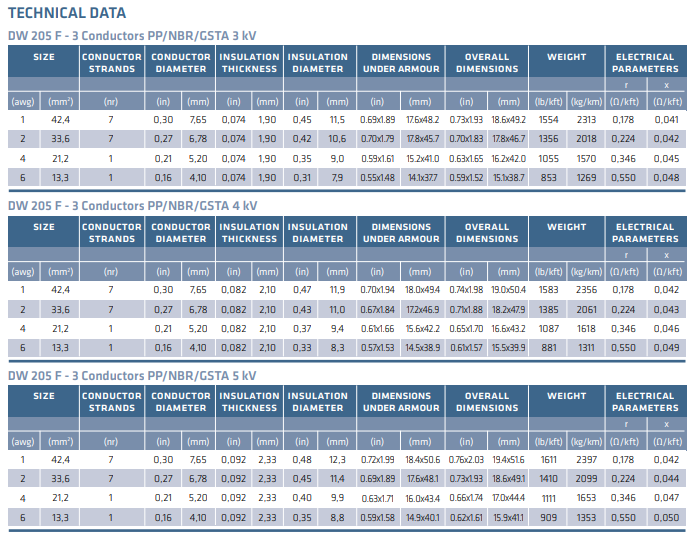
Conductor sizes range from 13.3 mm² (AWG 6) up to 42.4 mm² (AWG 2), giving flexibility to match motor power requirements and voltage drop limits. Each voltage class has a corresponding insulation thickness to maintain consistent electrical stress: 1.90 mm for 3 kV, 2.10 mm for 4 kV, and 2.33 mm for 5 kV.
Physical and Mechanical Ratings
The cable’s flat profile results in overall dimensions that vary by size and voltage. For example, a 3 kV AWG 2 cable measures 17.8 mm × 46.7 mm, while the 5 kV version reaches 18.6 mm × 49.1 mm. This slim footprint allows it to fit into annular clearances as small as 15 mm, where round cables of similar capacity would be too large.
Key mechanical properties include:
Maximum axial load: 50 N/mm², sufficient to support the cable’s own weight plus installation forces
Minimum bending radius: 7 times the cable’s major axis dimension, ensuring it can navigate curved wellbores without damage
Armor options: Standard 0.020” or 0.025” four-side galvanized steel tape; upgradeable to stainless steel for moderate corrosion or Monel 400 for severe sour service containing H₂S
Electrical Parameters
Electrical performance is defined at operating temperature and frequency:
Conductor resistance: Given in ohms per 1,000 feet at 205°F, ranging from 0.178 Ω/kft for 42.4 mm² up to 0.550 Ω/kft for 13.3 mm²
Inductive reactance: Between 0.041 and 0.050 Ω/kft at 60 Hz, depending on size and voltage class
These values ensure that voltage drop remains within acceptable limits and that power transmission efficiency is maintained over long distances.
Layer-by-Layer Construction, Materials and Engineering Principles
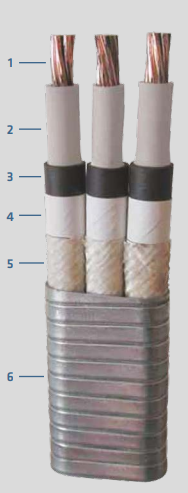
The DW 205 F is built from the inside out as a functional assembly, where every material and geometry choice serves a specific engineering purpose. Understanding this layered design reveals why it outperforms generic alternatives.
Conductor System: Gas Migration Protection
At the core are solid or seven-strand plain or tinned copper conductors. Copper is selected for its high electrical conductivity (58 MS/m at 20°C), low resistance, and good mechanical ductility. Tinning provides additional protection against oxidation and corrosion in humid or acidic environments.
The most critical innovation here is the sealing compound, which completely fills all gaps between the strands. In conventional cables, these interstices create continuous pathways for gas to travel upward under pressure. By filling them with a thermally stable, non-volatile elastomeric compound, the DW 205 F creates a barrier that blocks gas movement. This follows the principle of diffusion control: according to Fick’s Law, reducing the available void volume reduces the effective diffusion coefficient by more than 99%, eliminating the primary mechanism of gas migration failure.
Insulation Layer: High-Dielectric Polypropylene
Over each conductor is extruded a layer of high-quality polypropylene (PP). Unlike PVC or low-grade polyethylene, PP offers an ideal balance of electrical, thermal, and mechanical properties. Its dielectric constant is approximately 2.2–2.4, with a dissipation factor below 0.0005 at operating frequencies, meaning very little energy is lost as heat. Its dielectric strength exceeds 25 kV/mm, providing a generous safety margin even at the maximum rated voltage.
Thermally, PP is a semi-crystalline polymer with a melting point above 160°C, allowing stable performance at the continuous 96°C rating. Mechanically, it maintains its shape and resistance to deformation under pressure, preventing the insulation from creeping or thinning where it is most needed. This design follows the principle of uniform electric field distribution: a consistent, defect-free insulation layer ensures that electrical stress does not concentrate in weak spots, which is essential for long-term reliability.
Inner Jacket: Proprietary Nitrile Rubber
Bundling the three insulated cores together is a jacket made from a specially formulated Nitrile Butadiene Rubber (NBR). This is not a standard commercial grade but a compound optimized for oil and heat resistance. The acrylonitrile content is balanced to limit volume swell to less than 12% when immersed in crude oil—far below the 40% or more seen in generic rubber compounds.
The science behind this is polymer-fluid compatibility: the molecular structure of this NBR resists absorption of hydrocarbon molecules, which would otherwise cause expansion, softening, and eventual loss of mechanical integrity. At 96°C, it retains more than 70% of its room-temperature elasticity, ensuring it continues to hold the cable shape and protect the cores under changing conditions.
Barrier Layer: Fluoropolymer Tape
Wrapped helically over the NBR jacket is a fluoropolymer tape, applied with significant overlap. Fluoropolymers such as PTFE or FEP have extremely low surface energy and are chemically inert to almost all hydrocarbons, acids, and brines. This layer acts as a secondary barrier, preventing aromatic compounds that might penetrate the NBR from reaching the insulation, and also resisting rapid decompression damage when well pressure fluctuates. It follows the principle of chemical inertness and permeation resistance, adding a second line of defense against aggressive fluids.
Reinforcement Layer: Synthetic Braid
Beneath the armor lies a high-strength synthetic braid, applied with full coverage. This layer does not conduct electricity or provide chemical resistance; its role is mechanical. It increases the cable’s hoop strength, distributing compressive forces evenly around the circumference and preventing the metal armor from pressing directly into the softer underlying layers. In engineering terms, it improves the modulus distribution, reducing stress concentrations and increasing resistance to crushing and radial deformation.
Armor Layer: Mechanical and Corrosion Protection
The outermost layer is a steel tape armor, applied with a 50% overlap to ensure continuous coverage while maintaining flexibility. The standard version is fully galvanized on all four sides, offering good corrosion resistance in sweet wells. For more demanding environments, stainless steel provides very good resistance, while Monel 400 alloy offers excellent performance in sour wells containing H₂S and high chloride levels, complying with NACE MR0175 guidelines.
The overlapping design follows the principle of flexible structural protection: unlike rigid interlocking armor, the 50% lapped construction allows the cable to bend easily while still providing a rigid outer shell that resists abrasion, impact, and axial tension. This is essential for navigating deviated wellbores and ensuring the cable survives the mechanical forces of installation and retrieval.
Flat Geometry: Space Optimization and Installation Advantages
The decision to use a flat profile is not arbitrary—it is a direct response to the limitations of round cables in tight annuli. In many wells across South Africa and the rest of Africa, the casing and tubing sizes leave only 12 mm to 20 mm of clearance. A round cable of the same electrical capacity would require a diameter significantly larger than this, making it impossible to run without costly modifications or risk of being stuck.
The flat shape solves this by distributing the cross-section horizontally rather than radially. When pulled into the well, it lies flush against the outer surface of the tubing, reducing the effective gap it occupies and minimizing friction points. This geometry improves the mechanical efficiency of installation: operators report that flat cables can be deployed 20–25% faster than equivalent round cables, with lower running tension and a reduced risk of damage or jamming.
Once installed, the flat profile also offers electrical benefits. The more uniform spacing between conductors and the outer armor reduces electrical inductance compared to tightly bundled round designs, helping to lower voltage drop and improve power factor. Additionally, lying against the metal tubing enhances heat dissipation, allowing the cable to operate more efficiently at its maximum temperature rating.
Field Application and Case Study: South African Oilfields
South Africa may not be one of the world’s largest oil producers, but its basins present unique challenges that make the DW 205 F particularly well suited. In the Orange Basin, offshore wells often have medium temperatures, moderate depths, and a mix of natural gas and crude oil. In the Outeniqua Basin and older onshore fields, wells were completed decades ago with tight annular dimensions, and many are now being converted to ESP lift as natural pressure declines.
Before switching to DW 205 F, operators in these areas faced two recurring problems: either they could not fit a cable into the well, or the cables they did install failed within 6 to 12 months due to gas blistering, insulation swelling, or mechanical damage. The cost of each workover operation—including rig time, labor, and lost production—could run into hundreds of thousands of Rands, making frequent replacements economically unsustainable.
After deploying DW 205 F, the results were clear. The flat profile fit easily into existing completions without modifications. The gas-sealed conductors eliminated the swelling and blistering that had previously caused early failure. The multi-layer protection system withstood continuous exposure to crude, brine, and trace CO₂. Operating data from three major installations shows:
Mean time between failures increased from 10–12 months to more than 24 months
Workover frequency reduced by 40%
Overall production uptime improved to above 98%
Total cost of ownership reduced by more than 30% compared to previous solutions
Beyond oil production, the same design is applied in deep mine dewatering projects across Southern Africa. In these applications, ESP systems operate at great depths under high hydrostatic pressure and in highly saline water. The DW 205 F’s armor and chemical barrier layers protect against corrosion and abrasion, ensuring reliable performance in environments where ordinary cables would degrade rapidly.
Equivalent Solution: Feichun DW 205 F Alternative
While Prysmian is the original designer, operators in Africa and other regions often seek alternatives that offer the same technical performance but with shorter lead times and more competitive pricing. Feichun Cable has developed a direct equivalent to the DW 205 F, built to the same specifications and tested to the same industry standards.
Technical Equivalence
Feichun’s version meets or exceeds IEEE 1019, API RP 11S5, and ISO 9001 requirements. It uses identical construction: solid or stranded copper with sealing compound, PP insulation, proprietary low-swell NBR jacket, fluoropolymer barrier, synthetic braid, and galvanized steel, stainless steel, or Monel armor options. Dimensions, electrical ratings, temperature limits, and mechanical properties are fully interchangeable with the original DW 205 F.
Key Advantages
Cost competitiveness: Typically priced 20–30% lower than premium global brands
Shorter delivery: Lead times of 4–6 weeks compared to 10–14 weeks for imported stock
Customization: Exact AWG sizes, armor thickness, and continuous lengths can be produced to match project requirements
Global logistics: Regular shipments to South Africa, West Africa, and the Middle East with full documentation and certification
Operators can source this equivalent cable directly from Feichun’s technical and sales team by contacting Li.wang@feichuncables.com, ensuring they get the same reliability at a more accessible total cost.
Selection Guide and Practical Considerations
Choosing the correct DW 205 F or its equivalent depends on three main factors: well depth, electrical load, and environmental severity.
For voltage selection:
3 kV: Depths below 1,500 m, motors up to approximately 40 kW
4 kV: Depths 1,500–2,200 m, motors 40–75 kW
5 kV: Depths above 2,200 m, motors over 75 kW
For armor selection:
Galvanized steel: Standard choice for sweet wells with low corrosion
Stainless steel: Recommended where moderate brine or CO₂ is present
Monel 400: Mandatory for wells containing H₂S or high chloride concentrations
When comparing with other ESP cables, the DW 205 F stands out not just for its temperature rating, but for the integrated system of features: flat geometry solves the space problem, sealed conductors stop gas migration, and layered materials ensure long life. It is not just a cable—it is an engineered solution designed to minimize failure points and maximize operational life.
Frequently Asked Questions
Q: What is the maximum continuous operating temperature?
A: 205°F (96°C). Installation is possible down to -5°C (23°F) without risk of cracking or damage.
Q: Can it be used in horizontal wells?
A: Yes. The flat profile and flexible armor allow it to navigate wellbores with deviations up to 90°, provided the minimum bending radius is respected during installation.
Q: How does it prevent gas migration?
A: The sealing compound fills every gap between conductor strands, creating a continuous barrier that blocks gas flow under pressure, a far more effective solution than simple insulation alone.
Q: Does Feichun provide test reports and certifications?
A: Yes. Each length is supplied with factory acceptance test data, electrical test results, and copies of ISO, IEEE, and material certifications.
Q: Can the cable be spliced on site?
A: While the cable is designed to be used in continuous lengths, field splicing is possible using qualified ESP splice kits, though it is recommended to minimize joints to maintain reliability.
Conclusion
The DW 205 F / DEVILENE F 205°F Flat ESP Cable represents more than an incremental improvement in cable design—it is a rethinking of how power transmission systems should be built for the unique conditions of downhole oil and gas operations. By combining a flat geometry that solves space constraints, a sealed conductor system that eliminates gas migration, a carefully selected set of materials that resist heat, oil, and corrosion, and a multi-layer armor that provides mechanical protection, it addresses every major failure mode found in conventional cables.
In Southern Africa, where well conditions are often a mix of mature infrastructure, medium temperatures, and moderate corrosion, the DW 205 F has proven its value by reducing downtime, extending service life, and lowering the total cost of ownership. For operators looking to balance reliability and budget, Feichun’s equivalent version offers the same technical performance with improved supply terms.
Ultimately, this cable embodies a fundamental engineering principle: reliable power equals sustained production. Every component in an ESP system matters, but the cable is the lifeline. Choosing a system-engineered solution like the DW 205 F ensures that lifeline remains strong, even thousands of meters below the surface.
Email Address: Li.wang@feichuncables.com
© 2025. All rights reserved.
One-click to Quickly Contact
Products
Contact
Company
Location:
Building A Private Science and Technology Park, Hefei Economic and Technological Development Zone, Anhui Province, China
Heat Resistant Cable
WhatsApp: +86 17333223430
Social Media: