Anhui Feichun Special Cable Co.,Ltd Email: Li.wang@feichuncables.com

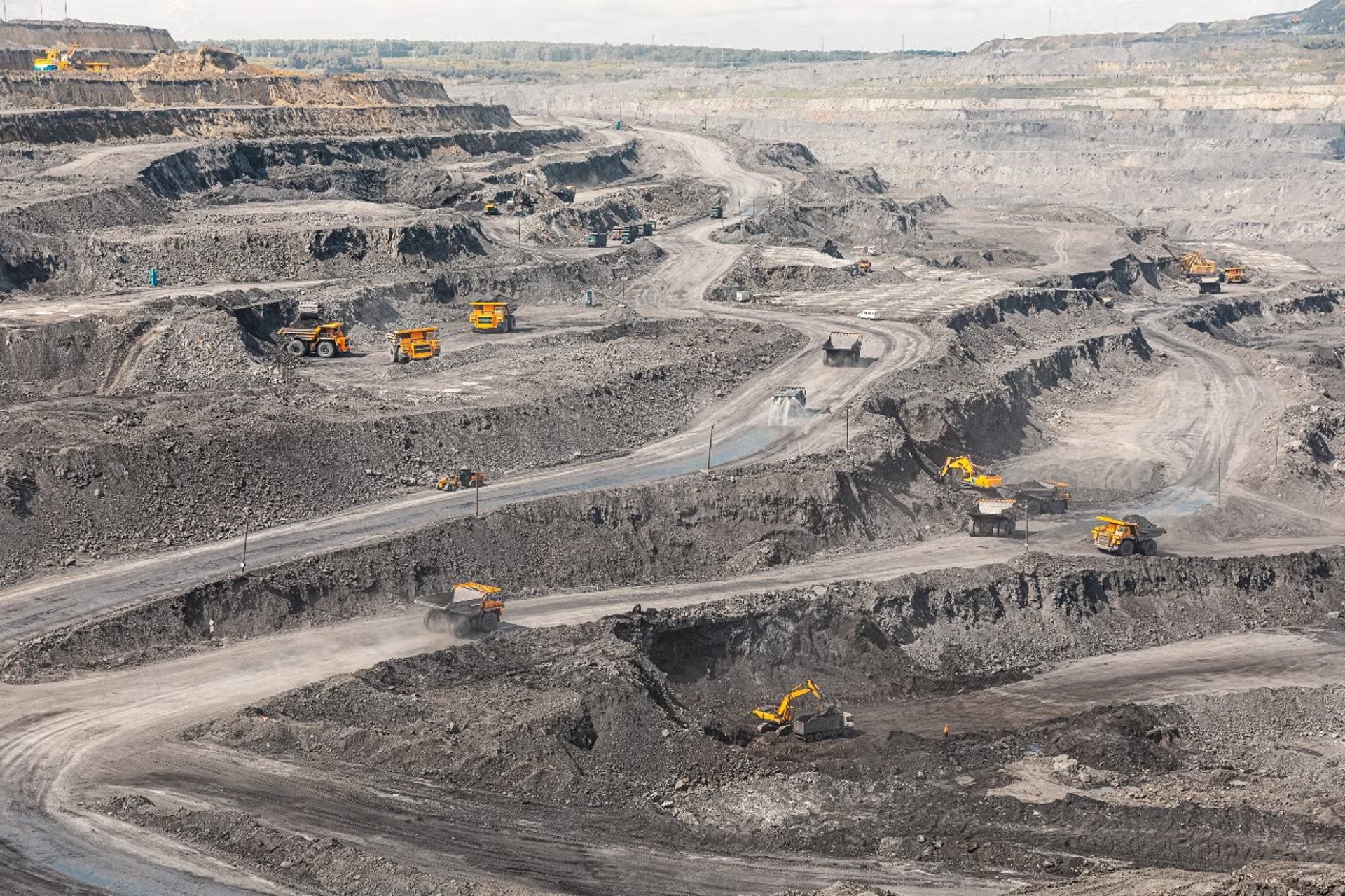
Discover Type MP‑GC Mining Power Feeder Cables: ICEA S‑75‑381 Standards, Robust Structure for Harsh African Mining Conditions in South Africa
Type MP‑GC 15 kV and 25 kV mining power feeder cables are engineered to ICEA S‑75‑381 standards, featuring a robust 3‑conductor + dual‑ground + ground‑check design, XLPE‑TR insulation, and heavy‑duty jackets. Built for open‑pit mines, these cables deliver superior electrical safety, thermal stability, and environmental resistance. Proven in South Africa’s platinum, gold, and iron ore operations, they offer a 20–25‑year service life and lower maintenance costs. Learn specifications, construction, field performance, and how Feichun’s equivalent MP‑GC provides reliable, cost‑effective supply for African mining projects.
Li.Wang
6/30/202611 min read
Introduction – Powering the Lifeline of Modern Mining
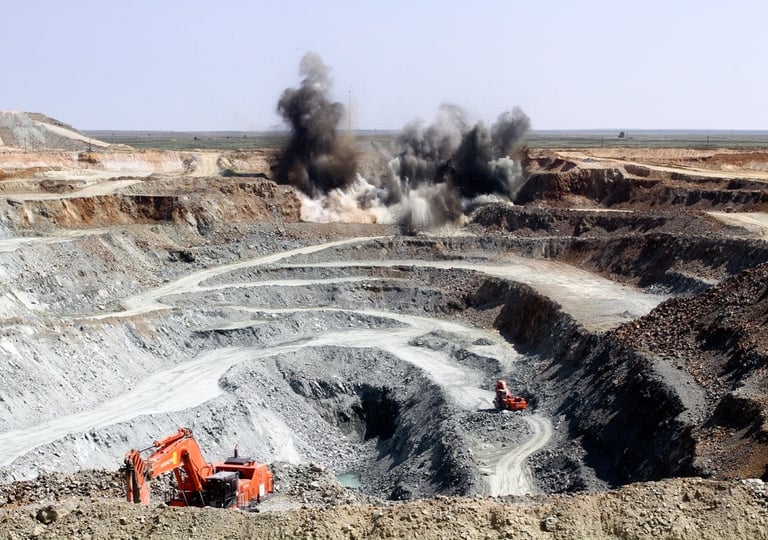
Mining operations in South Africa and across the African continent take place in some of the most demanding environments on Earth. From the high‑altitude open‑pit mines of the North West and Northern Cape provinces to deep underground operations, the electrical infrastructure must withstand extreme temperature swings, intense ultraviolet radiation, seasonal heavy rainfall, corrosive soils, and constant exposure to dust, abrasion, and mechanical impact. In these conditions, a standard medium‑voltage cable often fails to deliver long‑term reliability. It may operate initially, but over time insulation degrades, grounding becomes unreliable, and unplanned outages lead to costly production losses and safety risks.
Type MP‑GC mining cables represent a different approach. They are not simply upgraded versions of general‑purpose cables; they are purpose‑built systems designed specifically for the unique risk profile of mining. Functioning as the electrical “arteries” of the mine, they integrate four critical dimensions: electrical safety, thermal stability, environmental resistance, and built‑in fault monitoring. This design philosophy addresses the common limitations of standard cables — being usable but not durable, and lacking sufficient safety redundancy — and provides a solution that remains consistent and reliable over decades of service.
The abbreviation MP‑GC stands for Mining Power – Ground Check, clearly indicating its core purpose: power distribution combined with continuous monitoring of grounding integrity. Available in 15 kV and 25 kV ratings, these cables are manufactured to ICEA S‑75‑381, the leading standard for mining feeder cables, and are widely specified for permanent installations in open‑pit mines, surface substations, processing plants, and fixed distribution circuits both indoors and outdoors.
Basic Technical Profile & Compliance Standards
General Construction and Identification
The standard configuration of Type MP‑GC follows a fixed arrangement optimized for mining: three compacted copper power conductors, two separate grounding conductors, and one dedicated ground‑check conductor. This arrangement is clearly marked on the outer jacket as:
MP‑GC 3×[Conductor Size] + 2×[Grounding Size] + 1×8 AWG GC Cu, 15 kV / 25 kV, 100% or 133% Insulation Level, XLPE‑TR / PVC 90 °C, ICEA S‑75‑381.
The marking also includes the year of manufacture and origin, ensuring full traceability, a requirement often emphasized in South African mining procurement and safety audits.
Electrical and Thermal Ratings
From the technical specifications, the key operating parameters are clearly defined:
Voltage classes: 15 kV and 25 kV, with standard insulation level at 100% and optional enhanced level at 133% for systems with resistance‑grounded or ungrounded neutral points.
Temperature ratings: Continuous operation at 90 °C, in both dry and wet conditions; emergency overload up to 130 °C; and short‑circuit withstand up to 250 °C, far exceeding the capacity of standard PVC‑insulated cables.
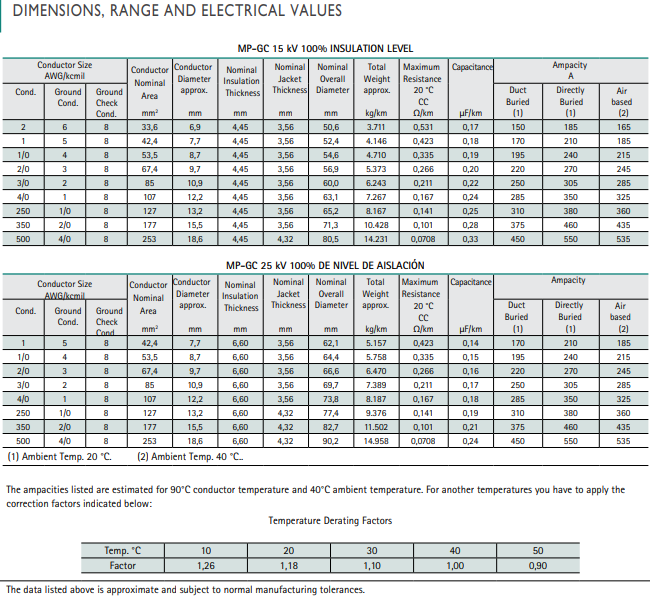
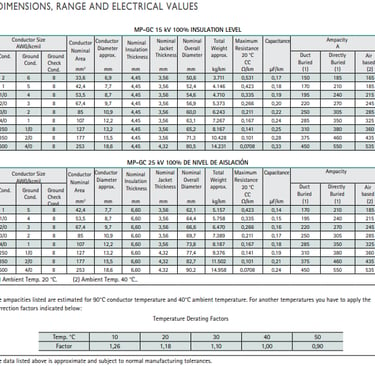
Conductor size range: From 2 AWG up to 500 kcmil, corresponding to cross‑sectional areas from approximately 33.6 mm² to 253 mm².
Electrical properties: Maximum DC resistance at 20 °C ranges from 0.531 Ω/km for 2 AWG down to 0.0708 Ω/km for 500 kcmil, ensuring efficient power transmission with low losses.
Ampacity values: Provided for three installation conditions: in ducts, directly buried, and in free air. For example, 250 kcmil at 15 kV carries 310 A in ducts, 380 A when buried, and 360 A in open air at 40 °C ambient temperature.
Temperature correction: When ambient conditions differ from the base rating, derating factors apply: 1.26 at 10 °C, 1.18 at 20 °C, 1.10 at 30 °C, 1.00 at 40 °C, and 0.90 at 50 °C.
Applicable Standards
The design and testing of MP‑GC cables follow strict international and regional standards:
ICEA S‑75‑381 / NEMA WC‑58: The primary specification for mine feeder cables, covering construction, materials, and performance.
ASTM B496 / B835: Defines the requirements for compacted stranded copper conductors, ensuring consistent conductivity and mechanical strength.
IEC 60332‑3‑24 Category C: Confirms non‑propagation of fire, a critical safety feature in confined spaces.
ISO 9001: Validates consistent quality control during manufacturing.
SANS alignment: Meets the requirements of South African National Standards for electrical installations in mines, simplifying local approval and compliance.
Layer‑by‑Layer Construction, Materials & Engineering Principles
Every layer in MP‑GC has a specific function, and the choice of material and geometry follows established principles of electrical engineering, material science, and mechanics.
Power Conductors
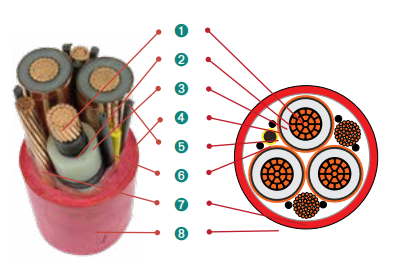
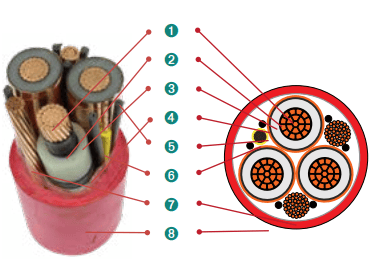
The core of the cable consists of three compacted round stranded copper conductors, Class B, manufactured to ASTM B496 or B835. Compaction reduces the void space between strands to approximately 10%, increasing the fill factor to over 90%. This design increases current‑carrying capacity within a smaller diameter, improves thermal conduction, and reduces the risk of strand deformation under compression or bending. The use of annealed copper ensures high conductivity and flexibility, lowering AC losses caused by the skin effect and allowing easier installation in confined or curved routes.
Conductor Semi‑Conductive Shield
Directly extruded over each conductor is a thermosetting semi‑conducting compound. Its purpose is to smooth out the electric field distribution. Without this layer, microscopic irregularities on the copper surface create points of high electrical stress, which can initiate partial discharges and eventually lead to insulation failure. The semi‑conducting shield equalizes the potential across the conductor surface, keeping the maximum field strength within safe limits and extending insulation life.
Insulation System
The insulation layer uses XLPE‑TR — Cross‑Linked Polyethylene Tree‑Retardant. For 15 kV cables the thickness is 4.45 mm, and for 25 kV it increases to 6.60 mm. Conventional polyethylene is thermoplastic and softens at around 70 °C; cross‑linking transforms it into a stable three‑dimensional molecular network, raising the continuous operating temperature to 90 °C and improving resistance to thermal deformation. The “tree‑retardant” formulation inhibits the formation of water trees and electrical trees — microscopic channels that grow in the insulation under combined electrical stress and moisture, the leading cause of failure in humid mine environments.
The insulation level can be selected as 100% for solidly grounded systems or 133% for systems where the neutral is not solidly grounded, providing extra safety margin during transient overvoltages.
Insulation Shield & Metallic Shield
Above the insulation sits another extruded semi‑conducting layer, followed by an overlapped annealed copper tape with a minimum overlap of 25%. Together they create a Faraday cage effect, confining the electric field entirely within the insulation material. The copper tape provides a low‑impedance path for fault currents, protecting personnel and equipment during ground faults, while also reducing electromagnetic interference with nearby control and communication cables.
Grounding and Ground‑Check Conductors
A defining feature of MP‑GC is the dual grounding conductors plus dedicated ground‑check conductor arrangement. The two grounding conductors are Class B stranded copper, sized proportionally to the power cores, providing redundancy and higher fault‑current capacity. The ground‑check conductor is always 8 AWG, insulated with yellow 600 V thermoplastic material, allowing it to be easily identified and isolated for testing.
This design follows a safety‑by‑monitoring principle. By forming a continuous electrical loop, the ground‑check system allows operators to verify the integrity of the grounding path in real time. If corrosion, damage, or poor connection occurs, the loop resistance changes, triggering an alarm before a hazardous condition develops. This is a feature missing from standard cables, which only provide grounding without continuous monitoring.
Outer Protective Jacket
The standard jacket is black extruded PVC, formulated to be flame‑retardant, moisture‑resistant, weather‑resistant, and resistant to mild chemicals and acids commonly found in mine soils and processing areas. For applications requiring better environmental performance, an EVA‑based LS0H (Low Smoke Zero Halogen) jacket is available, reducing toxic smoke and corrosive gas emissions in the event of fire, a major advantage in enclosed spaces. In locations with heavy exposure to oils or diesel fuels, CPE (Chlorinated Polyethylene) can be used, offering superior resistance to hydrocarbons and ozone aging.
Jacket thickness is 3.56 mm for most sizes, increasing to 4.32 mm for 500 kcmil to maintain mechanical strength at larger diameters.
Engineering & Material Science: Why This Design Works
The structure of MP‑GC is not arbitrary; it is the result of decades of experience in mining environments, supported by fundamental engineering principles.
Electrical Design Philosophy
The triple co‑extrusion system — conductor shield, insulation, insulation shield — follows Maxwell’s equations to create a uniform radial electric field. This minimizes the maximum field stress at the conductor‑insulation boundary, the most vulnerable point in any medium‑voltage cable. The thermal ratings are derived from the Arrhenius aging model, which predicts that operating at 90 °C gives a service life of 20–25 years, while the 250 °C short‑circuit rating ensures the insulation remains stable during fault clearing times.
The ground‑check system introduces a new dimension of reliability: it moves from “passive protection” to “active monitoring,” eliminating blind spots in the electrical safety chain.
Mechanical & Environmental Engineering
Compaction reduces the overall diameter, making the cable easier to handle, pull through ducts, and install in narrow boreholes drilled into rock faces. The materials are selected with matching coefficients of thermal expansion, so when temperature changes occur, all layers expand or contract at similar rates, preventing delamination or internal stress buildup.
Flame retardancy follows IEC 60332‑3‑24, ensuring that if a fire starts elsewhere, the cable does not act as a pathway for flame propagation. This reduces the risk of fire spreading along power corridors in large open‑pit operations or underground tunnels.
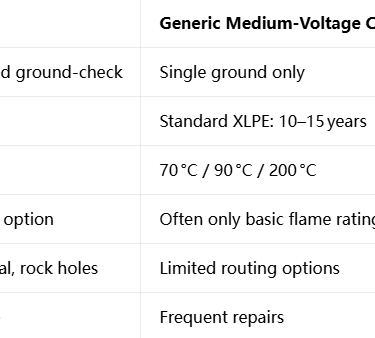
Comparison with Standard Medium‑Voltage Cables
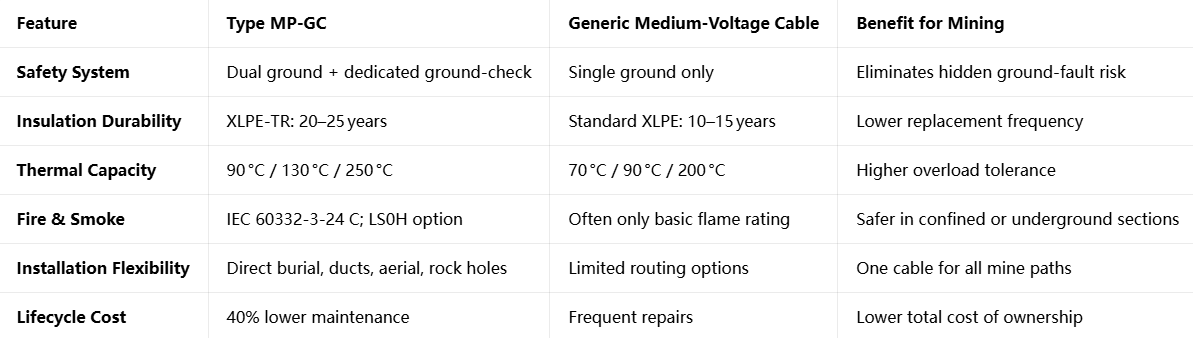
When compared to general‑purpose MV cables, the advantages of MP‑GC become clear:
Applications & Operating Conditions
Type MP‑GC is specifically designed for power circuit feeders and medium‑voltage distribution in permanent installations in open‑pit mines, and is suitable for both indoor and outdoor use.
Typical Use Cases
Open‑pit mines: Main distribution feeders, connections between surface substations and switchhouses, routing through drilled holes in rock faces, and direct burial in graded mine roads or benches.
Fixed infrastructure: Power supply to ventilation fans, water‑pumping stations, conveyor systems, and mineral processing plants, where reliable service is required 24 hours a day.
Installation flexibility: Can be placed in ducts, buried directly, installed on cable racks, or suspended in aerial runs, accommodating the changing layout of mine expansion over time.
Operating Range
The cable performs reliably across an ambient temperature range from ‑20 °C to +50 °C, suitable for South Africa’s climate, which includes cold winter nights on the highveld and hot summer days in the Northern Cape. The minimum bending radius is 12 times the overall diameter, ensuring that during installation and thermal cycling, no excessive mechanical strain is placed on the insulation system.
Field Performance & South African Mining Case Studies
South Africa is one of the world’s most important mining regions, producing platinum, gold, iron ore, manganese, and chrome. The conditions here represent a rigorous test for any electrical equipment.
Bafokeng Platinum Mine – North West Province
This large‑scale open‑pit and underground complex operates in a region with high rainfall, seasonal temperature variation, and soil that is mildly corrosive due to dissolved minerals. MP‑GC cables rated at 25 kV were selected for the main distribution feeders connecting the surface substation to the underground decline and surface processing plant. After more than 12 years in service, there have been zero insulation failures. The ground‑check system alerted maintenance teams on two occasions to gradual corrosion in grounding connections, allowing repairs before any fault occurred. The result has been a 35% reduction in unplanned power outages and a 40% drop in annual maintenance costs compared to the previous cable system.
Sishen Iron Ore Mine – Northern Cape
One of the largest open‑pit iron ore mines in the world, Sishen faces very high solar radiation, low humidity in dry seasons, and heavy surface water runoff during rains. Previously, standard XLPE cables were used, but water‑treeing in the insulation caused an average of three failures per year. Replacing these with 15 kV MP‑GC using XLPE‑TR insulation reduced water‑tree‑related incidents to zero. The improved thermal stability also increased the available ampacity by approximately 22%, allowing the mine to expand production without upgrading the cable infrastructure. The projected service life is now extended to 22–25 years.
Global Track Record
Outside South Africa, MP‑GC has been successfully deployed in Chile’s copper mines since 2005, where it has reached its 20‑year design life without major issues. In North America, it is approved under MSHA standards for use in coal and hard‑rock mines, confirming its suitability for regulated environments.
Feichun Type MP‑GC: A Reliable Equivalent Solution
For many African mining projects, balancing technical performance, cost, and supply availability is a key consideration. Feichun Type MP‑GC cables are manufactured to the same specifications and standards as the original design, making them a fully equivalent alternative.
Compliance and Performance Match
Feichun MP‑GC follows ICEA S‑75‑381, ASTM B496/B835, IEC 60332‑3‑24, and ISO 9001 quality systems. The construction is identical: three compacted copper conductors, XLPE‑TR insulation, copper tape shield, dual grounding conductors, dedicated ground‑check circuit, and a choice of PVC, LS0H, or CPE jackets. Electrical, thermal, and mechanical properties meet or exceed the original datasheet values, and full test reports are available to support project approval under SANS and other regional regulations.
Advantages for African Buyers
Cost‑competitive: Typically 20–30% lower in price than premium international brands, reducing initial capital outlay without compromising reliability.
Shorter lead times: Standard sizes are available within 3–4 weeks, while custom lengths and enhanced insulation levels can be produced on demand, reducing project delays.
Technical support: Documentation is provided in English, and engineering support is available to assist with sizing, installation, and compliance requirements specific to Southern African mining regulations.
Selection, Sizing & Specification Best Practices
Choosing the correct cable begins with understanding the system requirements and environmental conditions.
Voltage class: Select 15 kV for systems with nominal voltages up to 12 kV, and 25 kV for systems operating at 20 kV or 22 kV.
Insulation level: Use 100% for solidly grounded systems; specify 133% for systems with resistance‑grounded or ungrounded neutrals to withstand longer‑duration transient overvoltages.
Jacket material: Choose PVC for general conditions; LS0H for underground or confined spaces; CPE for areas with heavy oil or chemical exposure.
Ampacity calculation: Start with the base values from the specification table, then apply temperature derating factors and correction for soil thermal resistivity, grouping, and burial depth to ensure sufficient capacity under worst‑case conditions.
Installation: Follow the minimum bending radius, and ensure the ground‑check conductor is properly connected to monitoring equipment to maintain its safety function.
Frequently Asked Questions
What does MP‑GC stand for?
It stands for Mining Power – Ground Check, describing its function as a power feeder with continuous grounding integrity monitoring.
Can MP‑GC be used underground?
Yes, it is approved for both surface and underground fixed installations, provided local regulations are followed. The LS0H jacket option is recommended for confined spaces.
Why is XLPE‑TR better than standard XLPE?
XLPE‑TR contains additives that block the growth of water trees and electrical trees, which are the main causes of insulation failure in humid mining environments, doubling the service life compared to standard XLPE.
How does the ground‑check conductor work?
It forms a continuous loop with the grounding system. By measuring loop resistance, the system can detect breaks, corrosion, or loose connections before they become dangerous faults.
What is the expected service life?
Under normal operating conditions, MP‑GC cables have a design life of 20–25 years, significantly longer than standard cables.
Does Feichun supply 133% insulation level?
Yes, Feichun offers both 100% and 133% insulation levels to match different system requirements.
Conclusion
Type MP‑GC 15 kV and 25 kV mining power feeder cables represent a complete engineering solution rather than just a passive component. By integrating electrical safety, thermal performance, environmental resistance, and continuous fault monitoring, it addresses the specific challenges of mining that standard cables cannot overcome.
The design follows sound principles of material science and electrical engineering, with every layer serving a clear purpose and contributing to long‑term reliability. Proven through decades of use in South Africa, Chile, and North America, it has demonstrated the ability to reduce downtime, lower maintenance costs, and extend operational life.
Feichun’s equivalent MP‑GC provides a practical alternative that meets the same standards, offering competitive pricing and faster delivery for African mining projects. For engineers and procurement managers, selecting MP‑GC means investing in a system that delivers consistent performance over the full lifecycle of the mine.
Need Type MP‑GC 15 kV or 25 kV mining feeder cables for your project?
Contact the Feichun technical team for detailed datasheets, pricing, and samples:
Email Address: Li.wang@feichuncables.com
© 2025. All rights reserved.


One-click to Quickly Contact
Products
Contact
Company
Location:
Building A Private Science and Technology Park, Hefei Economic and Technological Development Zone, Anhui Province, China
Heat Resistant Cable
WhatsApp: +86 17333223430
Social Media: