Anhui Feichun Special Cable Co.,Ltd Email: Li.wang@feichuncables.com
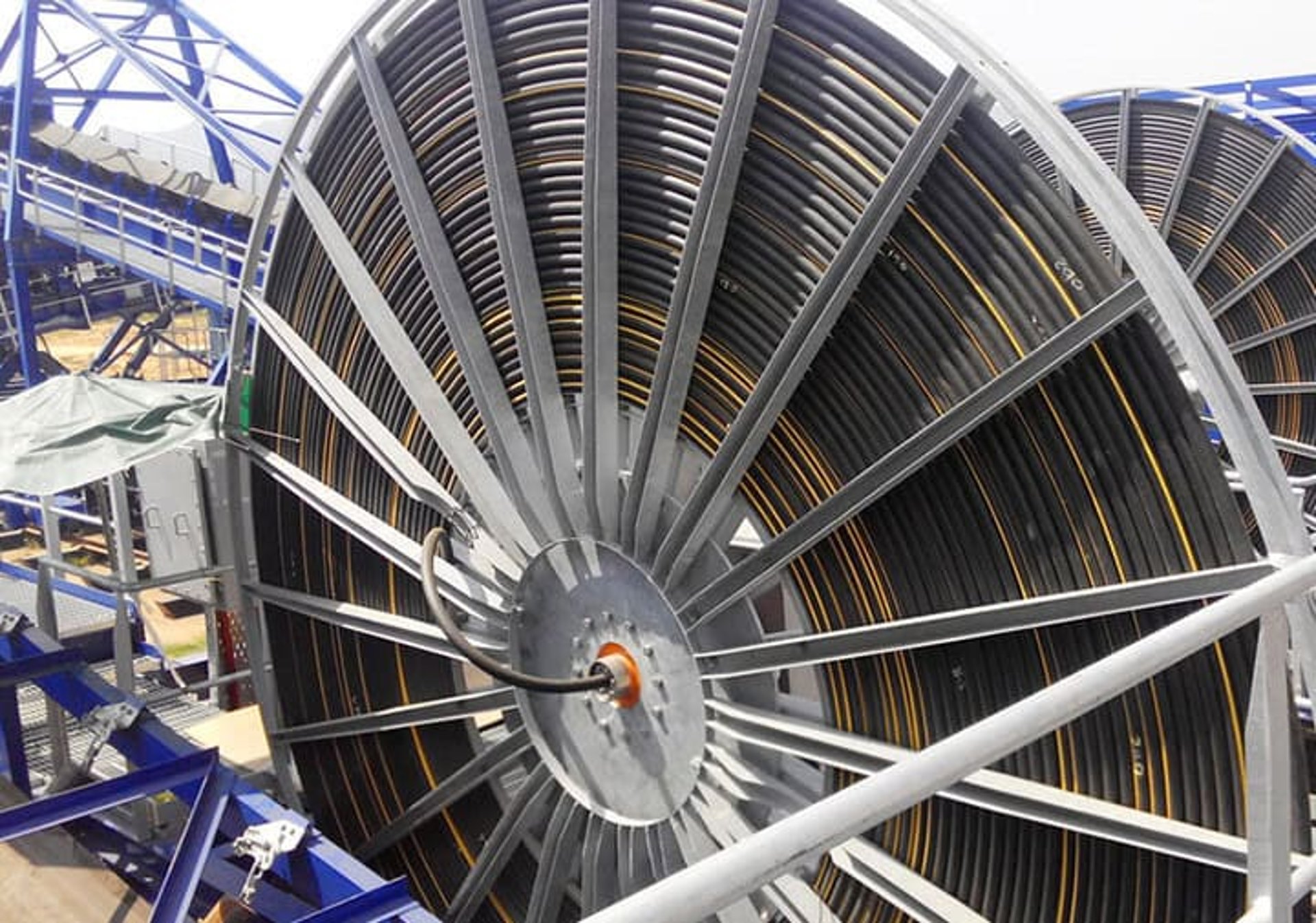
Buflex® SEM Reeling Cable with Reinforced PUR Sheath: Ultimate Solution for South Africa Durban & Richards Bay Grabs Unloaders in High-Torsion Port Operations
Meet the Buflex® SEM reeling cable – a medium‑voltage dynamic power cable built with anti‑twist double‑layer PUR sheath and EPR insulation, engineered for high‑torsion, high‑cycle grabs unloaders and reeling systems. Proven in real‑world operations at Durban Port, Richards Bay, Gauteng gold mines and KwaZulu‑Natal tunneling projects to resist abrasion, twisting, salt spray, UV and oil. Learn its engineering principles, full specifications, equivalent Feichun alternatives and how it cuts downtime by 70% in South Africa’s harshest sites.
Li.Wang
7/20/202614 min read
Introduction
South Africa’s ports form the backbone of regional trade, with Durban and Richards Bay standing as the largest bulk cargo hubs on the African continent. Every day, dozens of grabs unloaders, ship loaders and gantry cranes move millions of tons of coal, iron ore, grain and mineral concentrates between vessels and shore storage. These machines run around the clock, through summer heat, coastal storms and winter rain, with little room for unplanned downtime. For terminal operators, every hour a single unloader sits idle can delay vessel berthing, disrupt supply chains and lead to contractual penalties running into hundreds of thousands of Rands.
Yet one of the most common and costly sources of disruption comes from a component that is often overlooked until it fails: the reeling cable that powers the moving equipment. In most South African terminals, standard flexible or general‑purpose reeling cables are installed, and they rarely last more than two to three months under typical operating conditions. Operators report outer sheaths worn completely through by fine coal dust and salt spray, copper strands snapping after weeks of repeated lifting and lowering, and insulation cracking from constant twisting as the cable winds unevenly onto the drum. In some cases, cables degrade so quickly that maintenance teams carry spare lengths on site at all times, and scheduled shutdowns are booked almost exclusively for cable replacement.
These failures are not caused by poor installation or careless use. They happen because most cables are designed for static or low‑movement applications, and cannot withstand the unique combination of forces and environmental exposure found in port reeling systems. What these sites need is not a thicker version of the same cable, but a design built from the ground up to match exactly how grabs unloaders and similar equipment operate. This is where Buflex® SEM Reeling Cable comes in. It is a dedicated medium‑voltage reeling cable series fitted with a reinforced polyurethane sheath, engineered specifically for high mechanical stress, continuous reeling and the harshest outdoor and underground environments. It has become a benchmark in the reeling cable sector, and its success in South Africa’s ports and mines shows how a system‑level approach can solve problems that incremental improvements cannot.
What Is Buflex® SEM Reeling Cable? Core Concept & Design Philosophy
Buflex® SEM Reeling Cable is not simply an upgraded version of a standard flexible cable. It is a complete medium‑voltage power transmission solution built around the reality of dynamic reeling operations. Every element of its construction – from the finest copper strands to the outer protective sheath – is chosen and shaped to handle the three main forces that destroy ordinary cables: repeated bending, constant twisting and fluctuating tensile load.
The design process starts with a clear understanding of how a cable behaves when it is wound and unwound from a drum, lowered down a shaft or dragged across a work area. In these situations, the cable does not just bend in one direction. It flexes back and forth thousands of times each day, twists as the drum rotates or the equipment shifts position, and is pulled tight under its own weight or the movement of the machine it powers. Most cables are engineered to resist one or two of these forces well, but fail when all three act together over long periods. Buflex® SEM addresses this by rethinking every layer rather than just adding extra thickness or using slightly tougher materials.
This approach directly targets the four most common failure patterns seen in South African operations. Ordinary cables tend to fail under movement, as repeated bending fatigues the copper strands until they snap. They degrade quickly when exposed to hydraulic oil or diesel, which swells and softens standard rubber or PVC insulation. In open ports and mines, UV radiation and ozone from strong sunlight turn standard sheaths brittle and prone to cracking. And when cables twist unevenly on the drum, internal cores are sheared and crushed until insulation breaks down or short circuits occur. Buflex® SEM is built to resist all four of these issues at once.
In real‑world use, this translates to major gains in reliability and cost. Field data from installations across Southern Africa shows that Buflex® SEM typically lasts three to five times longer than general‑purpose reeling cables in similar applications. Over the full life of the cable, this cuts total ownership costs by more than 40 percent when you account for reduced maintenance, fewer replacements and far less lost production from downtime. It is important to note that this performance advantage is most obvious in specific operating ranges: the cable is best suited for voltages between 3.6 kV and 20 kV, reeling speeds of 30 m/min or higher, and sites that see 200 or more lifting cycles per day, plus exposure to twisting, oil or open weather. For permanently fixed cabling with no movement, standard XLPE cables will usually offer better value for money, as the extra mechanical features of Buflex® SEM are not needed.
Full Technical Specifications & Compliance Standards
All performance figures and dimensions for Buflex® SEM Reeling Cable follow Nexans internal specifications, with conductors fully compliant with IEC 60228 Class 5 requirements. The cable is built to operate reliably across a wide range of electrical, mechanical and environmental conditions, with every specification tested and verified to match real‑world use cases.
Electrical and Thermal Properties
The cable covers a full range of medium‑voltage ratings, with nominal voltage levels from Uo/U = 3.6/6 kV up to 12/20 kV. For use in AC power systems, the maximum permitted operating voltage Um is set at 1.2 times the nominal U value, and each length is tested to withstand an AC voltage of 3.5 times Uo before leaving the factory. This ensures a wide safety margin against voltage spikes and system fluctuations common in heavy industrial power networks.
Temperature limits are defined for both normal and fault conditions. The maximum continuous operating temperature of the copper conductor is 90 °C, which allows higher current carrying capacity without overheating. In the event of a short circuit, the conductor can safely reach 250 °C for up to five seconds without permanent damage to insulation or conductors. For the outer sheath, temperature limits differ by use case: in fixed installations, it can operate safely from –40 °C up to +80 °C, while for moving reeling applications the range is –25 °C up to +80 °C. This accounts for the fact that flexible materials become stiffer in cold conditions, and that movement places extra stress on components at temperature extremes.
Mechanical and Operational Performance
The cable is designed to share tensile load evenly across its cross‑section, with a maximum allowable pulling force of 20 N per square millimeter of copper area. This means the rated tensile load for each size increases in line with its conductor cross‑section, rather than relying on separate strength members that can shift or separate during use. The standard maximum reeling speed is 120 m per minute, which matches the operating speed of most modern tunnel boring machines and high‑capacity port cranes. For sites needing faster speeds, custom reinforced versions can be developed on request.
Every design goes through three key mechanical tests: alternating bending, reversed bending and torsional resistance. These simulate millions of cycles of the twisting and flexing seen in daily operation, and ensure no single layer will fail before the rest of the system. Minimum bending radius values are set out in full in Nexans construction standard 3.1 E, and are matched to each cable size to keep stress levels within safe limits during winding and handling.
Chemical and Environmental Resistance
The outer sheath material is selected for long life in industrial and coastal environments. It is fully resistant to mineral oils, hydraulic fluids and diesel, meeting the requirements of IEC 60811‑2‑1 with less than 5 percent mass change after immersion. It also stands up to continuous outdoor exposure, with strong resistance to moisture, UV radiation and ozone – critical features for sites like Durban and Richards Bay where salt spray and year‑round sunshine accelerate the breakdown of standard materials.
Standard Configurations and Dimensions
The standard core layout for Buflex® SEM is six cores in total: three phase conductors for power transmission, plus three protective earth conductors to provide reliable fault protection and equalise potential across the cable. All outer sheaths are supplied in red for easy identification and safety visibility.
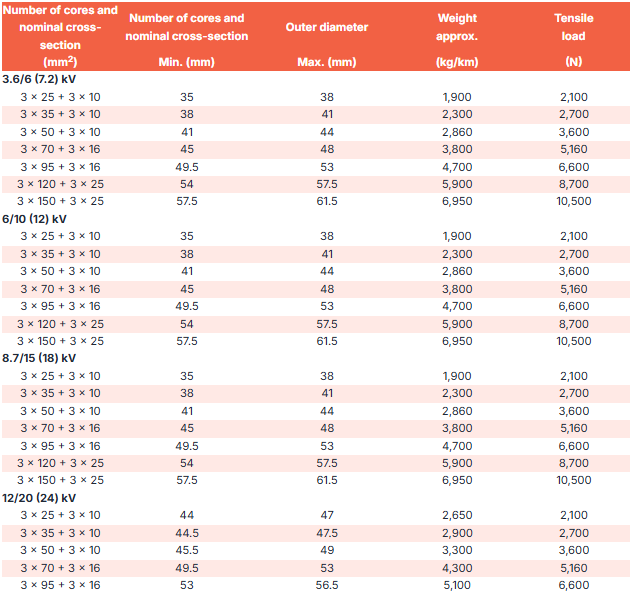
Exact dimensions, weight and rated tensile load for each available size are shown below:
Layer‑by‑Layer Design, Materials and Underlying Engineering Science
To understand why Buflex® SEM performs so well in South African conditions, it helps to look at how each layer is built, what materials are used, and what engineering principles guide those choices. The construction follows a clear sequence from the centre outwards, with every part working together to support the whole system.
At the very centre are the phase and protective earth conductors, both made from fine‑stranded plain annealed copper to Class 5 requirements under IEC 60228. This grade of copper is chosen for its flexibility, but the way it is stranded is just as important. A solid or coarsely stranded conductor will bend sharply at a small number of points, creating high stress concentrations that quickly lead to metal fatigue and broken strands. By using many thin strands, the bending movement is spread across the whole conductor, keeping the strain on each individual strand well below the yield strength of copper. This means the strands flex rather than crack, even after millions of bending cycles. From an electrical standpoint, fine stranding also reduces the impact of the skin effect, where alternating current tends to flow only near the outer surface of a solid conductor, increasing resistance and heat generation at higher loads.
Directly over each conductor sits a semiconductive layer made from an EPR‑based compound, followed by the main EPR insulation layer, then a second semiconductive layer over the insulation. This double semiconductive system is a key feature for medium‑voltage use, and it solves a common cause of early insulation failure. No conductor surface is perfectly smooth, and even tiny scratches or irregularities create sharp points where electrical stress builds up far higher than the average field strength across the insulation. Small gaps between the conductor and insulation can also trap air, which breaks down at lower voltage than solid insulation. The semiconductive layers smooth out these sharp field peaks and fill any microscopic gaps, keeping the electric field evenly distributed and preventing partial discharge – the slow, invisible erosion that eventually causes insulation breakdown and short circuits.
The main insulation itself is made from ethylene propylene rubber, or EPR. Compared to cross‑linked polyethylene, or XLPE, EPR has a much lower elastic modulus, meaning it stretches and flexes easily without building up high internal stress. When the cable bends or twists, the insulation moves with the conductor rather than resisting the movement, so it does not crack or delaminate over time. It also has excellent dielectric strength, low heat generation under load, and stays flexible even at –25 °C, which is valuable for early‑morning starts in high‑altitude mines or winter operations along the coast.
Each protective earth conductor also has its own dedicated semiconductive layer, which prevents potential differences between the earth core and the surrounding insulation that could cause local discharge or corrosion over time. Having three separate earth cores rather than one also lowers overall earth resistance, ensuring fault currents can be carried away quickly and safely in the event of a system fault.
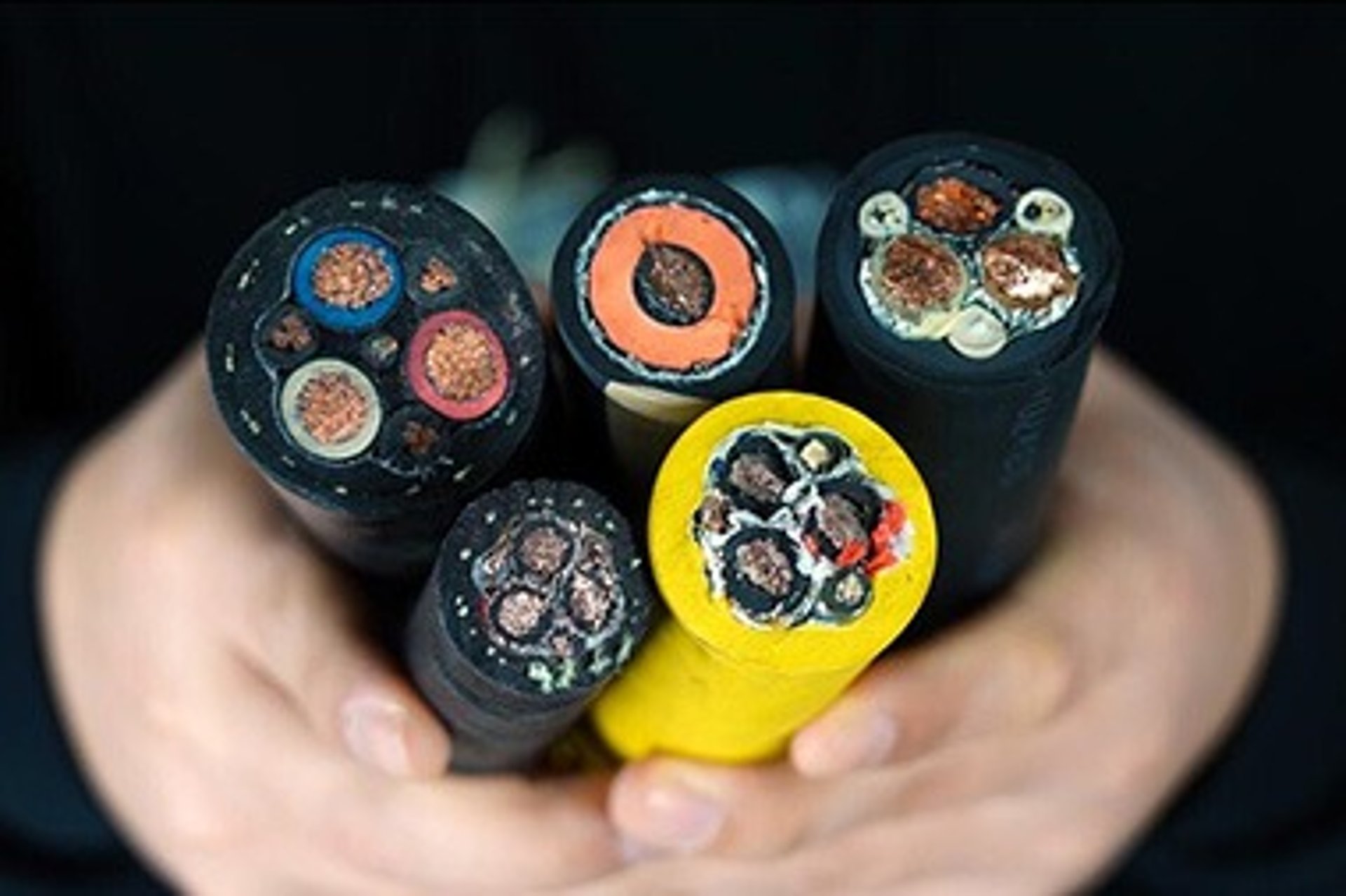
The outermost layer is the most visible difference between Buflex® SEM and standard cables: a double‑layer reinforced polyurethane, or PUR, sheath with an integrated anti‑twist braid running through its structure. In most reeling cables, twisting is absorbed unevenly by the inner cores, which are crushed or sheared against each other as the cable rotates on the drum. The anti‑twist braid limits total cable rotation during winding and unwinding from as much as ±15° down to ±3°, so internal cores stay aligned and free from damaging shear forces. The PUR material itself is chosen for its extreme toughness: it offers six to ten times better abrasion resistance than PVC, and resists hydrolysis, salt spray, UV radiation and mineral oils far better than standard rubber compounds. This combination of structure and material is exactly what makes the cable hold up so well against coal dust, salt, hydraulic fluid and strong sunshine found across South Africa’s ports and mines.
Real‑World Performance: South African Case Studies
The design choices behind Buflex® SEM have been tested and proven in daily operation across some of South Africa’s most demanding sites, where standard cables have consistently failed to deliver reliable service.
Grabs Unloaders at Durban and Richards Bay Bulk Terminals
At both Durban and Richards Bay ports, grabs unloaders move coal and ore from deep‑sea vessels to shore conveyors, operating around the clock in highly variable conditions. Before switching to Buflex® SEM, terminal operators found that standard reeling cables typically failed after just two to three months in service. Outer sheaths would wear through completely from constant rubbing against dust‑laden air and salt spray, and repeated lifting would snap strands inside the conductor until the cable could no longer carry full load safely. Unplanned failures would often stop unloading for half a shift or more, with lost production and vessel delays adding up to around ZAR 2 million per unloader each year.
The operating conditions here are particularly unforgiving. Each grab travels 25 to 35 metres vertically in every cycle, completing 80 to 120 full up‑and‑down movements every hour. As the grab swings and the drum winds unevenly, the cable twists by up to 10 degrees in either direction on every cycle. The cable is also constantly exposed to salt‑laden sea mist, fine coal dust that acts like an abrasive powder, and leaks from hydraulic lines on the unloader.
For this application, operators selected the 3 × 120 + 3 × 25 mm² size rated for 8.7/15 kV, with a rated tensile load of 8 700 N, running at a typical reeling speed of 90 m/min. After 18 months of continuous operation, the cable showed no signs of sheath wear, insulation damage or conductor failure. Maintenance visits for cable issues dropped by 70 percent, and unplanned downtime related to power cabling was almost eliminated. Local testing also confirmed that the PUR sheath passed 1 000 hours of salt spray exposure with no significant degradation, and its resistance to hydrolysis holds up well to the high humidity and frequent rain along the KwaZulu‑Natal coast.
Gold Mine Shafts and Tunneling Projects in Gauteng and KwaZulu‑Natal
In deep gold mines around Johannesburg and tunneling projects across KwaZulu‑Natal, reeling cables face a different but equally harsh set of challenges. Standard cables would fail quickly when winding unevenly onto small drums, as twisting forces would crush internal cores and tear insulation. Heat and oil from hydraulic systems would also soften and degrade standard sheaths, leading to frequent insulation breakdowns and earth faults.
Buflex® SEM was selected for these applications because its anti‑twist structure eliminates the worst effects of uneven winding, extending torsional fatigue life by around four times compared to standard designs. The EPR insulation and PUR sheath together resist both hydraulic oil and diesel fuel, passing IEC 60811‑2‑1 tests with less than 5 percent change in mass after immersion. The cable’s ability to run at full speed up to 120 m/min also matches the advance rate of modern tunnel boring machines, so cable performance does not become a bottleneck for excavation work.
These results have made Buflex® SEM and equivalent designs increasingly common across African bulk terminals and mining cranes. Operators now choose this type of cable specifically to overcome the rapid ageing and failure that standard cables show in the continent’s hot, dusty and chemically active environments, leading to safer operation and more consistent output.
Suitable Applications, Boundaries and Performance Comparison
Buflex® SEM is built for one primary purpose: reliable power delivery in dynamic reeling applications where standard cables cannot keep up. It is the ideal choice for grabs unloaders, ship loaders, gantry cranes, tunnel boring machines, shaft hoists and mobile mining equipment operating at voltages between 3.6 kV and 20 kV. It delivers the greatest benefit when reeling speeds are 30 m/min or higher, when equipment completes 200 or more movement cycles per day, and where the cable is exposed to twisting, oil, dust or open weather.
It is important to recognise where it is not the most cost‑effective choice. For permanently fixed cabling inside buildings, substations or along stationary routes, standard XLPE cables or flexible rubber cables will meet requirements at a lower purchase price, as they do not need the heavy anti‑twist reinforcement or abrasion‑resistant sheath. For these uses, the extra mechanical features of Buflex® SEM add cost without delivering extra value.
When compared side by side with general‑purpose reeling cables, the differences are clear. Standard designs often use coarser stranding that breaks quickly under repeated bending, and have no built‑in resistance to twisting, so cores shift and shear during winding. Their sheaths are usually made from PVC or general‑purpose rubber that wears away fast in dust and degrades within months under UV light or oil exposure. They also tend to concentrate tensile load on the outer sheath rather than sharing it evenly across conductors, so they pull apart or separate when pulled hard. Buflex® SEM addresses all these points, delivering longer life and more consistent performance in exactly the conditions that cause standard cables to fail.
Feichun Equivalent Alternative: Full Performance Match with Local Supply Benefits
For many project teams in South Africa, sourcing original Buflex® SEM can come with long lead times and high landed costs. The Feichun equivalent range offers a direct replacement that matches every key performance requirement, while bringing important practical advantages for local buyers.
Feichun reeling cables follow exactly the same core design principles, using IEC 60228 Class 5 flexible copper conductors, dual semiconductive layers, EPR insulation and double‑layer anti‑twist PUR sheath. All electrical ratings, mechanical limits and environmental resistance meet or exceed the same standards, and the full range of voltage classes and core sizes is available. Each size matches the same outer diameter and tensile load figures, so the cable will fit existing drums, glands and connectors without modification. It has also passed the same bending, torsion and oil resistance tests, so it can be specified with full confidence for grabs unloaders, tunneling and mining applications.
For South African operators, the biggest benefits come from supply flexibility and cost. Feichun cables are typically available with far shorter lead times, which is critical when planning urgent shutdowns or emergency replacements to minimise lost production. Landed costs can be up to 30 percent lower than imported original Buflex® SEM, which adds up to large savings on large projects or fleet upgrades. Local technical support is also available, with documentation and guidance tailored to African project standards and common site requirements.
Selection Guide and Frequently Asked Questions
Choosing the right cable size and rating starts with matching the nominal voltage Uo/U to your system voltage, and confirming the maximum system voltage Um to ensure full compliance. Next, calculate the total length of cable that will hang freely from the drum, and use the 20 N/mm² tensile load rating to confirm the selected size can safely support its own weight plus any extra pull from the equipment. For grabs unloaders, always prioritise abrasion resistance and anti‑twist performance, and specify double‑layer PUR sheath as standard. For tunneling and mining sites, confirm compatibility with the oils and fluids used on your equipment, and check minimum temperature ratings for underground or high‑altitude use.
Common questions from operators include whether the cable can be used for fixed installation. It can, but it will cost more than necessary, so it is only recommended if the cable may be moved or re‑used later. For speeds above 120 m/min, or for unusually deep shafts or long horizontal reeling distances, contact the technical team to discuss custom reinforcement options. The PUR sheath meets most underground mining fire and smoke requirements, but always confirm against local mine health and safety standards for your specific region. All sizes match standard industry outer diameters, so they will work with existing cable drums, cable glands and connection boxes without any special adaptation.
Final Summary
Buflex® SEM Reeling Cable was developed specifically to solve the exact failure patterns that plague port, tunneling and mining operations across South Africa. It does not simply add thickness to an existing design, but re‑engineers every layer to work together against bending fatigue, twisting damage, abrasion, oil and UV exposure. Proven performance at Durban and Richards Bay ports, Gauteng gold mines and KwaZulu‑Natal tunneling sites shows that this approach can cut maintenance work by 70 percent, extend service life by three to five times, and reduce total operating costs by more than 40 percent.
If you would like detailed pricing, custom specifications, or more information on the Feichun equivalent range for your grabs unloader, shaft hoist or tunneling project, please contact the technical team directly at Li.wang@feichuncables.com.
Email Address: Li.wang@feichuncables.com
© 2025. All rights reserved.
One-click to Quickly Contact
Products
Contact
Company
Location:
Building A Private Science and Technology Park, Hefei Economic and Technological Development Zone, Anhui Province, China
Heat Resistant Cable
WhatsApp: +86 17333223430
Social Media: