Anhui Feichun Special Cable Co.,Ltd Email: Li.wang@feichuncables.com
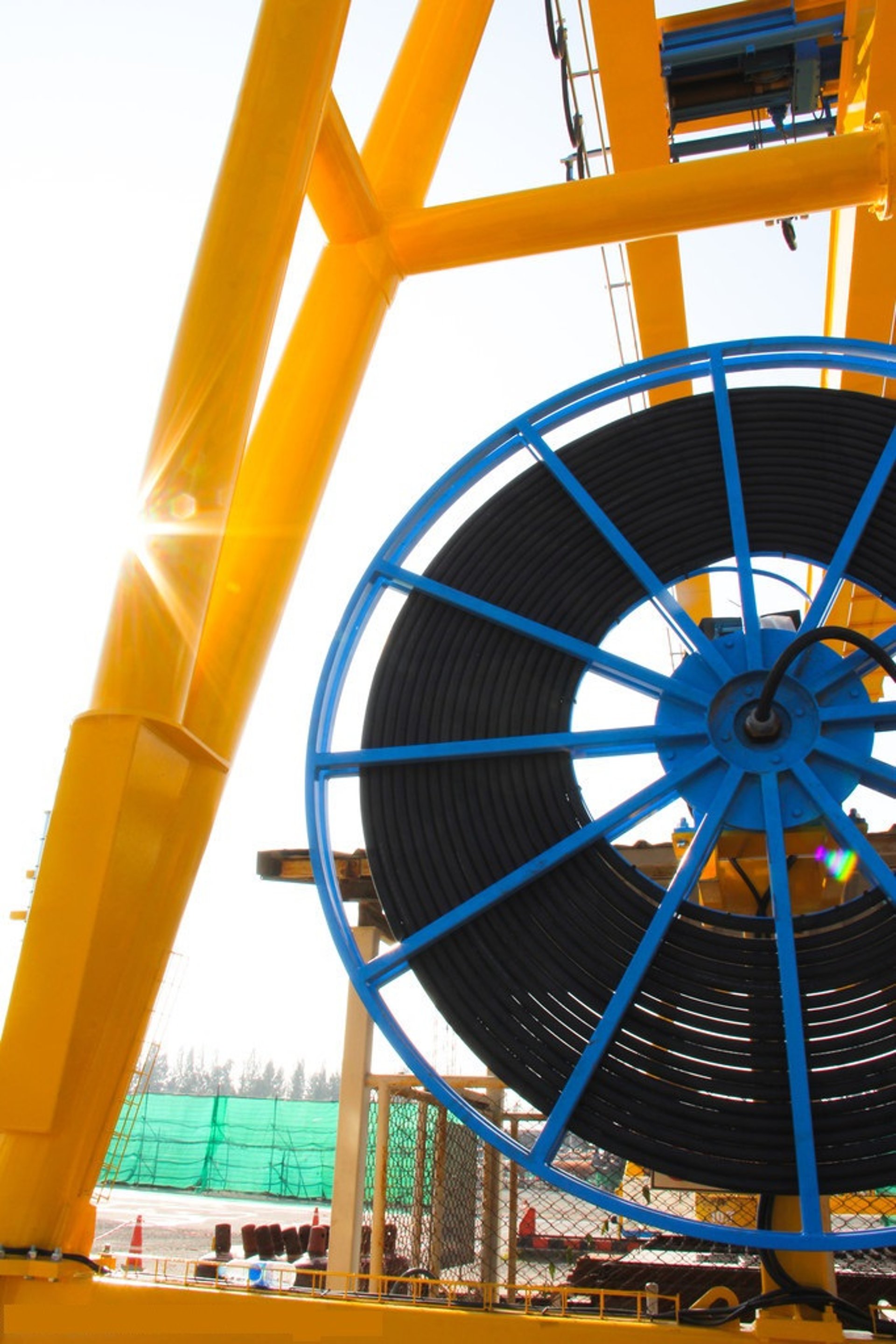
Buflex X’Prem Low Voltage Control & Power Reeling Cable: PU Sheath, Aramid Strength Member for Mining & Port Applications in South Africa
Buflex X’Prem is a purpose-engineered 0.6/1kV reeling cable with central aramid reinforcement, XLPE insulation and double-layer anti-twist polyurethane sheath. Built for extreme tension, torsion, abrasion and harsh outdoor conditions, it has proven to deliver reliable performance in South African mines, bulk terminals and heavy industrial sites. This guide covers full design principles, specifications, real-world case results, equivalent supply options and sourcing details.
Li.Wang
7/20/202615 min read
Introduction: Solving the Hidden Reliability Crisis in South Africa’s Dynamic Reeling Systems
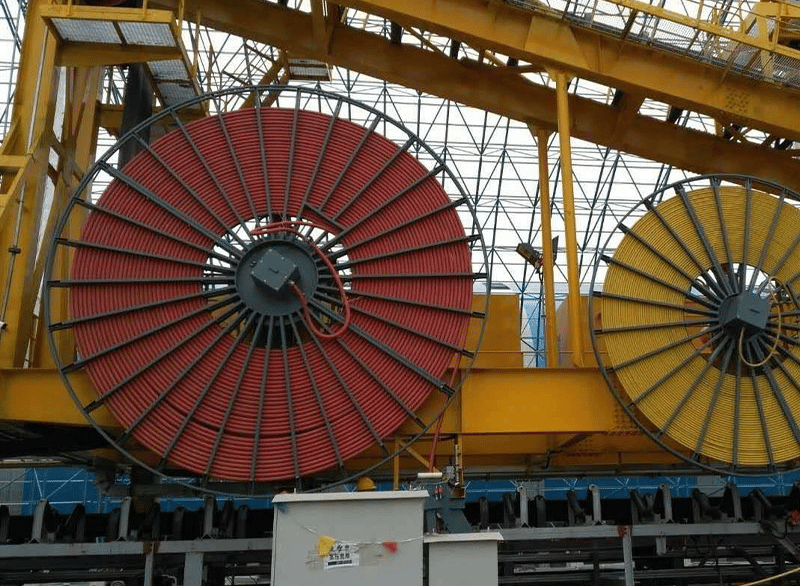
South Africa’s industrial landscape is defined by large-scale operations that move vast volumes of resources across mines, ports and heavy manufacturing sites. From the iron ore pits of the Northern Cape to the coal terminals of Richards Bay and the multi-purpose bulk handling facilities in Durban, almost every major facility relies on mobile equipment that must draw power while moving continuously. Stacker-reclaimers, ship unloaders, bucket-wheel excavators and gantry cranes all depend on cables that wind and unwind hundreds of times each day, often suspended high above the ground or dragged across abrasive surfaces.
For decades, teams on site have faced a persistent problem: standard rubber or PVC-sheathed cables rarely last more than six to twelve months in these roles. They snap internally, split open, twist beyond repair or degrade rapidly under the African sun. Each failure forces unplanned shutdowns that cost thousands of rands in lost production, labour and emergency replacements. What many operators do not realise is that these failures are not simply a matter of “bad quality” – they stem from fundamental design flaws in cables built for static or light-duty use, not for the unique demands of dynamic reeling.
Buflex X’Prem is Nexans’ direct answer to this challenge. It is not an adaptation of a general-purpose cable, but a series engineered from the ground up exclusively for low-voltage power and control reeling applications. Fitted with a robust polyurethane outer sheath, it is built to withstand the harshest combinations of mechanical stress and environmental exposure, including repeated twisting, sustained pulling, sharp torque spikes and constant abrasive wear. At its core runs an integrated strength member that transforms how the cable carries load, allowing it to handle far higher tension, acceleration and operating speeds than conventional alternatives.
This cable represents a significant step forward in reeling technology. By combining a central aramid strength member, Class 5 flexible copper conductors, XLPE insulation and a double-layer anti-twist polyurethane sheath, Nexans has targeted the exact points where standard cables fail. The difference lies not just in using tougher materials, but in how stress is distributed across the entire structure. This approach delivers much longer service life, smoother equipment operation and significantly lower total ownership cost, making it ideal for the most demanding mining, port and heavy lifting environments. It is not simply “more durable” – it is a complete system upgrade that allows for smaller cable drums, faster operating speeds and far less maintenance over time.
Buflex X’Prem addresses three deep-seated issues that have long troubled reeling cable design. In most standard cables, the copper conductors, insulation and outer jacket all share the mechanical load of tension and bending, leading to early fatigue and breakage. Many also lack any built-in resistance to twisting, so they deform and separate internally as the drum rotates. Finally, common sheathing materials struggle to cope with South Africa’s mix of intense UV light, extreme temperature swings and abrasive dust. Buflex X’Prem resolves these through a carefully balanced structure that keeps mechanical load separate from electrical function, controls how twisting forces move through the cable and uses materials chosen specifically for long life in harsh outdoor settings.
It maintains full compliance with 0.6/1 kV low-voltage safety standards, while pushing mechanical performance well beyond what was previously practical for high-speed, long-travel applications. Real-world deployment across South African mines and ports has confirmed its ability to perform reliably under extreme torsion, heavy wear and wide-ranging environmental conditions. While the initial purchase price may be higher than standard options, most operators see service life extended by three to five times and maintenance costs reduced by around 60%. It also fits directly onto existing drum sizes without modification, making it one of the most cost-effective and capable choices for large mobile reeling equipment available today.
Core Purpose, Applications & Official Standards
What Makes Buflex X’Prem Different by Design?
Every choice in the Buflex X’Prem range starts with the specific demands of reeling duty. Most flexible cables are designed for static installation or occasional movement, where tension is low and twisting is minimal. Reeling cables face the exact opposite: they must be wound and unwound repeatedly, pulled under their own weight, bent sharply and twisted continuously as the drum turns. Any design that does not account for these forces from the beginning will fail quickly.
Buflex X’Prem is built to handle sustained tension, rapid acceleration, constant twisting and heavy surface abrasion as primary operating conditions, not as exceptions. The integrated central strength member is not an optional extra – it is part of the core architecture, placed exactly where it can carry the full mechanical load without interfering with electrical performance. The polyurethane sheath is also selected for its ability to resist both mechanical wear and chemical attack, while remaining flexible even at low temperatures.
This cable is designed to carry both main power and low-voltage control signals within the same assembly, eliminating the need for separate cables and simplifying installation and maintenance. It balances electrical reliability with mechanical toughness, so operators do not need to compromise one for the other.
Primary Applications & Typical Operating Scenarios
In South Africa, Buflex X’Prem is most commonly deployed in three main sectors, each with its own set of punishing conditions. In surface mining, it is used on stacker-reclaimers, spreaders, bucket-wheel excavators and mobile crushing units that move across large stockpiles or work faces. These machines often operate around the clock, with cables hanging freely between the machine and the fixed power point for distances of up to 120 metres.
At ports and bulk terminals, the cable runs on continuous ship unloaders, gantry cranes, rail-mounted slewing cranes and tripper conveyors that move material between ships, stockpiles and rail wagons. These applications demand consistent performance at high speeds to keep vessel turnaround times short and supply chains moving.
In heavy industry, it supports large lifting cranes in steel mills, tunnel boring machines and elevated access platforms, where even small cable failures can halt entire production lines or create safety risks.
The duty profile Buflex X’Prem is built for includes long suspended runs, frequent winding cycles, rapid start-stop motion and exposure to both impact and friction. It is suitable for sites where cables cannot be easily protected from dust, water, chemicals or temperature changes.
Official Standards & Compliance
All Buflex X’Prem cables follow Nexans’ internal performance specification, while aligning with relevant international standards and meeting the requirements of most South African procurement frameworks. The nominal voltage rating is Uo/U 0.6/1 kV, with a maximum permitted system voltage Um of 1.2 kV. Power cores are tested at 3.5 kV AC and control cores at 2.5 kV AC to ensure consistent insulation integrity.
Conductors are manufactured to IEC 60228 Class 5, the standard for highly flexible copper conductors. Thermally, the cable operates continuously at a maximum conductor temperature of +90°C, and can safely withstand short-circuit conditions of up to +250°C for periods of five seconds or less. For surface temperature, fixed installation is rated from -40°C to +80°C, while mobile reeling operation is rated from -30°C to +80°C.
Each cable is clearly marked with the specification “BUFLEX® X’PREM – 0.6/1 kV”, followed by core count, cross-section, manufacturer name and production week and year. Control cores are white with printed numbers for easy identification. Power cores follow standard colour codes: four-core cables use black, brown, grey and green/yellow; five-core cables use black, brown, grey, blue and green/yellow; sizes above 25 mm² include three protective earth cores.
Layer-by-Layer Structure, Materials & Engineering Principles
Complete Construction Breakdown (Inside to Outside)
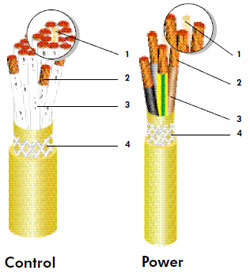
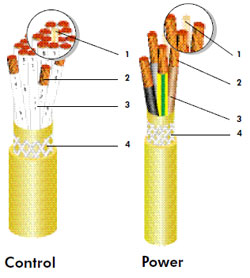
The performance of Buflex X’Prem comes from how each layer is designed to work with the others, rather than simply being stacked together. From the centre outwards, the structure consists of four key components.
At the very centre lies the central strength member, made from high-tenacity aramid yarns. Aramid fibres offer roughly five times the tensile strength of steel at only one-fifth the density, with very high elastic modulus and excellent resistance to repeated stretching and bending. They are also non-conductive, so they do not create electrical interference or carry fault currents. This layer is designed to carry all mechanical tension, shock load and inertial force, so the copper conductors are never pulled beyond their safe elastic limit.
Surrounding the strength member are the current-carrying conductors, made from fine-stranded plain copper meeting IEC 60228 Class 5 requirements. Each conductor is formed from many thin individual wires twisted together at carefully calculated lay lengths. This structure allows the conductor to bend tightly without creating sharp stress points, while maintaining full electrical conductivity and current capacity.
Next comes the insulation layer, made from cross-linked polyethylene, commonly referred to as XLPE. Unlike standard polyethylene, XLPE is chemically or physically treated to form a stable three-dimensional molecular network. This structure gives it much higher dielectric strength, typically above 20 kV per millimetre, very low electrical loss and far better resistance to heat and ageing. It stays consistent and reliable even as the cable flexes thousands of times.
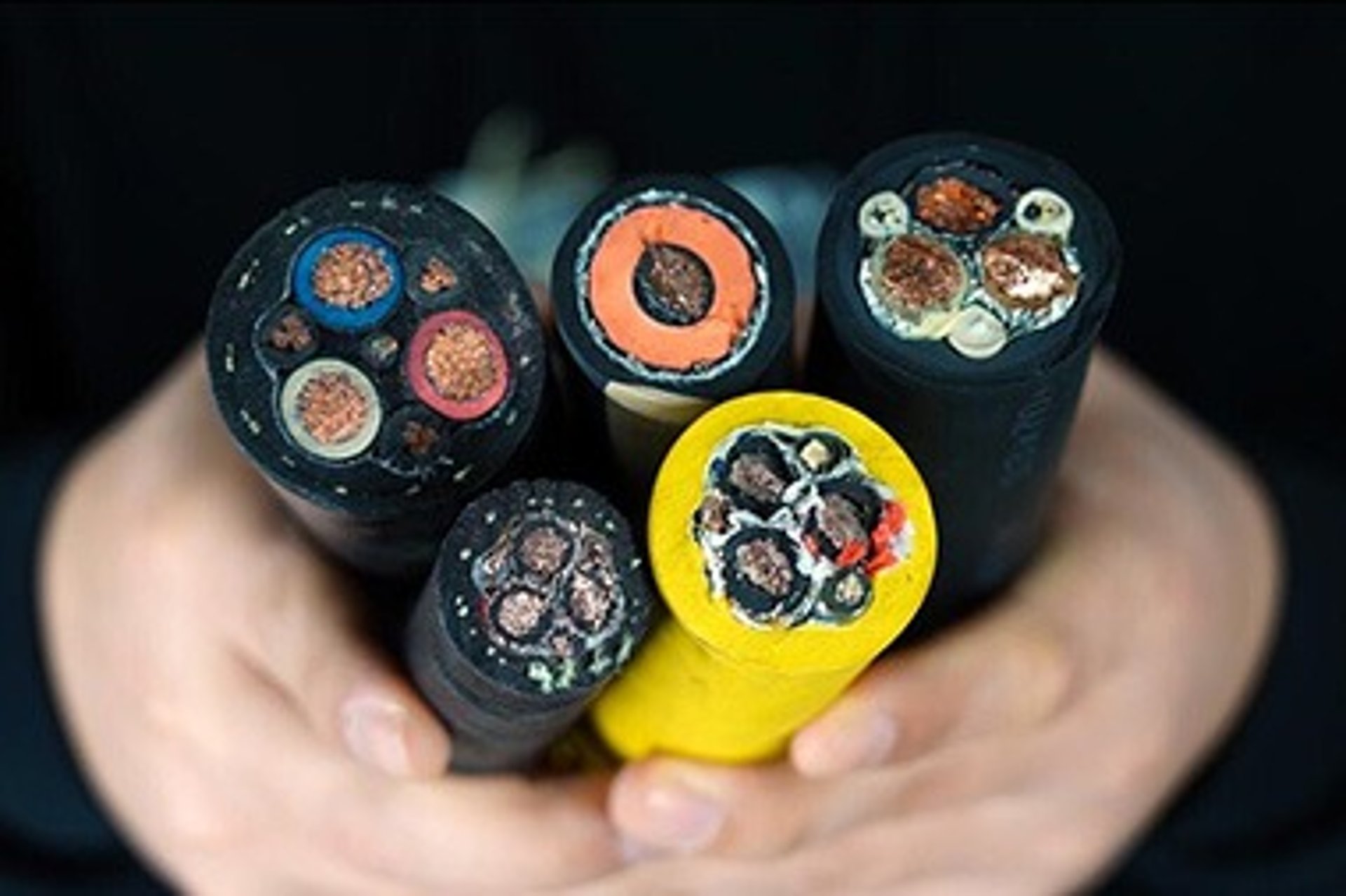
The outer layer is a double-layer anti-twist reinforced polyurethane sheath, finished in bright yellow for visibility on site. The inner reinforcement layer is a tightly woven aramid braid, laid at an angle of between 48 and 52 degrees with coverage of at least 85%. The outer sheath is made from aliphatic polyurethane, chosen specifically for its resistance to UV radiation, hydrolysis, mineral oils and abrasive wear.
Why This Design Works – Core Engineering & Scientific Principles
Every part of this design follows well-established engineering and material science principles, applied specifically to the challenges of reeling duty.
Mechanically, the most important principle is load separation. In most cables, tension pulls on the copper conductors directly, which can stretch them permanently or break individual strands over time. By placing the aramid strength member at the centre, Buflex X’Prem ensures that tension is carried almost entirely by the reinforcement, leaving the conductors to carry only electrical current. This is supported by strain matching: the elongation properties of aramid are very close to those of copper, so both layers stretch and recover together without creating shear forces that would separate the insulation or damage the conductor surface.
Bending radius limits are also set according to material strain limits. For fixed installation, the minimum radius is six times the cable diameter; for moving reeling operation, it is eight times the diameter; for S-shaped deflection, it is twenty times the diameter. These values ensure that no layer is bent beyond its allowable fatigue limit, preventing early cracking or failure.
Material science also plays a critical role. Aramid is chosen not just for strength, but because it does not suffer from the fatigue or corrosion that affects steel wires. XLPE is used because its cross-linked structure does not soften or flow at high temperatures, unlike thermoplastic insulation. Aliphatic polyurethane is selected instead of aromatic types because it does not degrade or become brittle under long-term exposure to UV light – a vital property for South Africa’s high-altitude sites.
Electrically, the uniform structure keeps each core in a consistent position as the cable winds and unwinds. This prevents changes in capacitance or partial discharge that can occur when insulation thickness varies or cores shift position. XLPE also has low dielectric loss, so energy waste remains minimal even under continuous operation.
Performance Advantages – System-Level Improvements Over Standard Cables
Verified Mechanical & Environmental Performance
Buflex X’Prem is tested and rated to withstand conditions that would damage or destroy most equivalent cables. It supports a maximum tensile load of 25 Newtons per square millimetre of copper cross-section, giving it ample reserve strength for long suspended runs. It passes full cyclic bending tests, continuous torsion tests and long-duration reeling tests to confirm reliability under repeated stress.
Standard reeling speeds go up to 150 metres per minute, making it suitable for fast-moving equipment such as high-capacity ship unloaders. Higher speeds can be accommodated with custom design on request. Chemically, the polyurethane sheath resists most common mineral oils, greases, hydraulic fluids and industrial chemicals. It is fully waterproof, ozone-resistant and UV-stable for permanent outdoor use, even in regions with high solar radiation.
Beyond “More Durable”: The Real Differentiators
The greatest advantage of Buflex X’Prem is that it resolves the root causes of failure rather than simply delaying them. Load separation eliminates conductor breakage, which is the single most common reason for reeling cable replacement. The anti-twist braid prevents the cable from unravelling or forming permanent kinks that block smooth winding or damage the drum.
Its compact outer diameter means it fits directly onto existing cable drums without needing larger drums or structural modifications. This saves significant capital cost and avoids the downtime required to retrofit equipment. It also supports faster acceleration and higher travel speeds, allowing operators to increase throughput without replacing the power delivery system.
Over the full life of the cable, the total cost of ownership is much lower. While the initial purchase price is higher, service life is typically three to five times longer than standard rubber or PVC cables, and maintenance requirements fall by roughly 60%. Most sites find that the extra investment pays for itself within the first two years through reduced downtime and fewer replacements.
Field-Proven Performance – Buflex X’Prem in South African Operations
The Unique Challenges Faced Locally
South African sites present some of the most demanding conditions for reeling cables anywhere in the world. Mechanically, stacker-reclaimers often suspend cables 80 to 120 metres above the ground, creating constant tension of between 2,000 and 10,000 Newtons just from the cable’s own weight. Start-stop acceleration can reach 2 to 3 metres per second squared, while uneven winding on the drum creates sharp torque spikes that twist the cable repeatedly in both directions.
Environmentally, operators deal with intense high-altitude UV radiation, temperature swings from -5°C to +45°C, and fine abrasive dust from ore, coal or sand that acts like sandpaper against the outer sheath. Many sites also face exposure to mineral slurry, leaking lubricants and occasional cold snaps that drop as low as -30°C.
Real-World Case Results
At a large iron ore mine in the Northern Cape, maintenance teams had been replacing standard rubber reeling cables every six months due to snapped conductors and internal breakage. After switching to Buflex X’Prem, the same cables operated continuously for 24 months without a single mechanical fault or core failure. The central aramid strength member absorbed the full tension of the long suspended run, protecting the copper conductors completely.
At Richards Bay Bulk Coal Terminal, Buflex X’Prem was fitted to continuous ship unloaders that previously required monthly sheath repairs due to dust abrasion and impact from falling material. The polyurethane outer layer reduced wear rates by roughly 70%, eliminating the need for regular patching and extending service intervals significantly.
In a mineral handling project at Durban Harbour, cables were exposed to full sun, salt spray and fluctuating temperatures for three years. Inspection showed no visible UV cracking, brittleness or sheath separation – a major improvement over standard rubber cables that typically required full replacement after 12 to 18 months in the same location.
Several terminals also noted that the 150 metres per minute speed rating allowed them to increase operating speed and reduce vessel turnaround times, while the compact outer diameter meant the cables fitted directly onto existing drums with no modifications needed.
Full Technical Specification, Ordering & Custom Options
Complete Performance & Dimension Tables
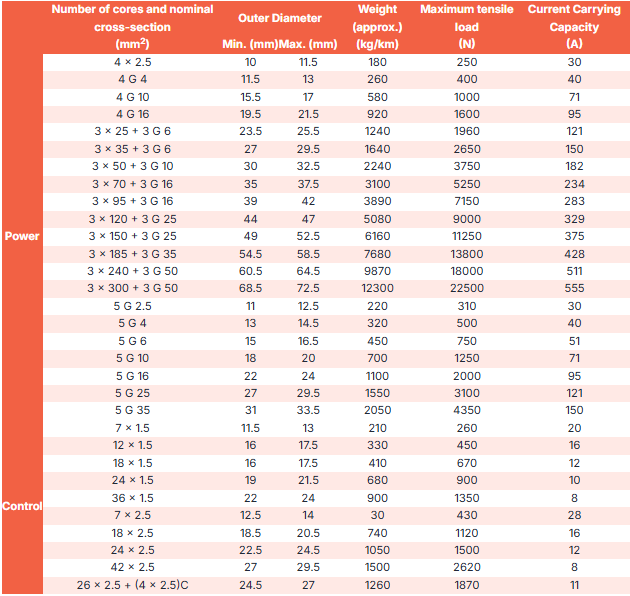
All specifications below match the official datasheet exactly. Current carrying capacities apply to uncoiled cable laid on the ground, with a conductor temperature of 90°C and ambient temperature of 30°C. Correction factors must be applied for grouped installation, burial, higher or lower ambient temperatures or other operating conditions, following IEC 60354-5-52-12.
Power Cables
4 x 2.5 mm²: OD 10–11.5 mm, weight 180 kg/km, max tension 250 N, current 30 A
4 G 4 mm²: OD 11.5–13 mm, weight 260 kg/km, max tension 400 N, current 40 A
4 G 10 mm²: OD 15.5–17 mm, weight 580 kg/km, max tension 1000 N, current 71 A
4 G 16 mm²: OD 19.5–21.5 mm, weight 920 kg/km, max tension 1600 N, current 95 A
3 x 25 + 3 G 6 mm²: OD 23.5–25.5 mm, weight 1240 kg/km, max tension 1960 N, current 121 A
3 x 35 + 3 G 6 mm²: OD 27–29.5 mm, weight 1640 kg/km, max tension 2650 N, current 150 A
3 x 50 + 3 G 10 mm²: OD 30–32.5 mm, weight 2240 kg/km, max tension 3750 N, current 182 A
3 x 70 + 3 G 16 mm²: OD 35–37.5 mm, weight 3100 kg/km, max tension 5250 N, current 234 A
3 x 95 + 3 G 16 mm²: OD 39–42 mm, weight 3890 kg/km, max tension 7150 N, current 283 A
3 x 120 + 3 G 25 mm²: OD 44–47 mm, weight 5080 kg/km, max tension 9000 N, current 329 A
3 x 150 + 3 G 25 mm²: OD 49–52.5 mm, weight 6160 kg/km, max tension 11250 N, current 375 A
3 x 185 + 3 G 35 mm²: OD 54.5–58.5 mm, weight 7680 kg/km, max tension 13800 N, current 428 A
3 x 240 + 3 G 50 mm²: OD 60.5–64.5 mm, weight 9870 kg/km, max tension 18000 N, current 511 A
3 x 300 + 3 G 50 mm²: OD 68.5–72.5 mm, weight 12300 kg/km, max tension 22500 N, current 555 A
5 G 2.5 mm²: OD 11–12.5 mm, weight 220 kg/km, max tension 310 N, current 30 A
5 G 4 mm²: OD 13–14.5 mm, weight 320 kg/km, max tension 500 N, current 40 A
5 G 6 mm²: OD 15–16.5 mm, weight 450 kg/km, max tension 750 N, current 51 A
5 G 10 mm²: OD 18–20 mm, weight 700 kg/km, max tension 1250 N, current 71 A
5 G 16 mm²: OD 22–24 mm, weight 1100 kg/km, max tension 2000 N, current 95 A
5 G 25 mm²: OD 27–29.5 mm, weight 1550 kg/km, max tension 3100 N, current 121 A
5 G 35 mm²: OD 31–33.5 mm, weight 2050 kg/km, max tension 4350 N, current 150 A
Control Cables
7 x 1.5 mm²: OD 11.5–13 mm, weight 210 kg/km, max tension 260 N, current 20 A
12 x 1.5 mm²: OD 16–17.5 mm, weight 330 kg/km, max tension 450 N, current 16 A
18 x 1.5 mm²: OD 16–17.5 mm, weight 410 kg/km, max tension 670 N, current 12 A
24 x 1.5 mm²: OD 19–21.5 mm, weight 680 kg/km, max tension 900 N, current 10 A
36 x 1.5 mm²: OD 22–24 mm, weight 900 kg/km, max tension 1350 N, current 8 A
7 x 2.5 mm²: OD 12.5–14 mm, weight 300 kg/km, max tension 430 N, current 28 A
18 x 2.5 mm²: OD 18.5–20.5 mm, weight 740 kg/km, max tension 1120 N, current 16 A
24 x 2.5 mm²: OD 22.5–24.5 mm, weight 1050 kg/km, max tension 1500 N, current 12 A
42 x 2.5 mm²: OD 27–29.5 mm, weight 1500 kg/km, max tension 2620 N, current 8 A
26 x 2.5 + (4 x 2.5)C mm²: OD 24.5–27 mm, weight 1260 kg/km, max tension 1870 N, current 11 A
Custom Configuration Options
Standard assemblies can be modified to suit specific project needs. Common customisations include combined power and control cores within a single cable, shielded twisted pairs for sensitive signal transmission, and integrated optical fibre elements for condition monitoring or data transfer. Alternative core counts, cross-sections or sheath colours can also be manufactured on request.
Feichun Equivalent – A Cost-Effective, Fully Compliant Alternative for South African Projects
Full Performance & Standard Alignment
For projects where supply lead times or budget require a local alternative, Feichun produces an equivalent reeling cable that matches every core specification of Buflex X’Prem exactly. It carries the same 0.6/1 kV voltage rating, uses IEC 60228 Class 5 flexible copper conductors, XLPE insulation, central aramid strength member and double-layer anti-twist polyurethane sheath.
It meets the same 25 N/mm² tensile limit, supports reeling speeds up to 150 m/min, and passes identical bending, torsion and reeling endurance tests. It offers the same resistance to oil, chemicals, moisture, UV and ozone, and fits within the same temperature and bending radius limits. All core identification and marking follows the same standards, so it can be used as a direct drop-in replacement without changes to installation or maintenance procedures.
Key Supply Advantages for Local Projects
Feichun’s equivalent cable typically comes at a price 15% to 30% lower than the branded product, while maintaining full performance parity. It also offers shorter lead times, which is particularly valuable for urgent breakdown replacements or fast-track project schedules in South Africa. Technical documentation and compliance guidance are aligned with local procurement requirements, and custom configurations can be delivered faster than many international suppliers.
Frequently Asked Questions
Can Buflex X’Prem or its Feichun equivalent be fitted directly to existing cable drums?
Yes, the compact outer diameter is designed to match or be smaller than standard reeling cables, so it fits most existing drums without modification.
How do I adjust current ratings for high ambient temperatures common in Limpopo or Mpumalanga?
Use the correction factors outlined in IEC 60354-5-52-12. For ambient temperatures above 30°C, reduce current capacity according to the insulation rating and installation method.
What is the maximum side pressure the cable can withstand when fully wound on a drum?
When loaded within the specified tensile limit, the cable can safely handle side pressures typical of standard reeling drums. For unusually narrow drums or heavy stacking, consult the manufacturer for guidance.
Can this cable carry both power and analogue or digital control signals reliably?
Standard control cores work well for most low-voltage control circuits. For high-frequency or low-level signals, choose versions with shielded twisted pairs to minimise interference.
What is the typical lead time for standard and custom orders?
Standard sizes can be available within two to four weeks, while custom assemblies usually take four to six weeks. Feichun can often deliver faster for urgent local requirements.
How does the PU sheath hold up against coal dust, iron ore fines or mineral slurry?
Aliphatic polyurethane is highly resistant to abrasive particles and mineral slurries. In field trials, it showed 70% less wear than rubber sheaths under similar conditions.
Summary
Buflex X’Prem sets a new benchmark for reeling cable performance by addressing the root causes of failure rather than simply adding surface protection. Its load-separating structure, carefully matched materials and anti-twist design make it uniquely suited to the high-tension, high-torsion and high-wear conditions found across South Africa’s mines, ports and heavy industrial sites. Real-world use has confirmed its ability to extend service life, reduce maintenance and support faster equipment operation without requiring costly equipment upgrades.
For teams looking for a fully compatible alternative with faster delivery and better pricing, Feichun’s equivalent cable offers identical performance and compliance, making it a practical choice for both new projects and replacement work.
If you would like detailed pricing, technical support or a custom configuration quote for your mining, port or industrial project, contact the Feichun team directly at Li.wang@feichuncables.com.
Email Address: Li.wang@feichuncables.com
© 2025. All rights reserved.
One-click to Quickly Contact
Products
Contact
Company
Location:
Building A Private Science and Technology Park, Hefei Economic and Technological Development Zone, Anhui Province, China
Heat Resistant Cable
WhatsApp: +86 17333223430
Social Media: